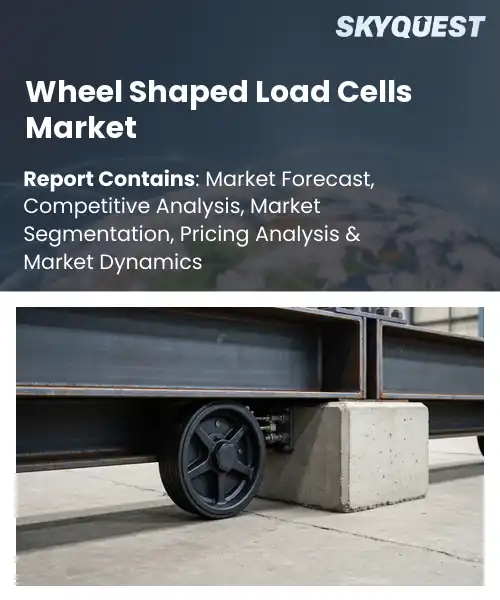
Wheel Shaped Load Cells Market
Report ID: SQMIG45J2771
Report ID: SQMIG45J2771
[email protected]
USA +1 351-333-4748
Report ID:
SQMIG45J2771 |
Region:
Global |
Published Date: August, 2026
Pages:
157
|Tables:
150
|Figures:
78


Global Wheel Shaped Load Cells Market size was valued at USD 286.5 Million in 2024 and is poised to grow from USD 305.7 Million in 2025 to USD 513.58 Million by 2033, growing at a CAGR of 6.7% during the forecast period (2026-2033).
The global wheel‑shaped load cell market comprises sensors that integrate a circular load‑bearing element with electronic conversion circuitry, enabling precise force measurement in rotating or constrained environments. Its significance stems from the growing need for compact, high‑accuracy transducers in material handling, robotics, and vehicle testing where traditional linear cells cannot fit. The market emerged in the early 2000s when manufacturers replaced bulky strain‑gauge rigs with modular wheel designs, exemplified by early deployments on conveyor‑belt rollers and agricultural sprayers. Over the past decade, adoption accelerated as Industry 4.0 standards demanded real‑time data, prompting OEMs to embed wheel cells directly into equipment for improved process control systems.
Price competitiveness and integration capability now drive the market’s expansion, because manufacturers seek load cells that can be mounted without redesigning chassis while delivering lower total ownership cost. This factor encourages suppliers to offer configurable outputs, wireless communication, and self‑calibration, which in turn open opportunities in autonomous warehouse forklifts, offshore wind turbine blade testing, and smart agricultural harvesters. For example, a logistics firm equipped its robotic arm with a wheel‑shaped cell that automatically compensated for eccentric loads, reducing downtime by 15 %. The resulting efficiency gains illustrate how the cause simplified integration produces the effect of broader adoption across diverse sectors in global supply chains.
How are AI and IoT Integration Driving Innovation In The Wheel‑shaped Load Cells Market?
AI and IoT are reshaping wheel shaped load cells by turning raw force data into actionable insight. Sensors now embed micro processors that run predictive models while wireless modules stream measurements to cloud dashboards. This combination enables real time health monitoring of rotating equipment, early fault detection and adaptive calibration without manual intervention. Manufacturers embed edge analytics to reduce latency and trigger alerts directly to maintenance teams.
The market sees tighter integration with digital twins, allowing engineers to simulate load conditions and optimize designs before physical testing. These capabilities expand the appeal of wheel load cells beyond traditional weighing to predictive maintenance and smart manufacturing. In August 2023, Kistler introduced a smart wheel shaped load cell that embeds AI analytics and IoT connectivity, allowing continuous condition monitoring and automatic calibration. This innovation shortens downtime and improves measurement accuracy, reinforcing market growth driven by intelligent sensing solutions.
Market snapshot - (2026-2033)
Global Market Size
USD 286.5 Million
Largest Segment
Compression Load Cells
Fastest Growth
Multi-Axis Load Cells
Growth Rate
6.7% CAGR
To get more insights on this market click here to Request a Free Sample Report
Global wheel shaped load cells market is segmented by load cell type, capacity, technology, application, end user and region. Based on load cell type, the market is segmented into Compression Load Cells, Tension Load Cells, Tension-Compression Load Cells and Multi-Axis Load Cells. Based on capacity, the market is segmented into Low Capacity, Medium Capacity and High Capacity. Based on technology, the market is segmented into Strain Gauge, Hydraulic and Pneumatic. Based on application, the market is segmented into Industrial Weighing, Material Testing, Robotics & Automation, Automotive Testing, Aerospace Testing and Others. Based on end user, the market is segmented into Manufacturing, Automotive, Aerospace & Defense, Research & Testing Laboratories and Others. Based on region, the market is segmented into North America, Europe, Asia Pacific, Latin America and Middle East & Africa.
Compression Load Cells segment dominates because wheel shaped devices inherently require axial force measurement, and compression sensors provide the most direct, stable response under such loads. Their simple construction offers high reliability and ease of integration into existing platforms, reducing calibration complexity. Designers favor compression cells for their predictable behavior in harsh environments, which accelerates product development cycles and lowers total ownership costs, reinforcing their market leadership.
However, Multi-Axis Load Cells segment is witnessing the strongest growth momentum as robotics and autonomous systems demand simultaneous measurement of forces along several directions. These cells enable richer data for complex motion control, attracting innovators seeking finer precision. Their adoption expands design possibilities and fuels new product concepts, acting as a catalyst for broader market expansion.
Strain Gauge technology segment dominates because it delivers highly linear output and exceptional sensitivity that align with the precision requirements of wheel shaped load cells. The mature manufacturing ecosystem ensures consistent quality and cost effectiveness, enabling widespread adoption across diverse industries. Its compatibility with digital signal processing simplifies integration, while limited temperature drift enhances reliability, making it the preferred choice for engineers focused on accuracy and repeatability.
On the other hand, Hydraulic technology segment emerges as the fastest growing area as heavy duty applications require larger force capacities beyond the limits of solid state sensors. Hydraulic cells provide robust overload protection and maintain performance under extreme environmental conditions, attracting sectors such as large scale material testing and aerospace ground support. Their scalability opens new opportunities, driving market diversification and future growth pathways.
To get detailed segments analysis, Request a Free Sample Report
Asia Pacific leads the global wheel shaped load cells market due to a combination of advanced manufacturing capabilities, strong demand from automotive and precision equipment sectors, and a deep engineering talent pool. The region benefits from integrated supply chains that enable rapid prototyping and cost‑effective production of high‑precision sensors. Close collaboration between academic institutions and industrial firms drives continuous innovation in materials and signal processing. Moreover, extensive export networks allow regional manufacturers to serve demanding markets worldwide, reinforcing the perception of Asia Pacific as a hub of quality and reliability. The strategic focus on research and development, coupled with supportive governmental policies promoting high‑tech industries, consolidates the region’s dominant position. Continued investment in digital manufacturing and automation further sharpens the region’s competitive edge, ensuring that Asia Pacific remains at the forefront of sensor technology evolution.
Wheel Shaped Load Cells Market in Japan is propelled by a long‑standing reputation for precision engineering and a dense network of component suppliers. Domestic manufacturers benefit from close proximity to sophisticated automotive and robotics assemblers, fostering tight feedback loops that accelerate product refinement. Strong emphasis on quality standards and certifications reinforces confidence among global buyers, while collaborative research initiatives with leading universities keep innovation cycles brisk. This ecosystem sustains Japan’s role as a benchmark for reliability.
Wheel Shaped Load Cells Market in South Korea thrives on a forward‑looking industrial policy that emphasizes smart manufacturing and high‑performance sensors. The presence of global electronics conglomerates creates a demand for compact, accurate load measurement solutions, encouraging local suppliers to innovate in miniaturization and wireless communication. Strong collaboration between research institutes and private firms accelerates technology transfer, while a culture of rapid prototyping shortens time‑to‑market. These dynamics position South Korea as a hub for cutting‑edge load cell applications.
North America experiences rapid expansion of the wheel shaped load cells market driven by a confluence of high‑value end‑use sectors and a vibrant ecosystem of technology providers. The aerospace and defense industries demand ultra‑reliable force measurement for critical testing, prompting manufacturers to adopt advanced sensor designs. Concurrently, extensive infrastructure renewal projects and sophisticated material handling facilities create steady demand for robust load monitoring solutions. A strong culture of private‑sector research and collaboration with leading universities fuels continuous improvements in sensor accuracy and integration with digital monitoring platforms. Additionally, emphasis on safety standards and regulatory compliance reinforces the need for precise load measurement across diverse applications, reinforcing North America’s reputation as a leader in high‑performance sensor deployment. The region’s broad base of component manufacturers and flexible supply chains further accelerates product availability and customization for niche industrial requirements.
Wheel Shaped Load Cells Market in United States benefits from a diversified industrial base that includes aerospace, automotive, and heavy equipment manufacturing. Large‑scale research laboratories and test facilities drive stringent performance requirements, encouraging suppliers to deliver high accuracy and durability. The presence of major sensor manufacturers alongside agile start‑ups creates a competitive environment where innovation thrives. Strong intellectual property protection and robust supply chain logistics further enhance the market’s capacity to meet both domestic and global demand.
Wheel Shaped Load Cells Market in Canada is shaped by a strong emphasis on precision engineering within the mining and renewable energy sectors. Collaborative projects between government research agencies and private firms promote the development of load cells that can operate under extreme environmental conditions. The country’s focus on sustainable infrastructure and stringent safety regulations drives demand for reliable force measurement solutions. These factors collectively reinforce Canada’s niche position in the specialized sensor landscape.
The European wheel shaped load cells market strengthens its position through a blend of rigorous engineering standards, deep integration within high‑precision manufacturing, and coordinated research initiatives across member states. The automotive and renewable energy sectors demand exceptionally accurate load measurement, prompting manufacturers to adopt cutting‑edge materials and digital calibration techniques. Strong collaboration between technical universities, specialized research institutes, and industry consortia accelerates the transfer of innovative sensor concepts into commercial products. Harmonized regulatory frameworks and a commitment to sustainability compel suppliers to deliver energy‑efficient, long‑lasting devices. Additionally, a dense network of component suppliers enables rapid prototyping and customized solutions, reinforcing Europe’s reputation as a hub for reliable, high‑performance load cell technologies. The focus on digital twin integration and real‑time data analytics further enhances the value proposition of European load cell offerings.
Wheel Shaped Load Cells Market in Germany is anchored by a tradition of precision manufacturing and a strong automotive engineering base. Domestic suppliers leverage advanced metallurgy and stringent quality certification to produce load cells that meet demanding performance criteria. Close cooperation with research laboratories accelerates the adoption of smart sensing and Industry 4.0 connectivity. This combination of technical excellence and integrated digital solutions sustains Germany’s reputation as a benchmark for high‑reliability load measurement.
Wheel Shaped Load Cells Market in United Kingdom benefits from a robust aerospace sector and a growing emphasis on smart infrastructure monitoring. Collaboration between leading universities and specialist manufacturers fosters rapid development of load cells with enhanced signal processing and wireless capabilities. Regulatory emphasis on safety and precision encourages adoption across civil engineering projects, while a vibrant start‑up ecosystem introduces novel materials and miniaturized designs. These factors collectively reinforce the United Kingdom’s role as an innovative hub for advanced load sensing technologies.
Wheel Shaped Load Cells Market in France is driven by strong activity in high‑speed rail and renewable energy installations, where precise force measurement is critical. Collaboration between national research agencies and industrial clusters promotes the integration of advanced materials and real‑time diagnostic features into load cell designs. Emphasis on environmental sustainability leads manufacturers to develop energy‑efficient devices with reduced material waste. This synergistic approach positions France as a key contributor to the European advancement of sophisticated load sensing solutions.
To know more about the market opportunities by region and country, click here to
Buy The Complete Report
Increasing Automation Adoption
Expanding Use In Renewable Energy
High Initial Capital Investment
Complex Calibration Requirements
Request Free Customization of this report to help us to meet your business objectives.
The competitive landscape of the wheel shaped load cells market is fairly fragmented, with established sensor manufacturers and specialized force measurement companies competing on precision, durability, and application-specific customization rather than price alone. Key market players are focusing on product innovation, customization, and strategic partnerships to gain a competitive edge and expand their market presence in the industry. Product development remains central to differentiation, with firms investing in improved sensor accuracy, radial and axial force detection, and integration with automation and Industry 4.0 systems. Companies are also pursuing strategic alliances and collaborations with logistics, automotive, and material handling firms to embed their load cells into broader smart manufacturing ecosystems. Companies are focusing on innovation, quality, and customer service to differentiate their products and maintain a competitive edge in the market.
SkyQuest’s ABIRAW (Advanced Business Intelligence, Research & Analysis Wing) is our Business Information Services team that Collects, Collates, Correlates, and Analyses the Data collected by means of Primary Exploratory Research backed by robust Secondary Desk research.
As per SkyQuest analysis, the global wheel‑shaped load cells market is driven primarily by increasing automation adoption, which encourages OEMs to embed compact sensors for higher throughput and consistent quality, while expanding use in renewable energy projects adds a second growth catalyst as wind and solar installations demand precise force monitoring in confined spaces. High initial capital investment remains the main restraint, slowing uptake among price‑sensitive users who must weigh upfront costs against long‑term efficiency gains. Asia Pacific dominates the market due to its advanced manufacturing ecosystem and strong demand from automotive and robotics sectors, and the compression load cell segment leads in volume due to its reliability and simple integration.
| Report Metric | Details |
|---|---|
| Market size value in 2024 | USD 286.5 Million |
| Market size value in 2033 | USD 513.58 Million |
| Growth Rate | 6.7% |
| Base year | 2024 |
| Forecast period | (2026-2033) |
| Forecast Unit (Value) | USD Million |
| Segments covered |
|
| Regions covered | North America (US, Canada), Europe (Germany, France, United Kingdom, Italy, Spain, Rest of Europe), Asia Pacific (China, India, Japan, Rest of Asia-Pacific), Latin America (Brazil, Rest of Latin America), Middle East & Africa (South Africa, GCC Countries, Rest of MEA) |
| Companies covered |
|
| Customization scope | Free report customization with purchase. Customization includes:-
|
To get a free trial access to our platform which is a one stop solution for all your data requirements for quicker decision making. This platform allows you to compare markets, competitors who are prominent in the market, and mega trends that are influencing the dynamics in the market. Also, get access to detailed SkyQuest exclusive matrix.
Table Of Content
Executive Summary
Market overview
Parent Market Analysis
Market overview
Market size
KEY MARKET INSIGHTS
COVID IMPACT
MARKET DYNAMICS & OUTLOOK
Market Size by Region
KEY COMPANY PROFILES
Methodology
For the Wheel Shaped Load Cells Market, our research methodology involved a mixture of primary and secondary data sources. Key steps involved in the research process are listed below:
1. Information Procurement: This stage involved the procurement of Market data or related information via primary and secondary sources. The various secondary sources used included various company websites, annual reports, trade databases, and paid databases such as Hoover's, Bloomberg Business, Factiva, and Avention. Our team did 45 primary interactions Globally which included several stakeholders such as manufacturers, customers, key opinion leaders, etc. Overall, information procurement was one of the most extensive stages in our research process.
2. Information Analysis: This step involved triangulation of data through bottom-up and top-down approaches to estimate and validate the total size and future estimate of the Wheel Shaped Load Cells Market.
3. Report Formulation: The final step entailed the placement of data points in appropriate Market spaces in an attempt to deduce viable conclusions.
4. Validation & Publishing: Validation is the most important step in the process. Validation & re-validation via an intricately designed process helped us finalize data points to be used for final calculations. The final Market estimates and forecasts were then aligned and sent to our panel of industry experts for validation of data. Once the validation was done the report was sent to our Quality Assurance team to ensure adherence to style guides, consistency & design.
Analyst Support
Customization Options
With the given market data, our dedicated team of analysts can offer you the following customization options are available for the Wheel Shaped Load Cells Market:
Product Analysis: Product matrix, which offers a detailed comparison of the product portfolio of companies.
Regional Analysis: Further analysis of the Wheel Shaped Load Cells Market for additional countries.
Competitive Analysis: Detailed analysis and profiling of additional Market players & comparative analysis of competitive products.
Go to Market Strategy: Find the high-growth channels to invest your marketing efforts and increase your customer base.
Innovation Mapping: Identify racial solutions and innovation, connected to deep ecosystems of innovators, start-ups, academics, and strategic partners.
Category Intelligence: Customized intelligence that is relevant to their supply Markets will enable them to make smarter sourcing decisions and improve their category management.
Public Company Transcript Analysis: To improve the investment performance by generating new alpha and making better-informed decisions.
Social Media Listening: To analyze the conversations and trends happening not just around your brand, but around your industry as a whole, and use those insights to make better Marketing decisions.
REQUEST FOR SAMPLE
 REQUEST FREE CUSTOMIZATION
Global Wheel Shaped Load Cells Market size was valued at USD 286.5 Million in 2024 and is poised to grow from USD 305.7 Million in 2025 to USD 513.58 Million by 2033, growing at a CAGR of 6.7% during the forecast period (2026-2033).
Top Player’s Company Profile 'Flintec Inc.', 'HBK – Hottinger Brüel & Kjær', 'Vishay Precision Group, Inc.', 'TE Connectivity Ltd.', 'Honeywell International Inc.', 'Mettler-Toledo International Inc.', 'Interface, Inc.', 'FUTEK Advanced Sensor Technology, Inc.', 'Anyload Weigh & Measure Inc.', 'Laumas Elettronica S.r.l.', 'ZEMIC', 'MinebeaMitsumi Inc.', 'A&D Company, Limited', 'Rice Lake Weighing Systems', 'Sensor Techniques Limited', 'Transducer Techniques LLC', 'Tecsis GmbH', 'Mavin NA, Inc.', 'HBM Test and Measurement', 'Novatech Measurements Limited'
Manufacturers are increasingly integrating wheel shaped load cells into automated testing rigs because these sensors provide precise force measurement in compact form factors, reducing downtime associated with manual handling. This integration supports higher throughput and consistent product quality, which in turn encourages original equipment manufacturers to specify wheel shaped load cells as standard components. As production systems become more sophisticated, the perceived benefits of these devices drive broader adoption across multiple industrial sectors, reinforcing market expansion and fostering long‑term supplier relationships.
Smart Integration Driving Precision: Manufacturers are embedding wheel shaped load cells with advanced connectivity modules, enabling seamless data flow into central monitoring platforms. Real‑time force feedback supports adaptive control loops in heavy machinery, reducing downtime and improving cycle efficiency. Coupled with analytics, these smart sensors facilitate predictive maintenance, allowing operators to anticipate wear before failure. The convergence of edge processing and standardized communication protocols accelerates adoption across automotive, aerospace, and material handling sectors, positioning intelligent load measurement as a core component of automation strategies.
Why does Asia Pacific Dominate the Global Wheel Shaped Load Cells Market? |@12


Want to customize this report? This report can be personalized according to your needs. Our analysts and industry experts will work directly with you to understand your requirements and provide you with customized data in a short amount of time. We offer $1000 worth of FREE customization at the time of purchase.
Feedback From Our Clients


 USA (+1) 351-333-4748

