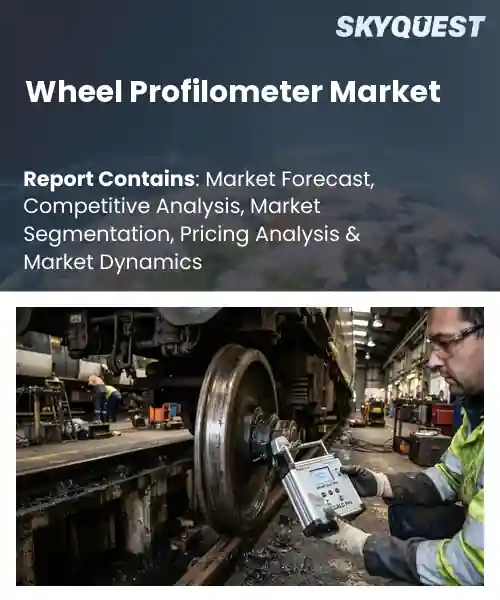
Wheel Profilometer Market
Report ID: SQMIG20I3744
Report ID: SQMIG20I3744
[email protected]
USA +1 351-333-4748
Report ID:
SQMIG20I3744 |
Region:
Global |
Published Date: August, 2026
Pages:
157
|Tables:
116
|Figures:
77


Global Wheel Profilometer Market size was valued at USD 487.0 Million in 2024 and is poised to grow from USD 517.68 Million in 2025 to USD 843.98 Million by 2033, growing at a CAGR of 6.3% during the forecast period (2026-2033).
The global wheel profilometer market supplies devices that capture the geometry of railway wheels, enabling operators to detect wear, crack propagation, and conditions before safety thresholds are breached. Its significance stems from the environment governing rail infrastructure and the cost of wheel failure, which can trigger service disruptions and replacements. Historically, the market emerged in the 1990s as manual gauges gave way to laser scanners, and adoption accelerated after derailments highlighted the need for monitoring. Today, major manufacturers such as ZwickRoell and Kistler provide solutions that feed data into maintenance platforms, illustrating the sector’s evolution from periodic inspection to analytics. The shift toward digital twins and condition‑based maintenance is redefining the wheel profilometer market because transit agencies aim to lower lifecycle costs. Feeding profilometry data into simulation models lets operators predict wheel‑rail stress and schedule grinding only when wear exceeds predefined limits, cutting unnecessary interventions. European high‑speed networks such as France’s TGV and Germany’s ICE have installed scanning stations that record thousands of profiles daily, delivering insights that shrink maintenance windows by up to 30 percent. Demonstrated efficiency gains drive investment in AI‑enhanced analytics, handheld units for regional lines, and hardware‑plus‑cloud service contracts, expanding OEM revenue streams and accelerating market adoption.
How is AI-driven automation reshaping the wheel profilometer market?
AI-driven automation is embedding advanced sensor fusion and real‑time analytics into wheel profilometers, turning them from manual measurement tools into predictive maintenance platforms. Machine‑learning models now interpret surface wear patterns, flag anomalies, and suggest corrective actions without human intervention. This shift reduces inspection cycles, improves safety compliance, and lowers operational costs for rail operators. Vendors are integrating cloud‑based dashboards that aggregate data across fleets, enabling operators to track performance trends and schedule interventions proactively. The technology also supports remote diagnostics, allowing specialists to troubleshoot issues from centralized hubs, which accelerates response times and enhances overall asset reliability.In July 2024, a leading wheel profilometer supplier launched an AI‑enhanced device, July 2024, that automatically processes measurement data, shortens inspection time and drives greater efficiency across the market.
Market snapshot - (2026-2033)
Global Market Size
USD 487.0 Million
Largest Segment
Fixed Wheel Profilometers
Fastest Growth
Portable Wheel Profilometers
Growth Rate
6.3% CAGR
To get more insights on this market click here to Request a Free Sample Report
Global wheel profilometer market is segmented by product type, technology, application, end user and region. Based on product type, the market is segmented into Portable Wheel Profilometers and Fixed Wheel Profilometers. Based on technology, the market is segmented into Laser-Based, Optical and Contact-Based. Based on application, the market is segmented into Railway Wheel Inspection, Manufacturing Quality Control and Maintenance & Repair. Based on end user, the market is segmented into Railway Operators, Rolling Stock Manufacturers and Maintenance Service Providers. Based on region, the market is segmented into North America, Europe, Asia Pacific, Latin America and Middle East & Africa.
Laser-Based segment dominates because it delivers unparalleled precision and real time data capture, which aligns with the high safety standards demanded by rail networks. The non contact nature reduces wear on measurement devices, extending service life and lowering total cost of ownership. Operators favor this technology for its ability to integrate with digital asset management platforms, enabling predictive maintenance and enhancing overall operational efficiency across multiple service lines and supporting long term reliability.
However, Optical segment is witnessing the strongest growth momentum as manufacturers seek compact, low cost solutions for inline quality checks. Advances in sensor miniaturization enable seamless integration into production lines, driving higher adoption rates. This rapid uptake fuels broader market expansion by opening new opportunities in automated wheel manufacturing processes.
Railway Wheel Inspection segment dominates because it directly addresses the core safety and reliability concerns of rail operators, who require frequent and accurate wheel geometry assessments. This application leverages established inspection protocols and integrates with existing maintenance schedules, ensuring minimal disruption. Its critical role in preventing derailments and extending wheel life makes it the primary driver of market demand and justifies substantial investment in advanced profiling equipment across global networks.
On the other hand, Maintenance & Repair segment is emerging as the key high growth area as operators shift toward condition based strategies. The need for rapid, on site wheel assessments drives demand for portable solutions that minimize downtime. This trend accelerates market expansion by creating recurring service contracts and fostering innovation in mobile profiling technologies.
To get detailed segments analysis, Request a Free Sample Report
Asia Pacific leads due to its expansive rail networks, significant investment in infrastructure modernization, and a cultural emphasis on safety and precision engineering. The region benefits from a mature manufacturing base that produces high‑quality measurement equipment at competitive costs. Strong collaboration between rail operators and technology providers accelerates adoption of sophisticated profiling solutions. Government policies that prioritize rail efficiency and environmental sustainability further drive demand, while the presence of key automotive and heavy‑industry sectors fuels continuous innovation in wheel health monitoring.
Wheel Profilometer Market in Japan benefits from a mature rail system that prioritizes precision maintenance and safety compliance. The presence of leading engineering firms drives continuous innovation in measurement technology, while close collaboration between manufacturers and rail operators ensures rapid adoption of advanced profiling solutions. Strong governmental emphasis on rail reliability and a robust supply chain further cement Japan's position as a benchmark for high‑quality wheel assessment.
Wheel Profilometer Market in South Korea is propelled by a strategic focus on high‑speed rail expansion and a culture of engineering excellence. Domestic manufacturers leverage advanced sensor technologies to deliver compact, high‑accuracy profiling devices suited for intensive maintenance regimes. Collaborative research initiatives with academic institutions foster cutting‑edge algorithms for defect detection, while proactive regulatory frameworks encourage early adoption across both passenger and freight networks, reinforcing South Korea’s reputation for technological leadership.
Europe’s wheel profilometer market is energized by a confluence of stringent safety standards, a legacy of high‑density rail corridors, and ambitious modernization programs across member states. Regulatory bodies demand precise wheel geometry monitoring, prompting operators to integrate sophisticated profiling tools into routine inspections. Investment in digitalization and data‑driven maintenance strategies amplifies demand for devices that deliver real‑time analytics. Collaborative ecosystems among equipment manufacturers, research institutions, and rail agencies foster continuous improvement of measurement accuracy and integration with predictive maintenance platforms, positioning Europe as a hub for innovative wheel health solutions. The emphasis on cross‑border interoperability drives harmonization of profiling standards, encouraging manufacturers to develop versatile solutions that meet diverse national regulations. Moreover, sustainability agendas promote efficient wheel wear management, linking profilometry to longer service life and reduced material consumption, further reinforcing market momentum.
Wheel Profilometer Market in Germany is anchored by an extensive high‑speed network and a strong engineering heritage that emphasizes precision diagnostics. Leading manufacturers collaborate closely with national rail operators to refine profiling technologies, integrating them with advanced condition‑based maintenance frameworks. The regulatory environment mandates rigorous wheel geometry checks, fostering continual upgrades of measurement equipment. This ecosystem of technical expertise and compliance focus sustains Germany’s role as a benchmark for reliability in wheel health monitoring.
Wheel Profilometer Market in United Kingdom is experiencing accelerated adoption driven by extensive network renewal projects and a proactive safety agenda. Rail operators prioritize integration of real‑time profiling tools to minimize service disruptions and extend wheel lifespan. Partnerships between domestic technology firms and academic research centres spur the development of predictive analytics platforms that enhance defect detection. This dynamic environment, coupled with supportive policy incentives, positions the United Kingdom as the continent’s most rapidly expanding market for wheel health technologies.
Wheel Profilometer Market in France is emerging as a focal point for innovative rail maintenance solutions amid ongoing infrastructure upgrades. National rail agencies emphasize modernizing inspection practices, encouraging the uptake of portable profiling devices that offer high accuracy with ease of deployment. Collaborative efforts with European research consortia drive the creation of integrated data platforms, enhancing the ability to predict wheel wear patterns. This emerging emphasis on smart diagnostics positions France as a growing contributor to the broader European market.
North America is consolidating its influence in the wheel profilometer arena through a blend of extensive freight corridors, emerging passenger rail revitalization, and a strong culture of technological adoption. Rail operators increasingly rely on precise wheel geometry monitoring to support high utilization rates and maintain stringent safety standards. Integration of profiling equipment with advanced asset management software enables predictive maintenance, reducing downtime and operational costs. Collaborative initiatives between equipment manufacturers, research universities, and industry consortiums accelerate the evolution of sensor accuracy and data analytics, reinforcing the region’s reputation for innovative, reliability‑focused rail solutions. Regulatory frameworks that emphasize proactive inspection regimes encourage rail companies to embed wheel profiling into routine maintenance cycles. Additionally, growing focus on sustainability drives interest in extending wheel service life, positioning profilometry as a key tool for achieving environmental targets across the North American rail sector.
Wheel Profilometer Market in United States is driven by an expansive freight network and increasing investment in high‑speed passenger projects. Operators prioritize accurate wheel condition monitoring to sustain high locomotive utilization and meet rigorous safety regulations. Domestic manufacturers leverage advanced laser and imaging technologies to deliver robust profiling solutions compatible with diverse rolling stock. Collaborative research with federal transportation agencies and private rail carriers fosters continuous enhancements in data integration and predictive maintenance capabilities.
Wheel Profilometer Market in Canada benefits from a coordinated national rail strategy that emphasizes safety and operational efficiency across both freight and passenger services. The adoption of portable, high‑precision profiling instruments supports harsh climate conditions and remote line inspections. Partnerships between Canadian technology firms and research institutions accelerate the development of intelligent sensor arrays and cloud‑based analytics. This collaborative environment promotes proactive wheel health management, aligning with the country’s broader objectives for sustainable and reliable rail transport.
To know more about the market opportunities by region and country, click here to
Buy The Complete Report
Increasing Safety Regulations
Adoption Of Predictive Maintenance
High Initial Equipment Cost
Limited Technical Expertise
Request Free Customization of this report to help us to meet your business objectives.
The wheel profilometer market is characterized by intense competition among equipment manufacturers, prompting strategic moves such as mergers, joint ventures, and technology upgrades to capture emerging rail‑infrastructure projects. Companies are actively forming partnerships with rail operators and sensor developers to integrate real‑time data analytics, while recent acquisitions aim to broaden product portfolios and geographic coverage, reinforcing market positioning amid rising demand for precision wheel‑wear monitoring.
Top Player’s Company Profile
Recent Developments
SkyQuest’s ABIRAW (Advanced Business Intelligence, Research & Analysis Wing) is our Business Information Services team that Collects, Collates, Correlates, and Analyses the Data collected by means of Primary Exploratory Research backed by robust Secondary Desk research. As per SkyQuest analysis, the global wheel profilometer market is propelled primarily by tightening safety regulations that compel rail operators to adopt precise wheel‑rail monitoring, while a second strong catalyst is the shift toward predictive maintenance supported by AI‑driven analytics and cloud platforms. The laser‑based technology segment leads the market thanks to its superior accuracy and seamless integration with digital asset tools. Asia Pacific stands out as the dominant region, driven by extensive rail networks, government investment and a mature manufacturing base. However, the high upfront cost of advanced profilometers remains a notable restraint, especially for smaller operators, tempering the overall pace of adoption.
| Report Metric | Details |
|---|---|
| Market size value in 2024 | USD 487.0 Million |
| Market size value in 2033 | USD 843.98 Million |
| Growth Rate | 6.3% |
| Base year | 2024 |
| Forecast period | (2026-2033) |
| Forecast Unit (Value) | USD Million |
| Segments covered |
|
| Regions covered | North America (US, Canada), Europe (Germany, France, United Kingdom, Italy, Spain, Rest of Europe), Asia Pacific (China, India, Japan, Rest of Asia-Pacific), Latin America (Brazil, Rest of Latin America), Middle East & Africa (South Africa, GCC Countries, Rest of MEA) |
| Companies covered |
|
| Customization scope | Free report customization with purchase. Customization includes:-
|
To get a free trial access to our platform which is a one stop solution for all your data requirements for quicker decision making. This platform allows you to compare markets, competitors who are prominent in the market, and mega trends that are influencing the dynamics in the market. Also, get access to detailed SkyQuest exclusive matrix.
Table Of Content
Executive Summary
Market overview
Parent Market Analysis
Market overview
Market size
KEY MARKET INSIGHTS
COVID IMPACT
MARKET DYNAMICS & OUTLOOK
Market Size by Region
KEY COMPANY PROFILES
Methodology
For the Wheel Profilometer Market, our research methodology involved a mixture of primary and secondary data sources. Key steps involved in the research process are listed below:
1. Information Procurement: This stage involved the procurement of Market data or related information via primary and secondary sources. The various secondary sources used included various company websites, annual reports, trade databases, and paid databases such as Hoover's, Bloomberg Business, Factiva, and Avention. Our team did 45 primary interactions Globally which included several stakeholders such as manufacturers, customers, key opinion leaders, etc. Overall, information procurement was one of the most extensive stages in our research process.
2. Information Analysis: This step involved triangulation of data through bottom-up and top-down approaches to estimate and validate the total size and future estimate of the Wheel Profilometer Market.
3. Report Formulation: The final step entailed the placement of data points in appropriate Market spaces in an attempt to deduce viable conclusions.
4. Validation & Publishing: Validation is the most important step in the process. Validation & re-validation via an intricately designed process helped us finalize data points to be used for final calculations. The final Market estimates and forecasts were then aligned and sent to our panel of industry experts for validation of data. Once the validation was done the report was sent to our Quality Assurance team to ensure adherence to style guides, consistency & design.
Analyst Support
Customization Options
With the given market data, our dedicated team of analysts can offer you the following customization options are available for the Wheel Profilometer Market:
Product Analysis: Product matrix, which offers a detailed comparison of the product portfolio of companies.
Regional Analysis: Further analysis of the Wheel Profilometer Market for additional countries.
Competitive Analysis: Detailed analysis and profiling of additional Market players & comparative analysis of competitive products.
Go to Market Strategy: Find the high-growth channels to invest your marketing efforts and increase your customer base.
Innovation Mapping: Identify racial solutions and innovation, connected to deep ecosystems of innovators, start-ups, academics, and strategic partners.
Category Intelligence: Customized intelligence that is relevant to their supply Markets will enable them to make smarter sourcing decisions and improve their category management.
Public Company Transcript Analysis: To improve the investment performance by generating new alpha and making better-informed decisions.
Social Media Listening: To analyze the conversations and trends happening not just around your brand, but around your industry as a whole, and use those insights to make better Marketing decisions.
REQUEST FOR SAMPLE
 REQUEST FREE CUSTOMIZATION


Want to customize this report? This report can be personalized according to your needs. Our analysts and industry experts will work directly with you to understand your requirements and provide you with customized data in a short amount of time. We offer $1000 worth of FREE customization at the time of purchase.
Feedback From Our Clients


 USA (+1) 351-333-4748

