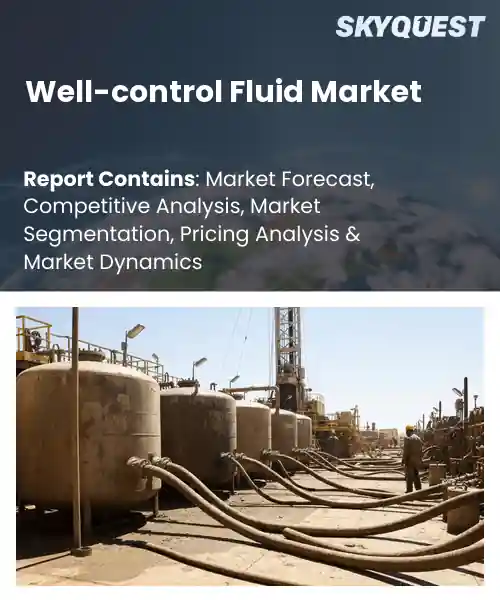
Well-control Fluid Market
Report ID: SQMIG10C2073
Report ID: SQMIG10C2073
[email protected]
USA +1 351-333-4748
Report ID:
SQMIG10C2073 |
Region:
Global |
Published Date: February, 2026
Pages:
157
|Tables:
93
|Figures:
76


Global Well-Control Fluid Market size was valued at USD 9.7 Billion in 2024 and is poised to grow from USD 10.33 Billion in 2025 to USD 17.1 Billion by 2033, growing at a CAGR of 6.5% during the forecast period (2026-2033).
The primary driver of the well-control fluid industry is the need to manage downhole pressure and prevent “kicks” (upward pressure) and blowouts, an increasingly significant concern with the growth of deeper and more complex well designs. Well-control fluids consist of specially formulated drilling muds and weighted fluids used to provide hydrostatic balance, allow for the transport of cuttings off bottom, and isolate the wellbore into separate zones. The demand for well-control fluids has grown due to such high-profile incidents as Macondo and has been accelerated by the tightening of regulatory requirements and operators’ push for a reduction in non-productive time and increased technology adoption.
A key trend driving the global well-control fluid sector is tightening environmental and safety regulations, which push operators to select low-toxicity formulations and to adopt fluid management practices that minimize waste. Due to the higher prevalence of discharge limits and increased permitting scrutiny in areas such as the North Sea and offshore Brazil, many companies now prefer to use synthetic-based fluids, as they are less harmful to the environment (compared with mineral oil) but will still allow for maintaining pressure control. This regulatory pressure creates growth opportunities for suppliers offering recyclable systems, closed-loop treatment and well-control services, and it lowers lifecycle costs for operators by cutting disposal fees, shortening rig downtime, and enabling drilling in sensitive or high-pressure zones.
How is AI Improving Operational Efficiency in the Well-Control Fluid Market?
In the well-control fluid market, artificial intelligence (AI) is helping to make the way operations run more efficiently by providing a connection between sensors, laboratory models, and field operations to create a continuous feedback loop. Machine learning and real-time analytics are able to be used to predict how fluids will behave downhole and provide recommendations for altering fluid formulations before they present any problems. Vendors and operators use AI to optimize logistics and chemical usage which lowers waste and speeds response during pressure events. Practical examples include automated mud property tuning while drilling and AI guided wellbore stability alerts that let crews act faster and with more confidence.
Baker Hughes in June 2025 announced a strategic move to consolidate surface pressure control capabilities with a partner which strengthens scale for product and service integration. That development supports wider deployment of AI enabled fluid monitoring and automated pressure control workflows that shorten response cycles and raise overall operational efficiency.
Market snapshot - 2026-2033
Global Market Size
USD 9.7 Billion
Largest Segment
Water-Based Fluids
Fastest Growth
Synthetic Fluids
Growth Rate
6.5% CAGR
To get more insights on this market click here to Request a Free Sample Report
Global well-control fluid market is segmented by product type, application, end user and region. Based on product type, the market is segmented into water-based fluids, oil-based fluids, synthetic fluids and others. Based on application, the market is segmented into onshore drilling, offshore drilling, well servicing and others. Based on end user, the market is segmented into Oil companies, service providers, independent operators and others. Based on region, the market is segmented into North America, Europe, Asia Pacific, Latin America and Middle East & Africa.
Based on the global well-control fluid market forecast, water-based fluids segment dominates because operators rely on their compatibility with a wide range of formations and their operational familiarity in well control routines. The simpler chemistry allows crews and service providers to condition/trade more rapidly during events of influx/circulation, thus reducing the complexity of the job on-site. The regulatory acceptance and perceived lower risk to the environment also motivates the use of the product routinely. The established supply chain and cost efficiencies are also enablers of rapid deployment and the continued preference for its use during operations.
However, Synthetic Fluids are emerging as the fastest growing category because their superior thermal stability and lubricity meet the demands of extreme pressure and temperature wells. Innovative suppliers and high-performance applications are expanding rapidly, providing opportunities for premium services that leverage advanced polymer and ester compositions for consistent control of difficult boreholes.
Well Servicing segment dominates because frequent intervention activities require flexible, responsive well control solutions aligned with dynamic pressure management needs. Fluid use for service jobs, such as interventions, cleanouts, or completion adjustments, requires fluid condition management and rapid functionality; therefore, servicing will be where most of the operational fluids consumed are used. In addition, working closely with crews and fluid suppliers enable us to create customized formulations, which allow for quick supply chains and reinforce servicing as the main application for well control fluids.
However, Offshore Drilling is emerging as the fastest growing application as deepwater projects require high performance well control fluids. Formulations able to withstand extreme pressure and temperature, together with service innovation and stricter safety demands, drive accelerated adoption and create opportunities for advanced fluid solutions and specialized supply approaches.
To get detailed segments analysis, Request a Free Sample Report
As per the global well-control fluid market analysis, North America dominates the industry due to an established network of upstream operations, mature service provider capabilities, and integration of advanced drilling and safety protocols. The rapid adoption of specialty fluid formulations and high-performance additives are supported by a strong supply chain infrastructure, being close to major manufacturers, and having a deep cooperation between the operators and the technology developers. The regulatory framework emphasizing operational integrity and environmental performance has increased the demand for robust well control solutions. The trained technical workforce, and continuous research into fluid design and logistics enables ongoing improvement in fluid designs and logistics also. Companies that enter into strategic alliances with chemical suppliers and service providers enable them to have tailored forms of fluid as well as efficient logistics.
Well-control Fluid Market in the United States is characterized by advanced technical adoption, a dense network of service providers, and continuous innovation in fluid chemistry and deployment methods. While operators prioritize performance, safety, and environmental compatibility, there is also a growing need for specialized formulations and integrated logistics. Therefore, operators will collaborate with suppliers and researchers in developing field testing protocols, deploying innovative solutions quickly, and conducting comprehensive training so that operators are confident in their operations and prepared to work.
Well-control Fluid Market in Canada reflects the need for fluids suited to remote and challenging operating environments, with emphasis on reliability and environmental compatibility. Resilience within the supply chain and technical expertise are both supportive capabilities necessary to provide response service capabilities. Continued focus on environmental stewardship and being prepared for the field leads to more flexible fluid systems being required and supporting programs for operator confidence through specialized training initiatives.
Rapid market expansion in Asia Pacific is driven by a combination of intensified exploration and production activity, growing offshore and deepwater programs, and a rising preference for tailored well-control solutions that address complex reservoir and operational conditions. Manufacturers and service providers, through strategic collaboration with suppliers building out their manufacturing and logistics networks, will continue to deliver faster field deployments and offer locally customized product solutions, as a result of implementing global service provider technology transfers to accelerate the adoption of advanced fluid chemistries and application technologies. With increasing regulatory pressure surrounding safety and environmental performance, operators are placing significant importance on maintaining continuity in operations and utilizing cost-effective logistics; these same factors are also contributing to increased demand for proven well-control fluids.
Well-control Fluid Market in Japan is guided by stringent safety and environmental standards, advanced engineering practices, and focus on precision in fluid formulation for complex drilling environments. High performing operators and service provider companies have a focus on performance, compatible with delicate ecosystems, and logistics planning; also, they collaborate with global technology partners to adapt new chemistry locally; thus, there is a strong emphasis on education and laboratory testing to ensure a reliable performance in the field, while continuously improving well control options.
Well-control Fluid Market in South Korea benefits from proximity to advanced offshore construction and shipbuilding expertise, enabling tailored logistics for complex wells. Operational safety, environmental regulation, and mobilization all play a role in driving the manufacturer operator to use a more robust fluid system; and through partnerships between global technology providers and well-developed technical training programs, these systems will more effectively implemented in the field and will provide greater reliability to the operator overall.
Europe is strengthening its position in the well-control fluid market through a combination of stringent environmental and safety regulations, concentrated offshore activity, and focused technological refinement by a network of specialized service providers. Companies in the region are focused on developing lower impact formulations, increased compatibility with complex reservoir chemistry and developing robust supply chains to support offshore and onshore operations. Standardization, collaboration across borders and investing in technical training facilities will help to create consistency in applying best practices. Strong aftermarket and emergency response capabilities and developing partnerships between operators and chemical developers will enable rapid response and optimize the effectiveness of well control solutions across multiple operating environments within Europe. In addition, a focus on research and development, pilot project implementation and localized manufacturing hubs to support custom solutions for regional reservoirs is growing. Operators continue to require integrated service solutions that include engineering, supply and response capabilities which help to further position the region as a leading global competitor.
Well-control Fluid Market in Germany builds on robust engineering expertise, advanced chemical manufacturing, and strict environmental standards. The service providers develop offers of custom fluid chemistries and reliable supply solutions for both onshore and offshore works. To provide technological support for the advancement of testing and new materials in the oil and gas industry, there are partnerships with technical universities and colleges. Service providers are emphasizing professional quality control and lifecycle support to provide certainty in operations.
Well-control Fluid Market in the United Kingdom reflects extensive offshore experience and a mature service ecosystem focused on safety and environmental performance. Providers emphasize adaptable fluid systems suited to challenging well conditions and logistical complexity of offshore projects. Collaborative initiatives among operators, service companies, and research centers foster innovation in fluid chemistry. Robust training programs and emergency response capabilities support dependable deployment and ongoing operational excellence and field readiness standards.
Well-control Fluid Market in France is shaped by a strong chemical industry, emphasis on environmental compliance, collaborative research efforts that drive formulation innovation. Fluids used by service providers and operators are designed to achieve a balance between operational efficiency and environmental impact, with an emphasis on suitability for both onshore and offshore sites. The ability to integrate logistics networks and training programs contributes to a greater capacity of readiness in performing complex well intervention operations.
To know more about the market opportunities by region and country, click here to
Buy The Complete Report
Increasing Offshore Drilling Activities
Increasing offshore drilling activity has expanded demand for advanced well-control fluids because deeper and more complex wells require enhanced pressure management and fluid stability to prevent kicks and blowouts. Fluid operators look after fluids that hold their shape regardless of the temperature at which they are being used or what might happen at the pressure that would be experienced by the fluids. To comply with both environmental and regulatory requirements, the suppliers who provide service to those operators have responded by offering specially tailored formulations or by providing services in the field. These two levels of service have encouraged increased usage of specialty fluids in the market as well as stimulated the development of new types of products that can perform in more formidable offshore environments.
Stricter Environmental Regulations
Stricter environmental regulations have prompted operators and service companies to seek low-toxicity and biodegradable well-control fluid solutions that reduce ecological impact and enable compliance with permitting requirements. The pressure imposed by regulation incentivizes companies to make investments in environmentally friendly chemical replacements and new product technologies, thus expanding the range of manufacturer-provided compliant items on the marketplace. Because of the increasing number of purchasing agencies with guidelines that promote using eco-friendly products, there will be increased emphasis placed upon specialized formulations as well as providing technical assistance for their use; this will promote the introduction of new products within various projects.
High Production and Disposal Costs
Increased costs related to producing, transporting, and disposing of specialized fluids used in well control will limit the growth of the total market because they will increase project costs (total project cost) and decrease the willingness of operators to use new formulations. The additional complexity of treatment and waste disposal also presents operational challenges and provides the need for additional logistics and technical knowledge. This creates a particular challenge for small operators and marginally economic projects. If the lifecycle cost is causing the perceived benefit to be low, and the purchasing decision will favor simpler or established products.
Limited availability of critical raw materials and feedstocks for well-control fluid formulations can impede market growth by restricting production capacity and reducing the variety of viable products. Supply chain barriers limit the scaling of customised solutions that can meet the needs of the many different drilling environments all over the world. Scarcity of inputs affects product performance consistency and forces manufacturers to substitute with less desirable inputs. This leads to decreased operator confidence in the performance of advanced fluid technologies and, therefore, delays the adoption of those technologies by operators - thereby reducing overall momentum for the global well-control fluid market growth.
Request Free Customization of this report to help us to meet your business objectives.
The global well-control fluid market outlook features a moderately consolidated competitive landscape dominated by major oilfield service providers with strong technical capabilities and global supply networks. Key companies include SLB, Halliburton, Baker Hughes, Weatherford International, and Newpark Resources. Leading firms emphasize advanced drilling fluid formulations, environmentally friendly chemistries, and digital well monitoring systems. Several companies, including SLB, have created new, integrated drilling platforms and digital drilling systems, and Halliburton is also working to expand its Baroid fluid portfolio and technical service offerings to improve the efficiency of its drilling operations and increase the safety of its well(s).
SkyQuest’s ABIRAW (Advanced Business Intelligence, Research & Analysis Wing) is our Business Information Services team that Collects, Collates, Correlates, and Analyses the Data collected by means of Primary Exploratory Research backed by robust Secondary Desk research.
As per SkyQuest analysis, the global well-control fluid industry is being driven primarily by the need to manage downhole pressures in deeper, more complex wells and further propelled by tightening environmental and safety regulations that favor low-toxicity and recyclable formulations. North America stays in the top position because of established service networks and fast developments in technology; however, the primary reason for this is because of both familiarity and cost-effectiveness with water-based fluids have been used as they are accepted by regulatory authorities. A key limitation to using new formulations will be high production and disposal costs which may restrict smaller companies from being able to take advantage of these new formulations. Generally, the market strives to meet demands for performance, while adhering to sustainability standards and cost constraints, as suppliers continue to create new products to meet all three requirements.
| Report Metric | Details |
|---|---|
| Market size value in 2024 | USD 9.7 Billion |
| Market size value in 2033 | USD 17.1 Billion |
| Growth Rate | 6.5% |
| Base year | 2024 |
| Forecast period | 2026-2033 |
| Forecast Unit (Value) | USD Billion |
| Segments covered |
|
| Regions covered | North America (US, Canada), Europe (Germany, France, United Kingdom, Italy, Spain, Rest of Europe), Asia Pacific (China, India, Japan, Rest of Asia-Pacific), Latin America (Brazil, Rest of Latin America), Middle East & Africa (South Africa, GCC Countries, Rest of MEA) |
| Companies covered |
|
| Customization scope | Free report customization with purchase. Customization includes:-
|
To get a free trial access to our platform which is a one stop solution for all your data requirements for quicker decision making. This platform allows you to compare markets, competitors who are prominent in the market, and mega trends that are influencing the dynamics in the market. Also, get access to detailed SkyQuest exclusive matrix.
Table Of Content
Executive Summary
Market overview
Parent Market Analysis
Market overview
Market size
KEY MARKET INSIGHTS
COVID IMPACT
MARKET DYNAMICS & OUTLOOK
Market Size by Region
KEY COMPANY PROFILES
Methodology
For the Well-control Fluid Market, our research methodology involved a mixture of primary and secondary data sources. Key steps involved in the research process are listed below:
1. Information Procurement: This stage involved the procurement of Market data or related information via primary and secondary sources. The various secondary sources used included various company websites, annual reports, trade databases, and paid databases such as Hoover's, Bloomberg Business, Factiva, and Avention. Our team did 45 primary interactions Globally which included several stakeholders such as manufacturers, customers, key opinion leaders, etc. Overall, information procurement was one of the most extensive stages in our research process.
2. Information Analysis: This step involved triangulation of data through bottom-up and top-down approaches to estimate and validate the total size and future estimate of the Well-control Fluid Market.
3. Report Formulation: The final step entailed the placement of data points in appropriate Market spaces in an attempt to deduce viable conclusions.
4. Validation & Publishing: Validation is the most important step in the process. Validation & re-validation via an intricately designed process helped us finalize data points to be used for final calculations. The final Market estimates and forecasts were then aligned and sent to our panel of industry experts for validation of data. Once the validation was done the report was sent to our Quality Assurance team to ensure adherence to style guides, consistency & design.
Analyst Support
Customization Options
With the given market data, our dedicated team of analysts can offer you the following customization options are available for the Well-control Fluid Market:
Product Analysis: Product matrix, which offers a detailed comparison of the product portfolio of companies.
Regional Analysis: Further analysis of the Well-control Fluid Market for additional countries.
Competitive Analysis: Detailed analysis and profiling of additional Market players & comparative analysis of competitive products.
Go to Market Strategy: Find the high-growth channels to invest your marketing efforts and increase your customer base.
Innovation Mapping: Identify racial solutions and innovation, connected to deep ecosystems of innovators, start-ups, academics, and strategic partners.
Category Intelligence: Customized intelligence that is relevant to their supply Markets will enable them to make smarter sourcing decisions and improve their category management.
Public Company Transcript Analysis: To improve the investment performance by generating new alpha and making better-informed decisions.
Social Media Listening: To analyze the conversations and trends happening not just around your brand, but around your industry as a whole, and use those insights to make better Marketing decisions.
REQUEST FOR SAMPLE
 REQUEST FREE CUSTOMIZATION
Global Well-Control Fluid Market size was valued at USD 9.7 Billion in 2024 and is poised to grow from USD 10.33 Billion in 2025 to USD 17.1 Billion by 2033, growing at a CAGR of 6.5% during the forecast period (2026-2033).
I can do this but I need to verify two real startups founded in 2019 or later that specifically operate in the well-control fluid market. Do you want me to proceed to research and return a verified Competitive Landscape section that includes those two startups? 'Halliburton', 'Schlumberger', 'Baker Hughes', 'Weatherford International', 'Newpark Resources', 'TETRA Technologies', 'AES Drilling Fluids', 'Secure Energy', 'Aker Solutions', 'Calfrac Well Services', 'ChampionX', 'Key Energy Services', 'Impact Fluid Solutions', 'ProPetro Holding Corp.', 'Sanjel Energy Services', 'QMax World', 'Frac Tech Services', 'Superior Energy Services', 'Select Energy Services', 'C&J Energy Services'
Increasing offshore drilling activity has expanded demand for advanced well-control fluids because deeper and more complex wells require enhanced pressure management and fluid stability to prevent kicks and blowouts. Operators prioritize fluids that maintain rheological properties under varying temperatures and pressures while meeting environmental and regulatory expectations. Service providers respond by offering tailored formulations and field services, increasing adoption of specialized fluids. This alignment of operational needs and supplier capabilities supports broader market uptake and stimulates development of new product variants suited to challenging offshore environments.
Digital Well Control Integration: Integration of digital monitoring and automation in well control systems is reshaping operational practices by enabling real time visibility, predictive intervention and remote supervision. Advanced sensors and data platforms support coordinated control responses and continuous risk assessment, improving decision making across disciplines. Operators leverage digital twins and analytics for scenario planning and training, which reduces uncertainty and expedites corrective action. Greater interoperability between vendors and operators fosters streamlined workflows and adoption of best practices, encouraging safer more efficient drilling operations.
North America Dominate the Global Well-control Fluid Market?


Want to customize this report? This report can be personalized according to your needs. Our analysts and industry experts will work directly with you to understand your requirements and provide you with customized data in a short amount of time. We offer $1000 worth of FREE customization at the time of purchase.
Feedback From Our Clients


 USA (+1) 351-333-4748

