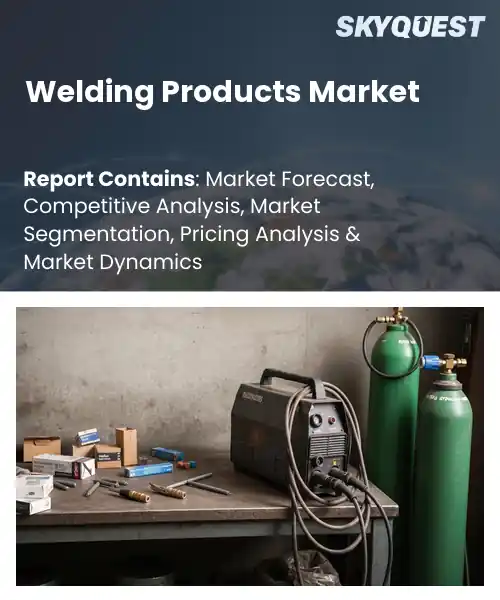
Welding Products Market
Report ID: SQMIG20I3070
Report ID: SQMIG20I3070
[email protected]
USA +1 351-333-4748
Report ID:
SQMIG20I3070 |
Region:
Global |
Published Date: June, 2026
Pages:
157
|Tables:
94
|Figures:
76


Global Welding Products Market size was valued at USD 20.88 Billion in 2024 and is poised to grow from USD 22.59 Billion in 2025 to USD 42.44 Billion by 2033, growing at a CAGR of 8.2% during the forecast period (2026-2033).
The primary driver of the welding products market is industrial infrastructure expansion, which has steadily increased demand for consumables, equipment, and automation solutions. Welding products encompass electrodes, wires, gases, torches, power sources, and robotic systems used across construction, shipbuilding, automotive, and energy sectors, and their performance directly affects productivity, safety, and structural integrity. This market matters because reliable joining technologies enable large-scale projects and maintenance of critical assets; historically demand shifted from manual stick welding toward gas metal arc welding and now toward automated cell deployment, for example, shipyards in South Korea and automotive plants in Germany that adopted robotics.
Building on the shift to automation, technological innovation stands out as the key factor propelling global welding products growth because advances in robotics, sensors, and power electronics increase efficiency and lower total cost of ownership. As manufacturers adopt collaborative robots and closed-loop monitoring, welding defects fall and throughput rises, prompting investment in consumables optimized for automated stations; for example, automotive body shops applying arc sensors realize reduced rework and faster cycle times. This cause-and-effect dynamic creates opportunities for suppliers to offer integrated systems, software-as-a-service for weld quality analytics, and specialized filler metals tailored to high-speed automated processes and aftermarket services.
How is IoT enhancing quality control in the welding products market?
IoT is raising quality control in the welding products market by connecting sensors on power sources, torches and fixtures to cloud platforms for real time monitoring and traceability. Key aspects include continuous capture of welding parameters, automated alerts when settings drift and comparison of each weld against procedure libraries so non conforming work is flagged immediately. The market shows growing adoption of sensor enabled welding equipment and software that consolidates machine data for audits and operator coaching. Cloud based weld management tools also enable remote diagnostics and more proactive inspection, which reduces scrap and shortens time to repair.
ESAB March 2026, demonstrated WeldCloud with real time traceability and automatic parameter checks. This IoT driven visibility helps catch deviations during production and speeds corrective action, supporting higher throughput, more consistent quality and reduced rework which improves operational efficiency and market competitiveness.
Market snapshot - (2026-2033)
Global Market Size
USD 20.88 Billion
Largest Segment
Arc Welding
Fastest Growth
Laser Welding
Growth Rate
8.2% CAGR
To get more insights on this market click here to Request a Free Sample Report
Global welding products market is segmented by technology, product type, end-use industry and region. Based on technology, the market is segmented into Arc Welding, Laser Welding, Spot Welding and Others. Based on product type, the market is segmented into Welding Consumables, Welding Equipment and Others. Based on end-use industry, the market is segmented into Automotive, Building and Construction, Heavy Engineering, Railway and Shipbuilding, Oil and Gas and Others. Based on region, the market is segmented into North America, Europe, Asia Pacific, Latin America and Middle East & Africa.
Arc Welding segment dominates because its broad applicability across metals and thicknesses makes it the default choice for many industries, anchoring supplier investment in complementary technologies. Its operational familiarity and compatibility with a wide range of consumables result in steady demand, encouraging manufacturers to improve ergonomics, safety features, and process controls. This continuing demand and installed base create incentives for incremental product innovations and ecosystem development.
However, Laser Welding is emerging as the most rapidly expanding area, driven by needs for high precision, minimal heat distortion, and fast automated cycles in advanced manufacturing. Its suitability for thin materials and electronics assembly is prompting adoption of integrated laser cells and process monitoring, unlocking high value equipment sales and specialized service offerings that expand future market opportunities.
Welding Consumables segment dominates because consumables are the consumptive core of welding operations, generating recurring purchases and defining process performance across applications. Material composition, flux formulation, and quality reliability directly influence weld strength and operator productivity, prompting suppliers to invest in specialized alloys and chemistry improvements. These supplier advances and strong procurement preferences stabilize revenue streams and shape equipment compatibility and procurement strategies.
Conversely, Welding Equipment is witnessing the strongest growth momentum as manufacturers shift toward inverter technology, digital controls, and automation ready systems to enhance throughput and energy efficiency. Rising demand for portable units, robotics integration, and integrated monitoring spurs capital investment, enabling equipment makers to offer bundled services and lifecycle support that create new revenue streams and broaden market reach.
To get detailed segments analysis, Request a Free Sample Report
Asia Pacific dominance is rooted in a convergence of industrial scale, concentrated manufacturing ecosystems, and a deep supply chain integration that supports welding product demand across sectors. Strong automotive, shipbuilding, infrastructure and electronics manufacturing clusters stimulate demand for varied welding consumables and equipment while local suppliers and global suppliers coexist with specialized distributors. Continuous investments in automation, skilled workforce development and technology adoption enhance quality and productivity, enabling regional firms to supply advanced welding solutions. Proximity to raw material sources and competitive production costs support cost-effective manufacturing. Strong policy support for industrial modernization and growing adoption of advanced materials further extend market depth, while regional trading links enable efficient distribution to adjacent markets.
Welding Products Market Japan focuses on precision welding solutions for advanced manufacturing and electronics. Local producers emphasize automation, process control and high-quality consumables suited to automotive and industrial equipment. A cohesive supplier network and strong technical expertise accelerate adoption of refined welding methods. Market expectations center on reliability, consistency and adherence to strict quality protocols, prompting close cooperation between equipment vendors, materials specialists and industrial end users and service providers.
Welding Products Market South Korea combines strong shipbuilding, automotive and heavy industry demand with a focus on versatile equipment and durable consumables. Emphasis on manufacturing efficiency, automation and specialized welding techniques directs supplier attention to process reliability. Close collaboration among industrial groups and technology providers encourages tailored solutions and workforce training. End users favor equipment with proven performance under demanding conditions and reliable material supply and strong aftersales service availability.
Rapid expansion in North America reflects a combination of modernization across manufacturing, infrastructure renewal and a strategic shift toward advanced fabrication techniques that increase demand for diverse welding products. Growth is supported by investments in industrial automation, workforce upskilling and the integration of welding with digital monitoring and quality assurance systems. A competitive supplier landscape, strong distribution networks and emphasis on safety and environmental compliance drive adoption of higher-performance consumables and equipment. Collaboration between manufacturers, technical institutes and end users accelerates technology transfer and application-specific solutions. Regional focus on supply chain resilience and closer ties between domestic production and industrial end markets further enhances market depth and responsiveness to evolving fabrication requirements. Policy emphasis on industrial competitiveness and incentives for technological adoption bolster procurement of advanced welding solutions and encourage domestic innovation.
Welding Products Market United States is driven by modernization in aerospace, construction and heavy fabrication requiring advanced welding systems and high-performance consumables. Emphasis on automation, digital welding controls and qualification protocols raises demand for integrated solutions and services. A robust network of suppliers and service providers supports rapid deployment. Industry collaboration with training institutions enhances workforce capabilities, while stringent safety and environmental standards shape procurement toward reliable, compliant welding technologies.
Welding Products Market Canada is influenced by activity in energy, infrastructure and manufacturing that favors rugged welding equipment and adaptable consumables. Suppliers respond to diverse operational environments with portable systems and training programs. Growing interest in efficient fabrication methods and adherence to safety and environmental protocols encourages investment in quality welding solutions. Collaboration between industry and training centers strengthens technical capabilities and ensures availability of certified processes and operators nationwide.
Europe is strengthening its position through a combination of technological advancement, stringent quality and safety frameworks, and coordinated industry-academia partnerships that accelerate innovation in welding processes and materials. Emphasis on high-value manufacturing sectors such as automotive, aerospace and renewable energy fosters demand for specialized welding systems and certified consumables. Manufacturers emphasize energy efficiency, process traceability and integration with digital quality management, while suppliers adapt portfolios to meet regulatory and sustainability requirements. Cross-border collaboration and strong supplier networks enable efficient dissemination of best practices and advanced equipment, reinforcing Europe as a center for both sophisticated welding applications and high-standard product development. Investment in workforce training and certification, together with a growing focus on low-emission fabrication practices and recyclable materials, further differentiates European offerings. This combination of capabilities and standards supports the region in supplying advanced, compliance-oriented welding solutions to global and regional industrial customers.
Welding Products Market Germany benefits from a strong engineering tradition and a focus on precision industrial fabrication, driving demand for high-quality welding systems and certified consumables. Suppliers emphasize automation, process consistency and rigorous qualification protocols to meet automotive, machinery and plant engineering needs. Close collaboration between manufacturers, research institutions and vocational training centers fosters advanced welding methods and skilled operators. Market priorities include energy efficiency, reliability and compliance with standards.
Welding Products Market United Kingdom is shaped by a diverse industrial base and a growing emphasis on lightweight fabrication for automotive and aerospace applications. Suppliers focus on flexible welding equipment, process qualification and service support to meet changing production needs. Investment in training and certification programs enhances operator skills and quality control. Regulatory attention to safety and environmental performance steers procurement toward efficient, low-emission welding solutions and comprehensive aftersales support.
Welding Products Market France emphasizes innovation in welding techniques for construction, energy and transportation sectors, encouraging suppliers to offer adaptable equipment and specialty consumables. Strong ties between industrial clusters and research institutions foster application-driven development and validation of advanced processes. Attention to operator training and certification ensures consistent quality in fabrication environments. Procurement considerations prioritize systems that balance efficiency, compliance with environmental norms and capability to support complex, integrity welding requirements.
To know more about the market opportunities by region and country, click here to
Buy The Complete Report
Advancements In Welding Technology
Expansion Of End Use Industries
Fluctuating Raw Material Costs
Regulatory Compliance And Safety
Request Free Customization of this report to help us to meet your business objectives.
Competitive landscape in the global welding products market is driven by consolidation, supplier-robotics partnerships and rapid technology deployment as OEMs demand automated, traceable welding for EV and heavy industries. Companies pursue bolt-on acquisitions and roll-up strategies, form robotics and power-source alliances (for example Fronius with ABB), and commercialize WAAM and laser-based welding and surface-prep systems to secure integrated cell contracts.
SkyQuest’s ABIRAW (Advanced Business Intelligence, Research & Analysis Wing) is our Business Information Services team that Collects, Collates, Correlates, and Analyses the Data collected by means of Primary Exploratory Research backed by robust Secondary Desk research.
As per SkyQuest analysis, a key driver is industrial infrastructure expansion, which spurs demand for consumables, equipment and automation. A restraint is fluctuating raw material costs that pressure margins and slow procurement. The dominating region is Asia Pacific, given its manufacturing scale and integrated supply chains, and the dominating segment is Arc Welding due to its broad applicability across metals and thicknesses. A second driver is technological innovation, including robotics, sensors and IoT-enabled weld monitoring that raise productivity and traceability. Overall, suppliers who combine automated systems, specialized consumables and cloud-enabled quality tools are best positioned for growth. Market momentum will favor vendors offering integrated services and lifecycle support.
| Report Metric | Details |
|---|---|
| Market size value in 2024 | USD 20.88 Billion |
| Market size value in 2033 | USD 42.44 Billion |
| Growth Rate | 8.2% |
| Base year | 2024 |
| Forecast period | (2026-2033) |
| Forecast Unit (Value) | USD Billion |
| Segments covered |
|
| Regions covered | North America (US, Canada), Europe (Germany, France, United Kingdom, Italy, Spain, Rest of Europe), Asia Pacific (China, India, Japan, Rest of Asia-Pacific), Latin America (Brazil, Rest of Latin America), Middle East & Africa (South Africa, GCC Countries, Rest of MEA) |
| Companies covered |
|
| Customization scope | Free report customization with purchase. Customization includes:-
|
To get a free trial access to our platform which is a one stop solution for all your data requirements for quicker decision making. This platform allows you to compare markets, competitors who are prominent in the market, and mega trends that are influencing the dynamics in the market. Also, get access to detailed SkyQuest exclusive matrix.
Table Of Content
Executive Summary
Market overview
Parent Market Analysis
Market overview
Market size
KEY MARKET INSIGHTS
COVID IMPACT
MARKET DYNAMICS & OUTLOOK
Market Size by Region
KEY COMPANY PROFILES
Methodology
For the Welding Products Market, our research methodology involved a mixture of primary and secondary data sources. Key steps involved in the research process are listed below:
1. Information Procurement: This stage involved the procurement of Market data or related information via primary and secondary sources. The various secondary sources used included various company websites, annual reports, trade databases, and paid databases such as Hoover's, Bloomberg Business, Factiva, and Avention. Our team did 45 primary interactions Globally which included several stakeholders such as manufacturers, customers, key opinion leaders, etc. Overall, information procurement was one of the most extensive stages in our research process.
2. Information Analysis: This step involved triangulation of data through bottom-up and top-down approaches to estimate and validate the total size and future estimate of the Welding Products Market.
3. Report Formulation: The final step entailed the placement of data points in appropriate Market spaces in an attempt to deduce viable conclusions.
4. Validation & Publishing: Validation is the most important step in the process. Validation & re-validation via an intricately designed process helped us finalize data points to be used for final calculations. The final Market estimates and forecasts were then aligned and sent to our panel of industry experts for validation of data. Once the validation was done the report was sent to our Quality Assurance team to ensure adherence to style guides, consistency & design.
Analyst Support
Customization Options
With the given market data, our dedicated team of analysts can offer you the following customization options are available for the Welding Products Market:
Product Analysis: Product matrix, which offers a detailed comparison of the product portfolio of companies.
Regional Analysis: Further analysis of the Welding Products Market for additional countries.
Competitive Analysis: Detailed analysis and profiling of additional Market players & comparative analysis of competitive products.
Go to Market Strategy: Find the high-growth channels to invest your marketing efforts and increase your customer base.
Innovation Mapping: Identify racial solutions and innovation, connected to deep ecosystems of innovators, start-ups, academics, and strategic partners.
Category Intelligence: Customized intelligence that is relevant to their supply Markets will enable them to make smarter sourcing decisions and improve their category management.
Public Company Transcript Analysis: To improve the investment performance by generating new alpha and making better-informed decisions.
Social Media Listening: To analyze the conversations and trends happening not just around your brand, but around your industry as a whole, and use those insights to make better Marketing decisions.
REQUEST FOR SAMPLE
 REQUEST FREE CUSTOMIZATION
Global Welding Products Market size was valued at USD 20.88 Billion in 2024 and is poised to grow from USD 22.59 Billion in 2025 to USD 42.44 Billion by 2033, growing at a CAGR of 8.2% during the forecast period (2026-2033).
Competitive landscape in the global welding products market is driven by consolidation, supplier-robotics partnerships and rapid technology deployment as OEMs demand automated, traceable welding for EV and heavy industries. Companies pursue bolt-on acquisitions and roll-up strategies, form robotics and power-source alliances (for example Fronius with ABB), and commercialize WAAM and laser-based welding and surface-prep systems to secure integrated cell contracts. 'Lincoln Electric', 'Colfax Corporation', 'Illinois Tool Works', 'Kemppi', 'Kiswel', 'Obara Group', 'Senor Metals', 'Tianjin Bridge Welding Materials', 'Panasonic Holdings', 'Daihen Corporation', 'Voestalpine', 'Air Liquide', 'Carl Cloos Schweisstechnik', 'GCE Group', 'EWM AG', 'Kjellberg Finsterwalde', 'Arcon Welding', 'Ador Welding', 'Victor Technologies', 'Miller Electric'
Modern advancements in welding technology enhance efficiency, reliability, and process control, enabling manufacturers to achieve higher-quality joints with reduced rework and downtime. Improved power sources, automation interfaces, and auxiliary equipment simplify complex assemblies and extend applications across automotive, construction, and energy sectors. As fabrication processes become more predictable and repeatable, companies view investment in welding products as productivity enablers rather than mere consumables, encouraging procurement and integration of advanced welding solutions that directly support expanded production capacity and diverse application requirements.
Automation And Digital Integration: Adoption of robotic welding, sensor-enabled equipment and data analytics is reshaping production workflows and supplier relationships. Manufacturers prioritize interoperable systems that enable real-time process monitoring, predictive maintenance, and remote diagnostics to reduce downtime and enhance consistency. Digital platforms are facilitating tighter collaboration across engineering, procurement and aftermarket services, accelerating customization and shortening delivery cycles. Demand is rising for welding products designed for seamless integration with control systems and software ecosystems to support operational agility and continuous improvement and strategic differentiation.
Why does Asia Pacific Dominate the Global Welding Products Market? |@12


Want to customize this report? This report can be personalized according to your needs. Our analysts and industry experts will work directly with you to understand your requirements and provide you with customized data in a short amount of time. We offer $1000 worth of FREE customization at the time of purchase.
Feedback From Our Clients


 USA (+1) 351-333-4748

