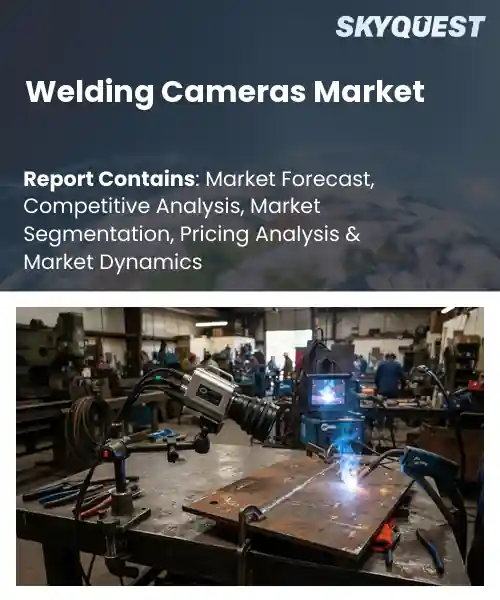
Welding Cameras Market
Report ID: SQMIG45J3024
Report ID: SQMIG45J3024
[email protected]
USA +1 351-333-4748
Report ID:
SQMIG45J3024 |
Region:
Global |
Published Date: November, 2026
Pages:
157
|Tables:
120
|Figures:
77


Global Welding Cameras Market size was valued at USD 185.0 Million in 2024 and is poised to grow from USD 198.32 Million in 2025 to USD 345.88 Million by 2033, growing at a CAGR of 7.2% during the forecast period (2026-2033).
The global welding cameras market comprises optical imaging systems designed to monitor, record, and analyze weld pools in real time, enabling manufacturers to improve product quality and reduce rework. Its importance stems from the rising demand for high‑precision welding in automotive, shipbuilding, and aerospace sectors, where defect detection directly impacts safety and cost. Historically, the market lingered in niche applications until the early 2010s, when advances in high‑resolution sensors and robust wireless data transmission lowered entry barriers. For example, Toyota’s adoption of vision‑guided welding stations in 2015 accelerated industry acceptance, marking a shift from manual inspection to automated quality control. Building on that foundation, the principal growth driver now is the convergence of Industry 4.0 initiatives with advanced imaging analytics, which creates a feedback loop that transforms raw weld data into predictive maintenance insights. As manufacturers integrate welding cameras with cloud‑based AI platforms, they can automatically flag anomalies, schedule robot recalibration, and cut downtime by up to 30 percent, as demonstrated by a German shipyard that reduced defect rates after deploying a real‑time vision system in 2022. These efficiencies attract capital investment, spur component miniaturization, and open new markets in renewable‑energy turbine assembly, where precise weld verification is critical for long‑term reliability.
How is AI-driven automation influencing the performance and adoption of welding cameras?
AI driven automation is reshaping welding cameras by embedding real time image analysis, defect detection and process feedback directly into the lens. The technology combines deep learning models with high speed sensors to evaluate bead shape, spatter and alignment as the weld progresses. Manufacturers now rely on these smart lenses to reduce rework, improve quality and shorten cycle time. Integration with robotic arms allows the system to adjust parameters on the fly, creating a closed loop that mirrors human expertise but at a faster pace. As factories adopt Industry 4.0 principles the demand for such intelligent vision tools continues to rise, making the market more dynamic.Keyence released an AI enabled welding inspection camera in April 2023, the system combines high resolution imaging with on board neural networks that flag defects instantly. This launch has accelerated adoption by demonstrating how automation can cut inspection time and boost confidence in weld quality across automotive and shipbuilding lines.
Market snapshot - (2026-2033)
Global Market Size
USD 185.0 Million
Largest Segment
Visible-Light Welding Cameras
Fastest Growth
High-Speed Welding Cameras
Growth Rate
7.2% CAGR
To get more insights on this market click here to Request a Free Sample Report
Global welding cameras market is segmented by camera type, component, application, end-use industry and region. Based on camera type, the market is segmented into Visible-Light Welding Cameras, Infrared Welding Cameras and High-Speed Welding Cameras. Based on component, the market is segmented into Camera Hardware, Imaging Sensors and Software & Control Systems. Based on application, the market is segmented into Welding Process Monitoring, Weld Quality Inspection, Robotic Welding and Welding Research & Development. Based on end-use industry, the market is segmented into Automotive, Aerospace & Defense, Heavy Machinery, Shipbuilding and Other Manufacturing Industries. Based on region, the market is segmented into North America, Europe, Asia Pacific, Latin America and Middle East & Africa.
Visible-light welding cameras segment dominates because they provide operators with immediate visual feedback that aligns closely with human perception, enabling swift detection of defects such as spatter or misalignment. Their compatibility with existing optical systems and lower integration complexity foster widespread adoption, while continuous improvements in resolution and low‑light performance reinforce their central position in ensuring consistent weld quality throughout production environments.
Meanwhile, infrared welding cameras are emerging as the key high‑growth area in the welding cameras market. Their ability to capture thermal signatures offers deeper insight into melt pool dynamics and heat distribution, which is increasingly critical for advanced alloys and high‑precision applications. As manufacturers seek tighter process control and predictive maintenance, the demand for thermal imaging accelerates, opening new opportunities for integrated monitoring solutions.
High-speed welding cameras segment leads because they deliver ultra‑fast frame rates that synchronize with robotic arm movements, allowing precise tracking of rapid weld bead formation. This capability reduces latency in feedback loops, supporting tighter control algorithms that improve seam consistency and minimize rework. Their robust design tolerates harsh shop‑floor conditions, making them indispensable for high‑throughput automotive production lines where speed and accuracy are paramount.
Conversely, software & control systems are witnessing the strongest growth momentum within the welding cameras market. Advanced analytics platforms and AI‑driven defect detection enhance the raw image data, turning visual information into actionable process adjustments. As manufacturers integrate smart factories and seek autonomous quality assurance, these intelligent control solutions expand rapidly, driving broader adoption of sophisticated camera technologies across robotic welding applications.
To get detailed segments analysis, Request a Free Sample Report
Asia Pacific leads the welding cameras arena through a blend of advanced manufacturing ecosystems, strong emphasis on precision engineering, and sizable investment in automation across heavy‑industry sectors. The region benefits from a deep talent pool specialized in optical sensing and robotics, fostering continuous innovation in camera resolution, ruggedization, and integration capabilities. Collaborative networks between original equipment manufacturers and technology providers accelerate product development cycles, while supportive policy frameworks encourage adoption of smart welding solutions to enhance productivity and quality control. As a result, the market enjoys a reputation for high‑performance, cost‑effective solutions that attract global OEMs seeking reliable visual monitoring for complex welding operations.
Welding Cameras Market in Japan is shaped by a legacy of precision manufacturing and a culture of continual improvement. Local firms prioritize high‑resolution imaging and seamless integration with robotic welding cells, delivering solutions that meet exacting quality standards. Strong ties between camera suppliers and automotive and shipbuilding sectors drive bespoke development, while academic‑industry collaborations fuel research into next‑generation sensor technologies.
Welding Cameras Market in South Korea thrives on rapid adoption of Industry 4.0 practices and a vibrant electronics supply chain. The emphasis on compact, high‑speed imaging aligns with the country's focus on high‑volume automotive and heavy‑equipment production. Close cooperation between global camera manufacturers and local system integrators accelerates deployment of advanced vision systems that enhance weld inspection accuracy and operational efficiency.
Europe’s welding cameras sector is propelled by a convergence of stringent quality regulations, deep engineering expertise, and a strategic shift toward digital manufacturing. The region’s strong tradition in mechanical engineering and precision tooling underpins demand for high‑fidelity visual inspection tools that support compliance and traceability. Collaborative initiatives among research institutions, standards bodies, and industrial consortia foster innovation in sensor fusion and AI‑enabled defect detection. Moreover, the drive for sustainable production encourages adoption of monitoring systems that minimize rework and material waste, positioning Europe as a hub for sophisticated, standards‑compliant welding vision solutions.
Welding Cameras Market in Germany is anchored by world‑renowned engineering firms that integrate cutting‑edge optics with robust industrial automation platforms. The market benefits from deep expertise in automotive and machinery sectors, where precision weld monitoring is critical for product reliability. Close alignment with technical standards and strong engineering education pipelines ensure continuous refinement of camera performance and reliability.
Welding Cameras Market in United Kingdom is energized by a dynamic ecosystem of technology start‑ups and established manufacturers focusing on smart welding solutions. Emphasis on digital twins and real‑time data analytics drives demand for high‑speed cameras that feed into predictive maintenance frameworks. Collaborative research initiatives with universities accelerate development of AI‑driven inspection capabilities.
Welding Cameras Market in France is emerging through focused investments in aerospace and advanced manufacturing clusters. The market leverages expertise in optical engineering to offer high‑resolution, lightweight camera systems suited for complex weld geometries. Partnerships between research institutes and industrial players help translate innovative sensor technologies into practical applications for weld quality assurance.
North America advances its welding cameras position by integrating advanced vision technologies with a robust industrial base and a culture of technological entrepreneurship. The region’s emphasis on digital transformation and additive manufacturing creates a fertile environment for high‑performance imaging solutions that support real‑time weld monitoring and defect analytics. Strong collaboration between defense, automotive, and energy sectors drives demand for rugged, high‑resolution cameras capable of operating in harsh conditions. Furthermore, a proactive regulatory landscape encourages adoption of precise inspection tools to meet safety and quality mandates, reinforcing the region’s role as a leader in sophisticated welding vision systems.
Welding Cameras Market in United States reflects a vibrant blend of large‑scale manufacturing and innovative start‑ups delivering cutting‑edge imaging platforms. The market benefits from deep integration with robotics and AI, enabling real‑time weld quality assessment across aerospace, automotive, and oil‑and‑gas industries. Strong venture capital support fuels rapid development of next‑generation sensors and analytics software.
Welding Cameras Market in Canada builds on a strong resource‑extraction and infrastructure sector that values reliable weld inspection for safety and efficiency. Emphasis on ruggedized camera designs suited for extreme environments aligns with the country’s focus on energy and transportation projects. Collaborative research programs between academia and industry promote advancement of indigenous imaging technologies.
To know more about the market opportunities by region and country, click here to
Buy The Complete Report
Enhanced Weld Quality Assurance
Cost Reduction Through Defect Prevention
High Initial Investment Costs
Technical Complexity and Training Requirements
Request Free Customization of this report to help us to meet your business objectives.
The welding cameras market is intensively competitive as manufacturers race to embed AI, high‑speed imaging and edge‑computing into weld inspection solutions. Drivers include rising demand for real‑time defect detection and Industry 4.0 integration. Major players are pursuing M&A, such as Teledyne’s acquisition of FLIR, forging partnerships like Nikon with welding sensor firms, and accelerating tech innovation through AI‑enabled analytics platforms.
Top Player’s Company Profile
Recent Developments
SkyQuest’s ABIRAW (Advanced Business Intelligence, Research & Analysis Wing) is our Business Information Services team that Collects, Collates, Correlates, and Analyses the Data collected by means of Primary Exploratory Research backed by robust Secondary Desk research. As per SkyQuest analysis, the global welding cameras market is being propelled primarily by the need for enhanced weld quality assurance, as manufacturers use real‑time visual feedback to cut rework and improve product reliability. A second strong catalyst is cost reduction through early defect prevention, which lowers material waste and downtime. The visible‑light welding cameras segment remains the dominant choice because of its ease of integration and high‑resolution imaging, while Asia Pacific leads the market thanks to its advanced manufacturing ecosystem and strong investment in automation. However, widespread adoption is tempered by the high initial investment costs required for sophisticated camera systems and associated integration.
| Report Metric | Details |
|---|---|
| Market size value in 2024 | USD 185.0 Million |
| Market size value in 2033 | USD 345.88 Million |
| Growth Rate | 7.2% |
| Base year | 2024 |
| Forecast period | (2026-2033) |
| Forecast Unit (Value) | USD Million |
| Segments covered |
|
| Regions covered | North America (US, Canada), Europe (Germany, France, United Kingdom, Italy, Spain, Rest of Europe), Asia Pacific (China, India, Japan, Rest of Asia-Pacific), Latin America (Brazil, Rest of Latin America), Middle East & Africa (South Africa, GCC Countries, Rest of MEA) |
| Companies covered |
|
| Customization scope | Free report customization with purchase. Customization includes:-
|
To get a free trial access to our platform which is a one stop solution for all your data requirements for quicker decision making. This platform allows you to compare markets, competitors who are prominent in the market, and mega trends that are influencing the dynamics in the market. Also, get access to detailed SkyQuest exclusive matrix.
Table Of Content
Executive Summary
Market overview
Parent Market Analysis
Market overview
Market size
KEY MARKET INSIGHTS
COVID IMPACT
MARKET DYNAMICS & OUTLOOK
Market Size by Region
KEY COMPANY PROFILES
Methodology
For the Welding Cameras Market, our research methodology involved a mixture of primary and secondary data sources. Key steps involved in the research process are listed below:
1. Information Procurement: This stage involved the procurement of Market data or related information via primary and secondary sources. The various secondary sources used included various company websites, annual reports, trade databases, and paid databases such as Hoover's, Bloomberg Business, Factiva, and Avention. Our team did 45 primary interactions Globally which included several stakeholders such as manufacturers, customers, key opinion leaders, etc. Overall, information procurement was one of the most extensive stages in our research process.
2. Information Analysis: This step involved triangulation of data through bottom-up and top-down approaches to estimate and validate the total size and future estimate of the Welding Cameras Market.
3. Report Formulation: The final step entailed the placement of data points in appropriate Market spaces in an attempt to deduce viable conclusions.
4. Validation & Publishing: Validation is the most important step in the process. Validation & re-validation via an intricately designed process helped us finalize data points to be used for final calculations. The final Market estimates and forecasts were then aligned and sent to our panel of industry experts for validation of data. Once the validation was done the report was sent to our Quality Assurance team to ensure adherence to style guides, consistency & design.
Analyst Support
Customization Options
With the given market data, our dedicated team of analysts can offer you the following customization options are available for the Welding Cameras Market:
Product Analysis: Product matrix, which offers a detailed comparison of the product portfolio of companies.
Regional Analysis: Further analysis of the Welding Cameras Market for additional countries.
Competitive Analysis: Detailed analysis and profiling of additional Market players & comparative analysis of competitive products.
Go to Market Strategy: Find the high-growth channels to invest your marketing efforts and increase your customer base.
Innovation Mapping: Identify racial solutions and innovation, connected to deep ecosystems of innovators, start-ups, academics, and strategic partners.
Category Intelligence: Customized intelligence that is relevant to their supply Markets will enable them to make smarter sourcing decisions and improve their category management.
Public Company Transcript Analysis: To improve the investment performance by generating new alpha and making better-informed decisions.
Social Media Listening: To analyze the conversations and trends happening not just around your brand, but around your industry as a whole, and use those insights to make better Marketing decisions.
REQUEST FOR SAMPLE
 REQUEST FREE CUSTOMIZATION


Want to customize this report? This report can be personalized according to your needs. Our analysts and industry experts will work directly with you to understand your requirements and provide you with customized data in a short amount of time. We offer $1000 worth of FREE customization at the time of purchase.
Feedback From Our Clients


 USA (+1) 351-333-4748

