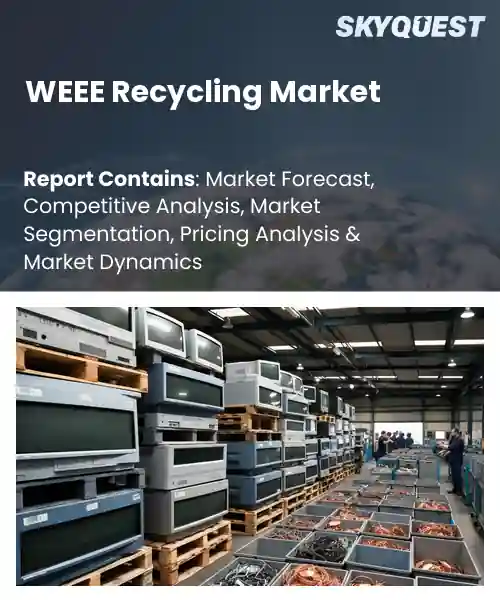
WEEE Recycling Market
Report ID: SQMIG20I3367
Report ID: SQMIG20I3367
[email protected]
USA +1 351-333-4748
Report ID:
SQMIG20I3367 |
Region:
Global |
Published Date: July, 2026
Pages:
157
|Tables:
153
|Figures:
78


Global Weee Recycling Market size was valued at USD 2.87 Billion in 2024 and is poised to grow from USD 3.08 Billion in 2025 to USD 5.37 Billion by 2033, growing at a CAGR of 7.2% during the forecast period (2026-2033).
Technology in economies is now a catalyst, with urbanization driving demand for low-cost electronics and a corresponding rise in waste. Governments are being forced to roll out extended producer responsibility schemes under the pressure, and companies like Samsung and Dell have set up refurbishment hubs that recover up to 60% of valuable metals. Recycled copper and rare earths lower the cost of production for local manufacturers, creating a feedback loop in which recycled inputs lead to product development. That’s why venture capital is pouring into sorting facilities – like a 2023 AI-powered plant in Indonesia that processes 150,000 tons a year and builds export corridors to Europe.
How is AI-driven Automation Improving Efficiency in the WEEE Recycling Market?
AI-led automation is changing the WEEE recycling landscape by connecting smart sensors, computer vision and predictive analytics to every step of the material recovery process. AI is being used in today’s processors to scan incoming streams, sort plastics, metals and batteries and predict equipment wear, which cuts down on downtime and increases throughput. Real-time data feeds allow operators to change feed rates and labor allocation more efficiently, while machine-learning models iteratively improve sorting rules based on new product designs. These capabilities turn previously mixed waste into higher-grade feedstock, helping to create a more circular electronics economy.
In March 2026, Material Focus will launch an AI-driven sorting platform costing £1m, which will instantly identify the component types found in e-waste streams, cutting down the need for manual inspection and boosting recovery yields. The system’s real-time analytics speed up processing and demonstrate how AI automation is driving market growth.
Market snapshot - (2026-2033)
Global Market Size
USD 2.87 Billion
Largest Segment
Large Household Appliances
Fastest Growth
IT & Telecommunication Equipment
Growth Rate
7.2% CAGR
To get more insights on this market click here to Request a Free Sample Report
Global weee recycling market is segmented by waste type, material recovered, recycling process, end user, collection source and region. Based on waste type, the market is segmented into Large Household Appliances, Small Household Appliances, IT & Telecommunication Equipment, Consumer Electronics and Others. Based on material recovered, the market is segmented into Ferrous Metals, Non-Ferrous Metals, Plastics, Precious Metals and Others. Based on recycling process, the market is segmented into Collection & Sorting, Mechanical Recycling, Hydrometallurgical Recycling, Pyrometallurgical Recycling and Others. Based on end user, the market is segmented into Metal Refiners, Plastic Recyclers, Electronics Manufacturers and Others. Based on collection source, the market is segmented into Residential, Commercial, Industrial, Government Collection Programs and Others. Based on region, the market is segmented into North America, Europe, Asia Pacific, Latin America and Middle East & Africa.
The Large Household Appliances segment is the major segment, owing to the highest volumetric weight of end of life products, which drives the collection logistics and the processing capacity. Manufacturers and municipalities are required to create dedicated take back schemes for bulky items, creating a steady feedstock for recyclers. These appliances are also durable and contain a high density of components providing valuable ferrous and non ferrous metals, making them attractive for material recovery and creating a constant demand for recycling services throughout the value chain.
However, Small Household Appliances sub segment is experiencing the highest growth momentum as consumer adoption of smart and energy efficient devices accelerates feedstock turnover. Shorter product cycles and regulatory focus on circular design are leading to higher return rates, which in turn is pushing recyclers to install more specialized processing lines and opening up new revenue streams in the market.
The Precious Metals segment is dominant because the high intrinsic value of these metals leads to intensive recovery efforts throughout the WEEE chain. End of life electronics concentrate gold, silver, palladium and other rare metals, driving recyclers to invest into advanced extraction technologies. Priority processing is enabled by financial incentives and strict environmental standards for proper handling, fostering a robust market for precious metal refining and presenting a lucrative focus for investors and service providers across global supply chains.
Plastics sub segment is meanwhile emerging as a growth area as polymer rich components proliferate in devices. The demand for reclaimed resin is growing due to legislation banning landfill disposal and advances in chemical recycling, with recyclers building depolymerisation lines. This momentum opens up market opportunities, attracts new players and builds models in the WEEE ecosystem.
To get detailed segments analysis, Request a Free Sample Report
Europe benefits from a long‑standing regulatory framework that places extended producer responsibility at the core of its waste management approach. Robust legislation drives manufacturers to design for disassembly, while comprehensive collection schemes ensure high recovery rates across urban and rural areas. Market participants leverage advanced sorting technologies and well‑established downstream processing facilities, creating a virtuous cycle of efficiency and innovation. Consumer awareness of environmental impacts further fuels participation, and collaborative industry consortia promote best practices and continuous improvement. Together, these elements generate a resilient ecosystem that positions Europe as a leader in turning electronic waste into valuable secondary raw materials.
WEEE Recycling Market in Germany is characterized by an integrated network of collection points, specialist recyclers, and strong governmental oversight. The nation emphasizes design for recyclability, encouraging manufacturers to adopt modular product architectures that simplify material recovery. High levels of public participation complement sophisticated mechanical and manual separation processes, enabling the extraction of precious metals and plastics with minimal loss. Ongoing research collaborations between industry and academic institutions drive technological upgrades that keep the German system at the forefront of efficiency and environmental compliance.
WEEE Recycling Market in United Kingdom hinges on a collaborative model that blends private sector agility with public policy direction. The country’s producer responsibility obligations compel manufacturers to fund collection schemes and invest in state‑of‑the‑art treatment facilities. Consumer engagement programs raise awareness, while streamlined logistics reduce the distance between collection sites and recycling hubs. Advanced material sorting lines coupled with specialist recovery of rare earth elements enhance the overall value proposition, reinforcing the United Kingdom’s role as a progressive market within the European landscape.
WEEE Recycling Market in France is driven by a strong legislative backbone that sets ambitious collection and recovery targets. National agencies work closely with industry associations to standardize processes and promote eco‑design principles across the electronics sector. The French system benefits from widespread community collection points and a network of certified recyclers equipped with both mechanical and manual separation capabilities. Continuous investment in research and development ensures that emerging technologies are rapidly adopted, maintaining France’s position as an influential player in the European recycling arena.
The Asia Pacific region experiences vigorous growth due to soaring demand for consumer electronics and a rising middle class that accelerates product turnover. Governments across the region are implementing increasingly stringent waste management policies, compelling producers to adopt circular strategies and fund collection infrastructure. Strong industrial capabilities enable the rapid scaling of advanced recycling facilities, while strategic public‑private partnerships foster technology transfer and capacity building. Growing awareness of environmental stewardship among citizens further boosts participation in take‑back schemes, creating a fertile environment for the expansion of sophisticated recycling ecosystems throughout the region.
WEEE Recycling Market in Japan is distinguished by a culture of meticulous resource stewardship and a highly organized collection network. National policies promote manufacturer responsibility, motivating the development of sophisticated dismantling and material recovery processes. State‑of‑the‑art automation and precision sorting technologies enable the efficient extraction of high‑purity metals and polymers. Collaborative industry clusters support continuous innovation, ensuring that Japan remains at the cutting edge of electronic waste reuse and value creation.
WEEE Recycling Market in South Korea benefits from a proactive governmental stance that intertwines environmental goals with economic incentives. Robust take‑back programs and mandatory recycling quotas drive high participation rates among consumers and businesses alike. The country’s strong manufacturing base provides a foundation for advanced processing facilities capable of handling complex electronic assemblies. Emphasis on research and development fuels the adoption of next‑generation separation techniques, reinforcing South Korea’s rapid ascent in the regional recycling landscape.
North America is enhancing its role by aligning corporate sustainability commitments with evolving regulatory expectations. Industry leaders are investing in circular economy initiatives that prioritize product take‑back, refurbishment, and material recovery. Integrated logistics networks streamline the movement of electronic waste from collection points to high‑tech recycling hubs, reducing bottlenecks and improving overall efficiency. Partnerships between recyclers, technology providers, and original equipment manufacturers accelerate the development of innovative processing solutions, including advanced hydrometallurgical techniques. This collaborative, technology‑driven approach positions North America as a dynamic market poised for continued advancement in electronic waste stewardship.
WEEE Recycling Market in United States reflects a blend of market‑driven initiatives and emerging policy frameworks that encourage responsible end‑of‑life handling. Leading electronics firms are establishing voluntary take‑back programs, while a growing network of certified recyclers adopts cutting‑edge extraction methods for valuable components. Consumer awareness campaigns and convenient drop‑off locations increase participation, and strategic investments in automation and data analytics enhance processing efficiency. These factors collectively reinforce the United States’ trajectory toward a more circular electronics ecosystem.
WEEE Recycling Market in Canada is shaped by a collaborative approach that unites provincial regulations with national sustainability objectives. Government incentives support the expansion of modern recycling facilities equipped to handle a diverse range of electronic products. Strong emphasis on community outreach promotes higher collection rates, and partnerships with indigenous groups foster inclusive stewardship practices. Ongoing commitment to research and the integration of emerging recycling technologies ensure that Canada continues to strengthen its capacity to recover valuable resources from electronic waste.
To know more about the market opportunities by region and country, click here to
Buy The Complete Report
Increasing Regulatory Pressure
Circular Economy Initiatives
Complex Collection Logistics
High Processing Cost Barriers
Request Free Customization of this report to help us to meet your business objectives.
The competitive landscape is shaped by aggressive M&A activity, strategic partnerships with electronics manufacturers, and rapid adoption of AI‑driven sorting technology; firms such as Fortera have acquired smaller e‑waste processors to expand capacity, while AMP recently partnered with a major smartphone brand to pilot a closed‑loop material recovery system, illustrating how collaboration and consolidation are key drivers of market positioning.
SkyQuest’s ABIRAW (Advanced Business Intelligence, Research & Analysis Wing) is our Business Information Services team that Collects, Collates, Correlates, and Analyses the Data collected by means of Primary Exploratory Research backed by robust Secondary Desk research.
As per SkyQuest analysis, the global WEEE recycling market is being propelled primarily by increasing regulatory pressure that obliges manufacturers to establish take‑back schemes and fuels demand for professional recyclers, while a second strong catalyst is the rise of circular‑economy initiatives where recovered metals and plastics are reintegrated into new products, boosting steady feedstock volumes. Europe remains the dominant region, benefitting from mature extended producer responsibility laws and advanced sorting infrastructure, and the large‑household‑appliances segment leads the market because of its high weight and metal content. However, complex collection logistics across dispersed residential and industrial sources act as a significant restraint, limiting feedstock availability and raising costs.
| Report Metric | Details |
|---|---|
| Market size value in 2024 | USD 2.87 Billion |
| Market size value in 2033 | USD 5.37 Billion |
| Growth Rate | 7.2% |
| Base year | 2024 |
| Forecast period | (2026-2033) |
| Forecast Unit (Value) | USD Billion |
| Segments covered |
|
| Regions covered | North America (US, Canada), Europe (Germany, France, United Kingdom, Italy, Spain, Rest of Europe), Asia Pacific (China, India, Japan, Rest of Asia-Pacific), Latin America (Brazil, Rest of Latin America), Middle East & Africa (South Africa, GCC Countries, Rest of MEA) |
| Companies covered |
|
| Customization scope | Free report customization with purchase. Customization includes:-
|
To get a free trial access to our platform which is a one stop solution for all your data requirements for quicker decision making. This platform allows you to compare markets, competitors who are prominent in the market, and mega trends that are influencing the dynamics in the market. Also, get access to detailed SkyQuest exclusive matrix.
Table Of Content
Executive Summary
Market overview
Parent Market Analysis
Market overview
Market size
KEY MARKET INSIGHTS
COVID IMPACT
MARKET DYNAMICS & OUTLOOK
Market Size by Region
KEY COMPANY PROFILES
Methodology
For the WEEE Recycling Market, our research methodology involved a mixture of primary and secondary data sources. Key steps involved in the research process are listed below:
1. Information Procurement: This stage involved the procurement of Market data or related information via primary and secondary sources. The various secondary sources used included various company websites, annual reports, trade databases, and paid databases such as Hoover's, Bloomberg Business, Factiva, and Avention. Our team did 45 primary interactions Globally which included several stakeholders such as manufacturers, customers, key opinion leaders, etc. Overall, information procurement was one of the most extensive stages in our research process.
2. Information Analysis: This step involved triangulation of data through bottom-up and top-down approaches to estimate and validate the total size and future estimate of the WEEE Recycling Market.
3. Report Formulation: The final step entailed the placement of data points in appropriate Market spaces in an attempt to deduce viable conclusions.
4. Validation & Publishing: Validation is the most important step in the process. Validation & re-validation via an intricately designed process helped us finalize data points to be used for final calculations. The final Market estimates and forecasts were then aligned and sent to our panel of industry experts for validation of data. Once the validation was done the report was sent to our Quality Assurance team to ensure adherence to style guides, consistency & design.
Analyst Support
Customization Options
With the given market data, our dedicated team of analysts can offer you the following customization options are available for the WEEE Recycling Market:
Product Analysis: Product matrix, which offers a detailed comparison of the product portfolio of companies.
Regional Analysis: Further analysis of the WEEE Recycling Market for additional countries.
Competitive Analysis: Detailed analysis and profiling of additional Market players & comparative analysis of competitive products.
Go to Market Strategy: Find the high-growth channels to invest your marketing efforts and increase your customer base.
Innovation Mapping: Identify racial solutions and innovation, connected to deep ecosystems of innovators, start-ups, academics, and strategic partners.
Category Intelligence: Customized intelligence that is relevant to their supply Markets will enable them to make smarter sourcing decisions and improve their category management.
Public Company Transcript Analysis: To improve the investment performance by generating new alpha and making better-informed decisions.
Social Media Listening: To analyze the conversations and trends happening not just around your brand, but around your industry as a whole, and use those insights to make better Marketing decisions.
REQUEST FOR SAMPLE
 REQUEST FREE CUSTOMIZATION
Global Weee Recycling Market size was valued at USD 2.87 Billion in 2024 and is poised to grow from USD 3.08 Billion in 2025 to USD 5.37 Billion by 2033, growing at a CAGR of 7.2% during the forecast period (2026-2033).
The competitive landscape is shaped by aggressive M&A activity, strategic partnerships with electronics manufacturers, and rapid adoption of AI‑driven sorting technology; firms such as Fortera have acquired smaller e‑waste processors to expand capacity, while AMP recently partnered with a major smartphone brand to pilot a closed‑loop material recovery system, illustrating how collaboration and consolidation are key drivers of market positioning. 'Umicore NV', 'Aurubis AG', 'Sims Limited', 'TES-AMM Pte. Ltd.', 'Stena Metall AB', 'Boliden AB', 'Veolia Environnement S.A.', 'SUEZ SA', 'ERI (Electronic Recyclers International)', 'EnviroServe Inc.', 'Kuusakoski Group Oy', 'Dowa Holdings Co., Ltd.', 'Mitsubishi Materials Corporation', 'Mitsui Mining & Smelting Co., Ltd.', 'Enviro-Hub Holdings Ltd.', 'ELG Haniel GmbH', 'Lobbe Industries GmbH & Co. KG', 'MBA Polymers, Inc.', 'Remondis SE & Co. KG', 'SERI Group S.r.l.'
Governments worldwide are implementing stricter e‑waste directives that require manufacturers and distributors to take‑of‑life handling. This legal obligation compels companies to establish take‑back schemes, invest in certified recycling facilities, and ensure compliance with environmentally sound practices. As a result, demand for professional recycling services escalates, prompting market participants to expand capacity, adopt advanced recovery technologies, and form strategic partnerships. The regulatory environment thus acts as a catalyst, driving consistent growth in the global WEEE recycling market. Through increased compliance monitoring and reporting requirements, the sector experiences heightened accountability.
Electrification Drives Recycling Demand: Electrification of transport and consumer electronics is rapidly expanding the volume of end‑of‑life batteries and high‑value components entering waste streams. Manufacturers are integrating take‑back schemes, while recyclers are upgrading facilities to safely recover valuable metals such as lithium, cobalt and nickel. This shift is prompting new collaborative models between OEMs, utilities and specialized processors, accelerating technology adoption and creating a more resilient supply chain for critical raw materials, while also strengthening compliance with emerging regulatory frameworks worldwide across major markets.
Why does Europe Dominate the Global WEEE Recycling Market? |@12


Want to customize this report? This report can be personalized according to your needs. Our analysts and industry experts will work directly with you to understand your requirements and provide you with customized data in a short amount of time. We offer $1000 worth of FREE customization at the time of purchase.
Feedback From Our Clients


 USA (+1) 351-333-4748

