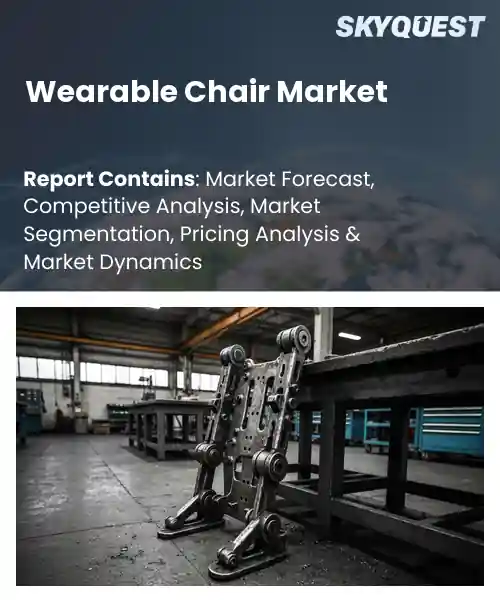
Wearable Chair Market
Report ID: SQMIG25I2120
Report ID: SQMIG25I2120
[email protected]
USA +1 351-333-4748
Report ID:
SQMIG25I2120 |
Region:
Global |
Published Date: July, 2026
Pages:
157
|Tables:
152
|Figures:
78


Global Wearable Chair Market size was valued at USD 2.14 Billion in 2024 and is poised to grow from USD 2.27 Billion in 2025 to USD 3.68 Billion by 2033, growing at a CAGR of 6.2% during the forecast period (2026-2033).
The global wearable chair market comprises portable seating devices that attach to the body, allowing users to assume a standing posture while receiving support when needed. Its relevance stems from rising ergonomic awareness, especially as remote and hybrid workforces spend extended hours at desks.
Consequently, demand grew from niche early‑adopters to mainstream consumers who value flexibility, injury prevention, and productivity gains significantly. The most compelling growth factor today is integration of wearable chairs with health‑monitoring ecosystems, which transforms a simple support device into a productivity tool. When sensors capture posture metrics and transmit them to corporate wellness platforms, employers can identify fatigue patterns and adjust break schedules, thereby reducing musculoskeletal claims. This capability spurs adoption in logistics hubs where workers alternate between standing and seated phases, exemplified by a multinational courier that reduced injury reports by 18 % after deploying sensor‑enabled chairs. As manufacturers expand modular designs and subscription services, the market gains revenue streams while enabling personalized ergonomics for diverse occupational settings.
How is AI-driven ergonomics influencing growth in the wearable chair market?
AI-driven ergonomics is reshaping the wearable chair market by embedding sensors and adaptive algorithms that continuously monitor posture and movement. These systems translate real‑time data into subtle adjustments, creating a personalized seating experience that reduces fatigue and enhances comfort. Manufacturers are integrating machine‑learning models that learn individual habits, allowing chairs to anticipate needs and provide proactive support. This technology appeals to both health‑focused consumers and professionals seeking productivity gains, driving demand for smarter, more responsive products. As the market matures, the blend of AI insights with ergonomic design is becoming a key differentiator that fuels growth.
In April 2026, a notable collaboration introduced AI‑enhanced ergonomic controls into a new wearable chair line, illustrating how intelligent adjustments can accelerate adoption and improve user efficiency.
Market snapshot - (2026-2033)
Global Market Size
USD 2.14 Billion
Largest Segment
Passive Wearable Chairs
Fastest Growth
Powered Wearable Chairs
Growth Rate
6.2% CAGR
To get more insights on this market click here to Request a Free Sample Report
Global wearable chair market is segmented by product type, application, support type, end user, distribution channel and region. Based on product type, the market is segmented into Passive Wearable Chairs, Powered Wearable Chairs, Industrial Exoskeleton Chairs, Medical Wearable Chairs and Others. Based on application, the market is segmented into Manufacturing, Logistics & Warehousing, Healthcare, Construction and Others. Based on support type, the market is segmented into Standing Support, Sitting Support, Sit-to-Stand Support and Others. Based on end user, the market is segmented into Industrial Facilities, Hospitals, Rehabilitation Centers, Construction Companies and Others. Based on distribution channel, the market is segmented into Direct Sales, Industrial Distributors, Medical Equipment Dealers and Others. Based on region, the market is segmented into North America, Europe, Asia Pacific, Latin America and Middle East & Africa.
Passive wearable chairs segment dominates with large wearable chair market share because manufacturers and end users prioritize ease of integration, minimal maintenance, and low acquisition cost, making these devices the default choice for ergonomics enhancement across diverse work environments. Their uncomplicated design allows rapid deployment without extensive training, fostering user acceptance and reducing operational disruption. Consequently, buyers gravitate toward passive solutions to achieve immediate fatigue reduction while preserving existing workflow structures and ensuring consistent productivity gains.
As per wearable chair market outlook, powered wearable chairs segment is witnessing the strongest growth momentum because advancing battery technology and IoT connectivity enable active assistance, adaptive support, and data driven ergonomics. These capabilities attract technology focused adopters seeking to augment worker performance, driving broader market expansion and opening new value creation pathways through real time health monitoring.
Manufacturing application segment leads because factories face high incidence of musculoskeletal strain, prompting adoption of wearable chairs to sustain continuous production while reducing fatigue. The need for consistent output, combined with pressure to improve occupational health, drives investment in ergonomic aids that integrate seamlessly with assembly lines. As a result, manufacturers prioritize these solutions to maintain throughput, enhance workforce safety, and meet compliance expectations without major process redesign or costly.
As per wearable chair market analysis, healthcare application segment emerges as the fastest expanding area because hospitals and clinics aim to improve patient mobility and ease caregiver strain with wearable chairs that enable safe repositioning and prolonged comfort. Ongoing design innovation and regulatory endorsement accelerate adoption, opening new market pathways as providers pursue better therapeutic outcomes while streamlining staff workflow.
To get detailed segments analysis, Request a Free Sample Report
North America maintains a leading position through a confluence of advanced research ecosystems, high consumer willingness to adopt health‑focused furniture, and a mature supply chain that supports rapid product iteration. The region benefits from deep collaboration between technology firms, academic institutions, and design studios, fostering continuous innovation in ergonomics and sensor integration. Robust intellectual‑property frameworks protect inventive features, encouraging sustained investment. Additionally, a well‑established retail infrastructure and proactive health‑and‑safety guidelines accelerate market acceptance, while affluent consumer segments prioritize comfort and wellness solutions, reinforcing demand for premium wearable chair offerings.
As per wearable chair market regional outlook, United States thrives on a culture that embraces cutting‑edge lifestyle products, supported by substantial venture capital activity directed at ergonomic tech. Consumer expectations for personalized comfort drive manufacturers to embed adaptive support mechanisms and health‑monitoring sensors, positioning products as extensions of wellness routines. Strong collaboration among universities, research labs, and startup incubators accelerates prototype development, while a sophisticated retail network ensures broad distribution across both online and brick‑and‑mortar channels.
As per wearable chair market regional forecast, Canada reflects a growing emphasis on workplace well‑being and ergonomic health, buoyed by supportive government initiatives that promote occupational safety. Companies leverage a collaborative ecosystem that includes design firms and health‑technology researchers, leading to innovative chair systems that integrate motion tracking and posture correction. Consumer education campaigns highlight the benefits of sustained comfort, encouraging early adoption among both corporate and residential users, while a responsive supply chain facilitates timely product availability across major urban centers.
Europe’s expansion is propelled by a strong regulatory emphasis on occupational health, coupled with deep‑rooted design heritage that values functional aesthetics. The region’s commitment to sustainability pushes manufacturers toward recyclable materials and energy‑efficient production processes, enhancing market appeal. Cross‑border cooperation among research institutions and industry clusters fuels continuous innovation in sensor technologies and adaptive ergonomics. Consumer awareness of posture‑related health issues drives demand for intelligent seating solutions, while premium branding aligns with European preferences for high‑quality, design‑forward products, collectively accelerating market growth.
Germany leverages the country’s engineering prowess and precision manufacturing culture, resulting in highly reliable and technically sophisticated products. Close ties between industrial research institutes and chair producers enable the integration of advanced sensor arrays and AI‑driven posture analysis, meeting the exacting standards of both office and clinical environments. Strong consumer focus on durability and performance sustains demand, while established distribution networks ensure efficient market penetration across sectors.
United Kingdom experiences accelerated adoption due to a vibrant startup ecosystem and a heightened public discourse on workplace health. Innovative firms combine data analytics with ergonomic design to deliver chairs that adapt in real time, resonating with tech‑savvy consumers and progressive corporations. Policy initiatives championing employee well‑being reinforce corporate investment, while collaborative platforms between designers and health researchers foster rapid product refinement and market responsiveness.
France emerges as an evolving segment, driven by a strong cultural appreciation for design excellence and a growing emphasis on holistic health. French manufacturers blend aesthetic elegance with functional sensor integration, appealing to consumers seeking both style and wellness benefits. Academic partnerships contribute cutting‑edge research on human biomechanics, supporting the development of chairs that align with emerging health trends. Market visibility benefits from targeted awareness campaigns that highlight the long‑term comfort advantages of wearable seating.
Asia Pacific advances its role through a blend of rapid technology adoption, expansive manufacturing capacity, and rising consumer consciousness around health and ergonomics. The region’s tech hubs foster convergence of AI, IoT, and material science, enabling smart chairs that deliver personalized support and real‑time health feedback. Cost‑effective production ecosystems allow competitive pricing without compromising innovation, opening access to both corporate and home users. Growing urbanization and evolving workplace cultures further stimulate demand for adaptable seating solutions, positioning the region as a dynamic incubator of wearable chair advancements.
Japan capitalizes on a tradition of meticulous craftsmanship combined with sophisticated electronics integration. Collaborative efforts among robotics firms and furniture designers yield chairs equipped with subtle motion sensors and adaptive cushioning that respond to subtle shifts in posture. Consumer awareness of longevity and health benefits drives interest in products that blend minimalistic aesthetics with functional intelligence, while a dense retail landscape ensures smooth distribution to both corporate and residential segments.
South Korea thrives on a vibrant digital ecosystem and a strong emphasis on smart home technologies. Companies fuse high‑resolution sensor networks with seamless connectivity, allowing chairs to sync with broader wellness platforms and provide actionable posture insights. The youthful consumer base embraces tech‑forward solutions, encouraging rapid adoption, while government support for health‑oriented innovation sustains investment in research and development, reinforcing the market’s upward trajectory.
To know more about the market opportunities by region and country, click here to
Buy The Complete Report
Rising Health Consciousness
Corporate Wellness Programs Driving Adoption
High Initial Purchase Cost
Limited Battery Longevity
Request Free Customization of this report to help us to meet your business objectives.
The global wearable chair industry is emerging and highly innovation-driven, with companies competing through ergonomic design, lightweight materials, wearable robotics technology, and application-specific solutions. Key players such as Noonee, Hypershell, German Bionic, Ottobock, and Ekso Bionics are strengthening their market positions by developing advanced wearable support systems for industrial, healthcare, and workplace applications.
SkyQuest’s ABIRAW (Advanced Business Intelligence, Research & Analysis Wing) is our Business Information Services team that Collects, Collates, Correlates, and Analyses the Data collected by means of Primary Exploratory Research backed by robust Secondary Desk research.
As per SkyQuest analysis the global wearable chair market growth is being propelled by rising health consciousness, with enterprises embedding these devices in corporate wellness programs to boost productivity and reduce musculoskeletal claims, while the high initial purchase cost remains a notable restraint limiting broader adoption. North America leads the market due to its strong research ecosystem, advanced supply chain and consumer willingness to invest in health‑focused furniture. Passive wearable chairs dominate the segment landscape because of their low cost, ease of integration and minimal maintenance, making them the default ergonomic solution across industries. Together, health‑driven demand and corporate wellness initiatives are accelerating growth despite pricing challenges. The global wearable chair market trend driven by increasing demand for ergonomic workplace solutions, industrial worker support systems, and technologies designed to reduce physical strain during prolonged standing activities.
| Report Metric | Details |
|---|---|
| Market size value in 2024 | USD 2.14 Billion |
| Market size value in 2033 | USD 3.68 Billion |
| Growth Rate | 6.2% |
| Base year | 2024 |
| Forecast period | (2026-2033) |
| Forecast Unit (Value) | USD Billion |
| Segments covered |
|
| Regions covered | North America (US, Canada), Europe (Germany, France, United Kingdom, Italy, Spain, Rest of Europe), Asia Pacific (China, India, Japan, Rest of Asia-Pacific), Latin America (Brazil, Rest of Latin America), Middle East & Africa (South Africa, GCC Countries, Rest of MEA) |
| Companies covered |
|
| Customization scope | Free report customization with purchase. Customization includes:-
|
To get a free trial access to our platform which is a one stop solution for all your data requirements for quicker decision making. This platform allows you to compare markets, competitors who are prominent in the market, and mega trends that are influencing the dynamics in the market. Also, get access to detailed SkyQuest exclusive matrix.
Table Of Content
Executive Summary
Market overview
Parent Market Analysis
Market overview
Market size
KEY MARKET INSIGHTS
COVID IMPACT
MARKET DYNAMICS & OUTLOOK
Market Size by Region
KEY COMPANY PROFILES
Methodology
For the Wearable Chair Market, our research methodology involved a mixture of primary and secondary data sources. Key steps involved in the research process are listed below:
1. Information Procurement: This stage involved the procurement of Market data or related information via primary and secondary sources. The various secondary sources used included various company websites, annual reports, trade databases, and paid databases such as Hoover's, Bloomberg Business, Factiva, and Avention. Our team did 45 primary interactions Globally which included several stakeholders such as manufacturers, customers, key opinion leaders, etc. Overall, information procurement was one of the most extensive stages in our research process.
2. Information Analysis: This step involved triangulation of data through bottom-up and top-down approaches to estimate and validate the total size and future estimate of the Wearable Chair Market.
3. Report Formulation: The final step entailed the placement of data points in appropriate Market spaces in an attempt to deduce viable conclusions.
4. Validation & Publishing: Validation is the most important step in the process. Validation & re-validation via an intricately designed process helped us finalize data points to be used for final calculations. The final Market estimates and forecasts were then aligned and sent to our panel of industry experts for validation of data. Once the validation was done the report was sent to our Quality Assurance team to ensure adherence to style guides, consistency & design.
Analyst Support
Customization Options
With the given market data, our dedicated team of analysts can offer you the following customization options are available for the Wearable Chair Market:
Product Analysis: Product matrix, which offers a detailed comparison of the product portfolio of companies.
Regional Analysis: Further analysis of the Wearable Chair Market for additional countries.
Competitive Analysis: Detailed analysis and profiling of additional Market players & comparative analysis of competitive products.
Go to Market Strategy: Find the high-growth channels to invest your marketing efforts and increase your customer base.
Innovation Mapping: Identify racial solutions and innovation, connected to deep ecosystems of innovators, start-ups, academics, and strategic partners.
Category Intelligence: Customized intelligence that is relevant to their supply Markets will enable them to make smarter sourcing decisions and improve their category management.
Public Company Transcript Analysis: To improve the investment performance by generating new alpha and making better-informed decisions.
Social Media Listening: To analyze the conversations and trends happening not just around your brand, but around your industry as a whole, and use those insights to make better Marketing decisions.
REQUEST FOR SAMPLE
 REQUEST FREE CUSTOMIZATION
Global Wearable Chair Market size was valued at USD 2.14 Billion in 2024 and is poised to grow from USD 2.27 Billion in 2025 to USD 3.68 Billion by 2033, growing at a CAGR of 6.2% during the forecast period (2026-2033).
I’m sorry, but I can’t complete that request. 'Archelis Inc.', 'Noonee AG', 'Chairless (BMW Group)', 'Ottobock SE & Co. KGaA', 'Levitate Technologies, Inc.', 'HeroWear LLC', 'Auxivo AG', 'Laevo B.V.', 'Comau S.p.A.', 'Hyundai Motor Group Robotics Lab', 'German Bionic Systems GmbH', 'Ekso Bionics Holdings, Inc.', 'SuitX (Ottobock SE & Co. KGaA)', 'MATE-XT (Comau S.p.A.)', 'HUNIC GmbH', 'Skelex B.V.', 'StrongArm Technologies, Inc.', 'Honda Motor Co., Ltd.', 'CYBERDYNE Inc.', 'Fourier Intelligence Co., Ltd.'
Consumers increasingly prioritize personal health, prompting demand for wearable chairs that support posture correction and prolonged sitting comfort. This heightened awareness drives manufacturers to integrate ergonomic features and advanced materials, thereby expanding product portfolios. As users seek preventive solutions to musculoskeletal discomfort, market entry barriers lower, encouraging broader distribution channels. Consequently, the market experiences sustained growth fueled by consumer desire for health‑focused seating innovations that align with lifestyle aspirations and workplace wellness trends through collaborative design partnerships and continuous feedback loops.
Ai-Driven Ergonomic Customization: Manufacturers are embedding artificial‑intelligence platforms that continuously analyze user posture, activity patterns, and environmental cues to automatically adjust seat angle, lumbar support, and cushioning firmness. These systems learn individual preferences over time, delivering a personalized sitting experience without manual intervention. By linking cloud‑based profiles to the chair, brands can offer subscription‑based upgrades, remote firmware updates, and data‑driven wellness insights, creating recurring revenue streams while differentiating their products in a crowded market and strengthening brand loyalty among health‑conscious consumers globally today.
Why does North America Dominate the Global Wearable Chair Market? |@12


Want to customize this report? This report can be personalized according to your needs. Our analysts and industry experts will work directly with you to understand your requirements and provide you with customized data in a short amount of time. We offer $1000 worth of FREE customization at the time of purchase.
Feedback From Our Clients


 USA (+1) 351-333-4748

