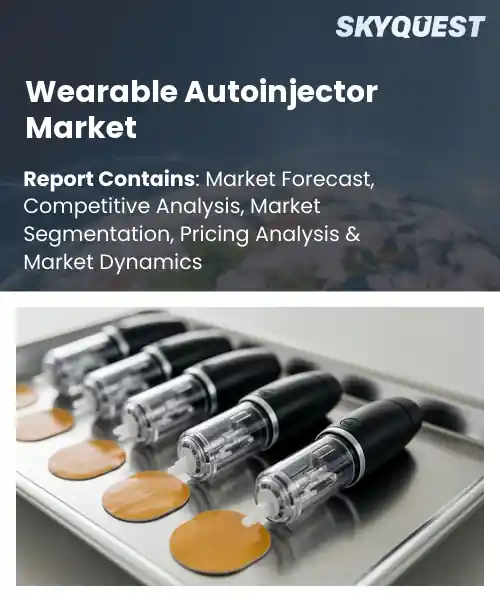
Wearable Autoinjector Market
Report ID: SQMIG35A3201
Report ID: SQMIG35A3201
[email protected]
USA +1 351-333-4748
Report ID:
SQMIG35A3201 |
Region:
Global |
Published Date: February, 2026
Pages:
157
|Tables:
259
|Figures:
82


Global Wearable Autoinjector Market size was valued at USD 9.2 Billion in 2024 and is poised to grow from USD 10.25 Billion in 2025 to USD 24.31 Billion by 2033, growing at a CAGR of 11.4% during the forecast period (2026-2033).
Rapid shifts in treatment paradigms are the primary driver of the wearable autoinjector market because biologic therapies and chronic conditions demand frequent subcutaneous dosing outside clinical settings. The market comprises on body patchlike devices that deliver controlled doses of medications such as biologics and high volume formulations while capturing usage data and simplifying administration for patients. This segment matters because it reduces dosing errors, improves adherence, and shifts care from hospitals to homes, lowering costs. Over past decade the field evolved from manual syringes and pens to integrated electronic wearables developed by device firms and pharma partnerships, illustrated by collaborations.Building on those collaborations, payers increasingly favor wearable autoinjectors because health systems prioritize reducing hospital visits and real time data capture. This demand drives investment in device and pharma co development and standards for connectivity, which in turn accelerates product approvals and commercial scale. For example patients with rheumatoid arthritis who previously needed clinic infusions can self administer biologics at home, resulting in fewer missed doses and lower total cost of care. As manufacturers iterate on higher volume delivery and user ergonomics they unlock opportunities for chronic indications and oncology supportive therapies, creating recurring revenue models and expanded market access.
How is IoT enhancing patient adherence in the wearable autoinjector market?
Internet of Things enhances patient adherence in the wearable autoinjector market by linking device sensors, mobile apps and cloud analytics to daily therapy routines. Key aspects include automated reminders, real time injection confirmation, step by step guidance and secure data sharing with clinicians. The current market is shifting from standalone mechanical devices toward connected therapy ecosystems that reduce user uncertainty and support self confidence. These systems encourage persistence by making dosing visible to patients and care teams and by enabling timely interventions when doses are missed. Real world device programs report improved patient satisfaction when apps and clinician dashboards are part of the solution.Ypsomed September 2025, the company received FDA clearance for SmartPilot which converts the YpsoMate into a connected system with automatic dose logging and clinician dashboards, supporting adherence by simplifying reminders, enabling remote follow up and smoothing commercial adoption of wearable autoinjector therapies.
Market snapshot - (2026-2033)
Global Market Size
USD 9.2 Billion
Largest Segment
On-body Wearable Injectors
Fastest Growth
Off-body Wearable Injectors
Growth Rate
11.4% CAGR
To get more insights on this market click here to Request a Free Sample Report
Global wearable autoinjector market is segmented by product type, usage, volume capacity, technology, type of molecule delivered, route of administration, application, end user, distribution channel and region. Based on product type, the market is segmented into On-body Wearable Injectors and Off-body Wearable Injectors. Based on usage, the market is segmented into Disposable Wearable Autoinjectors and Reusable Wearable Autoinjectors. Based on volume capacity, the market is segmented into Up to 5 mL, 5 mL – 10 mL and Above 10 mL. Based on technology, the market is segmented into Spring-based, Motor-driven, Rotary pump, Expanding battery and Other. Based on type of molecule delivered, the market is segmented into Antibodies, Peptides, Proteins, Small Molecules and Others. Based on route of administration, the market is segmented into Intramuscular, Intravenous and Subcutaneous. Based on application, the market is segmented into Oncology, Diabetes, Autoimmune Diseases, Cardiovascular Diseases, Pain Management, Infectious Diseases and Other Therapeutic Applications. Based on end user, the market is segmented into Hospitals, Clinics, Ambulatory Surgical Centers and Home Care Settings. Based on distribution channel, the market is segmented into Hospital Pharmacies, Retail Pharmacies and Online Pharmacies. Based on region, the market is segmented into North America, Europe, Asia Pacific, Latin America and Middle East & Africa.
On-body Wearable Injectors segment dominates because their integrated, patient-attached design directly addresses adherence and convenience by enabling hands-free, discreet administration that fits daily life. This form factor reduces clinic visits and supports continuous or extended dosing profiles, encouraging pharma adoption. Close integration with sensors and connectivity enables real-time monitoring and remote care workflows, driving payer and provider acceptance and reinforcing their lead in home-focused therapy models.
However, Off-body Wearable Injectors are emerging as the most rapidly expanding area, driven by modular reservoir and pump architectures that support larger volumes and easier device servicing. Their detachment from the patient supports sterility management and flexible placement, appealing to therapies requiring higher payloads or multi-day dosing. Ongoing innovation in docking interfaces and usability is accelerating adoption across broader therapeutic indications and commercial partnerships.
Motor-driven segment leads because motorized actuation delivers fine-grained, programmable control over flow rates and pressure, enabling accurate delivery of viscous biologics and complex infusion profiles. This precision supports clinically demanding molecules and variable dosing regimens while enabling closed-loop features with sensor feedback. The predictable performance and data logging build regulatory confidence and foster collaboration with biopharma developers pursuing reliable home-administered delivery for advanced therapies.
Conversely, Expanding battery technology is witnessing the fastest growth as it enables ultra-thin, lightweight wearable platforms with extended operational life and consistent power output. Advances in materials and energy density reduce device bulk and improve patient comfort, unlocking new form factors and prolonged infusion capabilities. Regulatory progress and investor interest in compact power solutions are accelerating product development and creating opportunities for next-generation wearable autoinjectors.
To get detailed segments analysis, Request a Free Sample Report
North America dominates the global wearable autoinjector market because of a strong convergence of advanced healthcare infrastructure, concentrated industry presence, and a supportive innovation ecosystem. The region benefits from mature clinical research networks, experienced manufacturing capabilities, and close collaboration between device developers and biopharmaceutical companies. Reimbursement frameworks and care delivery models in many settings favor adoption of adherence enhancing technologies, while regulatory emphases on safety and human factors encourage robust product design. High levels of provider and patient familiarity with connected health solutions, combined with extensive distribution and service networks, enable rapid commercialization and sustained post market support, reinforcing North America as the primary hub for novel wearable delivery solutions. Ongoing investments in digital health integration and user centered design continue to differentiate offerings across the region.
Wearable Autoinjector Market in United States is driven by a dense ecosystem of medical device developers, biopharma collaboration opportunities, and adoption across care settings. Emphasis on human factors engineering, integration with digital adherence platforms, and strong post market support enhances clinician and patient confidence. Reimbursement frameworks and private payer engagement encourage novel delivery solutions, while commercialization expertise and distribution channels support rapid product rollout and lifecycle management across care environments.
Wearable Autoinjector Market in Canada benefits from coordinated public health systems, procurement structures, and clinician networks support technology adoption. Focus on patient centric care models and remote monitoring creates opportunities for devices that simplify self administration and enhance adherence. Collaboration between local innovators and international manufacturers fosters tailored solutions for important therapeutic areas. Strong emphasis on safety evaluation and user training programs supports confident uptake among healthcare providers and communities.
Rapid expansion in Europe is being driven by harmonized regulatory standards, strong clinical stakeholder engagement, and targeted investment in patient centered care pathways that emphasize home based therapy and adherence support. National health systems and payer dialogues across markets are increasingly receptive to technologies that demonstrate improved convenience and care continuity, while local manufacturing and collaborative innovation enable customization to diverse reimbursement environments. Germany acts as a technical and commercial anchor, supporting rigorous device development and validation, while markets such as United Kingdom demonstrate significant momentum and France shows emerging adoption in niche segments. Cross border pilot programs and structured payer engagement validate real world benefits and inform procurement strategies, with strong provider education and patient advocacy reinforcing confidence among decision makers.
Wearable Autoinjector Market Germany leverages a strong engineering base, clinical trial infrastructure, and close industry academia collaboration to advance device innovation. Emphasis on manufacturing excellence, safety evaluation, and integration with healthcare IT supports product development. Payer engagement tends to reward demonstrable improvements in adherence and outcomes, encouraging adoption in chronic therapy areas. Strategic partnerships with multinational firms enable scalable commercialization, while regional procurement programs facilitate deployments and clinician validation initiatives.
Wearable Autoinjector Market United Kingdom is characterized by adoption of patient centric technologies, payer experimentation, and strong clinical leadership in care settings. Emphasis on digital integration and remote monitoring supports home based therapy management and adherence strategies. Collaborations with health service providers and academic centers accelerate evidence generation. Flexible procurement approaches and programs enable innovators to demonstrate value, while a vibrant medtech sector fosters refinement of device features and services.
Wearable Autoinjector Market France is emerging through interest in patient friendly delivery and support for chronic therapies. National health authorities and care networks engage in initiatives prioritizing safety, training, and integration with care pathways. Local device makers collaborate with clinical centers to adapt ergonomic designs and user interfaces to patient needs. Emphasis on equitable access and robust evaluation fosters cautious adoption, creating opportunities for niche therapeutic applications and service models.
Asia Pacific is strengthening its position through advanced manufacturing capabilities, regulatory modernization, and growing investment in medtech innovation that supports regional competitiveness. Markets such as Japan and South Korea offer engineering talent and precision production that enable high quality device fabrication and customization. Local firms increasingly partner with global biopharma to co develop regionally tailored solutions and embed digital adherence and connectivity features. Health systems are exploring remote care models that increase demand for user friendly interoperable delivery devices. Government supported innovation programs and export oriented value chains bolster competitive positioning, while expanding clinical research capacity enables robust real world evaluation and broader market acceptance across the region.
Wearable Autoinjector Market Japan benefits from advanced precision engineering, a strong medtech manufacturing base, and strong quality control. Collaboration between device developers and academic research centers fosters design improvements focused on ergonomics and user safety. Healthcare providers emphasize integrated care models and technology that supports home administration. Local firms pursue partnerships with international biopharma to adapt devices to clinical needs, while supply chain strengths enable reliable production and customization capabilities.
Wearable Autoinjector Market South Korea draws strength from technology ecosystem, strong electronics and precision manufacturing, and startup innovation. Collaborative clusters bring together device engineers, software developers, and clinical partners to accelerate delivery solutions. Health providers and technology firms are piloting monitoring integrations that align with value based care models. International partnerships and export oriented ambitions support scaling, while regulatory engagement fosters pathways for evaluation and market entry across regional markets.
To know more about the market opportunities by region and country, click here to
Buy The Complete Report
Rising Prevalence Of Chronic Diseases
Advancements In Sensor and Connectivity
Stringent Regulatory Approval Requirements
Limited Reimbursement and High Costs
Request Free Customization of this report to help us to meet your business objectives.
The competitive landscape of the global wearable autoinjector market is defined by platform partnerships, contract manufacturing alliances, and rapid device platform launches that accelerate commercialization. Competition is driven by firms securing supply chain readiness and platform compatibility rather than price alone. Examples include BD’s collaboration with ten23 health to scale the Libertas platform and Jabil’s contract manufacturing agreement to produce TxSphere’s reusable on body injectors.
Top Player’s Company Profile
Recent Developments
SkyQuest’s ABIRAW (Advanced Business Intelligence, Research & Analysis Wing) is our Business Information Services team that Collects, Collates, Correlates, and Analyses the Data collected by means of Primary Exploratory Research backed by robust Secondary Desk research. As per SkyQuest analysis, the global wearable autoinjector market is driven primarily by the rising prevalence of chronic diseases, which increases demand for convenient home-based biologic delivery, and a second major driver is rapid advancements in sensor and connectivity that enable adherence monitoring and remote care. A key restraint remains stringent regulatory approval requirements that can delay product introductions and raise development costs. North America currently dominates the market due to strong innovation ecosystems, reimbursement frameworks and established commercialization channels, while the on-body wearable injectors segment leads because their patient-attached, hands-free designs improve adherence and enable continuous, extended dosing outside clinical settings.
| Report Metric | Details |
|---|---|
| Market size value in 2024 | USD 9.2 Billion |
| Market size value in 2033 | USD 24.31 Billion |
| Growth Rate | 11.4% |
| Base year | 2024 |
| Forecast period | (2026-2033) |
| Forecast Unit (Value) | USD Billion |
| Segments covered |
|
| Regions covered | North America (US, Canada), Europe (Germany, France, United Kingdom, Italy, Spain, Rest of Europe), Asia Pacific (China, India, Japan, Rest of Asia-Pacific), Latin America (Brazil, Rest of Latin America), Middle East & Africa (South Africa, GCC Countries, Rest of MEA) |
| Companies covered |
|
| Customization scope | Free report customization with purchase. Customization includes:-
|
To get a free trial access to our platform which is a one stop solution for all your data requirements for quicker decision making. This platform allows you to compare markets, competitors who are prominent in the market, and mega trends that are influencing the dynamics in the market. Also, get access to detailed SkyQuest exclusive matrix.
Table Of Content
Executive Summary
Market overview
Parent Market Analysis
Market overview
Market size
KEY MARKET INSIGHTS
COVID IMPACT
MARKET DYNAMICS & OUTLOOK
Market Size by Region
KEY COMPANY PROFILES
Methodology
For the Wearable Autoinjector Market, our research methodology involved a mixture of primary and secondary data sources. Key steps involved in the research process are listed below:
1. Information Procurement: This stage involved the procurement of Market data or related information via primary and secondary sources. The various secondary sources used included various company websites, annual reports, trade databases, and paid databases such as Hoover's, Bloomberg Business, Factiva, and Avention. Our team did 45 primary interactions Globally which included several stakeholders such as manufacturers, customers, key opinion leaders, etc. Overall, information procurement was one of the most extensive stages in our research process.
2. Information Analysis: This step involved triangulation of data through bottom-up and top-down approaches to estimate and validate the total size and future estimate of the Wearable Autoinjector Market.
3. Report Formulation: The final step entailed the placement of data points in appropriate Market spaces in an attempt to deduce viable conclusions.
4. Validation & Publishing: Validation is the most important step in the process. Validation & re-validation via an intricately designed process helped us finalize data points to be used for final calculations. The final Market estimates and forecasts were then aligned and sent to our panel of industry experts for validation of data. Once the validation was done the report was sent to our Quality Assurance team to ensure adherence to style guides, consistency & design.
Analyst Support
Customization Options
With the given market data, our dedicated team of analysts can offer you the following customization options are available for the Wearable Autoinjector Market:
Product Analysis: Product matrix, which offers a detailed comparison of the product portfolio of companies.
Regional Analysis: Further analysis of the Wearable Autoinjector Market for additional countries.
Competitive Analysis: Detailed analysis and profiling of additional Market players & comparative analysis of competitive products.
Go to Market Strategy: Find the high-growth channels to invest your marketing efforts and increase your customer base.
Innovation Mapping: Identify racial solutions and innovation, connected to deep ecosystems of innovators, start-ups, academics, and strategic partners.
Category Intelligence: Customized intelligence that is relevant to their supply Markets will enable them to make smarter sourcing decisions and improve their category management.
Public Company Transcript Analysis: To improve the investment performance by generating new alpha and making better-informed decisions.
Social Media Listening: To analyze the conversations and trends happening not just around your brand, but around your industry as a whole, and use those insights to make better Marketing decisions.
REQUEST FOR SAMPLE
 REQUEST FREE CUSTOMIZATION


Want to customize this report? This report can be personalized according to your needs. Our analysts and industry experts will work directly with you to understand your requirements and provide you with customized data in a short amount of time. We offer $1000 worth of FREE customization at the time of purchase.
Feedback From Our Clients


 USA (+1) 351-333-4748

