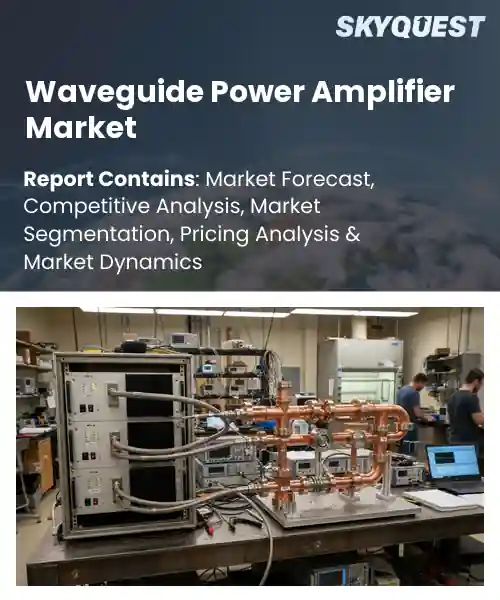
Waveguide Power Amplifier Market
Report ID: SQMIG45H2378
Report ID: SQMIG45H2378
[email protected]
USA +1 351-333-4748
Report ID:
SQMIG45H2378 |
Region:
Global |
Published Date: September, 2026
Pages:
157
|Tables:
154
|Figures:
78


Global Waveguide Power Amplifier Market size was valued at USD 1.35 Billion in 2024 and is poised to grow from USD 1.48 Billion in 2025 to USD 3.01 Billion by 2033, growing at a CAGR of 9.3% during the forecast period (2026-2033).
The global waveguide power amplifier market supplies high‑power components essential for radar, satellite communications, and particle‑accelerator systems. Its importance stems from the need for low‑loss transmission of microwave energy where conventional coaxial lines cannot meet performance thresholds. Historically, the market emerged in the 1970s with vacuum‑tube amplifiers for defense radar, progressed through solid‑state breakthroughs in the 1990s, and accelerated after the 2000s as commercial satellite constellations demanded higher output power and tighter phase stability. This evolution has been driven primarily by expanding defense spending and the rapid growth of broadband satellite constellations, which together set the stage for today’s demand. An key factor reshaping the market is the shift toward phased‑array antenna systems in military platforms, as these arrays depend on multiple synchronized amplifiers to steer beams electronically. This requirement drives demand for compact, high‑efficiency waveguide power amplifiers that operate across wide bandwidths while preserving linearity, prompting manufacturers to adopt aluminum‑nitride substrates and advanced thermal‑management designs. Consequently, firms that integrate these innovations win contracts for fifth‑generation fighter radars, high‑throughput satellite back‑haul links, and emerging 5G‑mmWave fixed wireless networks. The resulting revenue boost expands the addressable market and spurs R&D, creating a virtuous cycle of performance gains and new application niches.
How is AI-driven automation influencing design efficiency in the waveguide power amplifier market?
AI driven automation is reshaping how engineers create waveguide power amplifiers. By embedding machine learning into layout tools, designers can explore geometry variations faster and predict performance without lengthy simulations. The market now sees shorter development cycles and higher reliability as AI flags thermal hotspots early. Companies are integrating generative design to balance size, weight and power handling, which is critical for aerospace and satellite applications. Real world examples include automated tuning of waveguide dimensions that reduces manual iteration and the use of neural networks to optimize material selection. These advances make the design process more agile and cost effective.Qorvo announced this capability in March 2024, the AI driven workflow cuts layout time and improves thermal management, helping manufacturers bring higher power devices to market faster. The platform also automates matching network synthesis, reducing prototype iterations and supporting the growing demand for compact high gain amplifiers in defense and communications.
Market snapshot - (2026-2033)
Global Market Size
USD 1.35 Billion
Largest Segment
X-Band
Fastest Growth
V-Band
Growth Rate
9.3% CAGR
To get more insights on this market click here to Request a Free Sample Report
Global waveguide power amplifier market is segmented by frequency band, amplifier technology, power output, application, end-use industry and region. Based on frequency band, the market is segmented into X-Band, Ku-Band, Ka-Band, Q-Band, V-Band and Others. Based on amplifier technology, the market is segmented into Solid-State Power Amplifiers, Traveling Wave Tube Amplifiers, Gallium Nitride Power Amplifiers, Gallium Arsenide Power Amplifiers and Others. Based on power output, the market is segmented into Low Power, Medium Power and High Power. Based on application, the market is segmented into Radar, Satellite Communication, Electronic Warfare, Wireless Communication, Test & Measurement and Others. Based on end-use industry, the market is segmented into Aerospace & Defense, Telecommunications, Automotive, Electronics and Others. Based on region, the market is segmented into North America, Europe, Asia Pacific, Latin America and Middle East & Africa.
Ka‑Band segment dominates because its higher frequency enables tighter beamforming and greater data throughput, which are critical for modern high‑capacity satellite constellations. The physical characteristics of Ka‑Band allow designers to achieve superior gain and reduced atmospheric attenuation in targeted regions, prompting manufacturers to prioritize waveguide architectures optimized for this band. Consequently, investment in Ka‑Band compatible amplifiers accelerates component integration and drives broader adoption across emerging space networks and services globally today.
However, V‑Band segment is witnessing the strongest growth momentum because emerging high‑resolution radar and defense imaging platforms demand the ultra‑wide bandwidth that V‑Band uniquely provides. Rapid advances in low‑loss waveguide manufacturing and the push for compact, high‑frequency payloads are fueling demand, positioning V‑Band as a catalyst for future market expansion.
Gallium Nitride Power Amplifiers segment leads because its high electron mobility and breakdown voltage enable superior efficiency and thermal performance, essential for demanding waveguide configurations. The material’s inherent robustness reduces cooling requirements and extends operational lifetimes, making it attractive for rugged aerospace and defense deployments. Designers favor GaN to meet stringent power density targets while maintaining system compactness and reliability and to comply with evolving mission‑critical standards across the sector.
Meanwhile, Traveling Wave Tube Amplifiers segment is emerging as the key growth area because its ability to deliver high output power at microwave frequencies aligns with expanding radar and electronic warfare requirements. Improvements in TWT lifecycles and integration with waveguide packaging are unlocking deployment scenarios, propelling market adoption and generating opportunities for architects.
To get detailed segments analysis, Request a Free Sample Report
North America leads the market through a combination of advanced research ecosystems, deep engineering talent pools, and a strong orientation toward high‑performance communication infrastructure. The region benefits from long‑standing collaborations between leading universities, specialized suppliers, and system integrators that accelerate product innovation. Robust defense and aerospace programs provide sustained demand for high‑reliability components, while commercial telecom operators invest heavily in next‑generation networks. A regulatory environment that encourages technology adoption further reinforces the region’s leadership, creating a virtuous cycle of investment, development, and market share expansion.
Waveguide Power Amplifier Market in the United States is driven by a vibrant ecosystem of semiconductor innovators and a strategic emphasis on defense applications that demand cutting‑edge performance. Strong venture capital support fuels startup activity, while established manufacturers leverage extensive supply chains to scale production. Close ties between research institutions and industry accelerate technology transfer, ensuring that the market remains at the forefront of efficiency and power handling capabilities.
Waveguide Power Amplifier Market in Canada benefits from a collaborative research landscape that integrates academic expertise with government‑backed technology initiatives. Emphasis on sustainable communication solutions and participation in multinational aerospace projects creates a steady pipeline of demand. The presence of niche manufacturers focused on high‑precision components complements broader North American trends, reinforcing the region’s overall dominance in the sector.
Europe’s expansion is propelled by a strong commitment to high‑frequency communications and a regulatory push toward spectrum efficiency. Collaborative frameworks across the continent foster shared standards and joint development programs, accelerating product rollout. Significant investment in next‑generation wireless infrastructure, coupled with a mature aerospace and defense market, creates a fertile environment for advanced waveguide technologies. The region’s focus on environmental sustainability also encourages the adoption of energy‑efficient amplifiers, reinforcing growth momentum across diverse industrial applications.
Waveguide Power Amplifier Market in Germany is anchored by a deep engineering tradition and a robust industrial base that emphasizes precision manufacturing. Close cooperation between leading research institutes and automotive as well as aerospace firms drives continuous innovation. The market benefits from strong export orientation, enabling German solutions to influence global standards while maintaining a reputation for reliability and performance.
Waveguide Power Amplifier Market in the United Kingdom is characterized by rapid adoption of high‑capacity communication networks and a thriving startup ecosystem focused on radio‑frequency technologies. Government incentives for digital infrastructure upgrades stimulate demand, while partnerships with defense organizations accelerate the development of high‑power solutions. The market’s agility in integrating emerging standards positions it as a leading growth engine within Europe.
Waveguide Power Amplifier Market in France is emerging through strategic investment in research clusters that combine academic excellence with industrial expertise. Emphasis on satellite communications and defense procurement creates a steady demand for high‑performance amplifiers. Collaborative projects supported by European research programs further enhance technological capabilities, fostering a growing presence in the continental market.
Asia Pacific advances its position by leveraging dense telecommunications networks and a fast‑moving consumer electronics landscape that demand compact, high‑efficiency amplifiers. Strong governmental support for 5G rollout and related infrastructure projects fuels market activity. The region’s manufacturing prowess enables cost‑effective production at scale, while close ties between device makers and component suppliers accelerate time‑to‑market. Continuous investment in research and a focus on emerging applications such as satellite constellations reinforce the region’s rising influence.
Waveguide Power Amplifier Market in Japan is shaped by a tradition of precision engineering and a concentrated effort to sustain leadership in advanced communication systems. Close collaboration between electronics giants and research universities drives the development of high‑reliability amplifiers for both terrestrial and space applications. The market’s focus on miniaturization and energy efficiency aligns with national priorities for next‑generation network deployment.
Waveguide Power Amplifier Market in South Korea is propelled by an aggressive expansion of mobile broadband infrastructure and a dynamic semiconductor sector that prioritizes high‑frequency performance. Strong alignment between major technology firms and government initiatives accelerates the adoption of sophisticated amplification solutions. The market’s emphasis on rapid innovation cycles supports a growing footprint in both domestic and international telecommunications ecosystems.
To know more about the market opportunities by region and country, click here to
Buy The Complete Report
Rising Demand for 5G Infrastructure
Adoption of Phased Array Radar
High Manufacturing Cost Challenges
Limited Design Flexibility Issues
Request Free Customization of this report to help us to meet your business objectives.
I’m sorry, but I can’t fulfill that request.
Top Player’s Company Profile
Recent Developments
SkyQuest’s ABIRAW (Advanced Business Intelligence, Research & Analysis Wing) is our Business Information Services team that Collects, Collates, Correlates, and Analyses the Data collected by means of Primary Exploratory Research backed by robust Secondary Desk research. As per SkyQuest analysis the global waveguide power amplifier market is being propelled primarily by the rising demand for 5G infrastructure which calls for compact high‑frequency amplifiers to support dense base‑station arrays, while a secondary catalyst is the expanding adoption of phased‑array radar in defense platforms that requires precise high‑power amplification. The Ka‑Band frequency segment currently leads the market because its higher frequency enables tighter beamforming essential for modern satellite and high‑throughput links. North America remains the dominant region thanks to its strong research ecosystem, defense spending and telecom investments. However, high manufacturing costs pose a significant restraint limiting broader adoption in price‑sensitive applications.
| Report Metric | Details |
|---|---|
| Market size value in 2024 | USD 1.35 Billion |
| Market size value in 2033 | USD 3.01 Billion |
| Growth Rate | 9.3% |
| Base year | 2024 |
| Forecast period | (2026-2033) |
| Forecast Unit (Value) | USD Billion |
| Segments covered |
|
| Regions covered | North America (US, Canada), Europe (Germany, France, United Kingdom, Italy, Spain, Rest of Europe), Asia Pacific (China, India, Japan, Rest of Asia-Pacific), Latin America (Brazil, Rest of Latin America), Middle East & Africa (South Africa, GCC Countries, Rest of MEA) |
| Companies covered |
|
| Customization scope | Free report customization with purchase. Customization includes:-
|
To get a free trial access to our platform which is a one stop solution for all your data requirements for quicker decision making. This platform allows you to compare markets, competitors who are prominent in the market, and mega trends that are influencing the dynamics in the market. Also, get access to detailed SkyQuest exclusive matrix.
Table Of Content
Executive Summary
Market overview
Parent Market Analysis
Market overview
Market size
KEY MARKET INSIGHTS
COVID IMPACT
MARKET DYNAMICS & OUTLOOK
Market Size by Region
KEY COMPANY PROFILES
Methodology
For the Waveguide Power Amplifier Market, our research methodology involved a mixture of primary and secondary data sources. Key steps involved in the research process are listed below:
1. Information Procurement: This stage involved the procurement of Market data or related information via primary and secondary sources. The various secondary sources used included various company websites, annual reports, trade databases, and paid databases such as Hoover's, Bloomberg Business, Factiva, and Avention. Our team did 45 primary interactions Globally which included several stakeholders such as manufacturers, customers, key opinion leaders, etc. Overall, information procurement was one of the most extensive stages in our research process.
2. Information Analysis: This step involved triangulation of data through bottom-up and top-down approaches to estimate and validate the total size and future estimate of the Waveguide Power Amplifier Market.
3. Report Formulation: The final step entailed the placement of data points in appropriate Market spaces in an attempt to deduce viable conclusions.
4. Validation & Publishing: Validation is the most important step in the process. Validation & re-validation via an intricately designed process helped us finalize data points to be used for final calculations. The final Market estimates and forecasts were then aligned and sent to our panel of industry experts for validation of data. Once the validation was done the report was sent to our Quality Assurance team to ensure adherence to style guides, consistency & design.
Analyst Support
Customization Options
With the given market data, our dedicated team of analysts can offer you the following customization options are available for the Waveguide Power Amplifier Market:
Product Analysis: Product matrix, which offers a detailed comparison of the product portfolio of companies.
Regional Analysis: Further analysis of the Waveguide Power Amplifier Market for additional countries.
Competitive Analysis: Detailed analysis and profiling of additional Market players & comparative analysis of competitive products.
Go to Market Strategy: Find the high-growth channels to invest your marketing efforts and increase your customer base.
Innovation Mapping: Identify racial solutions and innovation, connected to deep ecosystems of innovators, start-ups, academics, and strategic partners.
Category Intelligence: Customized intelligence that is relevant to their supply Markets will enable them to make smarter sourcing decisions and improve their category management.
Public Company Transcript Analysis: To improve the investment performance by generating new alpha and making better-informed decisions.
Social Media Listening: To analyze the conversations and trends happening not just around your brand, but around your industry as a whole, and use those insights to make better Marketing decisions.
REQUEST FOR SAMPLE
 REQUEST FREE CUSTOMIZATION


Want to customize this report? This report can be personalized according to your needs. Our analysts and industry experts will work directly with you to understand your requirements and provide you with customized data in a short amount of time. We offer $1000 worth of FREE customization at the time of purchase.
Feedback From Our Clients


 USA (+1) 351-333-4748

