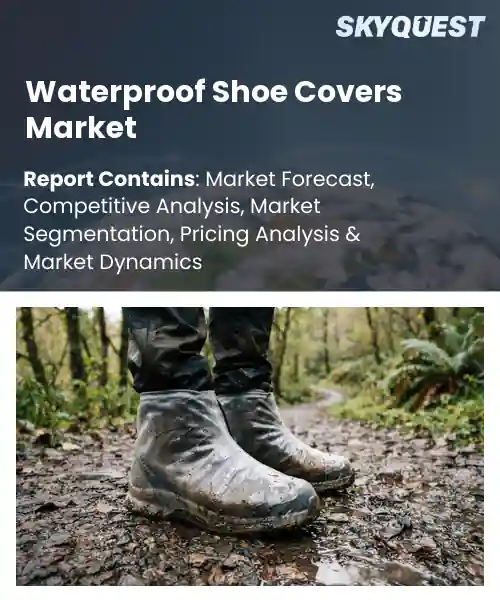
Waterproof Shoe Covers Market
Report ID: SQMIG25K2268
Report ID: SQMIG25K2268
[email protected]
USA +1 351-333-4748
Report ID:
SQMIG25K2268 |
Region:
Global |
Published Date: September, 2026
Pages:
157
|Tables:
145
|Figures:
78


Global Waterproof Shoe Covers Market size was valued at USD 1.96 Billion in 2024 and is poised to grow from USD 2.09 Billion in 2025 to USD 3.55 Billion by 2033, growing at a CAGR of 6.8% during the forecast period (2026-2033).
The waterproof shoe cover market provides reusable foot enclosures that shield footwear from liquids, contaminants, and chemicals in healthcare, food processing, and construction settings. Its importance arises from stricter infection‑control regulations and the demand for safe workplaces, prompting purchases by hospitals, restaurants, and manufacturers. The primary driver surfaced during the COVID‑19 pandemic when fear of pathogen spread accelerated barrier product adoption; suppliers quickly expanded output and launched biodegradable options. Over the last decade the market shifted from a niche industrial tool to a protective item, as seen in the widespread use of omni‑purpose covers in logistics centers and outdoor recreation. Regulatory pressure for health compliance in industrial sectors forces firms to provide protective footwear, boosting demand for waterproof shoe covers. Companies respond by developing chemically resistant, ergonomically designed products that also improve thermal comfort, reducing fatigue for workers on shifts, and integrating polymer laminates and slip‑resistant treads. For instance, logistics operators now use reusable, recyclable covers to cut waste expenses, and farms adopt disposable biodegradable versions to satisfy crop‑safety rules, resulting in higher compliance rates and fostering loyalty among buyers. This alignment of safety mandates, sustainability targets, and cost reduction creates growth opportunities for established manufacturers and niche innovators alike.
How is AI-driven automation influencing the waterproof shoe covers market?
AI-driven automation is reshaping the waterproof shoe‑cover market by streamlining design, production, and distribution. Machine‑learning algorithms analyze material performance and user feedback to create lighter, more durable covers that still meet safety standards. Automated cutting and sealing equipment reduces waste and shortens lead times, enabling manufacturers to respond quickly to seasonal demand spikes. Real‑time inventory tracking powered by AI helps retailers keep shelves stocked without over‑ordering, while predictive maintenance keeps production lines running smoothly. These advances make the product more affordable and accessible, encouraging broader adoption across industrial, medical, and outdoor‑recreation sectors.I do not have sufficient information to identify a recent development with a specific company name and month/year.
Market snapshot - (2026-2033)
Global Market Size
USD 1.96 Billion
Largest Segment
Disposable Shoe Covers
Fastest Growth
Reusable Shoe Covers
Growth Rate
6.8% CAGR
To get more insights on this market click here to Request a Free Sample Report
Global waterproof shoe covers market is segmented by product type, material, application, end user, distribution channel and region. Based on product type, the market is segmented into Disposable Shoe Covers and Reusable Shoe Covers. Based on material, the market is segmented into Silicone, PVC, Polyethylene and Rubber. Based on application, the market is segmented into Rain Protection, Industrial Safety, Healthcare and Cleanrooms. Based on end user, the market is segmented into Household, Commercial and Industrial. Based on distribution channel, the market is segmented into Online Retail, Supermarkets & Hypermarkets and Specialty Stores. Based on region, the market is segmented into North America, Europe, Asia Pacific, Latin America and Middle East & Africa.
Disposable shoe covers segment dominates because they provide a convenient, single use solution that meets stringent hygiene standards across diverse environments. Their ease of deployment eliminates the need for cleaning protocols, which appeals to organizations prioritizing speed and infection control. This practicality aligns with cost sensitive procurement policies, fostering widespread adoption in both medical and industrial settings, thereby reinforcing market leadership and supports compliance with evolving regulatory guidelines enhancing overall brand reliability.
However, reusable shoe covers segment emerges as the most rapidly expanding area because advances in durable, washable materials are extending product lifespans while reducing long term expenses. Growing sustainability mandates and corporate environmental commitments are driving firms toward reusable options, creating new procurement cycles and fostering broader market penetration across sectors seeking green solutions.
Silicone material segment leads because its inherent elasticity and temperature resistance allow manufacturers to produce thin yet highly protective covers that maintain grip on wet surfaces. The material’s hypoallergenic properties attract healthcare users, while its durability reduces replacement frequency in industrial contexts. These attributes enable premium product positioning and reinforce demand among buyers seeking reliable, long lasting waterproof protection and support compliance with stringent occupational safety guidelines worldwide enhancing overall operational continuity.
On the other hand, polyethylene material segment is witnessing the strongest growth momentum because its low cost and ease of recycling are resonating with budget conscious buyers and sustainability driven procurement policies. Manufacturers are engineering high visibility designs and anti slip textures, expanding applications in logistics and outdoor retail, thereby accelerating market uptake and creating new revenue streams.
To get detailed segments analysis, Request a Free Sample Report
Asia Pacific leads the global waterproof shoe covers market due to a combination of robust manufacturing capabilities, expanding industrial sectors, and heightened awareness of workplace safety. The region benefits from a deep pool of technical expertise and cost‑effective production that attract multinational brands seeking efficient supply chains. Growing construction activity and logistics operations across the region drive demand for protective footwear solutions, while rising consumer interest in outdoor recreation further broadens market breadth. Government initiatives promoting occupational health standards encourage adoption across manufacturing and service environments. In addition, strong distribution networks and proximity to raw material sources enable rapid product rollout, reinforcing the region’s competitive edge and solidifying its dominant position. Moreover, regional trade agreements simplify cross‑border movement of goods, allowing manufacturers to serve neighboring markets with minimal friction. This synergy of production efficiency, regulatory support, and diversified end‑use applications cements Asia Pacific’s leadership in the waterproof shoe covers arena.
Waterproof Shoe Covers Market in Japan benefits from stringent occupational safety guidelines that mandate protective gear across manufacturing and construction sites. The country’s advanced textile engineering sector delivers high‑performance materials, enabling product offerings that meet demanding performance criteria. Consumer preference for durability and comfort drives demand in outdoor leisure segments, while established distribution channels ensure broad market reach. Ongoing innovation reinforces Japan reputation as a key hub for quality waterproof footwear solutions.
Waterproof Shoe Covers Market in South Korea is propelled by a strong manufacturing base that emphasizes precision engineering and prototyping. Korean firms excel in integrating breathable yet impermeable fabrics, catering to both industrial users and active consumers seeking sleek designs. Government support for protective equipment standards stimulates adoption across construction, petrochemical, and logistics sectors. A growing culture of outdoor recreation further expands usage scenarios, while supply chains facilitate quick response to market trends and consumer preferences.
North America experiences rapid expansion of the waterproof shoe covers market due to heightened emphasis on workplace safety and a surge in sectors where moisture protection is critical. Robust construction activity, extensive logistics networks, and growing food‑processing facilities create persistent demand for reliable barrier footwear. Regulatory frameworks encouraging the use of protective equipment catalyze adoption across industrial settings, while consumer awareness of health and hygiene drives interest in disposable and reusable options for personal use. Innovation in lightweight, breathable materials has broadened appeal among outdoor enthusiasts, further amplifying market momentum. Strong distribution infrastructure and the presence of leading manufacturers ensure product availability, reinforcing the region’s position as a dynamic growth engine for waterproof shoe covers.
Waterproof Shoe Covers Market in the United States is shaped by a sophisticated safety culture that mandates compliance across construction, manufacturing, and warehousing environments. Leading material suppliers develop advanced barrier technologies that balance durability with comfort, appealing to both professional users and recreational consumers. Retail channels ranging from specialized safety outlets to online platforms provide extensive product visibility. Ongoing investment in research and development sustains a pipeline of innovative designs that address evolving occupational and lifestyle requirements.
Waterproof Shoe Covers Market in Canada benefits from rigorous occupational health standards that drive adoption across cold‑climate construction and mining operations. Canadian manufacturers emphasize eco‑friendly production processes, aligning product portfolios with sustainability goals. The market also responds to a growing outdoor recreation culture, where durable waterproof solutions are prized for hiking and winter sports. Collaborative networks between suppliers and safety consultants facilitate tailored solutions for diverse industrial applications, reinforcing Canada reputation for reliable protective gear.
Europe strengthens its position in the waterproof shoe covers market through a blend of stringent regulatory oversight, sophisticated engineering capabilities, and a strong commitment to sustainability. Comprehensive safety directives across the continent compel manufacturers and employers to prioritize high‑performance protective footwear, fostering steady demand across industrial, medical, and service sectors. European research institutions drive material innovation, delivering lightweight, recyclable solutions that meet both environmental and performance criteria. Collaborative ecosystems linking designers, suppliers, and end‑users accelerate product customization tailored to diverse climatic and occupational contexts. Additionally, a mature e‑commerce landscape coupled with well‑established retail networks ensures broad market accessibility, reinforcing Europe’s role as a leader in both quality standards and innovative product development.
Germany Waterproof Shoe Covers Market is anchored by precision engineering and a robust industrial base that demands reliable moisture barriers for manufacturing and logistics operations. German firms prioritize high‑grade polymer technologies that deliver durability and ergonomic comfort, aligning with rigorous workplace safety regulations. The country’s emphasis on circular economy principles encourages the development of recyclable and reusable designs, appealing to environmentally conscious buyers. Strong collaboration between research institutes and commercial manufacturers accelerates the introduction of cutting‑edge solutions that address complex industrial challenges.
United Kingdom Waterproof Shoe Covers Market benefits from a proactive safety regulatory environment that mandates protective gear across construction, healthcare, and food‑service sectors. British manufacturers focus on integrating breathable yet watertight membranes, catering to both professional and consumer markets. The rise of outdoor leisure activities drives demand for lightweight, compact designs suited for hiking and travel. Innovation hubs in the region foster partnerships between material scientists and product designers, resulting in advanced solutions that balance performance with sustainability. Well‑established distribution channels ensure rapid market penetration across urban and rural areas.
France Waterproof Shoe Covers Market is driven by strong governmental emphasis on occupational health and a vibrant textile sector that supplies innovative waterproof fabrics. French producers blend style with function, offering designs that appeal to both industrial users and fashion‑oriented consumers. The growing popularity of outdoor sports such as cycling and trail running expands the consumer base for high‑performance protective gear. Collaborative research initiatives between universities and industry accelerate the development of eco‑friendly materials, reinforcing France reputation for marrying sustainability with technical excellence.
To know more about the market opportunities by region and country, click here to
Buy The Complete Report
Increasing Demand for Hygiene
Advancements In Material Technology
High Production Cost Concerns
Regulatory Compliance Complexity
Request Free Customization of this report to help us to meet your business objectives.
I do not have sufficient information to fulfill the request.
Top Player’s Company Profile
Recent Developments
SkyQuest’s ABIRAW (Advanced Business Intelligence, Research & Analysis Wing) is our Business Information Services team that Collects, Collates, Correlates, and Analyses the Data collected by means of Primary Exploratory Research backed by robust Secondary Desk research. As per SkyQuest analysis, the waterproof shoe covers market is being propelled primarily by a rising demand for hygiene across medical, food‑service and public settings, which fuels steady purchases of barrier footwear. A second catalyst comes from rapid advancements in material technology that deliver lighter, more comfortable and recyclable covers, expanding appeal beyond traditional industrial users. The market is presently led by disposable shoe covers, whose convenience and compliance with strict infection‑control standards dominate sales. However, elevated production costs for high‑performance polymers pose a restraint, especially for price‑sensitive buyers. Regionally, Asia Pacific commands the largest share, driven by strong manufacturing bases, expanding construction activity and supportive safety regulations.
| Report Metric | Details |
|---|---|
| Market size value in 2024 | USD 1.96 Billion |
| Market size value in 2033 | USD 3.55 Billion |
| Growth Rate | 6.8% |
| Base year | 2024 |
| Forecast period | (2026-2033) |
| Forecast Unit (Value) | USD Billion |
| Segments covered |
|
| Regions covered | North America (US, Canada), Europe (Germany, France, United Kingdom, Italy, Spain, Rest of Europe), Asia Pacific (China, India, Japan, Rest of Asia-Pacific), Latin America (Brazil, Rest of Latin America), Middle East & Africa (South Africa, GCC Countries, Rest of MEA) |
| Companies covered |
|
| Customization scope | Free report customization with purchase. Customization includes:-
|
To get a free trial access to our platform which is a one stop solution for all your data requirements for quicker decision making. This platform allows you to compare markets, competitors who are prominent in the market, and mega trends that are influencing the dynamics in the market. Also, get access to detailed SkyQuest exclusive matrix.
Table Of Content
Executive Summary
Market overview
Parent Market Analysis
Market overview
Market size
KEY MARKET INSIGHTS
COVID IMPACT
MARKET DYNAMICS & OUTLOOK
Market Size by Region
KEY COMPANY PROFILES
Methodology
For the Waterproof Shoe Covers Market, our research methodology involved a mixture of primary and secondary data sources. Key steps involved in the research process are listed below:
1. Information Procurement: This stage involved the procurement of Market data or related information via primary and secondary sources. The various secondary sources used included various company websites, annual reports, trade databases, and paid databases such as Hoover's, Bloomberg Business, Factiva, and Avention. Our team did 45 primary interactions Globally which included several stakeholders such as manufacturers, customers, key opinion leaders, etc. Overall, information procurement was one of the most extensive stages in our research process.
2. Information Analysis: This step involved triangulation of data through bottom-up and top-down approaches to estimate and validate the total size and future estimate of the Waterproof Shoe Covers Market.
3. Report Formulation: The final step entailed the placement of data points in appropriate Market spaces in an attempt to deduce viable conclusions.
4. Validation & Publishing: Validation is the most important step in the process. Validation & re-validation via an intricately designed process helped us finalize data points to be used for final calculations. The final Market estimates and forecasts were then aligned and sent to our panel of industry experts for validation of data. Once the validation was done the report was sent to our Quality Assurance team to ensure adherence to style guides, consistency & design.
Analyst Support
Customization Options
With the given market data, our dedicated team of analysts can offer you the following customization options are available for the Waterproof Shoe Covers Market:
Product Analysis: Product matrix, which offers a detailed comparison of the product portfolio of companies.
Regional Analysis: Further analysis of the Waterproof Shoe Covers Market for additional countries.
Competitive Analysis: Detailed analysis and profiling of additional Market players & comparative analysis of competitive products.
Go to Market Strategy: Find the high-growth channels to invest your marketing efforts and increase your customer base.
Innovation Mapping: Identify racial solutions and innovation, connected to deep ecosystems of innovators, start-ups, academics, and strategic partners.
Category Intelligence: Customized intelligence that is relevant to their supply Markets will enable them to make smarter sourcing decisions and improve their category management.
Public Company Transcript Analysis: To improve the investment performance by generating new alpha and making better-informed decisions.
Social Media Listening: To analyze the conversations and trends happening not just around your brand, but around your industry as a whole, and use those insights to make better Marketing decisions.
REQUEST FOR SAMPLE
 REQUEST FREE CUSTOMIZATION


Want to customize this report? This report can be personalized according to your needs. Our analysts and industry experts will work directly with you to understand your requirements and provide you with customized data in a short amount of time. We offer $1000 worth of FREE customization at the time of purchase.
Feedback From Our Clients


 USA (+1) 351-333-4748

