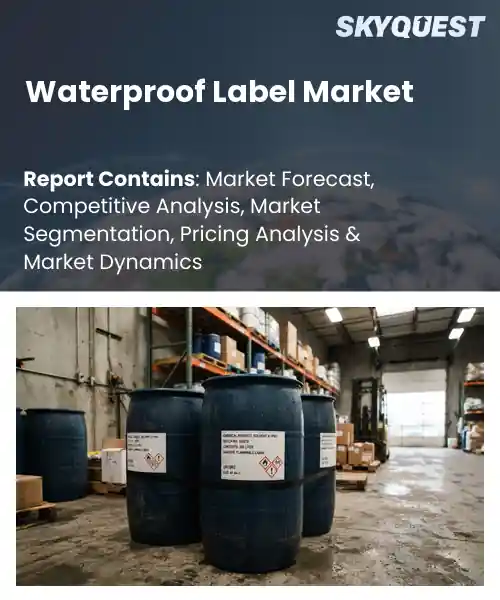
Waterproof Label Market
Report ID: SQMIG15H2303
Report ID: SQMIG15H2303
[email protected]
USA +1 351-333-4748
Report ID:
SQMIG15H2303 |
Region:
Global |
Published Date: August, 2026
Pages:
157
|Tables:
146
|Figures:
78


Global Waterproof Label Market size was valued at USD 18.42 Billion in 2024 and is poised to grow from USD 19.51 Billion in 2025 to USD 30.86 Billion by 2033, growing at a CAGR of 5.9% during the forecast period (2026-2033).
The waterproof label market comprises adhesive tags designed to retain legibility after exposure to moisture, chemicals, or extreme temperatures, and it underpins product safety, regulatory compliance, and brand integrity across sectors such as food, pharmaceuticals, and electronics. Its importance stems from the growing need to convey information on items that travel through harsh logistics chains or operate in wet environments. Historically, the market was niche, limited to industrial labeling, but the surge in e‑commerce, cold‑chain logistics, and labeling regulations over the decade has expanded demand. For instance, producers now mandate moisture‑resistant barcodes to prevent spoilage tracking errors, illustrating the market’s evolution.Key factor driving the market forward is integration of digital printing technologies, which enable customization and on‑demand production of waterproof labels, reducing inventory costs and meeting compliance requirements. As manufacturers adopt Industry 4.0 platforms, data‑rich labels equipped with QR codes or RFID tags can be printed with moisture‑proof adhesives, allowing traceability for perishable goods and anti‑counterfeit verification. This capability has prompted beverage companies to replace paper stickers with polymer‑based labels that survive refrigeration cycles, thereby extending shelf life visibility and supporting regulatory audits. Consequently, suppliers that invest in adaptive printing lines capture new significant revenue streams while customers gain operational resilience.
How is AI-driven automation reshaping the waterproof label market?
AI‑driven automation is redefining the waterproof label market by streamlining design, production and quality control. Machine‑learning algorithms now generate optimized label layouts that balance durability with brand aesthetics, reducing manual engineering time. Smart printers equipped with AI adjust ink flow and curing parameters in real time, ensuring consistent adhesion even under extreme conditions. Vision systems inspect each label for defects, catching imperfections that human eyes might miss and lowering waste. Integrated data platforms synchronize demand forecasts with material inventories, allowing manufacturers to scale output without overstocking. These technologies together accelerate time‑to‑market, improve reliability and enable highly customized runs for niche applications, making the sector more responsive to customer needs.In March 2024, a leading label manufacturer launched an AI‑powered production line, boosting efficiency and supporting market growth.
Market snapshot - (2026-2033)
Global Market Size
USD 18.42 Billion
Largest Segment
Pressure-Sensitive Labels
Fastest Growth
In-Mold Labels
Growth Rate
5.9% CAGR
To get more insights on this market click here to Request a Free Sample Report
Global waterproof label market is segmented by label type, material, adhesive type, application, end-use industry and region. Based on label type, the market is segmented into Pressure-Sensitive Labels, Shrink Sleeve Labels and In-Mold Labels. Based on material, the market is segmented into Polypropylene, Polyethylene, Polyester and Synthetic Paper. Based on adhesive type, the market is segmented into Permanent Adhesives and Removable Adhesives. Based on application, the market is segmented into Product Identification, Shipping & Logistics, Asset Tracking and Branding & Decoration. Based on end-use industry, the market is segmented into Food & Beverage, Pharmaceuticals, Chemicals and Logistics & Transportation. Based on region, the market is segmented into North America, Europe, Asia Pacific, Latin America and Middle East & Africa.
Pressure-sensitive labels segment dominates because they provide immediate adhesion without heat, simplifying integration into existing production lines. Their versatility across curved surfaces and compatibility with diverse inks make them the preferred choice for brands requiring reliable water resistance. Manufacturers favor them for low equipment investment and rapid changeover, which drives steady demand in the waterproof label market especially for consumer goods and outdoor packaging where durability is critical throughout the supply chain.
Meanwhile, shrink sleeve labels are witnessing the strongest growth momentum as brands seek seamless, 360 degree branding that also offers superior water barrier performance. Advances in printable film technology reduce costs and enable vibrant graphics, prompting adoption in premium product lines and expanding the overall market opportunity for manufacturers globally.
Polyethylene segment dominates because its inherent flexibility and excellent moisture barrier qualities align with the core requirements of waterproof labeling. The material tolerates a wide temperature range, enabling reliable performance on refrigerated and outdoor products. Its cost-effective production and compatibility with a variety of adhesives make it the default choice for high volume applications across diverse consumer sectors, reinforcing supplier confidence and encouraging continuous innovation in film formulations.
Conversely, polyester material is emerging as the key high growth area as manufacturers prioritize superior chemical resistance and enhanced durability for harsh environments. Developments in eco friendly polyester blends attract sustainability focused brands, while improved printability expands design options, accelerating adoption across specialty packaging and driving future market expansion for the next decade.
To get detailed segments analysis, Request a Free Sample Report
The Asia Pacific region benefits from a confluence of advanced manufacturing ecosystems, high consumer demand for durable packaging, and strong investment in research and development of polymer technologies. Leading electronics and automotive producers in the region require labels that can withstand exposure to moisture, chemicals, and temperature fluctuations, driving adoption of sophisticated waterproof solutions. Additionally, the presence of large-scale logistics hubs coupled with rising e‑commerce activity creates pressure for resilient labeling that maintains integrity throughout complex supply chains. Collaborative innovation between material suppliers and original equipment manufacturers further accelerates the introduction of next‑generation waterproof label formats, reinforcing the region’s leadership position. Strategic emphasis on sustainability and regulatory compliance also encourages the integration of eco‑friendly waterproof adhesives, cementing Asia Pacific’s dominance in the market.
Waterproof Label Market in Japan is shaped by the country's robust electronics and precision engineering sectors, which demand high‑performance labeling that can endure harsh operational environments. Manufacturers prioritize reliability and longevity, prompting adoption of advanced polymer substrates and resilient adhesive technologies. The market also reflects strong consumer expectations for product durability, influencing packaging strategies across consumer goods. Collaborative efforts between Japanese material innovators and global label producers foster continuous improvement in barrier properties and print quality, reinforcing the market’s reputation for premium waterproof solutions.
Waterproof Label Market in South Korea thrives on the nation’s dynamic automotive and heavy‑industry landscape, where exposure to moisture and chemicals is a routine challenge. Companies emphasize high‑grade functional films that protect critical information throughout the product lifecycle. The market is further propelled by a culture of rapid technology adoption, with local firms integrating smart labeling features that combine waterproof performance with data connectivity. Strong governmental support for manufacturing excellence and sustainability drives research into recyclable waterproof materials, positioning South Korea as a key innovator in resilient labeling solutions.
In North America, the waterproof label market expands rapidly due to heightened demand for product integrity across diverse sectors such as food and beverage, pharmaceuticals, and industrial equipment. Consumers increasingly expect packaging that preserves freshness and safety, prompting manufacturers to adopt moisture‑resistant labeling. Stringent regulatory frameworks governing label durability and traceability also compel companies to invest in reliable waterproof solutions. Technological advancements in digital printing and substrate engineering enable customized, high‑resolution labels that maintain performance under extreme conditions. Additionally, the growth of omnichannel retail and complex distribution networks intensifies the need for labels that survive variable climates and handling processes, fueling market momentum across the United States and Canada.
Waterproof Label Market in the United States is propelled by the scale of its consumer goods and industrial sectors, where product protection and brand communication are paramount. Manufacturers seek labels that can resist humidity, cleaning agents, and temperature shifts encountered in supply chains and retail environments. The market benefits from a strong ecosystem of label converters and technology providers that deliver innovative film blends and adhesive chemistries. Emphasis on sustainability also drives exploration of recyclable waterproof materials, aligning with corporate responsibility goals while maintaining high performance standards.
Waterproof Label Market in Canada reflects the country’s extensive natural resource and manufacturing base, where labels must endure harsh weather and logistical challenges. Industries such as forestry, mining, and food processing rely on moisture‑resistant labeling to safeguard product information in outdoor and refrigerated settings. The market is supported by a collaborative network of local suppliers and international partners focusing on durable substrates and eco‑friendly adhesives. Growing consumer awareness around product safety and environmental stewardship encourages adoption of waterproof labels that balance resilience with sustainable design.
Europe strengthens its position through a focus on regulatory compliance, sustainability, and technological integration across the labeling value chain. The region’s stringent quality and safety standards compel manufacturers to adopt waterproof labels that guarantee traceability and product protection. Investment in green chemistry and recyclable substrate development aligns with Europe’s broader environmental objectives, fostering market differentiation. Moreover, the rise of smart packaging and digital printing technologies enables the creation of interactive waterproof labels that convey rich information while withstanding rigorous handling. Collaborative research initiatives among industry associations, academic institutions, and material innovators further accelerate the rollout of advanced waterproof solutions, enhancing Europe’s competitive edge in the global market.
Waterproof Label Market in Germany is driven by its strong automotive and engineering sectors, where durability and precision are critical. Manufacturers demand labels that maintain adhesion and legibility under exposure to oils, moisture, and temperature variations. The market benefits from a robust network of chemical and polymer producers that supply high‑performance films and adhesives. Emphasis on circular economy principles fuels development of recyclable waterproof label materials, meeting both regulatory expectations and corporate sustainability goals.
Waterproof Label Market in the United Kingdom reflects the country’s mature pharmaceuticals and food‑processing industries, which require reliable labeling for safety and compliance. Companies prioritize barrier technologies that protect against humidity and cleaning processes while preserving print clarity. Collaboration between label designers and technology firms drives innovation in digital printing and smart label integration, enhancing functionality without compromising waterproof performance. Sustainability considerations also motivate the adoption of eco‑conscious waterproof substrates across market segments.
Waterproof Label Market in France is influenced by its vibrant luxury goods and cosmetics sectors, where product presentation and label integrity are essential. Brands seek waterproof solutions that retain aesthetic appeal despite exposure to moisture and handling. The market is supported by a strong tradition of material innovation, leveraging advanced polymer blends that combine elegance with durability. Growing consumer expectations for sustainable packaging encourage French manufacturers to explore recyclable waterproof label options, aligning brand values with environmental responsibility.
To know more about the market opportunities by region and country, click here to
Buy The Complete Report
Increasing Demand for Sustainable Packaging
Advancements in Digital Printing Technology
High Production Cost of Specialized Materials
Regulatory Variability Across Regions
Request Free Customization of this report to help us to meet your business objectives.
The competitive landscape of the global waterproof label market is shaped by a cluster of established manufacturers such as CCL Industries, Nitto, HERMA, SATO, Brady, ImageTek, Online Labels, TuffLabels and Jet Label, each leveraging advanced printing technologies and expanding product portfolios to meet stringent durability requirements. Recent strategic moves include partnerships that broaden distribution networks and technology collaborations that enhance label adhesion and resistance, intensifying competition and driving market differentiation.
Top Player’s Company Profile
Recent Developments
SkyQuest’s ABIRAW (Advanced Business Intelligence, Research & Analysis Wing) is our Business Information Services team that Collects, Collates, Correlates, and Analyses the Data collected by means of Primary Exploratory Research backed by robust Secondary Desk research. As per SkyQuest analysis the global waterproof label market is projected to grow to $30.9 billion by 2033, driven primarily by the rising demand for sustainable packaging that pushes manufacturers toward eco‑friendly, moisture‑resistant labels. A second strong catalyst is the rapid advancement of digital printing technology, which enables on‑demand customization and quick turnaround while keeping water resistance intact. The market’s leading segment remains pressure‑sensitive labels because of their ease of application and versatility across industries. Asia Pacific dominates the market thanks to its high‑volume manufacturing base and accelerating e‑commerce logistics. However, high production costs for premium polymers and specialty adhesives act as a restraint, slowing broader adoption in price‑sensitive segments.
| Report Metric | Details |
|---|---|
| Market size value in 2024 | USD 18.42 Billion |
| Market size value in 2033 | USD 30.86 Billion |
| Growth Rate | 5.9% |
| Base year | 2024 |
| Forecast period | (2026-2033) |
| Forecast Unit (Value) | USD Billion |
| Segments covered |
|
| Regions covered | North America (US, Canada), Europe (Germany, France, United Kingdom, Italy, Spain, Rest of Europe), Asia Pacific (China, India, Japan, Rest of Asia-Pacific), Latin America (Brazil, Rest of Latin America), Middle East & Africa (South Africa, GCC Countries, Rest of MEA) |
| Companies covered |
|
| Customization scope | Free report customization with purchase. Customization includes:-
|
To get a free trial access to our platform which is a one stop solution for all your data requirements for quicker decision making. This platform allows you to compare markets, competitors who are prominent in the market, and mega trends that are influencing the dynamics in the market. Also, get access to detailed SkyQuest exclusive matrix.
Table Of Content
Executive Summary
Market overview
Parent Market Analysis
Market overview
Market size
KEY MARKET INSIGHTS
COVID IMPACT
MARKET DYNAMICS & OUTLOOK
Market Size by Region
KEY COMPANY PROFILES
Methodology
For the Waterproof Label Market, our research methodology involved a mixture of primary and secondary data sources. Key steps involved in the research process are listed below:
1. Information Procurement: This stage involved the procurement of Market data or related information via primary and secondary sources. The various secondary sources used included various company websites, annual reports, trade databases, and paid databases such as Hoover's, Bloomberg Business, Factiva, and Avention. Our team did 45 primary interactions Globally which included several stakeholders such as manufacturers, customers, key opinion leaders, etc. Overall, information procurement was one of the most extensive stages in our research process.
2. Information Analysis: This step involved triangulation of data through bottom-up and top-down approaches to estimate and validate the total size and future estimate of the Waterproof Label Market.
3. Report Formulation: The final step entailed the placement of data points in appropriate Market spaces in an attempt to deduce viable conclusions.
4. Validation & Publishing: Validation is the most important step in the process. Validation & re-validation via an intricately designed process helped us finalize data points to be used for final calculations. The final Market estimates and forecasts were then aligned and sent to our panel of industry experts for validation of data. Once the validation was done the report was sent to our Quality Assurance team to ensure adherence to style guides, consistency & design.
Analyst Support
Customization Options
With the given market data, our dedicated team of analysts can offer you the following customization options are available for the Waterproof Label Market:
Product Analysis: Product matrix, which offers a detailed comparison of the product portfolio of companies.
Regional Analysis: Further analysis of the Waterproof Label Market for additional countries.
Competitive Analysis: Detailed analysis and profiling of additional Market players & comparative analysis of competitive products.
Go to Market Strategy: Find the high-growth channels to invest your marketing efforts and increase your customer base.
Innovation Mapping: Identify racial solutions and innovation, connected to deep ecosystems of innovators, start-ups, academics, and strategic partners.
Category Intelligence: Customized intelligence that is relevant to their supply Markets will enable them to make smarter sourcing decisions and improve their category management.
Public Company Transcript Analysis: To improve the investment performance by generating new alpha and making better-informed decisions.
Social Media Listening: To analyze the conversations and trends happening not just around your brand, but around your industry as a whole, and use those insights to make better Marketing decisions.
REQUEST FOR SAMPLE
 REQUEST FREE CUSTOMIZATION


Want to customize this report? This report can be personalized according to your needs. Our analysts and industry experts will work directly with you to understand your requirements and provide you with customized data in a short amount of time. We offer $1000 worth of FREE customization at the time of purchase.
Feedback From Our Clients


 USA (+1) 351-333-4748

