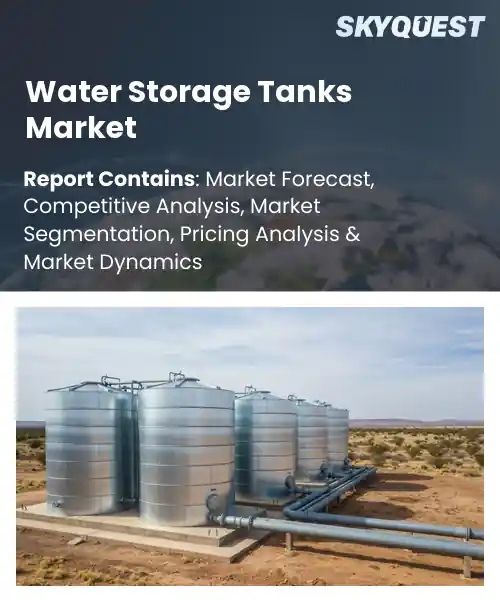
Water Storage Tanks Market
Report ID: SQMIG20B2202
Report ID: SQMIG20B2202
[email protected]
USA +1 351-333-4748
Report ID:
SQMIG20B2202 |
Region:
Global |
Published Date: July, 2026
Pages:
157
|Tables:
177
|Figures:
79


Global Water Storage Tanks Market size was valued at USD 25.10 Billion in 2024 and is poised to grow from USD 26.30 Billion in 2025 to USD 38.28 Billion by 2033, growing at a CAGR of 4.8% during the forecast period (2026-2033).
Water storage tanks market trends, both above ground and below ground, are manufactured around the world. These tanks are used to collect, hold and distribute water for municipal, industrial, agricultural and residential purposes. There is a growing demand for reliable water management due to climate variability, population growth and urban expansion; therefore, the water tank market has become increasingly important in the last few years. Water storage has evolved from basic steel cisterns in the mid-20th century to advanced composite tanks with smart-connected technology and monitoring devices.
The current major driver of this industry's growth is the increasing demand for resilient infrastructure to help prevent disruptions in supply due to drought conditions, such as California's incentive program for rainwater harvesting systems. Lastly, the second major influencing driver on the global water storage tank market share is the fast growing use of smarter water technology solutions. Smart water technology includes the combination of Internet of Things (IoT) connectivity and tank technologies that allow for remote monitoring, leak detection and predictive maintenance.
The advent of smart water technology will result in reduced operating costs, more efficient operations and greater upgrades for municipalities and industrial facilities; for instance, Singapore's public utilities board has installed smart reservoirs which have resulted in approximately 15% reduction in water loss, and a petrochemical facility in Saudi Arabia has implemented automated tanks to optimize circulating coolant. As a result of the implementation of smart water systems, the demand for tanks across the globe is growing rapidly and there are new opportunities for tank manufacturers who can analyze and integrate data associated with their products.
How is IoT Enhancing Monitoring and Maintenance Efficiency in the Water Storage Tanks Market?
IoT technology is revolutionizing the way water storage tanks market growth operate by creating a complete monitoring system, where sensors, communication modules and cloud platforms are interconnected. The operators have access to real time level and pressure data to determine the status of the tank; in addition, temperature and humidity sensors assist with ensuring the quality of the water. Advanced analytical techniques convert raw measurements into predictive analytics, alerting operators to possible leakages or overflows prior to them occurring.
Monitoring from a distance using dashboards reduces the frequency of manual inspections, leading to lower labour costs and increased safety for staff who might need to climb ladders. Finally, automated valve control is part of the technology, allowing operators to manage water as they have always done, and meet the increasing requirement for reliable infrastructure.
Caldwell Tanks (2021), in a general overview of the market, showed a growing desire for connected tank solutions, highlighting how the ability to use IoT enabled monitoring systems will make it possible to streamline inspections and extend the life of assets, thereby improving efficiency within the market. By utilizing sensors to provide operators with real time data on level and pressure, as well as the ability to predict when maintenance will be required, operators can reduce the amount of downtime and operational expense associated with asset failure.
Market snapshot - (2026-2033)
Global Market Size
USD 25.1 Billion
Largest Segment
Concrete Tanks
Fastest Growth
Plastic Tanks
Growth Rate
4.8% CAGR
To get more insights on this market click here to Request a Free Sample Report
Global water storage tanks market is segmented by material type, installation type, capacity, application, end user, distribution channel and region. Based on material type, the market is segmented into plastic tanks, steel tanks, concrete tanks and others. Based on installation type, the market is segmented into above ground tanks and underground tanks. Based on capacity, the market is segmented into up to 5,000 liters, 5,001–50,000 liters and above 50,000 liters. Based on application, the market is segmented into residential water storage, commercial water storage, industrial water storage and others. Based on end user, the market is segmented into residential, commercial, industrial and others. Based on distribution channel, the market is segmented into direct sales, dealers & distributors and others. Based on region, the market is segmented into North America, Europe, Asia Pacific, Latin America and Middle East & Africa.
The plastic tanks segment of the water storage tanks market share continues to be the most prominent choice. The lightweight construction and corrosion-resistant properties of plastic tanks simplify transportation, installation and deployment into many different types of applications, thereby reducing labor costs for cost-conscious buyers. In addition, the capacity to form complex shapes through the molding process provides options for customers' customized solutions within both residential and commercial applications and is reinforcing the demand for plastic tanks. Furthermore, as plastic tanks offer recyclability, they align with customers' expectations for sustainable solutions and support their continuing leadership position within the overall global market of water storage tanks.
On the other hand, the steel tanks segment of the water storage tanks market forecast continues to grow at the fastest pace. Advances in coating technologies are improving the service life of all types of steel tanks and allowing for their use in even the most harshly-corrosive environments. The rise of industrial projects is driving the need for pel size tanks with appropriate pressure ratings, thus increasing the usage of steel tanks. This growth will allow for new opportunities for manufacturers to innovate and increase their share of the market as it continues to expand at a substantial rate into the future.
The larger capacity segment (> 50,000 liters) dominates due to its ability to accommodate water management needs on a large scale (economies of scale) for municipal and industrial users, leading to less frequent refilling and therefore lower operating costs. Also, the ability to integrate with automation and monitoring systems provides reliability, which is crucial to critical infrastructure projects. In addition, the size of the larger capacity tank allows for integration with renewable energy-driven pumping systems, thereby further reducing operating costs and increasing sustainability.
On the other hand, the mid-size segment (5,001 – 50,000 liters) is experiencing the most rapid growth because modular designs are appealing to commercial projects that require more flexibility. Demand for tanks that achieve a favorable balance between footprint and volume is being driven by both urbanization and water treatment; this has caused manufacturers to add to their existing product line and invest in lighter-weight products; thus, the market will continue to expand.
To get detailed segments analysis, Request a Free Sample Report
Asia Pacific is the astaslzlaz market leader due to its large industrial ass batty, rapid city growth and a growing interest in managing. Alarka and here are your technology available in both industries iqon and raplace has beenllavytisciously used for innovative designs. It’s an industrial lavyinlysis in the lavyine and agricultural industries as well as a business for mainstream e-commerce. The lsaa u favourably provides services for infrastructure osured and means public service, and water management; pathways are frequent ways from producers to advertisers to managers to customers. In many of these cases, infrastructure building on the basic principles of urban renewal; then the global business will begin to operate as a full-service business using both urban development. The integration of these new technologies with lavying product solutions fundamentally improve product performance. As a result +]ia progeszama producers can be seen in the context of quality, innovation and efficiency globally.
Water storage tanks market regional outlook in Japan is shaped by a sophisticated industrial landscape and strict regulatory standards that prioritize safety and environmental stewardship. Domestic manufacturers excel in precision engineering, delivering high‑quality tanks suited for dense urban environments and seismic considerations. Collaboration between utilities and technology providers accelerates adoption of smart monitoring systems, improving operational efficiency. Strong emphasis on sustainability drives the development of recyclable materials and energy‑efficient production processes, reinforcing Japan’s reputation for cutting‑edge water storage solutions.
Water storage tanks market regional forecast in South Korea benefits from rapid industrial growth and proactive government policies focused on water resource management. The nation’s robust manufacturing sector delivers versatile tanks that cater to both heavy industry and burgeoning residential projects. Investment in research and development fosters advanced coatings and modular designs, enhancing durability and ease of installation. Growing awareness of climate variability spurs demand for resilient storage infrastructure, while partnerships with foreign firms expand access to innovative technologies, solidifying South Korea’s role in the regional market.
The drive for Europe to grow is influenced by strong environmental regulations, the need to replace old infrastructure and a commitment to implementing the circular economy concept. Germany has led in engineering capability and has established a benchmark for quality of product in this area, while in the UK private-public initiatives are promoting faster adoption of flood mitigation and resilience programs. The growth of the renewable energy market in France shows the need to invest in water storage technology and be able to store water for use. Across Europe, promoting sustainability, integrating smart-cities and facilitating the cross-border transfer of dynamic new tank technologies has created an environment where innovation and market growth will be encouraged.
Water storage tanks market penetration in Germany is anchored by robust engineering traditions and a regulatory framework that mandates high safety and environmental standards. Leading manufacturers emphasize precision fabrication, advanced composite materials, and integrated monitoring solutions. The country’s emphasis on renewable energy and industrial efficiency fuels demand for durable storage systems across sectors such as chemical processing and municipal utilities. Collaborative research initiatives with academic institutions promote ongoing innovation, reinforcing Germany’s position as a benchmark for quality and reliability in the European market.
Water storage tanks market analysis in the United Kingdom is experiencing rapid growth as infrastructure projects prioritize flood defense and water resilience. Government incentives and strategic partnerships encourage adoption of modular and smart‑connected tanks, enhancing operational visibility for utilities and private developers. The market benefits from a strong supply chain that integrates domestic manufacturers with international technology providers, fostering the introduction of corrosion‑resistant coatings and energy‑efficient designs. Growing public awareness of climate adaptation drives investment in robust storage solutions, positioning the United Kingdom as a leading growth engine in Europe.
Water storage tanks industry trends in France is emerging through focused investments in renewable energy and agricultural water management. Policy support for sustainable practices encourages the deployment of tanks that combine durability with environmentally friendly materials. French manufacturers are increasingly adopting digital monitoring platforms, enabling real‑time performance tracking for municipal and industrial users. Partnerships with European research clusters facilitate the development of innovative coating technologies that extend service life. This evolving landscape underlines France’s expanding role as an influential player within the broader European market.
Market position of North America has been strengthened through the combination of technological innovation, continued infrastructure development, as well as a strong commitment to ensuring water security. In the U.S., large industrial projects and agricultural demand have resulted in many advancements within tank design, materials, and smart integration. In Canada, the focus on sustainable resource management and supporting remote communities is supporting the adoption of flexible storage solutions. Both countries are experiencing strong investment cycles as well as collaborative R&D initiatives, along with regulatory environments that enhance safety and compliance with environmental standards thereby providing the foundation for a safe and sustainable market environment.
Water storage tanks industry in the United States is characterized by diverse applications ranging from large industrial complexes to suburban residential developments. Emphasis on high‑performance materials and intelligent monitoring systems enhances operational efficiency across sectors such as oil and gas, manufacturing, and municipal water supply. Leading firms invest heavily in research to improve corrosion resistance and energy‑saving designs, while regulatory standards drive adherence to safety and environmental protocols. Collaboration between manufacturers and technology providers accelerates the rollout of connected storage solutions, strengthening market dynamism.
Water storage tanks sector in Canada reflects a strong commitment to sustainable water management, especially in remote and northern communities where reliable storage is critical. Domestic producers focus on rugged, cold‑resistant designs that meet the country’s demanding environmental conditions. Partnerships with indigenous groups and government agencies promote the deployment of modular tanks that support both municipal supply and industrial needs. Innovation in eco‑friendly materials and integration of remote monitoring capabilities underscores Canada’s strategic approach to enhancing water security and reinforcing its market standing.
To know more about the market opportunities by region and country, click here to
Buy The Complete Report
Urban Infrastructure Expansion
Increasing Regulatory Emphasis
High Capital Investment Costs
Complex Installation Requirements
Request Free Customization of this report to help us to meet your business objectives.
The competitive landscape of the water storage tanks market is characterized by established tank manufacturers expanding their product portfolios through advanced materials, digital monitoring technologies, and sustainable water management solutions, while emerging companies introduce smart sensing, asset monitoring, and modular storage innovations. Leading players such as CST Industries, Tank Connection, and Caldwell Tanks continue to strengthen their market positions through infrastructure projects, engineering enhancements, and investments in operational efficiency. At the same time, technology-focused startups are supporting the industry's digital transformation through IoT-enabled monitoring systems, predictive maintenance platforms, and water infrastructure analytics. Strategic partnerships, product innovation, and increasing investments in water security and sustainability remain key competitive factors shaping market growth.
Top Player’s Company Profile
Recent Developments in the Water Storage Tanks Market
SkyQuest’s ABIRAW (Advanced Business Intelligence, Research & Analysis Wing) is our Business Information Services team that Collects, Collates, Correlates, and Analyses the Data collected by means of Primary Exploratory Research backed by robust Secondary Desk research. As per SkyQuest analysis the global water storage tanks market is being propelled primarily by rapid urban infrastructure expansion, which drives demand for reliable containers across municipal and residential projects, while a second strong catalyst is the increasing integration of smart monitoring IoT sensors that improve efficiency and lower operating costs. The market is led by Asia Pacific, where the combination of fast urbanization and supportive policies fuels growth, and plastic tanks dominate the segment landscape thanks to their light weight, corrosion resistance and recyclability. However, high upfront capital investment remains a notable restraint, especially for large‑scale installations, tempering the pace of adoption in cost‑sensitive regions.
| Report Metric | Details |
|---|---|
| Market size value in 2024 | USD 25.1 Billion |
| Market size value in 2033 | USD 38.28 Billion |
| Growth Rate | 4.8% |
| Base year | 2024 |
| Forecast period | (2026-2033) |
| Forecast Unit (Value) | USD Billion |
| Segments covered |
|
| Regions covered | North America (US, Canada), Europe (Germany, France, United Kingdom, Italy, Spain, Rest of Europe), Asia Pacific (China, India, Japan, Rest of Asia-Pacific), Latin America (Brazil, Rest of Latin America), Middle East & Africa (South Africa, GCC Countries, Rest of MEA) |
| Companies covered |
|
| Customization scope | Free report customization with purchase. Customization includes:-
|
To get a free trial access to our platform which is a one stop solution for all your data requirements for quicker decision making. This platform allows you to compare markets, competitors who are prominent in the market, and mega trends that are influencing the dynamics in the market. Also, get access to detailed SkyQuest exclusive matrix.
Table Of Content
Executive Summary
Market overview
Parent Market Analysis
Market overview
Market size
KEY MARKET INSIGHTS
COVID IMPACT
MARKET DYNAMICS & OUTLOOK
Market Size by Region
KEY COMPANY PROFILES
Methodology
For the Water Storage Tanks Market, our research methodology involved a mixture of primary and secondary data sources. Key steps involved in the research process are listed below:
1. Information Procurement: This stage involved the procurement of Market data or related information via primary and secondary sources. The various secondary sources used included various company websites, annual reports, trade databases, and paid databases such as Hoover's, Bloomberg Business, Factiva, and Avention. Our team did 45 primary interactions Globally which included several stakeholders such as manufacturers, customers, key opinion leaders, etc. Overall, information procurement was one of the most extensive stages in our research process.
2. Information Analysis: This step involved triangulation of data through bottom-up and top-down approaches to estimate and validate the total size and future estimate of the Water Storage Tanks Market.
3. Report Formulation: The final step entailed the placement of data points in appropriate Market spaces in an attempt to deduce viable conclusions.
4. Validation & Publishing: Validation is the most important step in the process. Validation & re-validation via an intricately designed process helped us finalize data points to be used for final calculations. The final Market estimates and forecasts were then aligned and sent to our panel of industry experts for validation of data. Once the validation was done the report was sent to our Quality Assurance team to ensure adherence to style guides, consistency & design.
Analyst Support
Customization Options
With the given market data, our dedicated team of analysts can offer you the following customization options are available for the Water Storage Tanks Market:
Product Analysis: Product matrix, which offers a detailed comparison of the product portfolio of companies.
Regional Analysis: Further analysis of the Water Storage Tanks Market for additional countries.
Competitive Analysis: Detailed analysis and profiling of additional Market players & comparative analysis of competitive products.
Go to Market Strategy: Find the high-growth channels to invest your marketing efforts and increase your customer base.
Innovation Mapping: Identify racial solutions and innovation, connected to deep ecosystems of innovators, start-ups, academics, and strategic partners.
Category Intelligence: Customized intelligence that is relevant to their supply Markets will enable them to make smarter sourcing decisions and improve their category management.
Public Company Transcript Analysis: To improve the investment performance by generating new alpha and making better-informed decisions.
Social Media Listening: To analyze the conversations and trends happening not just around your brand, but around your industry as a whole, and use those insights to make better Marketing decisions.
REQUEST FOR SAMPLE
 REQUEST FREE CUSTOMIZATION
Global Water Storage Tanks Market size was valued at USD 25.1 Billion in 2024 and is poised to grow from USD 26.3 Billion in 2025 to USD 38.28 Billion by 2033, growing at a CAGR of 4.8% during the forecast period (2026-2033).
The market is shaped by intense competition among established manufacturers and emerging players, with recent M&A activity consolidating regional producers and strategic partnerships enabling integrated water management solutions. Companies are accelerating technology adoption, such as smart monitoring systems and modular tank designs, to differentiate offerings and meet stricter sustainability standards. 'CST Industries, Inc.', 'Tank Connection, LLC', 'Caldwell Tanks, Inc.', 'Superior Tank Co., Inc.', 'Balmoral Tanks Limited', 'Permastore Limited', 'Containment Solutions, Inc.', 'Snyder Industries, LLC', 'Sintex Industries Limited', 'ZCL Composites Inc.', 'Balmoral Group Holdings Ltd.', 'Fiber Technology Corporation', 'Protank LLC', 'American Tank Company, Inc.', 'Tarsco Bolted Tank', 'AG Growth International Inc.', 'BH Tank', 'Belding Tank Technologies, Inc.', 'Royal Building Products', 'RotoTank (Pty) Ltd.'
Urban growth drives substantial demand for reliable water storage solutions as municipalities upgrade water distribution networks, construct new residential complexes, and improve public facilities; this creates a sustained requirement for durable tanks that can accommodate fluctuating consumption patterns, ensure supply continuity during peak usage, and support emergency preparedness, thereby stimulating manufacturers to expand production capacities and innovate design features to meet evolving urban needs. Additionally, integration of smart monitoring technologies enhances operational efficiency, encouraging further adoption across municipal projects and fosters long‑term service contracts.
Sustainable Materials Adoption: Manufacturers are increasingly integrating recycled plastics, high‑density polyethylene, and composite fibers into water storage tank designs to reduce environmental impact and meet stricter regulatory expectations. These materials provide comparable durability to traditional steel while offering lighter weight, corrosion resistance, and easier on‑site handling, which shortens installation times and lowers labor costs for end users. As sustainability becomes a core procurement criterion, project owners prioritize suppliers that demonstrate lifecycle carbon reductions, driving market demand toward eco‑friendly tank solutions worldwide and resilience.
Why does Asia Pacific Dominate the Global Water Storage Tanks Market? |@12


Want to customize this report? This report can be personalized according to your needs. Our analysts and industry experts will work directly with you to understand your requirements and provide you with customized data in a short amount of time. We offer $1000 worth of FREE customization at the time of purchase.
Feedback From Our Clients


 USA (+1) 351-333-4748

