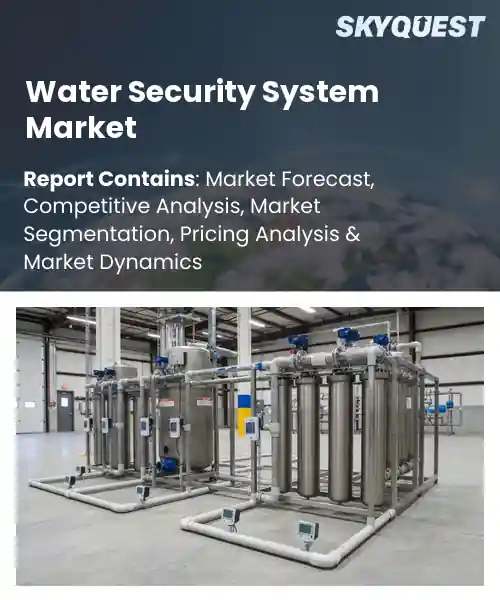
Water Security System Market
Report ID: SQMIG20B2261
Report ID: SQMIG20B2261
[email protected]
USA +1 351-333-4748
Report ID:
SQMIG20B2261 |
Region:
Global |
Published Date: July, 2026
Pages:
157
|Tables:
145
|Figures:
78


Global Water Security System Market size was valued at USD 18.62 Billion in 2024 and is poised to grow from USD 19.96 Billion in 2025 to USD 34.81 Billion by 2033, growing at a CAGR of 7.2% during the forecast period (2026-2033).
The water security system market comprises technologies and services that monitor, manage, and protect freshwater resources against scarcity, contamination, and volatility. Its importance stems from rising demand for clean water, intensified by urbanization, industrial expansion, and recurring droughts across continents. Historically, the sector emerged in the early 2000s as municipalities adopted SCADA‑based leakage detection, but a decade later smart sensors and cloud analytics accelerated adoption in agriculture and utilities. For instance, Israel’s drip‑irrigation networks now integrate real‑time moisture data, reducing waste by 30 percent. This evolution illustrates how escalating water stress has transformed a niche solution into an infrastructure pillar. Regulatory pressure acts as the primary catalyst driving the water security system market toward rapid expansion. Governments worldwide tighten discharge limits and require real‑time reporting, compelling utilities to invest in telemetry and predictive‑maintenance platforms. As a result, firms like Siemens and Xylem have accelerated product pipelines, delivering integrated IoT hubs that can cut operating costs by up to 25 percent. Simultaneously, climate‑resilient financing channels capital to projects that embed leak detection and desalination controls, opening opportunities in emerging economies. This convergence creates a significant feedback loop: compliance needs trigger technology adoption, which generates new revenue streams and reinforces investor confidence.
How is AI and IoT integration improving water security system market efficiency?
AI and IoT are reshaping water security by linking sensors, analytics platforms, and automated controls. Real time data from flow meters, pressure gauges, and quality probes feed machine learning models that predict leaks, demand spikes, and contamination events before they become critical. Operators can remotely adjust valves, balance pressure, and trigger alerts, reducing water loss and improving service reliability. The integration also enables dynamic allocation of scarce resources, supporting communities facing climate stress and aging infrastructure. As utilities adopt cloud based dashboards, decision makers gain a holistic view that shortens response times and cuts operational costs, making the sector more resilient.Water Forward, March 2026, launched an AI driven sensor network across pilot cities that detects contamination and optimizes distribution in real time. The platform’s predictive analytics cut response latency and improve allocation efficiency, illustrating how integrated intelligence fuels market growth and operational excellence for water utilities and municipalities.
Market snapshot - (2026-2033)
Global Market Size
USD 18.62 Billion
Largest Segment
Hardware
Fastest Growth
Software
Growth Rate
7.2% CAGR
To get more insights on this market click here to Request a Free Sample Report
Global water security system market is segmented by component, system type, application, deployment, end user and region. Based on component, the market is segmented into Hardware, Software and Services. Based on system type, the market is segmented into Physical Security Systems, Water Quality Monitoring Systems, Cybersecurity Solutions and Intrusion Detection Systems. Based on application, the market is segmented into Municipal Water Utilities, Industrial Facilities, Commercial Buildings and Critical Infrastructure. Based on deployment, the market is segmented into On-Premise and Cloud-Based. Based on end user, the market is segmented into Government, Utilities and Industrial Enterprises. Based on region, the market is segmented into North America, Europe, Asia Pacific, Latin America and Middle East & Africa.
Hardware segment dominates because it supplies the tangible infrastructure essential for real-time monitoring and control of water networks. Sensors, controllers, and communication devices enable continuous data capture, ensuring reliability and resilience against threats. The demand for durable field equipment drives investment in advanced materials and low‑power designs. These components also integrate with existing SCADA platforms, allowing utilities to enhance security without extensive retrofits, cementing hardware’s pivotal market role.
However, software segment is witnessing the strongest growth momentum as AI‑driven analytics and cloud‑native platforms accelerate water security intelligence. Emerging algorithms transform raw sensor data into predictive risk insights, enabling proactive threat mitigation. Rapid adoption of modular, updateable solutions expands market reach, fostering new service models and reinforcing system agility.
Water quality monitoring systems segment stands out because it directly addresses the core objective of protecting potable supplies from contamination and operational failures. Integrated sensors measure parameters such as turbidity, chlorine residuals, and microbial presence, delivering actionable data to operators. The critical need for early detection drives continuous innovation in sensor accuracy and data fusion, reinforcing confidence among stakeholders and making these systems indispensable for comprehensive water security strategies.
Meanwhile, cybersecurity solutions segment is emerging as the key high‑growth area within system types as cyber threats target connected water infrastructure. Advanced threat‑intelligence platforms and secure communication protocols reduce risks of remote monitoring and control. Regulatory emphasis on resilience and IoT adoption drive demand, making cybersecurity a catalyst for market expansion and resilient networks.
To get detailed segments analysis, Request a Free Sample Report
North America maintains a leading edge through a combination of mature infrastructure, high levels of investment in advanced treatment technologies, and strong regulatory frameworks that prioritize water safety and sustainability. The region benefits from a deep pool of technical expertise and a robust ecosystem of manufacturers, research institutions, and service providers that drive continuous innovation. Collaborative public‑private initiatives foster rapid deployment of intelligent monitoring solutions and integrated management platforms. Market participants leverage extensive experience in large‑scale projects, reinforcing confidence among utilities and industrial users. This convergence of policy support, financial resources, and technological capability consolidates North America’s position as the dominant market for water security solutions.
Water Security System Market in the United States is propelled by sophisticated demand‑side management programs and a proactive stance on cyber‑resilient infrastructure. Federal and state agencies encourage adoption of real‑time monitoring and predictive analytics, while private sector innovators deliver scalable IoT‑enabled platforms. The country’s emphasis on public health protection and climate resilience fuels ongoing upgrades to legacy networks, creating a fertile environment for next‑generation security solutions.
Water Security System Market in Canada reflects a strong commitment to sustainable water stewardship and indigenous partnership models. Provincial regulators promote the integration of advanced sensor networks and automated response mechanisms to address diverse geographic challenges. Collaborative research hubs and government incentives accelerate the commercialization of low‑impact treatment technologies, positioning Canada as a hub for environmentally conscious water security innovations.
Europe’s rapid expansion is driven by stringent environmental directives, ambitious decarbonization targets, and a unified focus on circular water economies. The region’s mature regulatory landscape compels utilities to adopt resilient, data‑rich solutions that enhance leak detection and resource optimization. Cross‑border collaborations and robust funding mechanisms support large‑scale modernization projects, while a strong tradition of engineering excellence fuels the development of modular, energy‑efficient systems. Consumer awareness and corporate sustainability commitments further stimulate demand for transparent, real‑time water quality monitoring. Together, these factors create a dynamic environment that accelerates market growth and positions Europe as a leader in innovative water security practices.
Water Security System Market in Germany is anchored by a highly coordinated industrial base and rigorous environmental standards that demand precision monitoring and automated control. German firms excel in integrating AI‑driven analytics with legacy infrastructure, enabling predictive maintenance and enhanced risk mitigation. Collaborative research institutions provide a pipeline of cutting‑edge technologies, reinforcing the country’s reputation for engineering reliability and operational excellence.
Water Security System Market in the United Kingdom is experiencing swift momentum due to ambitious national water strategies and strong governmental incentives for digital transformation. The sector benefits from a vibrant ecosystem of startups and established providers delivering cloud‑based analytics and smart sensor deployments. Emphasis on resilience against climate‑induced stressors drives rapid adoption of adaptive management tools across both urban and rural networks.
Water Security System Market in France is emerging through focused investments in smart grid integration and eco‑efficient treatment processes. French authorities prioritize water reuse and demand‑responsive systems, encouraging the rollout of advanced monitoring platforms. Partnerships between research labs and technology firms foster innovative solutions that align with national sustainability objectives.
Asia Pacific is strengthening its position by leveraging rapid urbanization, heightened awareness of water scarcity, and substantial government commitment to modernizing water infrastructure. The region embraces digital transformation, with extensive deployment of sensor‑rich networks and cloud‑centric analytics to improve operational visibility. Collaborative public‑private frameworks accelerate technology transfer and capacity building, while regional supply chains benefit from cost‑effective manufacturing capabilities. Growing emphasis on climate adaptation drives investment in resilient, automated control systems that safeguard water quality and supply continuity. These strategic actions collectively elevate Asia Pacific’s role as a dynamic and increasingly influential market for water security solutions.
Water Security System Market in Japan is characterized by a strong focus on precision engineering and disaster‑resilient designs. National policies promote the integration of advanced telemetry and AI‑based forecasting to manage aging infrastructure and mitigate flood risks. Partnerships between technology giants and utilities accelerate the rollout of compact, high‑efficiency monitoring devices, reinforcing Japan’s reputation for reliability and innovation.
Water Security System Market in South Korea benefits from a proactive governmental agenda that emphasizes smart city initiatives and real‑time data integration. The country’s rapid adoption of IoT platforms and automated valve controls enhances system responsiveness and resource efficiency. Collaborative R&D programs with academic institutions drive continuous improvement of low‑energy, high‑accuracy water security technologies.
To know more about the market opportunities by region and country, click here to
Buy The Complete Report
Increasing Urban Population Pressure
Adoption Of Smart Water Technologies
High Capital Investment Requirements
Regulatory Uncertainty In Water Policies
Request Free Customization of this report to help us to meet your business objectives.
The competitive landscape is shaped by intense rivalry among established water‑security firms and emerging innovators, driving rapid M&A activity, strategic partnerships with municipal utilities, and accelerated rollout of AI‑enabled filtration and real‑time monitoring technologies; recent collaborations between leading hardware manufacturers and data‑analytics providers illustrate how firms are leveraging combined expertise to secure market share and address escalating water‑scarcity challenges.
Top Player’s Company Profile
Recent Developments
SkyQuest’s ABIRAW (Advanced Business Intelligence, Research & Analysis Wing) is our Business Information Services team that Collects, Collates, Correlates, and Analyses the Data collected by means of Primary Exploratory Research backed by robust Secondary Desk research. As per SkyQuest analysis the global water security system market is expanding rapidly, driven primarily by increasing urban population pressure that pushes municipalities and utilities to invest in integrated monitoring and leakage‑detection solutions, while a second strong catalyst is the widespread adoption of smart water technologies such as IoT sensors and AI analytics that improve efficiency and compliance. The hardware segment remains the dominant contributor because it supplies the essential sensors and controllers needed for real‑time management. North America leads the market thanks to mature infrastructure, strong regulatory support and deep technological expertise. However, high capital investment requirements act as a restraint, slowing adoption in financially constrained regions.
| Report Metric | Details |
|---|---|
| Market size value in 2024 | USD 18.62 Billion |
| Market size value in 2033 | USD 34.81 Billion |
| Growth Rate | 7.2% |
| Base year | 2024 |
| Forecast period | (2026-2033) |
| Forecast Unit (Value) | USD Billion |
| Segments covered |
|
| Regions covered | North America (US, Canada), Europe (Germany, France, United Kingdom, Italy, Spain, Rest of Europe), Asia Pacific (China, India, Japan, Rest of Asia-Pacific), Latin America (Brazil, Rest of Latin America), Middle East & Africa (South Africa, GCC Countries, Rest of MEA) |
| Companies covered |
|
| Customization scope | Free report customization with purchase. Customization includes:-
|
To get a free trial access to our platform which is a one stop solution for all your data requirements for quicker decision making. This platform allows you to compare markets, competitors who are prominent in the market, and mega trends that are influencing the dynamics in the market. Also, get access to detailed SkyQuest exclusive matrix.
Table Of Content
Executive Summary
Market overview
Parent Market Analysis
Market overview
Market size
KEY MARKET INSIGHTS
COVID IMPACT
MARKET DYNAMICS & OUTLOOK
Market Size by Region
KEY COMPANY PROFILES
Methodology
For the Water Security System Market, our research methodology involved a mixture of primary and secondary data sources. Key steps involved in the research process are listed below:
1. Information Procurement: This stage involved the procurement of Market data or related information via primary and secondary sources. The various secondary sources used included various company websites, annual reports, trade databases, and paid databases such as Hoover's, Bloomberg Business, Factiva, and Avention. Our team did 45 primary interactions Globally which included several stakeholders such as manufacturers, customers, key opinion leaders, etc. Overall, information procurement was one of the most extensive stages in our research process.
2. Information Analysis: This step involved triangulation of data through bottom-up and top-down approaches to estimate and validate the total size and future estimate of the Water Security System Market.
3. Report Formulation: The final step entailed the placement of data points in appropriate Market spaces in an attempt to deduce viable conclusions.
4. Validation & Publishing: Validation is the most important step in the process. Validation & re-validation via an intricately designed process helped us finalize data points to be used for final calculations. The final Market estimates and forecasts were then aligned and sent to our panel of industry experts for validation of data. Once the validation was done the report was sent to our Quality Assurance team to ensure adherence to style guides, consistency & design.
Analyst Support
Customization Options
With the given market data, our dedicated team of analysts can offer you the following customization options are available for the Water Security System Market:
Product Analysis: Product matrix, which offers a detailed comparison of the product portfolio of companies.
Regional Analysis: Further analysis of the Water Security System Market for additional countries.
Competitive Analysis: Detailed analysis and profiling of additional Market players & comparative analysis of competitive products.
Go to Market Strategy: Find the high-growth channels to invest your marketing efforts and increase your customer base.
Innovation Mapping: Identify racial solutions and innovation, connected to deep ecosystems of innovators, start-ups, academics, and strategic partners.
Category Intelligence: Customized intelligence that is relevant to their supply Markets will enable them to make smarter sourcing decisions and improve their category management.
Public Company Transcript Analysis: To improve the investment performance by generating new alpha and making better-informed decisions.
Social Media Listening: To analyze the conversations and trends happening not just around your brand, but around your industry as a whole, and use those insights to make better Marketing decisions.
REQUEST FOR SAMPLE
 REQUEST FREE CUSTOMIZATION


Want to customize this report? This report can be personalized according to your needs. Our analysts and industry experts will work directly with you to understand your requirements and provide you with customized data in a short amount of time. We offer $1000 worth of FREE customization at the time of purchase.
Feedback From Our Clients


 USA (+1) 351-333-4748

