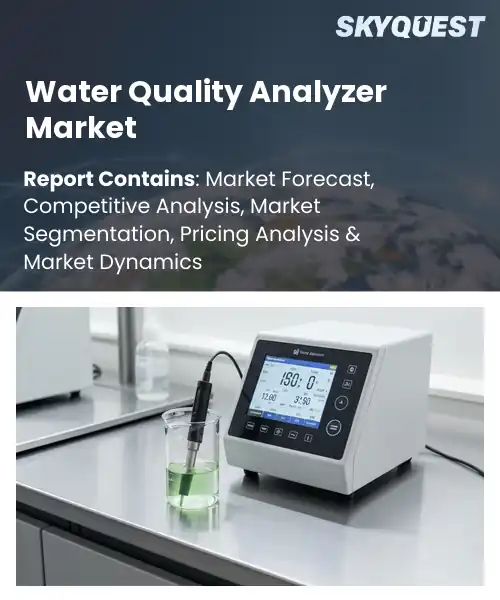
Water Quality Analyzer Market
Report ID: SQMIG45J2476
Report ID: SQMIG45J2476
[email protected]
USA +1 351-333-4748
Report ID:
SQMIG45J2476 |
Region:
Global |
Published Date: June, 2026
Pages:
157
|Tables:
119
|Figures:
77


Global Water Quality Analyzer Market size was valued at USD 4.70 Billion in 2024 and is poised to grow from USD 4.94 Billion in 2025 to USD 7.29 Billion by 2033, growing at a CAGR of 5.0% during the forecast period (2026-2033).
The primary driver of the water quality analyzer market trends is rising regulatory pressure and public demand for safe water, which has transformed a scientific instrument sector into a vital component of municipal, industrial and environmental monitoring. These analyzers measure parameters such as pH, dissolved oxygen, turbidity and conductivity to detect contamination and ensure compliance, and adoption accelerated as governments tightened discharge limits and high-profile contamination incidents raised awareness. Over time the market evolved from laboratory bench instruments to automated inline and remote sensors, with smart meters in cities and continuous monitors at wastewater plants delivering near-real-time data for rapid response.
Building on regulatory impetus, technological miniaturization and IoT integration constitute a key factor driving water quality analyzer market growth because sensor advances lower costs and enable distributed monitoring, which in turn expands applications across utilities, agriculture and aquaculture. As compact optical and electrochemical sensors became cheaper and more power-efficient, municipalities deployed networks of low-cost sondes to detect algal blooms earlier, while food processors used inline analyzers to prevent contamination and reduce recalls. Consequently vendors now offer subscription analytics and predictive maintenance, creating recurring revenue and incentivizing R&D, and investment flows into platforms that combine cloud analytics with sensor fleets create scalable market opportunities.
How is IoT Improving Remote Monitoring in the Water Quality Analyzer Market?
IoT is improving remote monitoring in the water quality analyzer market share by linking distributed sensors to networks that stream continuous, contextual data to cloud platforms. Key aspects are sensor connectivity, edge processing to clean and prioritize signals, automated alerts for anomalies, and remote diagnostics to reduce site visits. The current state sees vendors adding low power wide area connectivity and digital instrument interfaces so utilities and industrial users can shift from episodic sampling to ongoing oversight. Market pressure from regulation and the need for operational resilience is driving adoption. Examples from established sensor makers and platform providers show how remote visibility accelerates response times and lowers maintenance burdens for treatment plants and environmental monitoring.
Emerson May 2026, launched a new digital anti coating pH sensor that combines robust sensing with networked telemetry to deliver more reliable remote measurements and reduced maintenance, helping utilities scale IoT monitoring and improve operational efficiency.
Market snapshot - (2026-2033)
Global Market Size
USD 4.7 Billion
Largest Segment
Benchtop Laboratory Analyzers
Fastest Growth
Online In-Line Process Analyzers
Growth Rate
5.0% CAGR
To get more insights on this market click here to Request a Free Sample Report
Global water quality analyzer market is segmented by product configuration portfolio, parameter analysis focus, end-use industry, distribution channel and region. Based on product configuration portfolio, the market is segmented into benchtop laboratory analyzers, portable field meters and online in-line process analyzers. Based on parameter analysis focus, the market is segmented into physical parameters, chemical parameters and biological parameters. Based on end-use industry, the market is segmented into municipal water utilities, chemicals & petrochemicals, food & beverages, energy & utilities, healthcare & pharmaceuticals and others. Based on distribution channel, the market is segmented into direct and indirect. Based on region, the market is segmented into North America, Europe, Asia Pacific, Latin America, and Middle East & Africa.
Benchtop laboratory analyzers segment dominates because it provides the highest analytical precision and comprehensive measurement suites required by laboratories and regulatory testing. Complex water quality assessments default to benchtop systems because of their specialized instrument capabilities, validated methods and compliance with standardized protocols. This leads to procurement preference among professional users, creating a steady demand with reliability, traceability, and extended instrument lifecycles that complement compliance and research workflows.
However the fastest growing are portable field meters as field deployability, rapid on site decisions and intuitive interfaces drive adoption across utilities and industry. Advances in compact sensors, simplified calibration and mobile data capture are lowering barriers to routine monitoring and enabling new service models that unlock broader operational opportunities.
The chemical parameters segment is the leading area of growth due to regulations and procedures that emphasize the importance of measuring dissolved materials to ensure adequate public health and integrity of all treatment processes. Continuous measurement of chemical parameters provides insight into how effective chemical treatments continue to maintain compliance with effluent limits, corrosion and scale control. Therefore, the ongoing investment in strong chemical sensing technologies, and their associated analytical platforms, provides operators with real-time data on the concentration of chemicals and thus influences their decision-making.
Although the chemical parameters segment remains the main area of investment, biological parameters represent the fastest growing area of investment as identified by the growing emphasis placed on detecting pathogens and other microbial hazards, which has created an increased need for rapid, culture-free methods of detection. Developments in biosensing technology, methodologies based on real-time detection of DNA and reduced detection barriers through simplified sampling have led to the expansion of biosensing applications throughout the treatment, utility, and industrial sectors, thereby creating expanded opportunities for specialized analytical service providers.
To get detailed segments analysis, Request a Free Sample Report
North America commands the global water quality analyzer market due to a convergence of advanced regulatory expectations, mature water infrastructure, and high uptake of digital monitoring technologies. There is a large demand for certified analytical equipment and service contracts due to the wide-ranging industrial base, and there are many municipalities with systems that require this type of equipment. Strong manufacturing and engineering capability in the United States contributes to sensor development, and there are extensive distribution and aftermarket networks in place to provide rapid deployment and maintenance of these products. Collaboration among research organizations, utilities, and private vendors helps to establish product validation and performance benchmarks and promotes procurement methods that favour systems that are interoperable and provide guaranteed support by the vendor. A focus on compliance, operational resilience, and integration of analyzers into broader asset management approaches further enhances regional leadership, and will affect how global technical standards are developed and adopted.
Water quality analyzer market forecast in United States is driving the demand for advanced analyzers with remote connectivity and robust service networks due to extensive municipal and industrial monitoring requirements. A competitive ecosystem of innovation, testing labs and procurement frameworks that reward proven performance is good for vendors. Concentrating on utility asset management, operator training and aftersales support propels replacement cycles and the take-up of integrated monitoring solutions across a range of water management applications.
Water quality analyzer market outlook in Canada is driven by the need to safeguard sensitive watersheds and support water systems in remote communities, which creates demand for rugged analyzers and field service capabilities. Procurement is focused on long-term reliability and vendor support, incentivizing suppliers to offer customizable solutions and local service partnerships. The utilities’ partnerships with research centers offer opportunities for validation of new technologies. Distribution channels are evolving to meet the needs of dispersed geographic and regulatory requirements.
Asia Pacific is experiencing rapid expansion in the water quality analyzer market penetration is driven by intensified focus on urban water security, industrial compliance, and modernization of municipal treatment systems. Innovation has been encouraged by the increasing need for small, low-maintenance test devices that are ideal for high population density city areas and industrial parks. Local suppliers are modifying their products for the requirement of local conditions as international vendors form partnerships and service coverage areas. With policy-focused growth on water resource management and public health as a priority for monitoring purposes, the rise of digital integration will facilitate greater centralised managerial control over widely spread networks. Market growth is supported by procurement that seeks cost effective, scalable solutions and by cross border knowledge transfer that accelerates adoption of advanced analytical platforms and maintenance models. Expanding technical talent pools and strengthening aftermarket service capabilities further underpin market resilience and long term uptake.
Water quality analyzer market analysis in Japan benefits from a strong culture of precision engineering and innovation, resulting in high quality sensors and integrated monitoring platforms tailored to demanding applications. Collaboration between manufacturers, research institutions, and utilities drives validation of novel technologies and rapid incorporation into treatment operations. Domestic procurement emphasizes reliability and maintenance efficiency, encouraging companies to provide service agreements and modular systems integrating with broader smart water management initiatives.
Water quality analyzer industry in South Korea is characterized by the fast adoption of digital monitoring and automation in industrial and municipal systems supported by strong domestic electronics capabilities and supplier ecosystem. Local manufacturers are developing compact, networked analyzers that fit into smart plant initiatives, while service providers focus on field support and calibration. Governmental focus on clean water and industrial compliance encourages partnerships that validate new technologies and deploy effectively.
The European water quality analyzer marketplace is growing due to supportive regulations, universal data collection methodologies and a growing focus on environmental protection and resource efficiency. Each new marketplace development is backed by an established industrial base that includes high-precision measuring devices; total quality assurance processes and complete service offerings across the full product lifecycle. Public procurement is supporting this growth through a preference for integrated solutions that can be retrofitted to existing treatment facilities, while the regulatory environment is driving the need for continuous monitoring and transparency of data. Coordination among regulatory authorities, utilities, and technology vendors across national boundaries is facilitating interoperability and exchanging best practices. Investment in R&D and pilot projects has accelerated the adoption of low power, modular water quality analyzers and helped develop competitive domestic manufacturers that are setting technical standards and service models for the global market. Nationally recognized standards organizations and industry-wide certification procedures are helping create market confidence in buyers and, as a result, providing consistency in technical specifications within national markets. Manufacturers and service providers are developing strong aftermarket networks and collaborations that are providing long-term operational support and enabling efficiency in the delivery of municipal and industrial deployment projects.
Water quality analyzer industry trends in Germany engineering strength and manufacturing capabilities underpin a market that produces high precision analyzers for industrial and municipal users. Emphasis is placed on technical validation and sound aftersales engineering support, and vendors are encouraged to offer modular systems and complete calibration services. Cooperation with technical institutes and certification bodies ensures that the instruments meet stringent performance standards. Export routes allow domestic suppliers to influence technical expectations in markets.
Water quality analyzer market regional forecast in United Kingdom is driven by the significant focus on regulatory compliance, asset management and the adoption of digital monitoring. Suppliers compete on providing integrated solutions that combine accurate sensing and analytics and clear service agreements. Pilot partnerships between utilities, technology companies and academic centers help to validate technology and procurement is biased towards flexible systems that can be integrated into legacy infrastructure and contribute to operational resilience and service continuity.
Water quality analyzer market regional outlook in France is influenced by strong environmental policies and emphasis on water resource protection, prompting utilities to invest in continuous monitoring and validated analytical systems. Domestic suppliers and system integrators provide turnkey offerings that combine robust sensors with field services. Collaboration with research laboratories supports development of methodologies, while procurement tends to favor solutions that balance technical performance with lifecycle support and service availability and scalability.
To know more about the market opportunities by region and country, click here to
Buy The Complete Report
Increasing Regulatory Emphasis
Advances In Sensor Technologies
High Initial Capital Requirements
Data Management and Integration Challenges
Request Free Customization of this report to help us to meet your business objectives.
Competitive landscape in the global water quality analyzer market is driven by consolidation and targeted product innovation; incumbents pursue M&A and platform partnerships to sell bundled monitoring plus treatment services, exemplified by Xylem’s acquisition of Evoqua, while instrumentation vendors push advanced online analyzers and optical probes to win utility and industrial contracts as seen in recent Hach and ABB product rollouts.
Top Player’s Company Profile
Recent Developments in the Water Quality Analyzer Market
SkyQuest’s ABIRAW (Advanced Business Intelligence, Research & Analysis Wing) is our Business Information Services team that Collects, Collates, Correlates, and Analyses the Data collected by means of Primary Exploratory Research backed by robust Secondary Desk research. As per SkyQuest analysis, the global water quality analyzer market is propelled by rising regulatory pressure and public demand for safe water, which drives continuous monitoring and procurement of advanced instruments. A restraint is high initial capital requirements that can slow adoption among smaller utilities. The dominating region is North America, supported by mature infrastructure and rapid technology uptake, while the dominating segment remains benchtop laboratory analyzers due to their precision and compliance suitability. A second driver is sensor miniaturization and IoT-enabled remote monitoring, which lower costs, enable distributed networks and introduce subscription analytics that create recurring revenue and spur further investment across utilities and industry.
| Report Metric | Details |
|---|---|
| Market size value in 2024 | USD 4.7 Billion |
| Market size value in 2033 | USD 7.29 Billion |
| Growth Rate | 5.0% |
| Base year | 2024 |
| Forecast period | (2026-2033) |
| Forecast Unit (Value) | USD Billion |
| Segments covered |
|
| Regions covered | North America (US, Canada), Europe (Germany, France, United Kingdom, Italy, Spain, Rest of Europe), Asia Pacific (China, India, Japan, Rest of Asia-Pacific), Latin America (Brazil, Rest of Latin America), Middle East & Africa (South Africa, GCC Countries, Rest of MEA) |
| Companies covered |
|
| Customization scope | Free report customization with purchase. Customization includes:-
|
To get a free trial access to our platform which is a one stop solution for all your data requirements for quicker decision making. This platform allows you to compare markets, competitors who are prominent in the market, and mega trends that are influencing the dynamics in the market. Also, get access to detailed SkyQuest exclusive matrix.
Table Of Content
Executive Summary
Market overview
Parent Market Analysis
Market overview
Market size
KEY MARKET INSIGHTS
COVID IMPACT
MARKET DYNAMICS & OUTLOOK
Market Size by Region
KEY COMPANY PROFILES
Methodology
For the Water Quality Analyzer Market, our research methodology involved a mixture of primary and secondary data sources. Key steps involved in the research process are listed below:
1. Information Procurement: This stage involved the procurement of Market data or related information via primary and secondary sources. The various secondary sources used included various company websites, annual reports, trade databases, and paid databases such as Hoover's, Bloomberg Business, Factiva, and Avention. Our team did 45 primary interactions Globally which included several stakeholders such as manufacturers, customers, key opinion leaders, etc. Overall, information procurement was one of the most extensive stages in our research process.
2. Information Analysis: This step involved triangulation of data through bottom-up and top-down approaches to estimate and validate the total size and future estimate of the Water Quality Analyzer Market.
3. Report Formulation: The final step entailed the placement of data points in appropriate Market spaces in an attempt to deduce viable conclusions.
4. Validation & Publishing: Validation is the most important step in the process. Validation & re-validation via an intricately designed process helped us finalize data points to be used for final calculations. The final Market estimates and forecasts were then aligned and sent to our panel of industry experts for validation of data. Once the validation was done the report was sent to our Quality Assurance team to ensure adherence to style guides, consistency & design.
Analyst Support
Customization Options
With the given market data, our dedicated team of analysts can offer you the following customization options are available for the Water Quality Analyzer Market:
Product Analysis: Product matrix, which offers a detailed comparison of the product portfolio of companies.
Regional Analysis: Further analysis of the Water Quality Analyzer Market for additional countries.
Competitive Analysis: Detailed analysis and profiling of additional Market players & comparative analysis of competitive products.
Go to Market Strategy: Find the high-growth channels to invest your marketing efforts and increase your customer base.
Innovation Mapping: Identify racial solutions and innovation, connected to deep ecosystems of innovators, start-ups, academics, and strategic partners.
Category Intelligence: Customized intelligence that is relevant to their supply Markets will enable them to make smarter sourcing decisions and improve their category management.
Public Company Transcript Analysis: To improve the investment performance by generating new alpha and making better-informed decisions.
Social Media Listening: To analyze the conversations and trends happening not just around your brand, but around your industry as a whole, and use those insights to make better Marketing decisions.
REQUEST FOR SAMPLE
 REQUEST FREE CUSTOMIZATION
Global Water Quality Analyzer Market size was valued at USD 4.7 Billion in 2024 and is poised to grow from USD 4.94 Billion in 2025 to USD 7.29 Billion by 2033, growing at a CAGR of 5.0% during the forecast period (2026-2033).
Competitive landscape in the global water quality analyzer market is driven by consolidation and targeted product innovation; incumbents pursue M&A and platform partnerships to sell bundled monitoring plus treatment services, exemplified by Xylem’s acquisition of Evoqua, while instrumentation vendors push advanced online analyzers and optical probes to win utility and industrial contracts as seen in recent Hach and ABB product rollouts. 'Danaher Corporation', 'Thermo Fisher Scientific', 'Xylem Inc', 'Agilent Technologies', 'Shimadzu Corporation', 'Horiba', 'Honeywell International', 'Siemens AG', 'Emerson Electric', 'Yokogawa Electric', 'Endress+Hauser', 'ABB Ltd', 'Teledyne Technologies', 'Ametek', 'Metrohm AG', 'Mettler-Toledo International', 'Suez SA', 'Veolia Environnement', 'Jasco Corporation', 'YSI Incorporated'
Enhanced regulatory emphasis on water safety and discharge standards prompts utilities, industrial facilities, and municipalities to prioritize continuous monitoring and compliance. This requirement leads organizations to invest in reliable water quality analyzers to ensure adherence to prescribed limits and to avoid operational disruptions. As a result, demand for online and portable analyzers grows, encouraging suppliers to expand product portfolios and support services. The collective response to regulatory pressure thereby stimulates procurement cycles, technology adoption, and ongoing maintenance services across the market ecosystem.
Decentralized Monitoring Adoption: Adoption of decentralized monitoring hardware is accelerating use of portable and in-situ water quality analyzers across utilities, industrial sites, and remote installations. Operators favor localized measurement to enable faster operational decisions, tailored treatment strategies, and reduced transport burdens. This trend emphasizes ruggedized instruments, simplified maintenance, and stakeholder empowerment, shifting investment toward scalable fleets of analyzers that integrate with operational workflows. The outcome is enhanced situational awareness, more responsive management of contamination events, and closer alignment between monitoring and process control.
Why does North America Dominate the Global Water Quality Analyzer Market? |@12


Want to customize this report? This report can be personalized according to your needs. Our analysts and industry experts will work directly with you to understand your requirements and provide you with customized data in a short amount of time. We offer $1000 worth of FREE customization at the time of purchase.
Feedback From Our Clients


 USA (+1) 351-333-4748

