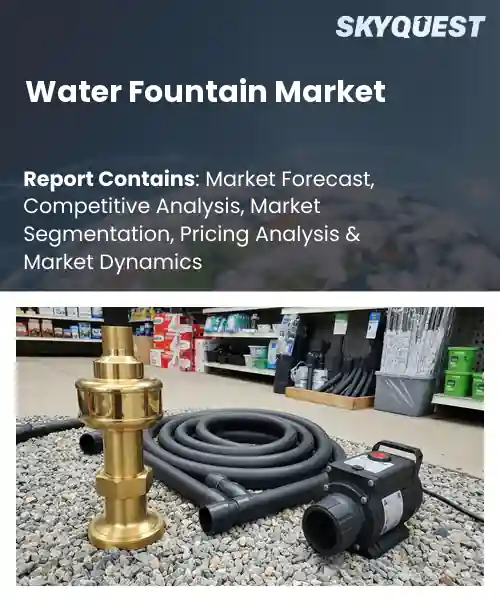
Water Fountain Market
Report ID: SQMIG25I2081
Report ID: SQMIG25I2081
[email protected]
USA +1 351-333-4748
Report ID:
SQMIG25I2081 |
Region:
Global |
Published Date: June, 2026
Pages:
157
|Tables:
142
|Figures:
78


Global Water Fountain Market size was valued at USD 2.8 Billion in 2024 and is poised to grow from USD 2.89 Billion in 2025 to USD 3.72 Billion by 2033, growing at a CAGR of 3.2% during the forecast period (2026-2033).
Urban placemaking and design constitute the primary driver of the water fountain market because cities and developers prioritize dynamic public spaces that attract visitors and stimulate business activity. Water fountains have transitioned from purely ornamental structures into multifunctional installations that anchor plazas, shopping districts, and cultural precincts, and their role has expanded alongside tourism and retail trends. In recent decades the industry shifted toward programmable hydraulics, integrated LED lighting, and closed loop water management to meet sustainability and spectacle demands. Signature projects, such as choreographed hotel displays and renovated waterfront promenades, demonstrate how strategic fountain investment increases footfall and revenue.
Building on urban placemaking, regulatory pressure to conserve water is a decisive growth driver because scarcity forces operators to adopt recirculating treatment technologies. As municipalities set higher efficiency standards, suppliers develop smart filtration and remote monitoring that lower operating costs and enable larger aesthetic investments. Lower costs create demand for choreographed installations in tourism hubs and for modular solutions in mixed developments, which in turn expand vendor revenues through design, installation, and long term maintenance contracts. Real world examples such as municipal plaza retrofits and resort fountain commissions show how regulation led innovation opens retrofit markets and recurring service streams.
How is IoT Enhancing Operational Efficiency in the Commercial Water Fountain Market?
IoT enhances operational efficiency in the commercial water fountain market by connecting sensors control and cloud analytics. Key aspects include remote monitoring of flow and quality predictive maintenance that flags filter or pump issues and automated alerts for leaks or abnormal usage. The current market is moving from standalone fixtures to managed devices that reduce manual checks and extend service life. Vendors integrate IoT with building management for centralized oversight. Examples range from smart bottle fillers that report usage to cloud platforms that schedule maintenance based on actual wear making operations more responsive and cost effective.
In January 2026, Sloan expanded its SC Argus Pro smart restroom platform to include bottle filler monitoring and remote management demonstrating how IoT sensors and cloud analytics reduce unnecessary service visits enable remote troubleshooting and optimize water use across facilities which supports market growth through lower operating cost and better uptime.
Market snapshot - (2026-2033)
Global Market Size
USD 2.8 Billion
Largest Segment
Outdoor Water Fountains
Fastest Growth
Outdoor Water Fountains
Growth Rate
3.2% CAGR
To get more insights on this market click here to Request a Free Sample Report
Global water fountain market is segmented by product type, core material composition, end-use industry, sales channel, distribution channel and region. Based on product type, the market is segmented into indoor water fountains and outdoor water fountains. Based on core material composition, the market is segmented into stone & marble, ceramic & glass, metal & stainless steel and resin & fiberglass. Based on end-use industry, the market is segmented into commercial hospitality & real estate, residential properties and municipal & public infrastructure. Based on sales channel, the market is segmented into online and offline. Based on distribution channel, the market is segmented into direct and indirect. Based on region, the market is segmented into North America, Europe, Asia Pacific, Latin America and Middle East & Africa.
Based on the global water fountain market growth, indoor water fountains segment dominates because it aligns with growing demand for integrated interior design and multifunctional decor, offering compact installation, controlled water circulation, and year round usability that suit residential and hospitality interiors. Its compatibility with smart controls and easy maintenance encourages specification by designers and property developers, while customization in finishes and lighting drives aesthetic differentiation and repeat purchases across projects seeking indoor ambiance and wellness focused spaces.
However, outdoor water fountains are the fastest growing area as outdoor living trends and landscape design prioritize permanent water features that enhance curb appeal. Advances in weather resistant materials and modular installation reduce labor and broaden adoption across residential landscapes, commercial plazas and hospitality exteriors, accelerating demand and enabling diversified product applications.
Stone & marble segment stands out because its innate perception of luxury, durability, and architectural permanence drives specification in high end hospitality, corporate lobbies, and premium residential projects seeking landmark features. The material's ability to be sculpted into bespoke forms and finishes supports designer led differentiation, while long service life and low perceived risk justify higher price points and sustained investment by developers and facility managers prioritizing prestige and timeless aesthetics.
Conversely, resin & fiberglass is emerging as the most rapidly expanding material choice due to lightweight manufacturability, cost efficiency and ease of customization that accelerate product iterations and deployment. Advances in composite formulations and finishes boost durability and visual fidelity, enabling broader adoption across residential installations and temporary public art, unlocking new commercial opportunities.
To get detailed segments analysis, Request a Free Sample Report
As per the global water fountain market share, Asia Pacific leads the industry due to a confluence of robust urban development strategies, strong public and private investment in public amenities, and a cultural emphasis on integrated recreational spaces. Technological adoption is advanced among infrastructure providers and manufacturers, enabling a wide range of product offerings and customization for municipal and commercial projects. Collaborative ecosystems among local manufacturers, service providers, and design firms accelerate deployment and aftersales support. Regulatory frameworks that prioritize public health and water conservation encourage higher specification products. Growing preference for aesthetic public installations and smart, low maintenance systems further strengthens regional demand and positions Asia Pacific as the dominant market player with deep supply chain integration and scalable project execution capability. Cross border partnerships and increasing focus on sustainability in public projects sustain long term momentum and create avenues for innovation, service differentiation, and durable product lifecycles.
Water fountain market in Japan benefits from mature manufacturing capabilities, strong design expertise, and a focus on precision engineering that supports high quality installations and advanced control systems for municipal and commercial projects. Local demand is driven by urban renewal programs and emphasis on public amenity aesthetics. Close collaboration between designers, contractors, and suppliers enhances customization, aftersales support, and long term reliability expectations across municipal, commercial, and cultural installation projects nationwide.
Water fountain market in South Korea reflects strong integration of design driven public spaces, advanced water treatment adoption, and responsive local manufacturing that supports tailored installations for urban and corporate campuses. Municipal initiatives emphasize multifunctional, low maintenance fountains with integrated lighting. Partnerships between technology providers and landscape architects facilitate solutions adapted to local climate and space constraints. Aftermarket service networks focus on consistent maintenance and lifecycle support to ensure sustained operation.
Based on global water fountain regional forecast, North America is experiencing rapid expansion in the industry driven by a combination of infrastructure reinvestment priorities, emphasis on public health and accessible drinking water, and strong demand from commercial property owners for amenity driven placemaking. Innovation from technology vendors in efficient water treatment, touchless operation, and modular designs improves deployment flexibility and maintenance economics. Municipal procurement increasingly favors reliable, low maintenance solutions and vendors who can provide integrated services. Private sector interest in branded installations and experiential public spaces further expands project types. Well developed distribution networks and service ecosystems enable faster rollout and aftermarket support, strengthening North America position as a dynamic and fast evolving market for both standard and premium fountain solutions. Collaboration between manufacturers and local service providers further enhances customization and regional responsiveness, helping stakeholders meet varying site and regulatory requirements.
Water fountain market United States is characterized by diverse procurement channels across municipalities, corporate campuses, and developments, with emphasis on accessibility, durability, and ease of maintenance. Demand favors modular solutions and technology enabled features such as touchless operation and advanced filtration. Strong networks of distributors, installers, and service providers support rapid deployment and maintenance. Design focused projects integrate fountains into placemaking strategies, driving specification of aesthetic and low maintenance systems.
Water fountain market in Canada reflects municipal focus on accessible potable water solutions and durable public amenities suited to varied climates. Preference for low maintenance, energy efficient systems guides procurement and park planning. Local suppliers work with design firms to deliver context sensitive installations addressing landscape and user needs. Service networks prioritize preventive maintenance and prompt response. Public projects favor fountains that balance aesthetic appeal with operational simplicity and environmental stewardship.
As per global water fountain regional outlook, Europe is strengthening its position in the industry through a combination of heritage driven urban renewal, stringent water quality and sustainability expectations, and a sophisticated design culture that values integration of public art and functionality. Manufacturers and specification professionals emphasize durable materials, water efficient systems, and bespoke aesthetic treatments that align with preservation and contemporary urban design requirements. Collaborative projects between local authorities, cultural institutions, and private developers encourage innovative installations that serve both civic and commercial objectives. Robust service networks and a focus on long term maintenance standards ensure installed systems meet high performance and public amenity expectations, reinforcing Europe role as a market with discerning buyers and high specification projects. Emphasis on circular economy principles and certification frameworks motivates manufacturers to adopt recyclable materials, efficient water recirculation, and service models that prioritize longevity and resource conservation.
Water fountain market in Germany emphasizes engineering quality, durable materials, and compliance with stringent water and environmental standards, yielding reliable public and commercial installations. Specifications balance functional efficiency with restrained design preferred by urban planners and architects. Manufacturers coordinate with service providers to deliver turnkey solutions that address maintenance and lifecycle needs. Procurements favor systems integrating efficient filtration, responsive controls, and robust construction to meet operational expectations across varied urban settings.
Water fountain market in United Kingdom combines strong heritage conservation with contemporary urban regeneration, prompting solutions that respect historic contexts while offering modern functionality. Planners and heritage bodies influence specifications, encouraging bespoke designs and sensitive material choices. Market actors prioritize water quality assurance, energy efficient operation, and maintainability. Collaboration between landscape architects, conservators, and technology providers yields installations that function as civic amenities and cultural assets, supported by local maintenance networks.
Water fountain market in France blends tradition of public square design with emphasis on environmental performance and urban livability. Municipal procurement favors installations that combine sculptural expression with efficient water management and low maintenance requirements. Local designers and fabricators collaborate to produce works that respond to heritage contexts and modern urban dynamics. Service arrangements emphasize preventive maintenance and component availability to preserve aesthetic quality and ensure continuous public amenity function overall.
To know more about the market opportunities by region and country, click here to
Buy The Complete Report
Urbanization and Infrastructure Expansion
Enhanced Water Quality Awareness
High Initial Installation Costs
Regulatory and Regional Variability
Request Free Customization of this report to help us to meet your business objectives.
Competition in the global water fountain market outlook has sharpened as operators prioritize sustainability led venue partnerships, IoT enabled refill networks, and capitalization to scale. Market drivers include corporate sustainability mandates and venue level service contracts. Firms pursue partnerships and funding backed rollouts, illustrated by Bluewater’s large event refill deployments and FloWater’s funding driven product expansion, alongside beverage sector consolidation such as PepsiCo’s SodaStream acquisition.
Top Player’s Company Profile
Recent Developments
SkyQuest’s ABIRAW (Advanced Business Intelligence, Research & Analysis Wing) is our Business Information Services team that Collects, Collates, Correlates, and Analyses the Data collected by means of Primary Exploratory Research backed by robust Secondary Desk research.
As per SkyQuest analysis, the global water fountain industry is being driven primarily by urban placemaking and design, which push developers and cities to invest in aesthetic, multifunctional installations, while a second important driver is regulatory pressure to conserve water that accelerates adoption of recirculating treatment and smart monitoring. A significant restraint remains high initial installation costs that can delay projects and favor simpler alternatives. Asia Pacific currently dominates the market thanks to rapid urban development and strong supply chains, and indoor water fountains are the leading segment due to compatibility with interior design, year‑round use, and integration with smart controls, offering steady demand across residential and hospitality settings.
| Report Metric | Details |
|---|---|
| Market size value in 2024 | USD 2.8 Billion |
| Market size value in 2033 | USD 3.72 Billion |
| Growth Rate | 3.2% |
| Base year | 2024 |
| Forecast period | (2026-2033) |
| Forecast Unit (Value) | USD Billion |
| Segments covered |
|
| Regions covered | North America (US, Canada), Europe (Germany, France, United Kingdom, Italy, Spain, Rest of Europe), Asia Pacific (China, India, Japan, Rest of Asia-Pacific), Latin America (Brazil, Rest of Latin America), Middle East & Africa (South Africa, GCC Countries, Rest of MEA) |
| Companies covered |
|
| Customization scope | Free report customization with purchase. Customization includes:-
|
To get a free trial access to our platform which is a one stop solution for all your data requirements for quicker decision making. This platform allows you to compare markets, competitors who are prominent in the market, and mega trends that are influencing the dynamics in the market. Also, get access to detailed SkyQuest exclusive matrix.
Table Of Content
Executive Summary
Market overview
Parent Market Analysis
Market overview
Market size
KEY MARKET INSIGHTS
COVID IMPACT
MARKET DYNAMICS & OUTLOOK
Market Size by Region
KEY COMPANY PROFILES
Methodology
For the Water Fountain Market, our research methodology involved a mixture of primary and secondary data sources. Key steps involved in the research process are listed below:
1. Information Procurement: This stage involved the procurement of Market data or related information via primary and secondary sources. The various secondary sources used included various company websites, annual reports, trade databases, and paid databases such as Hoover's, Bloomberg Business, Factiva, and Avention. Our team did 45 primary interactions Globally which included several stakeholders such as manufacturers, customers, key opinion leaders, etc. Overall, information procurement was one of the most extensive stages in our research process.
2. Information Analysis: This step involved triangulation of data through bottom-up and top-down approaches to estimate and validate the total size and future estimate of the Water Fountain Market.
3. Report Formulation: The final step entailed the placement of data points in appropriate Market spaces in an attempt to deduce viable conclusions.
4. Validation & Publishing: Validation is the most important step in the process. Validation & re-validation via an intricately designed process helped us finalize data points to be used for final calculations. The final Market estimates and forecasts were then aligned and sent to our panel of industry experts for validation of data. Once the validation was done the report was sent to our Quality Assurance team to ensure adherence to style guides, consistency & design.
Analyst Support
Customization Options
With the given market data, our dedicated team of analysts can offer you the following customization options are available for the Water Fountain Market:
Product Analysis: Product matrix, which offers a detailed comparison of the product portfolio of companies.
Regional Analysis: Further analysis of the Water Fountain Market for additional countries.
Competitive Analysis: Detailed analysis and profiling of additional Market players & comparative analysis of competitive products.
Go to Market Strategy: Find the high-growth channels to invest your marketing efforts and increase your customer base.
Innovation Mapping: Identify racial solutions and innovation, connected to deep ecosystems of innovators, start-ups, academics, and strategic partners.
Category Intelligence: Customized intelligence that is relevant to their supply Markets will enable them to make smarter sourcing decisions and improve their category management.
Public Company Transcript Analysis: To improve the investment performance by generating new alpha and making better-informed decisions.
Social Media Listening: To analyze the conversations and trends happening not just around your brand, but around your industry as a whole, and use those insights to make better Marketing decisions.
REQUEST FOR SAMPLE
 REQUEST FREE CUSTOMIZATION
Global Water Fountain Market size was valued at USD 2.8 Billion in 2024 and is poised to grow from USD 2.89 Billion in 2025 to USD 3.72 Billion by 2033, growing at a CAGR of 3.2% during the forecast period (2026-2033).
Competition in the global water fountain market has sharpened as operators prioritize sustainability led venue partnerships, IoT enabled refill networks, and capitalization to scale. Market drivers include corporate sustainability mandates and venue level service contracts. Firms pursue partnerships and funding backed rollouts, illustrated by Bluewater’s large event refill deployments and FloWater’s funding driven product expansion, alongside beverage sector consolidation such as PepsiCo’s SodaStream acquisition. 'Elkay Manufacturing', 'Haws Corporation', 'Murdock Manufacturing', 'Oasis International', 'Canplas Industries', 'Bradley Corporation', 'Sloan Valve Company', 'Kohler Co', 'TOTO Ltd', 'LIXIL Corporation', 'Roca Sanitario', 'Geberit', 'Stern-Williams', 'Most Dependable Fountains', 'Filtrine Manufacturing Company', 'Aquafil', 'Culligan International', 'BWT Group', 'Brita', 'Waterlogic'
Urbanization and expansion of urban infrastructure have led municipal authorities and private developers to prioritize accessible public amenities, creating opportunities for the installation of water fountains in parks, transit hubs, and commercial centers. Growing concentrations of people in urban areas increase demand for convenient hydration points and aesthetic landscape features, prompting planners to integrate fountains into new and renovated projects. This drives procurement of diverse fountain types and supports service ecosystems including design, installation, and maintenance, thereby stimulating market adoption and supplier engagement.
Sustainable Material Adoption: Manufacturers and designers are prioritizing environmentally responsible materials and circular design principles to meet evolving consumer values and institutional procurement criteria. Preference for durable, recyclable composites and low impact finishes is driving product differentiation and supplier collaboration across the value chain. Emphasis on lifecycle considerations and maintenance efficiency reduces operational footprints and supports brand sustainability claims, enabling premium positioning in public and private projects while fostering partnerships with green certification programs and downstream recycling initiatives and encouraging supplier innovation today.
Why does Asia Pacific Dominate the Global Water Fountain Market? |@12


Want to customize this report? This report can be personalized according to your needs. Our analysts and industry experts will work directly with you to understand your requirements and provide you with customized data in a short amount of time. We offer $1000 worth of FREE customization at the time of purchase.
Feedback From Our Clients


 USA (+1) 351-333-4748

