Water and Wastewater Treatment Equipment Market
Report ID: SQMIG55D2016
Report ID: SQMIG55D2016
[email protected]
USA +1 351-333-4748
Report ID:
SQMIG55D2016 |
Region:
Global |
Published Date: July, 2025
Pages:
197
|Tables:
131
|Figures:
68


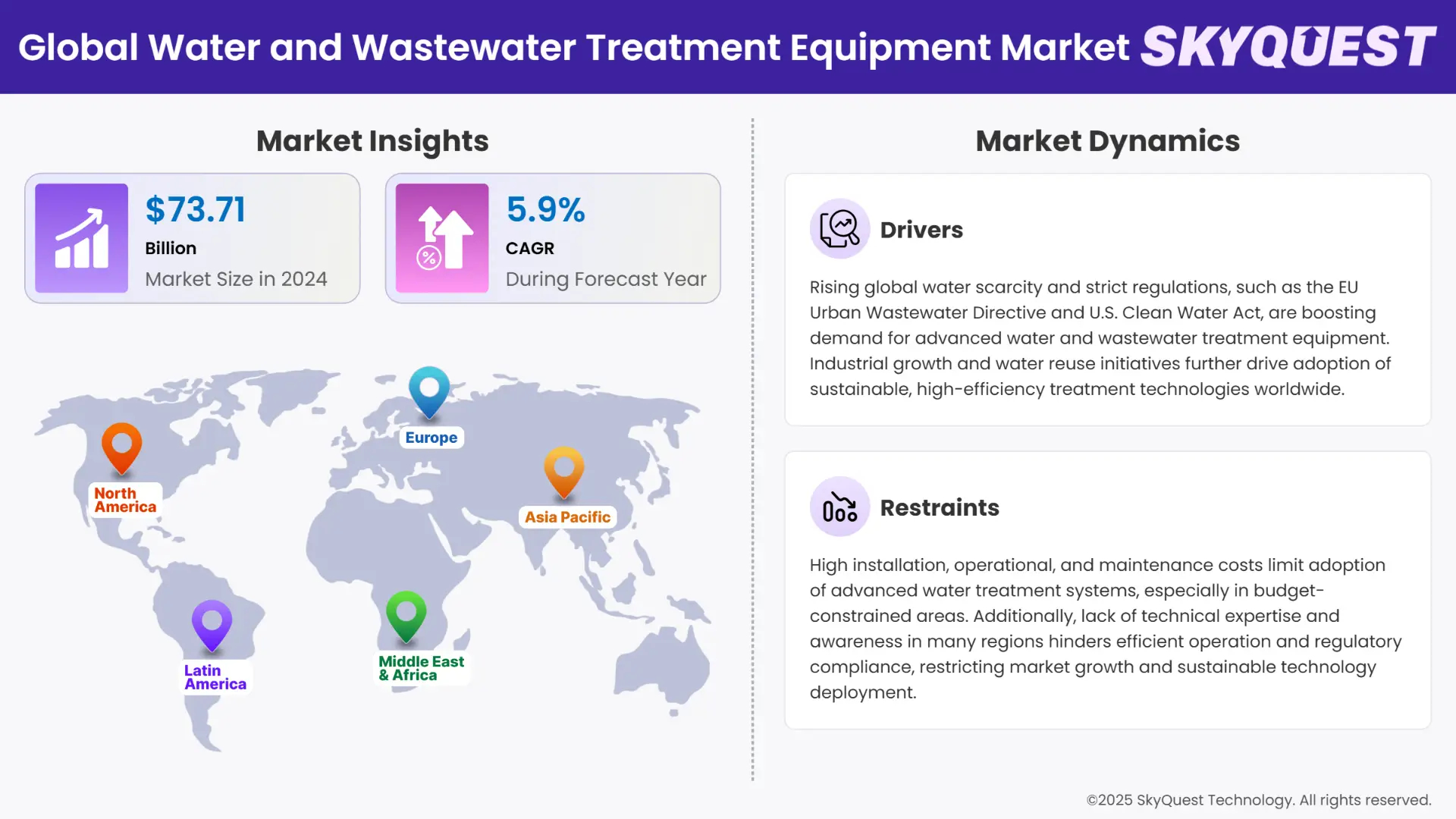
Global Water and Wastewater Treatment Equipment Market size was valued at USD 73.71 Billion in 2024 and is poised to grow from USD 78.06 Billion in 2025 to USD 123.48 Billion by 2033, growing at a CAGR of 5.9% during the forecast period (2026–2033).
The water and wastewater treatment equipment market continues to grow steadily as scarcity increases across the globe and industrialization expands. Urban population growth, together with the rate of compliance with stricter government environmental regulations and eco-friendliness, will continue to fuel demand. Governments and players in the private sector are investing significant sums of money to modernize infrastructure, particularly in developing economies. Developments in membrane technology, filtration systems, and smart monitoring systems will continue to bring positive change to the industry. As water reuse remains momentum in the market, the outlook will continue to remain positive for both municipal and industrial sectors.
With the rapid urbanization of developing countries and the rise of industrial growth, the demand for clean water and adequate wastewater disposal is on the rise. Strict government policies surrounding environmental pollutants allow industries to adopt advanced treatment system technology. Growing public awareness surrounding health and hygiene is driving demand for safe drinking water. Advancements in technology to allow IoT, energy-efficient filtration, and zero-liquid discharge systems will improve each respective operational efficiency. Growing importance of water reuse to food production in agriculture and manufacturing value chains will continue to affect market development for water reuse.
Although advanced treatment systems can be effective, the high installation and operational costs of the technology present challenges for smaller operations or in developing parts of the world. Add to the fact that notorious issues surround the lack of available skilled personnel and technical expertise for organizations practicing these systems so their intention can be fully utilized. Some areas of the world have out-of-date technology, and the employees or government infrastructure lack awareness of all available technology and systems to modernize and transition treatment systems. Fluctuations in raw material prices and limited funding in public sector projects may also slow down market growth. Additionally, regulatory complexities across different regions can create entry barriers for new market players.
How is Artificial Intelligence Reshaping the Landscape of Water and Wastewater Treatment Equipment?
IoT utilizes industrial-grade sensors dispersed throughout treatment systems to enable real-time monitoring of multiple critical parameters, including pH, turbidity, dissolved oxygen, flow rate, pressure, and concentrations of chemicals. This continuous flow of data enables improved data-driven decision-making in a proactive manner, providing early identification of anomalies, and optimization of equipment and system performance. Adaptive control mechanisms could respond to live inputs to alter operational flows or chemical dosing, improving water quality consistency and significantly reducing resource consumption.
The utilization of standard dashboards and mobile applications helps provide remote control of systems, regulatory compliance, and visibility for complex decentralized or legacy systems. In summary, IoT has the ability to measurably improve operational efficiency, reduce costs, and facilitate sustainability efforts across both municipal and industrial usages.
To get more insights on this market click here to Request a Free Sample Report
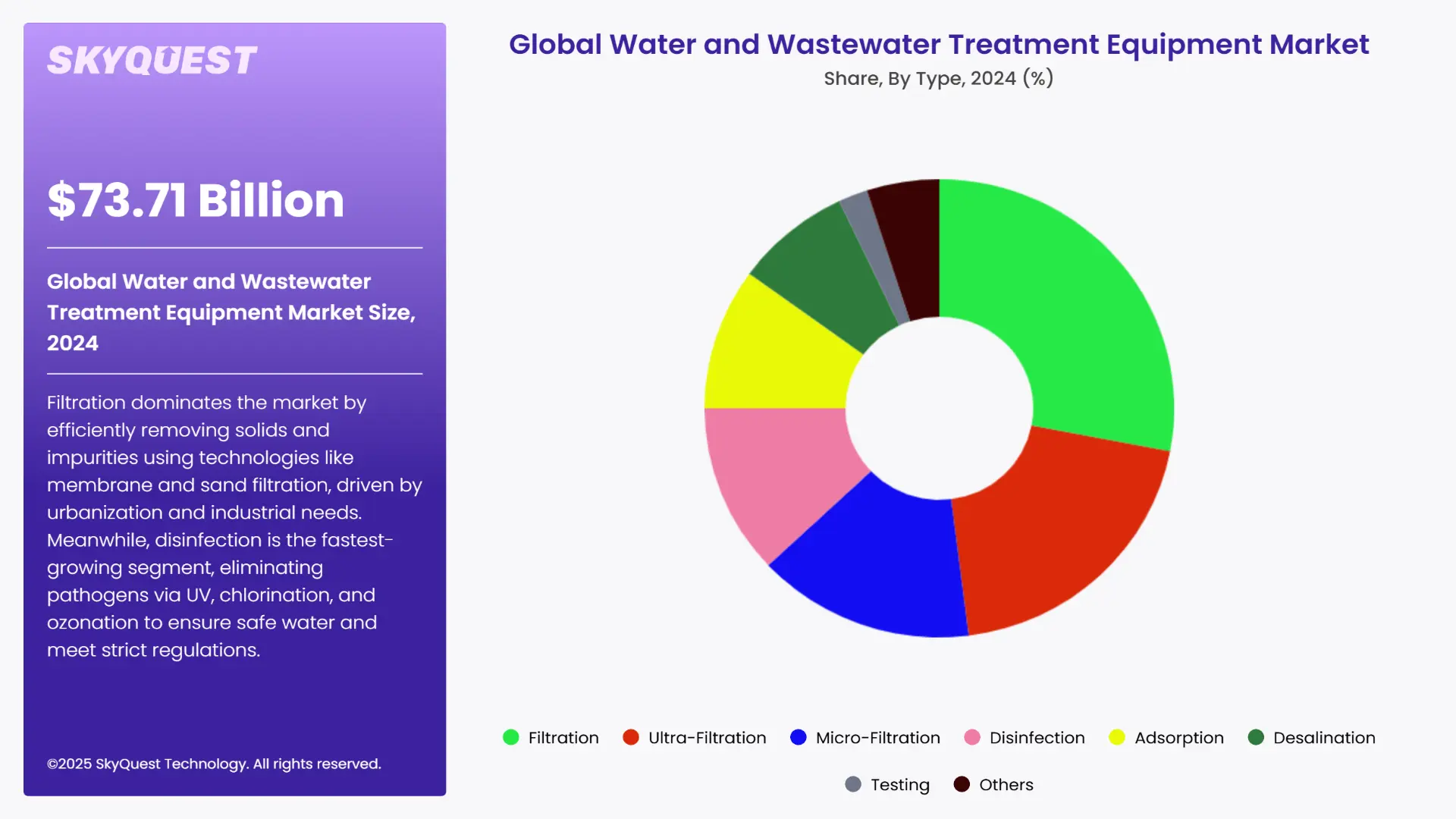
The global water and wastewater treatment equipment market is segmented by Type, Process, Equipment, Application and region. Based on Type, the market is segmented into Filtration, Ultra-Filtration, Micro-Filtration, Disinfection, Adsorption, Desalination, Testing and Others. Based on Process, the market is segmented into Primary Treatment, Secondary Treatment and Tertiary Treatment. Based on Equipment, the market is segmented into Membrane Separation, Biological, Disinfection, Sludge Dewatering and Others. Based on Application, the market is segmented into Municipal, Industrial, Oil & Gas, Pulp & Paper, Chemicals, Food & Beverage, Others, Power, Mining and Pharmaceuticals. Based on region, the water and wastewater treatment equipment market is segmented into North America, Europe, Asia Pacific, Latin America and Middle East & Africa.
Filtration is a critical segment of the water and wastewater treatment equipment market, focusing on removing suspended solids, particulates, and impurities from water through physical barriers. Technologies include sand filtration, membrane filtration (like microfiltration, ultrafiltration, and nanofiltration), and activated carbon filters. This segment is widely used in municipal and industrial applications to ensure compliance with water quality standards. Growing urbanization, increased industrial discharge, and the need for clean drinking water drive demand. Additionally, the rise in reuse and recycling of wastewater fuels filtration technology adoption due to its efficiency in pretreatment and polishing stages of water purification processes.
The disinfection segment plays a vital role in eliminating pathogenic microorganisms from water to ensure it is safe for human consumption and environmental discharge. Common disinfection methods include chlorination, ultraviolet (UV) irradiation, and ozonation. These technologies are essential in municipal water treatment plants, hospitals, pharmaceutical industries, and food processing units. Rising concerns over waterborne diseases and stringent regulations regarding water safety have led to the widespread adoption of disinfection equipment. Moreover, increasing awareness of chemical-free methods like UV treatment is driving innovation and investment in this segment. Disinfection ensures the final safety step in water treatment before distribution or reuse.
To get detailed segments analysis, Request a Free Sample Report
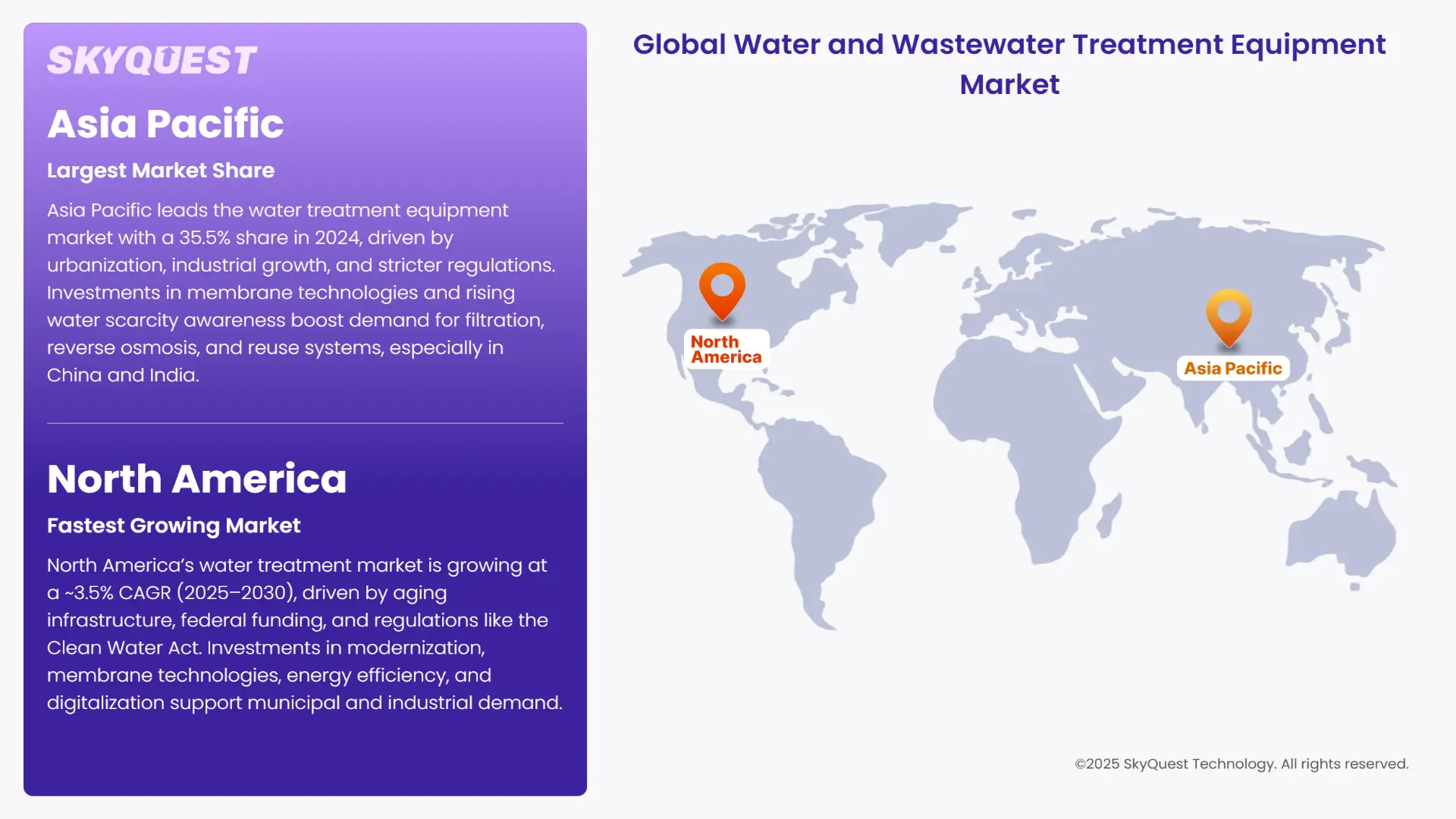
Asia Pacific holds the largest share—about 35.5 % of global water and wastewater treatment equipment market share in 2024—driven by rapid urbanization, industrial expansion, population growth, and tighter environmental regulations. Governments across the region are investing heavily in infrastructure, particularly in membrane‑based treatment technologies. High awareness around water scarcity, combined with rising industrial pollution, fuels adoption of membrane filtration, reverse osmosis and biological systems across municipal and industrial sectors. Demand for decentralized and reuse systems further accelerates growth in countries like China and India.
Japan Water and Wastewater Treatment Equipment Market
Japan’s water and wastewater treatment equipment market growth is supported by aging urban infrastructure and stringent water quality standards. Continuous upgrades to treatment equipment are prioritized to address environmental concerns and meet regulatory norms. Industrial sectors—including semiconductor manufacturing—demand ultrapure water, boosting adoption of membrane and advanced filtration technologies. A recent government initiative in 2025 launched a PPP program to retrofit municipal plants across major regions, leveraging public funding and private expertise to replace aging aeration and sludge systems with energy‑efficient alternatives.
South Korea Water and Wastewater Treatment Equipment Market
In South Korea, rapid industrialization and urban renewal programs are key drivers of water treatment investment. The government’s Green New Deal includes funding for smart water infrastructure, encouraging digital and energy‑efficient technologies. Compliance with strict effluent standards has accelerated uptake of advanced treatment gear like UV, nanofiltration, and sludge optimization. In early 2025, Seoul selected a consortium to implement real‑time monitoring across 10 municipal treatment plants, integrating sensors and cloud analytics to reduce downtime and enhance regulatory reporting.
North America water and wastewater treatment equipment market size is expanding steadily—projected CAGR ~3.5 % from 2025 to 2030—driven by aging infrastructure, federal funding, regulatory compliance, and sustainability priorities. The U.S. and Canada are investing in modernizing treatment systems to ensure resilient service, driven by Clean Water Act and Safe Drinking Water Act mandates. Public‑private partnerships, infrastructure funding programs, and urban development projects further support demand across municipal and industrial sectors. Key trends include membrane adoption, energy efficiency, and digitalization.
The United States Water and Wastewater Treatment Equipment Market
The U.S. water and wastewater treatment equipment market growth is driven by massive upgrades of aging municipal systems and industrial expansion, especially in oil, gas, and manufacturing. Federal programs like the Clean Water State Revolving Fund are funding modern membrane filtration, nanofiltration, and reverse osmosis installations. A recent development: San Antonio Water System is investing $163 million to upgrade its Clouse Water Recycling Center with new blowers and aeration basins—expected to yield over $1 million in annual energy savings and support operations through 2050.
Canada Water and Wastewater Treatment Equipment Market
Canada’s water and wastewater treatment equipment market share is expanding at ~3.8 % CAGR (2025–2030) supported by commitments to sustainability and freshwater ecosystem protection. Investments focus on remote communities and urban centres alike, tackling water scarcity and pollution. Recent projects include modernization of treatment plants in Ontario and BC, integrating membrane and UV systems. In mid‑2025, Canada announced a federal‑provincial initiative funding seven upgrade projects in indigenous and rural communities, including advanced treatment modules for drinking water and wastewater, improving reliability and eliminating boil‑water advisories.
Europe represents a mature but evolving market, driven by strict EU environmental regulations, focus on sustainability, and high consumer awareness. Adoption of advanced treatment technologies—including UV, ozone, nutrient removal, and energy‑efficient systems—is accelerating. Funding under EU cohesion and Green Deal initiatives supports modernization in municipal and industrial segments. Challenges include regulatory complexity and economic variability, but strong institutional support underpins steady demand.
Germany Water and Wastewater Treatment Equipment Market
Germany leads European uptake due to rigorous water treatment standards and industrial water reuse policies. Emphasis on reducing pollutant discharge, enhancing water recycling, and improving sludge treatment supports demand. In early 2025, Veolia inaugurated France‑Germany‑cross‑border membrane pilot collaborations (within Germany’s Rhine industrial corridor) to test energy‑efficient reverse osmosis units for chemical plants, reducing brine and enhancing wastewater reuse across borders.
France Water and Wastewater Treatment Equipment Market
In France, nutrient removal and agricultural wastewater treatment have spurred demand for equipment like biological reactors and UV disinfection. Investments under EU net‑zero targets drive innovation in energy‑efficient and resource‑recovering systems. A recent milestone: in November 2023 a Veolia‑Vendée Eau water reuse unit began operations as part of the Jourdain program, producing 1.5 million m³ drinking water during peak scarcity months—an example of advanced wastewater recycling at scale.
UK Water and Wastewater Treatment Equipment Market
The U.K. is the fastest‑growing European country within the water equipment market, driven by urban infrastructure renewal, regulatory tightening, and climate resilience planning. Municipalities are upgrading treatment plants with ozone, UV, and energy‑recovery systems. In mid‑2025, a UK government grant awarded a consortium led by SUEZ and Thames Water to retrofit a major wastewater treatment works with biogas recovery and enhanced nutrient removal, reducing carbon footprint and operational cost—attracting broad attention across the national water sector.
To know more about the market opportunities by region and country, click here to
Buy The Complete Report
Increasing Water Scarcity and Stringent Regulations
Industrial Growth and Water Reuse Initiatives
High Installation and Maintenance Costs
Lack of Technical Expertise and Awareness
Request Free Customization of this report to help us to meet your business objectives.
The competitive landscape in the water and wastewater treatment equipment market shows incumbent giants like Siemens, Veolia, Xylem, and Evoqua doubling down on smart, modular solutions—Siemens integrates its MindSphere platform for predictive maintenance while Evoqua pushes membrane bioreactors and reuse systems through strategic utility partnerships. These players differentiate by blending digital automation, regulatory compliance, and sustainability: Veolia leads in desalination and circular reuse adoption; Xylem focuses on intelligent disinfection systems meeting global standards.
Rising Adoption of Smart Water Treatment Technologies
Shift Toward Water Reuse and Circular Water Systems
SkyQuest’s ABIRAW (Advanced Business Intelligence, Research & Analysis Wing) is our Business Information Services team that Collects, Collates, Correlates, and Analyses the Data collected using Primary Exploratory Research backed by robust Secondary Desk research.
SkyQuest’s study suggests that the Water and Wastewater Treatment Equipment Market is expanding due to growing water scarcity and strict environmental regulations, which are driving demand for advanced filtration, membrane, and disinfection systems. However, high installation and operational costs remain a significant barrier, especially for small-scale users and in developing regions. Asia Pacific dominates the market, led by Japan and South Korea, due to strong regulatory frameworks and infrastructure upgrades. The municipal segment holds the largest share, driven by government investments in urban water systems. A second major driver is the rising adoption of water reuse technologies across industrial sectors, where closed-loop systems and zero-liquid discharge practices are gaining traction to reduce freshwater dependency and meet sustainability goals.
| Report Metric | Details |
|---|---|
| Market size value in 2024 | USD 73.71 Billion |
| Market size value in 2033 | USD 123.48 Billion |
| Growth Rate | 5.9% |
| Base year | 2024 |
| Forecast period | 2026–2033 |
| Forecast Unit (Value) | USD Billion |
| Segments covered |
|
| Regions covered | North America (US, Canada), Europe (Germany, France, United Kingdom, Italy, Spain, Rest of Europe), Asia Pacific (China, India, Japan, Rest of Asia-Pacific), Latin America (Brazil, Rest of Latin America), Middle East & Africa (South Africa, GCC Countries, Rest of MEA) |
| Companies covered |
|
| Customization scope | Free report customization with purchase. Customization includes:-
|
To get a free trial access to our platform which is a one stop solution for all your data requirements for quicker decision making. This platform allows you to compare markets, competitors who are prominent in the market, and mega trends that are influencing the dynamics in the market. Also, get access to detailed SkyQuest exclusive matrix.
Table Of Content
Executive Summary
Market overview
Parent Market Analysis
Market overview
Market size
KEY MARKET INSIGHTS
COVID IMPACT
MARKET DYNAMICS & OUTLOOK
Market Size by Region
KEY COMPANY PROFILES
Methodology
For the Water and Wastewater Treatment Equipment Market, our research methodology involved a mixture of primary and secondary data sources. Key steps involved in the research process are listed below:
1. Information Procurement: This stage involved the procurement of Market data or related information via primary and secondary sources. The various secondary sources used included various company websites, annual reports, trade databases, and paid databases such as Hoover's, Bloomberg Business, Factiva, and Avention. Our team did 45 primary interactions Globally which included several stakeholders such as manufacturers, customers, key opinion leaders, etc. Overall, information procurement was one of the most extensive stages in our research process.
2. Information Analysis: This step involved triangulation of data through bottom-up and top-down approaches to estimate and validate the total size and future estimate of the Water and Wastewater Treatment Equipment Market.
3. Report Formulation: The final step entailed the placement of data points in appropriate Market spaces in an attempt to deduce viable conclusions.
4. Validation & Publishing: Validation is the most important step in the process. Validation & re-validation via an intricately designed process helped us finalize data points to be used for final calculations. The final Market estimates and forecasts were then aligned and sent to our panel of industry experts for validation of data. Once the validation was done the report was sent to our Quality Assurance team to ensure adherence to style guides, consistency & design.
Analyst Support
Customization Options
With the given market data, our dedicated team of analysts can offer you the following customization options are available for the Water and Wastewater Treatment Equipment Market:
Product Analysis: Product matrix, which offers a detailed comparison of the product portfolio of companies.
Regional Analysis: Further analysis of the Water and Wastewater Treatment Equipment Market for additional countries.
Competitive Analysis: Detailed analysis and profiling of additional Market players & comparative analysis of competitive products.
Go to Market Strategy: Find the high-growth channels to invest your marketing efforts and increase your customer base.
Innovation Mapping: Identify racial solutions and innovation, connected to deep ecosystems of innovators, start-ups, academics, and strategic partners.
Category Intelligence: Customized intelligence that is relevant to their supply Markets will enable them to make smarter sourcing decisions and improve their category management.
Public Company Transcript Analysis: To improve the investment performance by generating new alpha and making better-informed decisions.
Social Media Listening: To analyze the conversations and trends happening not just around your brand, but around your industry as a whole, and use those insights to make better Marketing decisions.
REQUEST FOR SAMPLE
 REQUEST FREE CUSTOMIZATION
Global Water and Wastewater Treatment Equipment Market size was valued at USD 73.71 Billion in 2024 and is poised to grow from USD 78.06 Billion in 2025 to USD 123.48 Billion by 2033, growing at a CAGR of 5.9% during the forecast period (2026–2033).
Xylem Inc., Veolia Environnement S.A., Grundfos Holding A/S, Ebara Corporation, Kurita Water Industries Ltd., Kemira Oyj, Calgon Carbon Corporation, Alfa Laval AB, ITW Water Treatment, DuPont de Nemours, Inc., Aquatech International LLC, Ecolab Inc., SUEZ S.A., Pentair plc, Danaher Corporation, and Evoqua Water Technologies LLC.
The key driver of the Water and Wastewater Treatment Equipment Market is increasing water scarcity and stringent environmental regulations. Rapid urbanization, industrialization, and rising water pollution are accelerating demand for advanced treatment technologies to ensure clean water supplies and effective wastewater management.
The key market trend in the Water and Wastewater Treatment Equipment Market is the adoption of advanced and automated treatment technologies, including membrane filtration, UV disinfection, and IoT-enabled smart monitoring, to improve efficiency, reduce operating costs, and enable real-time water quality management.
Asia Pacific accounted for the largest share of the Water and Wastewater Treatment Equipment Market in 2024, representing approximately 35.5% of the global market. Growth is supported by rapid urbanization, industrial expansion, rising water demand, infrastructure investments, and stricter environmental regulations.


Want to customize this report? This report can be personalized according to your needs. Our analysts and industry experts will work directly with you to understand your requirements and provide you with customized data in a short amount of time. We offer $1000 worth of FREE customization at the time of purchase.
Feedback From Our Clients


 USA (+1) 351-333-4748

