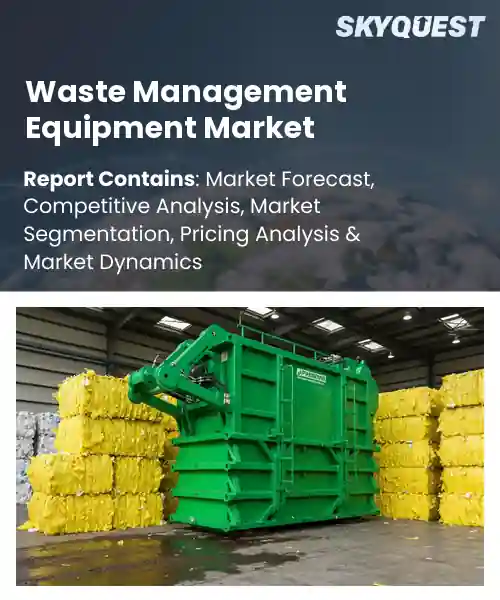
Waste Management Equipment Market
Report ID: SQMIG20I2724
Report ID: SQMIG20I2724
[email protected]
USA +1 351-333-4748
Report ID:
SQMIG20I2724 |
Region:
Global |
Published Date: February, 2026
Pages:
157
|Tables:
37
|Figures:
73


Global Waste Management Equipment Market size was valued at USD 16.8 Billion in 2024 and is poised to grow from USD 17.61 Billion in 2025 to USD 25.62 Billion by 2033, growing at a CAGR of 4.8% during the forecast period (2026-2033).
Stringent environmental regulations and resource recovery requirements are driving the waste management equipment industry, which include collection vehicles, compactors, sorting equipment, organic processors, and waste-to-energy systems. This market matters as it reduces landfill use, reduces greenhouse gas emissions, and recovers valuable materials before they become waste. Collectively, the waste management industry has developed from manual collections and manual baling in the past to mechanized trucks, automated optical sorting, and smart bins with sensors. Investment in the industry accelerated as a result of landmark regulations put pressure on municipalities and utility companies to upgrade their infrastructure.
The emergence of technology-based operational efficiency and regulatory compliance through digitalisation and automation has provided equipment suppliers with increased opportunities to integrate sensors. Artificial intelligence driven sorting systems into their products, and, thus, gain additional waste management equipment market share and develop service-based revenue streams. As collection routes get shorter and contamination rates decrease, municipalities will look to use the savings from collection costs to invest in advanced organic waste processing and waste-to-energy projects. Thus, creating greater demand for anaerobic digesters and combustion turbines. Pilot projects throughout Europe and elsewhere indicate that installation of sensor-enabled bins reduces the number of collection trips (by 40 percent), while the use of optical sorters increases the amount of recyclable material recovered. These two results demonstrate how the procurement cycle is driven by performance-related technology solutions, attracting private investment, and facilitating aftermarket service and retrofit opportunities worldwide.
How is IoT Improving Efficiency In The Waste Management Equipment Market?
By linking telematics, sensors, and analytics with everyday assets, IoT advancements are revolutionizing waste management equipment’s efficiency. Numerous examples include real-time fill level monitoring, data-driven vehicle routing based on actual needs, and remote diagnostics for equipment performance. Fleets and local governments are using data-driven methods instead of scheduled routes for collection services, minimizing unnecessary trips and idle time and maintaining responsive service. Examples include the utilization of ‘smart’ compactors that notify personnel when they must be emptied and fleet trucks that communicate their condition prior to breaking down. With these innovations, operations have become much more predictable allowing service providers to position crews and equipment where they can provide the greatest benefit.
On May 2025, Samsara announced an integration with Waste Vision AI to pair IoT telematics with image-based operational AI. This will provide operators with the ability to detect when containers are overflowing or contaminated, verify that proper service has been performed, and assist with optimized routing and faster decisions.
Market snapshot - (2026-2033)
Global Market Size
USD 16.8 Billion
Largest Segment
Waste Type
Fastest Growth
Technology
Growth Rate
4.8% CAGR
To get more insights on this market click here to Request a Free Sample Report
Global waste management equipment market is segmented into waste management equipment and region. Based on equipment type, the market is segmented into sorting & separation equipment, waste-to-energy equipment, collection equipment, transportation equipment, processing equipment, and disposal equipment. By waste type, the market is segmented into municipal solid waste, industrial waste, hazardous waste, electronic waste (e-waste), and biomedical waste. Based on application, the market covers residential, commercial, and industrial sectors. Based on technology, the market is segmented into manual systems, mechanical treatment equipment, sensor-based automation and AI based technologies, semi-automated systems, and fully automated/smart waste management solutions. Based on region, the market is segmented into North America, Europe, Asia Pacific, Latin America and Middle East & Africa.
As per waste management equipment market outlook, sorting & separation equipment segment predominantly leads the way due to its paramount importance in the first step of recovering materials. Thereby giving efficient preparation for recycling and processing parts downstream. The reason this segment has such a strong presence is attributed to the proven results of decreasing contaminants, reducing processing costs, and automating processes by means of investing into sensor-based sorting and optical separation, which provide clear competitive advantages.
As per waste management equipment market forecast, waste-to-energy equipment is emerging as the fastest growing segment due to rising demand for energy recovery from non-recyclable waste. In fact, as gasification and modular designs have developed rapidly over the last several years. There continues to be more investors that are interested in turning waste into a revenue stream. With this rapid development, waste-to-energy facilities should expect to see new equipment, sales, and service opportunities throughout the near future.
The mechanical treatment equipment market has the highest demand because of how important mechanical processes are as part of the basic process of physically preparing waste. They allow for the physical reduction of size, removal of moisture, densification and separation to allow for recycling or disposal of all types of materials after they have been processed further. The durability and versatility of mechanical treatment equipment in many types of waste means that these machines save costs when moving and handling materials and help to improve the quality of recycled items to enable more recycling by recyclers. When combined with their reliability, established supply chain and operational framework, this means that most waste service providers are using mechanical treatment equipment. Thus, freeing up resources to buy more equipment and provide better overall service
As per waste management equipment market analysis, the sensor-based automation and AI based technologies are growing the fastest because operators are starting to apply smart sorting, process monitoring and predictive maintenance to their operations to increase output and decrease downtime. Improvements in machine vision and lower cost sensors have resulted in greater use of data to optimize operations and provide aftermarket services which drive improvements in the machines and placing pressures on operators to invest more in equipment.
To get detailed segments analysis, Request a Free Sample Report
As per waste management equipment market regional outlook, the Asia Pacific region is leading the market due to industrialization, urbanisation, strong manufacturing capabilities and pro-active policy frameworks that prioritize the development of waste infrastructure. Regional supply chains encourage local production and customization of waste management equipment, while large urban centres create continued demand for collection, sorting and treatment services.
As per waste management equipment market regional forecast, Japan provides high-level technical integration of advanced equipment, high-performance standards and compact, energy-efficient design suitable for urban conditions. In addition, manufacturers and academia have developed close relationships to continuously improve automation and materials recovery systems. Local municipalities are focused on promoting waste separation and have a strong industrial demand for reliable treatment solutions, which drives equipment development. Vendors with strong capabilities in precision engineering and aftermarket services enable resilience and optimized operations.
Rapid adoption of smart waste technologies, integrated collection systems and emphasis on circular economy practices are driving the Waste Management Equipment market in South Korea. There is significant collaboration amongst technology companies, municipal operators and engineering firms to promote the use of sensor-based collection, advanced sorting and energy recovery solutions. Government regulations promote resource recovery and have driven strong demand for specialized treatment equipment, while manufacturers have established a strong manufacturing capacity to provide customized equipment solutions.
The North America is experiencing rapid waste management equipment market growth due to modernization of outdated facilities, private sector investment into greater operational efficiency in waste collection and processing operations. New technology that will reduce the operating costs of waste management and increase the material recovery rates for the recovered residue, leading to the increased usage of modular equipment and automated systems. Working closely together, municipal utilities, technology manufacturers, and funding sources are creating pilot projects and rolling out larger scale implementations of those solutions.
As per waste management equipment industry analysis, United States reflects a high demand for scalable waste collection and processing solutions throughout large urban areas, focusing on the need to upgrade existing infrastructure and to comply with established goals for environmental sustainability. Opportunities exist for the procurement of new sorting, composting, and energy recovery processes because of increased private sector activity to facilitate waste management financing, the ability to access financing through both public and private entities.
The waste management equipment market in Canada is affected by the municipal priorities in the areas of resource recovery, investment in new waste management operations/transfers, and increasing demand for equipment with improved resistance to cold climates. By developing partnerships between provincial authorities and local governments with private sector companies, more tailored solutions are available for more efficient collection. Public/private enterprise partnerships can facilitate the procurement of high-quality equipment and ongoing maintenance capabilities.
With the help of concerted policy frameworks, an emphasis on circular economy principles and a well-co-ordinated investment in waste management infrastructure, Europe is establishing itself as a force within the waste management equipment market. At the same time, manufacturers focus on designing to meet different regulatory requirements and meeting varying user needs through modular, energy-efficient designs and the interoperability of equipment. In addition to this, strong public procurement programs and close co-operation between research centres and manufacturers are expediting the commercialisation of advanced technologies such as sorting, anaerobic digestion and material recovery.
The waste management equipment market in Germany is well established because of the country's high engineering pedigree, a high level of quality assurance and a commitment to building energy-efficient, durable machinery. Manufacturers and research institutions are collaborating to develop improved technologies for recovering materials and thermally treated waste. Municipalities and industrial buyers are interested in purchasing long-lasting products supported by comprehensive service agreements. In addition, the maturity of the aftermarket and the development of export markets provide manufacturers with the opportunity to introduce their products internationally. Thus, helping to establish Germany as a leader in the development of niche equipment and reliability.
The United Kingdom waste management equipment market benefits from policies that aim to reduce the amount of waste generated and increase recycling rates, collaboration on research activities among various stakeholders, and significant focus on innovation in sorting and recovery technologies. Local councils, private sector, and academia work together to test new waste management equipment and integrate different systems to improve collection and processing efficiencies. In addition, emphasis on modular design and interoperability allows for more flexible deployment of waste management equipment throughout the country in urban and rural areas. Solution providers and manufacturers continue to provide products that have emphasis on efficiency, maintainability, and circularity and resilience.
The waste management equipment market in France benefits from policies to encourage waste valorisation, numerous initiatives at the local level, and a strong manufacturing base to produce waste management equipment. Use of advanced technologies to develop differentiated products for sorting, composting, and energy recovery will allow manufacturers to produce waste management equipment that meets the specific needs and characteristics of each region. Manufacturers collaborate with local authorities and other public and private entities to encourage pilot projects for waste management systems/products that they can test and evaluate. Manufacturers strive to design equipment that is easily maintainable and energy efficient to meet the needs of their customer's circular economy goals and operational resilience goals.
To know more about the market opportunities by region and country, click here to
Buy The Complete Report
Rapid Urbanization and Industrialization
With rapid urban growth and expanding industrial activities, the generation and the concentration of municipal and industrial waste have increased, resulting in the need for improved collection, transportation and processing capabilities by both municipalities and private operators. The sustained demand for these improvements has created an environment that encourages investment in new waste management equipment such as advanced collection vehicles and waste compactors. As infrastructure demands are increased to accommodate denser populations and more industrial areas, the demand for a more diverse equipment portfolio will continue to grow to help with integrated waste handling and recovery goals.
Innovations In Materials Sorting Technology
Through advances made in automated sorting, sensors and robotics technology many waste management systems now have improved capabilities to accurately sort and recover materials. The increases in recovery rates due to new technologies increase the overall value of today’s waste management equipment solutions because of system accuracies and greater adaptability in sorting equipment which ultimately can reduce reliance on manual labour. Manufacturers are responding by providing their customers with integrated, configurable systems that appeal to both private and public stakeholders; as well as, assisting in the increased procurements of specialized equipment. Thus, facilitating the continued acceleration of adoption in waste treatment and recycling facilities.
High Capital and Operational Costs
Costs associated with acquiring new advanced waste management equipment represent a significant financial barrier to municipalities for smaller communities and resource-constrained private organisations. In addition, municipalities are limited in their budgets and the time frames to replace equipment and invest in modern equipment due to their typical prudent purchasing practices. As a result, these suppliers may experience longer sales cycles, while also facing a high total cost of ownership associated with advanced waste equipment.
Uncertain Regulatory Environment and Compliance
Multiple sets of evolving and fragmented regulations limit the manufacturers and end users as they attempt to design, certify and deploy their products. The need for operators to develop and implement new operational processes is often driven by changes to regulations, and therefore operators may choose to delay their investment in capital projects until there is more certainty regarding those regulations. Similarly, the manufacturers are burdened with the certification of their products as they must anticipate future changes to regulations when designing their equipment. Regulatory complexity limits the fluidity in the marketplace and can therefore slow down both the introduction of standardised products as well as the growth in the overall marketplace and adoption of multinational equipment.
Request Free Customization of this report to help us to meet your business objectives.
The competition among firms offering global waste management equipment to be used in solid waste disposal is increasing as demand for increased recyclate purity and the need to reduce labour costs encourage companies' use of AI-enabled sorters, automated disassembly cells and modular retrofits for existing machines. The use of large companies acquiring businesses involved in robotics recycling, like a large manufacturer buying their way into an existing robotics recycling business, represents the non-consolidation or acquisition side of what will become a fundamental part of the global waste management equipment landscape. There is also venture funding on the rise for AI-enabled sorters as well as partnerships between suppliers and end-users that result in the installation of retrofit robotic cells at existing material recovery facilities.
SkyQuest’s ABIRAW (Advanced Business Intelligence, Research & Analysis Wing) is our Business Information Services team that Collects, Collates, Correlates, and Analyses the Data collected by means of Primary Exploratory Research backed by robust Secondary Desk research.
As per SkyQuest analysis, the global waste management equipment market is being driven chiefly by stricter environmental regulations and the push for resource recovery, supported by accelerating digitalization and AI-enabled automation that improves collection, sorting and operational efficiency. High capital and operational costs remain a key restraint, slowing procurement among smaller municipalities and private operators. Asia Pacific leads the market due to rapid urbanization, strong manufacturing ecosystems and cross-border supply chains, while sorting and separation equipment dominates due to proven returns in contamination reduction and recyclable recovery. Vendors integrating sensors, telematics and AI are best positioned to capture aftermarket and service revenues as circular economy priorities reshape procurement. The waste management equipment market is witnessing a strong trend toward automation and smart waste handling solutions, driven by increasing urbanization, sustainability regulations, and the adoption of IoT-enabled and energy-efficient equipment.
| Report Metric | Details |
|---|---|
| Market size value in 2024 | USD 16.8 Billion |
| Market size value in 2033 | USD 25.62 Billion |
| Growth Rate | 4.8% |
| Base year | 2024 |
| Forecast period | (2026-2033) |
| Forecast Unit (Value) | USD Billion |
| Segments covered |
|
| Regions covered | North America (US, Canada), Europe (Germany, France, United Kingdom, Italy, Spain, Rest of Europe), Asia Pacific (China, India, Japan, Rest of Asia-Pacific), Latin America (Brazil, Rest of Latin America), Middle East & Africa (South Africa, GCC Countries, Rest of MEA) |
| Companies covered |
|
| Customization scope | Free report customization with purchase. Customization includes:-
|
To get a free trial access to our platform which is a one stop solution for all your data requirements for quicker decision making. This platform allows you to compare markets, competitors who are prominent in the market, and mega trends that are influencing the dynamics in the market. Also, get access to detailed SkyQuest exclusive matrix.
Table Of Content
Executive Summary
Market overview
Parent Market Analysis
Market overview
Market size
KEY MARKET INSIGHTS
COVID IMPACT
MARKET DYNAMICS & OUTLOOK
Market Size by Region
KEY COMPANY PROFILES
Methodology
For the Waste Management Equipment Market, our research methodology involved a mixture of primary and secondary data sources. Key steps involved in the research process are listed below:
1. Information Procurement: This stage involved the procurement of Market data or related information via primary and secondary sources. The various secondary sources used included various company websites, annual reports, trade databases, and paid databases such as Hoover's, Bloomberg Business, Factiva, and Avention. Our team did 45 primary interactions Globally which included several stakeholders such as manufacturers, customers, key opinion leaders, etc. Overall, information procurement was one of the most extensive stages in our research process.
2. Information Analysis: This step involved triangulation of data through bottom-up and top-down approaches to estimate and validate the total size and future estimate of the Waste Management Equipment Market.
3. Report Formulation: The final step entailed the placement of data points in appropriate Market spaces in an attempt to deduce viable conclusions.
4. Validation & Publishing: Validation is the most important step in the process. Validation & re-validation via an intricately designed process helped us finalize data points to be used for final calculations. The final Market estimates and forecasts were then aligned and sent to our panel of industry experts for validation of data. Once the validation was done the report was sent to our Quality Assurance team to ensure adherence to style guides, consistency & design.
Analyst Support
Customization Options
With the given market data, our dedicated team of analysts can offer you the following customization options are available for the Waste Management Equipment Market:
Product Analysis: Product matrix, which offers a detailed comparison of the product portfolio of companies.
Regional Analysis: Further analysis of the Waste Management Equipment Market for additional countries.
Competitive Analysis: Detailed analysis and profiling of additional Market players & comparative analysis of competitive products.
Go to Market Strategy: Find the high-growth channels to invest your marketing efforts and increase your customer base.
Innovation Mapping: Identify racial solutions and innovation, connected to deep ecosystems of innovators, start-ups, academics, and strategic partners.
Category Intelligence: Customized intelligence that is relevant to their supply Markets will enable them to make smarter sourcing decisions and improve their category management.
Public Company Transcript Analysis: To improve the investment performance by generating new alpha and making better-informed decisions.
Social Media Listening: To analyze the conversations and trends happening not just around your brand, but around your industry as a whole, and use those insights to make better Marketing decisions.
REQUEST FOR SAMPLE
 REQUEST FREE CUSTOMIZATION
Global Waste Management Equipment Market size was valued at USD 16.8 Billion in 2024 and is poised to grow from USD 17.61 Billion in 2025 to USD 25.62 Billion by 2033, growing at a CAGR of 4.8% during the forecast period (2026-2033).
Competition in the global waste management equipment market is sharpening as demand for higher recyclate purity and labour-cost reduction drives adoption of AI-enabled sorters, automated disassembly cells and modular retrofit solutions. Consolidation and corporate acquisitions, for example a major equipment group acquiring a robotics recycler, sit alongside venture funding into AI sorters and supplier partnerships that install retrofit robotic cells in existing material recovery facilities. 'McNeilus', 'TOMRA Food/Recycling', 'Republic Services', 'Stericycle', 'Babcock & Wilcox', 'SUEZ Recycling and Recovery', 'Biffa', 'TANA', 'CP Group', 'EKO Environmental', 'Bollegraaf', 'Metso', 'Remondis', 'New Way Trucks', 'Daiseki Co., Ltd.', 'FCC Environment', 'Labrie Group', 'Casella Waste Systems', 'RWM Environmental Services'
Rapid urbanization and expanding industrial activity increase the generation and concentration of municipal and industrial waste, prompting municipalities and private operators to enhance collection, transportation, and processing capabilities. This sustained pressure encourages investment in new waste management equipment such as advanced collection vehicles, waste compactors, and treatment systems to manage complexity and volumes, improve operational efficiency, and comply with evolving service expectations. As infrastructure is upgraded to serve denser populations and industrial zones, demand for diversified equipment portfolios grows to support integrated waste handling and recovery objectives.
Circular Economy Integration: Manufacturers are increasingly designing equipment to support circular economy principles, focusing on resource recovery, modularity, repairability and interoperability with recycling infrastructure. Demand is rising for machines that enable higher-quality material separation, reprocessing and on-site treatment, while service models emphasize longevity and refurbishment. Strategic partnerships between equipment makers, recyclers and waste generators foster closed-loop flows and spur innovation in technologies. This shift elevates lifecycle thinking in procurement, encourages standardization, and opens market opportunities for solutions that minimize waste and maximize value.
As per waste management equipment market regional outlook, the Asia Pacific region is leading the market due to industrialization, urbanisation, strong manufacturing capabilities and pro-active policy frameworks that prioritize the development of waste infrastructure.


Want to customize this report? This report can be personalized according to your needs. Our analysts and industry experts will work directly with you to understand your requirements and provide you with customized data in a short amount of time. We offer $1000 worth of FREE customization at the time of purchase.
Feedback From Our Clients


 USA (+1) 351-333-4748

