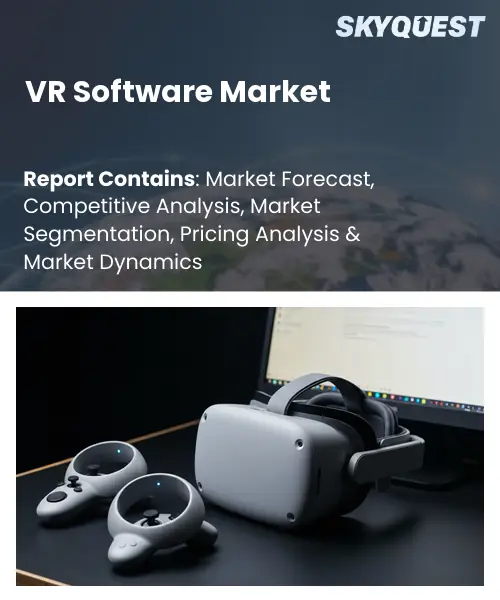
VR Software Market
Report ID: SQMIG20I2645
Report ID: SQMIG20I2645
[email protected]
USA +1 351-333-4748
Report ID:
SQMIG20I2645 |
Region:
Global |
Published Date: February, 2026
Pages:
157
|Tables:
95
|Figures:
76


Global VR Software Market size was valued at USD 25.2 Billion in 2024 and is poised to grow from USD 32.31 Billion in 2025 to USD 235.72 Billion by 2033, growing at a CAGR of 28.2% during the forecast period (2026-2033).
The growth of the gaming and entertainment industry, the high demand for remote collaboration and training, the development of VR software technologies, the growing demand for immersive content from consumers, and the growing use of VR software in the healthcare industry are factors that are promoting the sales of VR software.
The gaming industry is one of the primary adopters of VR software, offering highly immersive and interactive experiences. VR software is transforming how enterprises conduct remote training and collaboration. VR recreates real-world environments for training in the fields of healthcare, defense, aviation, and manufacturing, and it has been observed that it cuts costs and risks to a significant extent. The healthcare industry uses VR for training in surgery, pain management, physical therapy, mental health treatment, and patient education. Consumers are seeking more engaging and immersive digital experiences, driving VR software market growth via gaming, entertainment, retail, and travel sectors.
On the contrary, high costs of VR software equipment and development, limited content availability, health and safety concerns, and technical limitations are forecasted to impede the global VR software market penetration across the study period.
How is AI Enhancing User Immersion in the VR Software Market?
Integration of artificial intelligence is emerging as a hallmark trend in the global VR software market. Artificial intelligence adds to realism by incorporating intelligent non-player characters, adaptive simulations, and natural language processing. Machine learning algorithms in artificial intelligence enable personalization of VR experiences by adjusting levels of difficulty, pace, and content according to user behavior and performance analysis. AI also improves content creation by automating environment generation, animation, and testing. As AI capabilities mature, VR software becomes more immersive, responsive, and outcome-focused, increasing its value for education, healthcare, defense, and commercial training applications across global enterprise and institutional markets.
Market snapshot - 2026-2033
Global Market Size
USD 25.2 Billion
Largest Segment
Realtime Simulation Software
Fastest Growth
Realtime Simulation Software
Growth Rate
28.2% CAGR
To get more insights on this market click here to Request a Free Sample Report
The global VR software market is segmented into component, technology, device, application, and region. Based on the component, the market is segmented into hardware and software. Based on technology, the market is segmented into semi-and fully immersive and non-immersive. Based on application, the market is segmented into aerospace & defense, consumer, commercial, enterprise, healthcare, and others. Based on device, the market is segmented into, Head-Mounted Display (HMD), Gesture-Tracking Device (GTD), and Projectors & Display Wall (PDW). Based on the region, the market is segmented into North America, Europe, Asia Pacific, Latin America, and Middle East and Africa.
The semi-and fully immersive segment is expected to account for a significant chunk of the global VR software market share. Rapidly increasing adoption of head-mounted VR displays for industrial and educational applications is helping this segment hold sway over others. Advancements in VR software and other immersion technologies are also expected to help this segment maintain its dominance in the future.
On the other hand, the demand for non-immersive is slated to hold the second-largest share over the coming years. The restricted 2D interaction capabilities of this technology are keeping it limited to applications such as designing, gaming, and medical assistance.
The hardware segment is forecasted to spearhead the global VR software market revenue generation potential in the long run. The growing need for advanced VR software hardware to make immersion experiences better, such as headsets and advanced consoles, is helping this segment maintain its dominance going forward. Growing demand for VR headsets and accessories is slated to help sustain the sales of VR software-specific hardware over the coming years.
The software segment is emerging as the fastest-growing segment as per this VR software industry analysis. Growing application scope of VR software technology across multiple sectors and the need for specific software for each of them is creating a new business scope for VR software vendors industry.
To get detailed segments analysis, Request a Free Sample Report
The factors contributing to this area being leader, nationally and internationally, are its well established technology base; early adoption of virtual reality by a number of sectors (including video game; known also as gaming, health care, defence and business related) that have created demand for VR software. An array of supportive R&D environments; favourable conditions for entrepreneurial investment in VR companies and the rollout of 5G networks are expected to have a strong effect on the continued consolidation of this area’s position as a leader in global demand for VR software. The thriving entertainment industry in this region is also having a major impact on the adoption of VR software devices. The region has an attractive ecosystem of hardware majors, cloud and platform majors, and a large talent pool of specialized developers.
High investments in immersive tech by Meta, Apple, and Microsoft and the metaverse make this country a hub for VR software innovation around the globe. The entertainment industry is also thriving because of VR gaming and movie experiences. Venture capital backing is encouraging innovation in startups, and enterprise VR adoption is increasing because of remote collaboration and virtual onboarding. The adoption of advanced technologies is also contributing to the dominance of the United States in the future.
Government grants, tech-friendly policies, and a strong digital media landscape are steadily promoting the demand for VR software in Canada. Canadian startups innovate in VR therapy, real estate, and virtual tourism. The gaming and entertainment industries are forecasted to be at the forefront of the adoption of VR software technology in the country moving forward. Canada is poised to be a major innovator in VR technology in the region and globally due to its talent pool and focus on innovation. A growing cluster of boutique studios focuses on simulation, education, and culturally resonant content, thereby creating new business scope for VR software vendors.
The growing number of consumer bases, rising penetration of smartphones, and aggressive investments in the R&D of VR software by public and private institutions are contributing to the Asia Pacific region being the most opportune one. Initiatives such as the metaverse policies in China and the smart city initiatives in Japan are contributing to the adoption of immersive technologies such as VR software and AR. The availability of a huge youth population base and the growing digital transformation are expected to ensure that there is a constant demand for VR software solutions in the Asia Pacific region in the coming years. Cross-border collaborations and export-oriented development offer opportunities for local software to be adopted in international markets outside the Asia Pacific region.
Japan has a dynamic VR software industry, thanks to the fusion of a robust gaming culture with industrial and medical applications. The government is encouraging VR adoption in the education and smart city sectors. Events like virtual market showcase the nation’s VR creativity. High popularity of immersive gaming, anime-themed VR experiences, and virtual idols among consumers is also forecasted to create new business scope for VR software providers in the long run. Corporate research labs and content studios target enterprise applications of VR software in manufacturing and healthcare.
South Korea is a highly attractive market for VR software companies backed by cutting-edge connectivity, government support, and presence of tech-savvy consumers. Through its endorsement of XR start-ups, the South Korean Government has been active in promoting VR spaces throughout its public venues. The rise of virtual idols and K-Pop music has provided much momentum for VR's continued social and entertainment applications in South Korea along with creating one of the fastest growing markets for VR technology. The rise of esports and online social networks that cater to these types of experiences will also foster new and innovative types of content, and real-time interactive experiences across Korea and the entire region.
Public-private partnerships and R&D programs focused on VR software and other immersive technologies are helping promote market development in Europe. Regulatory clarity, strong manufacturing sectors, and rising demand for remote collaboration across industry verticals is also predicted to create new business scope for VR software companies operating in this region. Structured digital strategies, high-quality infrastructure, and emphasis on innovation are promoting the integration of VR software in healthcare, automotive, and industrial training applications going forward. The automotive, aerospace, healthcare, and cultural heritage industries offer strong demand for simulation and visualization of software across European countries.
Adoption of VR software in Germany is expected to be governed by industrial and engineering applications. Automotive companies like BMW and Volkswagen are using VR for prototyping and training. Integration of VR for Industry 4.0 transformation as demand for remote maintenance rises is also slated to create new opportunities for market players. A significant aspect of German growth lies in its emphasis on promoting businesses through government-supported funding initiatives for digital innovation. By investing heavily in physical infrastructure, Germany plays a leading role in defining what manufacturing in Europe will look like and is thus providing manufacturers with a solid foundation from which to build their operations.
The usage of VR by the UK population will drive demand for VR products through the use of VR in the healthcare, education, and media sectors. The NHS has been looking into how they can implement VR technology to help with pain relief, mental health, and surgical training. Universities are employing VR for immersive learning and collaborative work. The United Kingdom’s favorable digital economy and talent pool make the country’s mix of enterprise engagement and consumer interest a very appealing market for VR software companies. Incubators and market access make commercialization easier, and knowledge of regulation and standards enables developers to diversify their business.
Government grants for innovation in immersion technologies and presence of multiple VR studios are helping boost revenue generation for VR software companies operating in France. Startups and SMEs involved in VR software development are assisted through initiatives such as La French Tech. The retail and fashion sectors are also looking into virtual showrooms and events. With rising demand for immersive learning and cultural experiences, France combines creativity and engineering to foster a growing ecosystem of VR content and applications in the future.
To know more about the market opportunities by region and country, click here to
Buy The Complete Report
Expansion Of Metaverse and Social VR Platforms
Improved Content Creation Tools
High Development Costs
Interoperability and Standardization Challenges
Request Free Customization of this report to help us to meet your business objectives.
VR software providers should focus on making their offerings simpler to use and easier to understand. Integration of artificial intelligence technology is slated to be an essential strategy for all companies as per this global VR software market analysis. Innovations in VR hardware and content generation are expected to be areas of interest for new VR software companies.
SkyQuest’s ABIRAW (Advanced Business Intelligence, Research & Analysis Wing) is our Business Information Services team that Collects, Collates, Correlates, and Analyses the Data collected by means of Primary Exploratory Research backed by robust Secondary Desk research.
As per SkyQuest analysis, government support for VR software adoption and advancements in VR technology are slated to primarily drive the demand for VR software going forward. However, lack of content for VR software devices and technical limitations are anticipated to slow down the sales of VR software products in the future. North America is slated to emerge as the dominant region owing to the presence of top VR software companies and quick adoption of technology across multiple industry verticals. Development of standalone VR systems and industrial VR applications are slated to be key trends driving the VR software industry in the long run.
| Report Metric | Details |
|---|---|
| Market size value in 2024 | USD 25.2 Billion |
| Market size value in 2033 | USD 235.72 Billion |
| Growth Rate | 28.2% |
| Base year | 2024 |
| Forecast period | 2026-2033 |
| Forecast Unit (Value) | USD Billion |
| Segments covered |
|
| Regions covered | North America (US, Canada), Europe (Germany, France, United Kingdom, Italy, Spain, Rest of Europe), Asia Pacific (China, India, Japan, Rest of Asia-Pacific), Latin America (Brazil, Rest of Latin America), Middle East & Africa (South Africa, GCC Countries, Rest of MEA) |
| Companies covered |
|
| Customization scope | Free report customization with purchase. Customization includes:-
|
To get a free trial access to our platform which is a one stop solution for all your data requirements for quicker decision making. This platform allows you to compare markets, competitors who are prominent in the market, and mega trends that are influencing the dynamics in the market. Also, get access to detailed SkyQuest exclusive matrix.
Table Of Content
Executive Summary
Market overview
Parent Market Analysis
Market overview
Market size
KEY MARKET INSIGHTS
COVID IMPACT
MARKET DYNAMICS & OUTLOOK
Market Size by Region
KEY COMPANY PROFILES
Methodology
For the VR Software Market, our research methodology involved a mixture of primary and secondary data sources. Key steps involved in the research process are listed below:
1. Information Procurement: This stage involved the procurement of Market data or related information via primary and secondary sources. The various secondary sources used included various company websites, annual reports, trade databases, and paid databases such as Hoover's, Bloomberg Business, Factiva, and Avention. Our team did 45 primary interactions Globally which included several stakeholders such as manufacturers, customers, key opinion leaders, etc. Overall, information procurement was one of the most extensive stages in our research process.
2. Information Analysis: This step involved triangulation of data through bottom-up and top-down approaches to estimate and validate the total size and future estimate of the VR Software Market.
3. Report Formulation: The final step entailed the placement of data points in appropriate Market spaces in an attempt to deduce viable conclusions.
4. Validation & Publishing: Validation is the most important step in the process. Validation & re-validation via an intricately designed process helped us finalize data points to be used for final calculations. The final Market estimates and forecasts were then aligned and sent to our panel of industry experts for validation of data. Once the validation was done the report was sent to our Quality Assurance team to ensure adherence to style guides, consistency & design.
Analyst Support
Customization Options
With the given market data, our dedicated team of analysts can offer you the following customization options are available for the VR Software Market:
Product Analysis: Product matrix, which offers a detailed comparison of the product portfolio of companies.
Regional Analysis: Further analysis of the VR Software Market for additional countries.
Competitive Analysis: Detailed analysis and profiling of additional Market players & comparative analysis of competitive products.
Go to Market Strategy: Find the high-growth channels to invest your marketing efforts and increase your customer base.
Innovation Mapping: Identify racial solutions and innovation, connected to deep ecosystems of innovators, start-ups, academics, and strategic partners.
Category Intelligence: Customized intelligence that is relevant to their supply Markets will enable them to make smarter sourcing decisions and improve their category management.
Public Company Transcript Analysis: To improve the investment performance by generating new alpha and making better-informed decisions.
Social Media Listening: To analyze the conversations and trends happening not just around your brand, but around your industry as a whole, and use those insights to make better Marketing decisions.
REQUEST FOR SAMPLE
 REQUEST FREE CUSTOMIZATION
Global Vr Software Market size was valued at USD 25.2 Billion in 2024 and is poised to grow from USD 32.31 Billion in 2025 to USD 235.72 Billion by 2033, growing at a CAGR of 28.2% during the forecast period (2026-2033).
The competitive landscape in the global VR software market is driven by consolidation around platform owners, vertical specialization by enterprise and education vendors, and rapid product innovation. Major platform holders pursue acquisitions to secure first-party content and distribution, as seen in Meta’s high-profile attempt to acquire Within, while education and enterprise specialists expand through tuck-ins such as Labster’s purchase of UbiSim; engines add AI tooling to attract developers. 'Meta Platforms', 'Microsoft', 'Sony Interactive Entertainment', 'NVIDIA', 'Valve Corporation', 'Unity Technologies', 'Epic Games', 'HTC Corporation', 'Google LLC', 'Oculus VR', 'Pimax', 'Varjo', 'Immersion Corporation', 'Sketchfab', 'Crytek', 'Digital Monarch Media', 'Pixotope', 'VRChat', 'Ready At Dawn', 'Survios'
Enterprise investments in virtual reality platforms drive demand for sophisticated software solutions by creating sustained, mission oriented use cases across training, simulation, and remote collaboration. As organizations integrate VR into operational workflows, they require scalable, secure, and customizable applications, prompting vendors to expand feature sets, toolchains, and deployment options. This institutional demand encourages long term partnerships and recurring licensing or service agreements, which supports developer investment and ecosystem maturity, ultimately reinforcing market expansion through broader deployment and increasing expectations for continual platform improvement.
North America Dominates the Global VR Software Market


Want to customize this report? This report can be personalized according to your needs. Our analysts and industry experts will work directly with you to understand your requirements and provide you with customized data in a short amount of time. We offer $1000 worth of FREE customization at the time of purchase.
Feedback From Our Clients


 USA (+1) 351-333-4748

