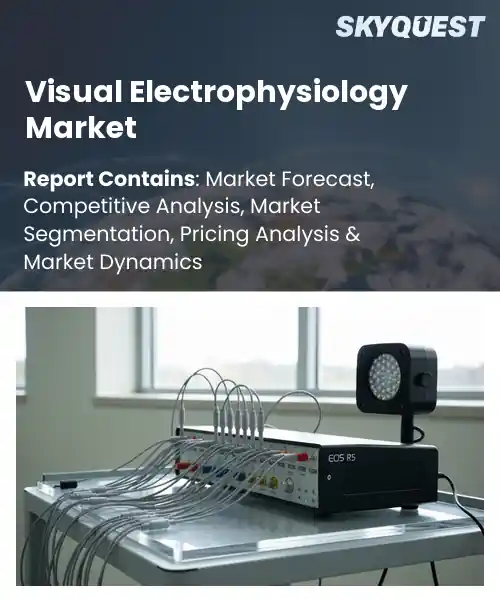
Visual Electrophysiology Market
Report ID: SQMIG35D2398
Report ID: SQMIG35D2398
[email protected]
USA +1 351-333-4748
Report ID:
SQMIG35D2398 |
Region:
Global |
Published Date: February, 2026
Pages:
157
|Tables:
115
|Figures:
77


Global Visual Electrophysiology Market size was valued at USD 1.1 Billion in 2024 and is poised to grow from USD 1.2 Billion in 2025 to USD 2.37 Billion by 2033, growing at a CAGR of 8.9% during the forecast period (2026-2033).
The global visual electrophysiology market growth is primarily driven by the rising need for objective, repeatable measurements of retinal and visual pathway function. The increase in demand is due to the growing populations of older people, and the rapidly increasing incidence of diabetes-related and hereditary retinal disorders. The market encompasses diagnostic modalities such as electroretinography, visual evoked potentials and electro-oculography, along with integrated multimodal platforms that combine electrophysiology with imaging. Over the past two decades systems evolved from bulky laboratory setups to digitized, portable devices enabling wider clinic and bedside use. The Multichannel ERG is a benefit for assisting with localized assessments of the retina; portable VEPs are utilized to assist with screening in children and for use in remote locations.
Building on clinical need, a key trend driving the global visual electrophysiology sector is the surge in therapeutic trials and personalized ophthalmic care, which increases demand for standardized, sensitive functional biomarkers, thereby stimulating device purchases and service development. As gene therapies for inherited retinal diseases proliferate, clinical sites require multifocal ERG and VEP to document efficacy, so manufacturers invest in validated protocols and clinical training programs. At the same time telemedicine and portable systems allow for screening programs in under-served areas, which is leading to the adoption of battery-operated systems and the use of cloud analytics by clinics to make workflows simpler. These factors create new commercial opportunities for integrated platform solutions, recurring software subscription models, and the development of a variety of data-driven diagnostic services.
How is AI Improving Diagnostic Accuracy in the Visual Electrophysiology Market?
Visual electrophysiology measures retinal and visual pathway function using ERG PERG and VEP recordings. AI improves diagnostic accuracy by cleaning noisy traces through advanced filtering and artifact rejection and by automating waveform recognition to highlight subtle abnormalities that can be missed in manual review. AI models bring consistent interpretation across operators and sites and can combine electrophysiology with imaging and clinical history to sharpen differential diagnoses. In practice this produces faster and more consistent assessments improved triage for retinal and optic nerve disease and better monitoring of therapy response while preserving clinician oversight.
In February 2026, AMETEK's acquisition of LKC signals greater scale for the RETeval ERG platform and opens investment in AI enabled analytics and workflow integration. This supports market efficiency by enabling automated interpretation and wider clinical adoption of visual electrophysiology testing.
Market snapshot - (2026-2033)
Global Market Size
USD 1.1 Billion
Largest Segment
Consumables
Fastest Growth
Software
Growth Rate
8.9% CAGR
To get more insights on this market click here to Request a Free Sample Report
Global visual electrophysiology market is segmented by product type, devices, applications, end users and region. Based on product type, the market is segmented into software and consumables. Based on devices, the market is segmented into electrodes and recording systems. Based on applications, the market is segmented into cardiology, neurology and others. Based on end users, the market is segmented into hospitals, research institutions and others. Based on region, the market is segmented into North America, Europe, Asia Pacific, Latin America and Middle East & Africa.
Based on the global visual electrophysiology market forecast, electrodes segment dominates because electrodes form the primary interface that directly determines signal quality and clinical trust in visual electrophysiology testing. Improvements in contact materials, ergonomic designs, and biocompatibility reduce noise and motion artifacts, which in turn improves diagnostic clarity and clinician confidence. To enhance procedural efficiency and reduce risks of infection throughout clinical and research processes, manufacturers of electrodes put great emphasis on the reliability and disposability of their products; thus allowing for the rapid acceptance of electrodes throughout clinical and research processes.
However, Recording Systems are the fastest growing area as compact architectures, cloud enabled analytics, and multimodal integration expand testing capacity into diverse clinical and research settings. By investing in both automation and seamless handling of data, vendors reduce the burden of set-up time and ease of interpretation, thereby allowing them to create more new use cases and service models while increasing the speed of adoption and creating opportunities for recurring revenue.
Software segment leads because advanced analysis platforms and workflow management tools convert raw electrophysiological signals into standardized, actionable outputs that increase throughput and reproducibility. Tight integration with acquisition hardware and clinical record systems streamlines patient workflows and supports longitudinal tracking, prompting adoption by clinicians and researchers. Regulatory compliance can be achieved via licensing & support services, which allows vendors to differentiate themselves through continuous improvements of their algorithms and enhancements in their user experiences.
Meanwhile, Consumables are emerging as the highest growth area due to rising demand for single use supplies, contact media, and procedure specific disposables that simplify testing and address infection control concerns. Reliable consumption patterns create steady revenue streams for manufacturers and motivate bundled offerings with devices and service models, expanding market reach and enabling ongoing product innovation.
To get detailed segments analysis, Request a Free Sample Report
As per the global visual electrophysiology market analysis, North America holds a leading position due to a convergence of advanced clinical infrastructure, concentrated research expertise, and a supportive innovation ecosystem. This region has strong academic hospitals and specialty clinics that have helped establish and validate the use of electrophysiology practices. There is an abundance of well-known device manufacturers and service providers. In many countries of North America, the existence of organized reimbursement mechanisms and professional guidelines for electrophysiology has produced standardized methods for adopting these services. The continued investment in the education and awareness of physicians will maintain a strong demand for diagnostic electrophysiological services throughout the fields of both ophthalmology and neurology.
Visual Electrophysiology Market in the United States is characterized by early clinical adoption, a dense network of tertiary referral centers, and strong industry engagement. As there are many clinical specialists and research centres, the process of continually validating and improving electrophysiology protocols is ongoing and supported by manufacturers having a close working relationship with healthcare providers to offer them the training and support necessary for deploying complex devices in both academic and private practice settings. All of this results in a continual demand for advanced diagnostic and monitoring tools in ophthalmologic and neuro-ophthalmologic care pathways.
Visual Electrophysiology Market in Canada is supported by integrated healthcare delivery and collaborative research networks that promote clinical standardization. Through the use of an evidence-based approach, the adoption of diagnostic electrophysiology for specialists and their patients in Canada's urban areas has increased. This has resulted from improved access through established centres of excellence, provincial/territorial programs, and strong partnerships between industry and clinical organisations (e.g., through strong, trusted relationships); and also from the presence of evidence-based practice guidelines.
Europe is experiencing rapid expansion driven by a combination of clinical need, coordinated research activity, and improving access across national health systems. Pan regional collaborations among academic centers, industry, and professional societies encourage harmonized protocols and multicenter studies that validate clinical utility. A mature medical device manufacturing base in several countries supports localized production and tailored solutions for diverse clinical environments. Policy focus on standardized care pathways and reimbursement in many jurisdictions reduces barriers to adoption. Investment in clinician education, portable technologies suitable for varied clinical settings, and networks that facilitate referral and specialty care amplify market growth across Western European markets.
Visual electrophysiology market in Germany is anchored by a strong medical technology industry and well established clinical infrastructure. Hospitals and specialized clinics integrate electrophysiology into diagnostic pathways for complex retinal and neuro-ophthalmic presentations. Having local manufacturing processes and service support increases opportunities to access and operate on the devices so that they remain a capable option for long-term use within major centers or specialty centers throughout the country.
Visual Electrophysiology Market in the United Kingdom is experiencing dynamic uptake driven by strong clinical networks and an emphasis on digital health integration. Clinical validation and guideline creation are done through the collaboration of specialist centers and academic hospitals to create clinical pathways for the national health system that will allow for larger clinical implementations based on proven value. The interest in portable devices and telemedicine-enabled assessments will further enhance the availability of these products in areas outside of the tertiary care setting. Clinicians working with technology companies to create new technologies will further facilitate their implementation in ophthalmology and other disciplines.
Visual Electrophysiology Market in France is maturing with growing investments in regional specialty centers and academic collaborations that emphasize clinical research and training. The uptake project is supported by an orientation towards using evidence based practice in addition to collaborating with multiple disciplines in diagnosing patients through electrophysiology (EP) techniques as part of their overall care. The development of more targeted / specialized services along with specialized clinician education will help expedite the broader use of these technologies within tertiary care institutions and specialty clinics.
Asia Pacific is strengthening its market position through a mix of technological innovation, expanding clinical capacity, and targeted collaborations between local industry and international partners. Adapting devices that meet local clinical needs while maintaining affordability and usability, has occurred due to collaboration with local manufacturers and research institutions. Along with clinical studies across borders and information sharing between clinicians, using telemedicine and portable diagnostic devices will help to reach patients beyond metropolitan areas. New governmental and organizational initiatives are being established or expanded in numerous markets, aimed at modernizing and improving the capability for diagnosing ocular and neurological conditions.
Visual electrophysiology market in Japan benefits from advanced research institutions and a focus on precision diagnostics that align with national innovation strengths. The continued success of developing advanced electrophysiological testing processes will also rely upon a strong emphasis on device usability, clinician education and the generation of evidence that supports ongoing utilization within specialty practice environments (e.g., in ophthalmology and neuro-ophthalmology).
Visual Electrophysiology Market in South Korea is characterized by rapid technological adoption and close industry clinical collaboration that accelerates product iteration and integration. Major teaching hospitals and specialist clinics serve as Clinical Validation Sites where technology companies develop solutions based on information collected from clinicians' work environments. As DHI expands its focus on integrating digital health and portable diagnostic solutions across various care settings, the use of electrophysiology by ophthalmic and neurologic practitioners will increase.
To know more about the market opportunities by region and country, click here to
Buy The Complete Report
Rising Prevalence Of Retinal Disorders
The increasing incidence of retinal and optic nerve disorders has elevated clinical demand for objective diagnostic assessments, prompting clinics and specialty centers to incorporate visual electrophysiology into diagnostic pathways; as a result, healthcare providers seek reliable tools for detection, monitoring, and therapeutic decision making, which encourages procurement of electrophysiology systems, investment in training, and expansion of service offerings, thereby creating a sustained need for devices and interpretive solutions across diagnostic and research settings. Manufacturers respond by enhancing device accessibility and support services to align with clinical workflows and reporting needs.
Technological Advancements In Devices
Rapid improvements in device miniaturization, signal processing algorithms, and software integration have enhanced test reliability and user experience, enabling broader clinical adoption beyond tertiary centers and facilitating point of care assessments. Intuitive interfaces and automated analysis reduce the need for specialized operators, easing workflow integration and encouraging clinicians to incorporate electrophysiology into routine evaluations, while software driven reporting and interoperability with electronic records support streamlined use and contribute to widening market acceptance. Vendors offer training and remote support to improve uptake across varied clinical settings.
High Cost Of Advanced Systems
The high cost of the initial acquisition, along with the continuing maintenance obligations and the ongoing costs associated with consumables and software licensing creates barriers to entry for smaller clinics or practices, as well as limiting their geographic reach or scope, since larger institutions are generally better financed than smaller ones. Prioritization of budget allocations for more broadly applicable diagnostic equipment limits the use of specialized training adds to OPEX in terms of operations and further decreases the likelihood of adoption and slows down the implementation of these products within many healthcare environments, despite the clinical value. Vendors need to develop pricing strategies that are flexible, as well as offer financing options or bundled service offerings in order to overcome the barriers associated with reluctance to purchase, and subsequently allow for increased distribution.
Limited Reimbursement and Awareness
Reimbursement policies that are inconsistent, and payers & referring clinicians who don't recognize or value electrophysiology as a clinically useful tool, reduce the demand for diagnostic tests, which discourages their routine incorporation into care pathways and complicates the evaluation of return on investment for providers. Healthcare organizations will typically deprioritize purchases and training when tests are not consistently covered or valued in their reimbursement schedules. The absence of general clinical awareness also leads to low referral rates for these tests and slows the rate of market penetration despite the potential to provide significant diagnostic benefits.
Request Free Customization of this report to help us to meet your business objectives.
Competitive pressure in the global visual electrophysiology market outlook is driven by rapid adoption of portable point of care ERG and VEP platforms, strategic M&A and partnerships, and AI enabled interpretation. Major moves include Lumithera’s acquisition of Diopsys and vendor collaborations to embed handheld solutions into telemedicine workflows; incumbents and newcomers pursue miniaturization and clinical validation to win clinical and research accounts.
AI Driven Integration: Artificial intelligence has been integrated into electrophysiological systems to help make the system more efficient in how they do their work, providing better interpretation of signals, and providing clinical decision support faster. Manufacturers of these devices are now integrating machine learning models within their devices to help clinicians with areas such as recognizing patterns in recordings, reducing artifacts from recordings automatically, and generating reports, thereby increasing diagnostic confidence and throughput. This global visual electrophysiology market trend of merging different types of products is leading to collaboration between device manufacturers, software developers, and healthcare providers demonstrating to them the improvement in efficiency with the adoption of these technologies.
Telehealth And Remote Monitoring: Telehealth and remote monitoring have extended electrophysiology service delivery beyond the traditional clinic environment to allow for the collection of data at home, to provide continuous monitoring, and to offer tele-consultations. The increased availability of connectivity options as well as portable imaging technology has enabled providers to use decentralized care delivery models to give patients who typically would not have had access to this type of treatment the ability to obtain early diagnoses of functional changes. Providers and industry partners are developing secure platforms for data transmission, remote quality control and interoperable records, which promote continuity of care, patient adherence and service models integrating diagnostics with follow-up management and efficient workflows.
SkyQuest’s ABIRAW (Advanced Business Intelligence, Research & Analysis Wing) is our Business Information Services team that Collects, Collates, Correlates, and Analyses the Data collected by means of Primary Exploratory Research backed by robust Secondary Desk research.
As per SkyQuest analysis, the global visual electrophysiology industry is propelled primarily by growing clinical need for objective, reproducible measures of retinal and visual pathway function driven by aging populations and rising retinal disorders. A second notable driver is expanding therapeutic trials and personalized ophthalmic care that increase demand for sensitive functional biomarkers and standardized testing. However, adoption is restrained by the high cost of advanced systems, ongoing maintenance, and consumable expenses. North America remains the dominant region thanks to advanced clinical infrastructure and strong research networks, while electrodes constitute the dominating segment because they directly determine signal quality, clinical trust and procedural efficiency.
| Report Metric | Details |
|---|---|
| Market size value in 2024 | USD 1.1 Billion |
| Market size value in 2033 | USD 2.37 Billion |
| Growth Rate | 8.9% |
| Base year | 2024 |
| Forecast period | (2026-2033) |
| Forecast Unit (Value) | USD Billion |
| Segments covered |
|
| Regions covered | North America (US, Canada), Europe (Germany, France, United Kingdom, Italy, Spain, Rest of Europe), Asia Pacific (China, India, Japan, Rest of Asia-Pacific), Latin America (Brazil, Rest of Latin America), Middle East & Africa (South Africa, GCC Countries, Rest of MEA) |
| Companies covered |
|
| Customization scope | Free report customization with purchase. Customization includes:-
|
To get a free trial access to our platform which is a one stop solution for all your data requirements for quicker decision making. This platform allows you to compare markets, competitors who are prominent in the market, and mega trends that are influencing the dynamics in the market. Also, get access to detailed SkyQuest exclusive matrix.
Table Of Content
Executive Summary
Market overview
Parent Market Analysis
Market overview
Market size
KEY MARKET INSIGHTS
COVID IMPACT
MARKET DYNAMICS & OUTLOOK
Market Size by Region
KEY COMPANY PROFILES
Methodology
For the Visual Electrophysiology Market, our research methodology involved a mixture of primary and secondary data sources. Key steps involved in the research process are listed below:
1. Information Procurement: This stage involved the procurement of Market data or related information via primary and secondary sources. The various secondary sources used included various company websites, annual reports, trade databases, and paid databases such as Hoover's, Bloomberg Business, Factiva, and Avention. Our team did 45 primary interactions Globally which included several stakeholders such as manufacturers, customers, key opinion leaders, etc. Overall, information procurement was one of the most extensive stages in our research process.
2. Information Analysis: This step involved triangulation of data through bottom-up and top-down approaches to estimate and validate the total size and future estimate of the Visual Electrophysiology Market.
3. Report Formulation: The final step entailed the placement of data points in appropriate Market spaces in an attempt to deduce viable conclusions.
4. Validation & Publishing: Validation is the most important step in the process. Validation & re-validation via an intricately designed process helped us finalize data points to be used for final calculations. The final Market estimates and forecasts were then aligned and sent to our panel of industry experts for validation of data. Once the validation was done the report was sent to our Quality Assurance team to ensure adherence to style guides, consistency & design.
Analyst Support
Customization Options
With the given market data, our dedicated team of analysts can offer you the following customization options are available for the Visual Electrophysiology Market:
Product Analysis: Product matrix, which offers a detailed comparison of the product portfolio of companies.
Regional Analysis: Further analysis of the Visual Electrophysiology Market for additional countries.
Competitive Analysis: Detailed analysis and profiling of additional Market players & comparative analysis of competitive products.
Go to Market Strategy: Find the high-growth channels to invest your marketing efforts and increase your customer base.
Innovation Mapping: Identify racial solutions and innovation, connected to deep ecosystems of innovators, start-ups, academics, and strategic partners.
Category Intelligence: Customized intelligence that is relevant to their supply Markets will enable them to make smarter sourcing decisions and improve their category management.
Public Company Transcript Analysis: To improve the investment performance by generating new alpha and making better-informed decisions.
Social Media Listening: To analyze the conversations and trends happening not just around your brand, but around your industry as a whole, and use those insights to make better Marketing decisions.
REQUEST FOR SAMPLE
 REQUEST FREE CUSTOMIZATION
Global Visual Electrophysiology Market size was valued at USD 1.1 Billion in 2024 and is poised to grow from USD 1.2 Billion in 2025 to USD 2.37 Billion by 2033, growing at a CAGR of 8.9% during the forecast period (2026-2033).
Competitive pressure in the global visual electrophysiology market is driven by rapid adoption of portable point of care ERG and VEP platforms, strategic M&A and partnerships, and AI enabled interpretation. Major moves include Lumithera’s acquisition of Diopsys and vendor collaborations to embed handheld solutions into telemedicine workflows; incumbents and newcomers pursue miniaturization and clinical validation to win clinical and research accounts. 'Electroretinography Solutions Inc.', 'Diopsys Inc.', 'Retinal Imaging Systems', 'RetinAI Medical', 'Pacific Neuropsychiatric Specialists', 'Harris Healthcare', 'Natus Medical Incorporated', 'MultiChannel Systems', 'NeuroVision Imaging', 'Synaptive Medical', 'GenSight Biologics', 'OptoVue Inc.', 'VisionSource', 'Eyenovia Inc.', 'Aerie Pharmaceuticals', 'AOptix Technologies', 'OptiMedica Corporation', 'Erytech Pharma', 'Spectral Devices', 'Pixium Vision'
The increasing incidence of retinal and optic nerve disorders has elevated clinical demand for objective diagnostic assessments, prompting clinics and specialty centers to incorporate visual electrophysiology into diagnostic pathways; as a result, healthcare providers seek reliable tools for detection, monitoring, and therapeutic decision making, which encourages procurement of electrophysiology systems, investment in training, and expansion of service offerings, thereby creating a sustained need for devices and interpretive solutions across diagnostic and research settings. Manufacturers respond by enhancing device accessibility and support services to align with clinical workflows and reporting needs.
Ai Driven Integration: Integration of artificial intelligence into electrophysiology systems is enabling streamlined workflows, enhanced signal interpretation and faster clinical decision support. Vendors are embedding machine learning models to assist clinicians with pattern recognition, automated artifact reduction and report generation, improving diagnostic confidence and throughput. This convergence fosters collaborations between device manufacturers, software developers and healthcare providers, driving adoption through demonstrable efficiency gains, easier training pathways and more consistent outcomes across clinical settings while creating opportunities for platform-based services and lifecycle software updates.
Why does North America Dominate the Global Visual Electrophysiology Market? |@12


Want to customize this report? This report can be personalized according to your needs. Our analysts and industry experts will work directly with you to understand your requirements and provide you with customized data in a short amount of time. We offer $1000 worth of FREE customization at the time of purchase.
Feedback From Our Clients


 USA (+1) 351-333-4748

