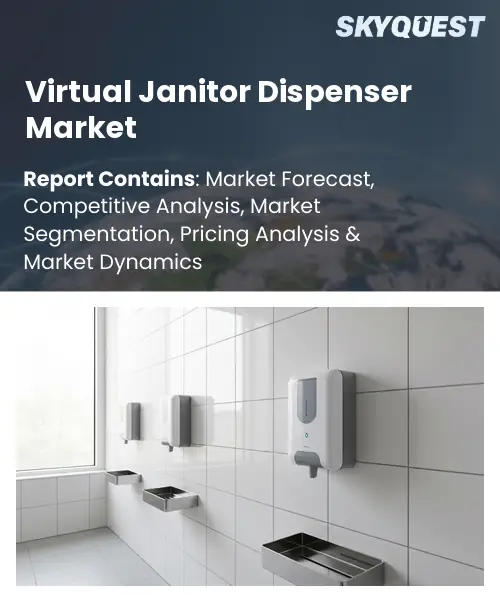
Virtual Janitor Dispenser Market
Report ID: SQMIG20I3470
Report ID: SQMIG20I3470
[email protected]
USA +1 351-333-4748
Report ID:
SQMIG20I3470 |
Region:
Global |
Published Date: August, 2026
Pages:
157
|Tables:
119
|Figures:
77


Global Virtual Janitor Dispenser Market size was valued at USD 214.8 Million in 2024 and is poised to grow from USD 226.83 Million in 2025 to USD 350.76 Million by 2033, growing at a CAGR of 5.6% during the forecast period (2026-2033).
Growing emphasis on infection prevention and hygiene standards is driving the Global Virtual Janitor Dispenser Market. As hospitals, offices, airports, hotels, and public facilities seek to reduce contact with frequently touched surfaces, demand for automated dispensing systems increases. Because touch-free dispensers deliver soap, sanitizer, or paper products without physical contact, they can reduce cross-contamination risks. Consequently, facility managers are replacing conventional dispensers with sensor-enabled alternatives, encouraging manufacturers to expand automated product portfolios. Greater awareness of infectious diseases and stricter workplace hygiene requirements further strengthens adoption, creating sustained demand for technologically advanced dispensing solutions.
Integration with IoT-enabled facility-management systems is a key trend driving the global virtual janitor dispenser sector development. Smart virtual janitor dispensers can collect usage data, monitor consumable levels, identify maintenance requirements, and provide remote alerts. Because these capabilities reduce manual inspections and enable timely replenishment, facility operators can improve janitorial efficiency while lowering labor and operational costs. Consequently, large commercial buildings, healthcare facilities, airports, and hospitality properties are increasingly adopting connected dispensing technologies. As smart-building infrastructure expands, manufacturers integrating sensors, connectivity, analytics, and automated maintenance features can differentiate their products, encouraging wider deployment and accelerating the transition from conventional dispensers toward intelligent facility-management solutions.
How is AI-Driven Automation Shaping the Virtual Janitor Dispenser Market?
AI is indirectly transforming the global virtual janitor dispenser market by making hygiene systems more predictive and data-driven. AI can analyze dispenser usage, footfall, refill patterns, and facility activity; consequently, operators can predict when consumables will run out and schedule janitorial services before disruptions occur. This reduces unnecessary inspections, labor costs, and dispenser downtime, increasing demand for connected smart dispensers. AI-powered computer vision can also analyze hygiene behavior and identify high-traffic areas, prompting targeted cleaning and replenishment.
In 2025, Kimberly-Clark Professional expanded its connected dispenser ecosystem, supporting data-driven restroom management. Such developments encourage integration of sensors, connectivity, analytics, and automated maintenance into dispensing solutions.
Market snapshot - (2026-2033)
Global Market Size
USD 214.8 Million
Largest Segment
Sanitizer Dispensers
Fastest Growth
Multi-Function Dispensers
Growth Rate
5.6% CAGR
To get more insights on this market click here to Request a Free Sample Report
Global virtual janitor dispenser market is segmented by product type, technology, application, end user and region. Based on product type, the market is segmented into soap dispensers, sanitizer dispensers, tissue dispensers and multi-function dispensers. Based on technology, the market is segmented into IoT-enabled, touchless and AI-enabled. Based on application, the market is segmented into commercial buildings, healthcare facilities, hospitality and educational institutions. Based on end user, the market is segmented into commercial, healthcare and institutional. Based on region, the market is segmented into North America, Europe, Asia Pacific, Latin America and Middle East & Africa.
Based on the global virtual janitor dispenser market growth, soap dispensers segment dominates because they fulfill the core requirement of delivering liquid hygiene solutions, which remains the most widely requested function in facilities seeking automated cleaning support. Their simplicity, reliability, and low maintenance encourage broad adoption across commercial, healthcare, and institutional sites. The entrenched preference for dispensers that provide consistent soap output drives vendor focus and sustains market momentum, reinforcing their leading position within the overall ecosystem for users.
However, sanitizer dispensers are witnessing the strongest growth momentum as heightened concern for pathogen control fuels demand for alcohol based solutions. Their compatibility with touchless activation and integration with health safety protocols accelerates adoption, opening new avenues for market expansion and encouraging innovative product developments across sectors in the industry today.
AI enabled segment leads because it transforms dispenser operations through predictive replenishment, usage analytics, and adaptive dispensing patterns that align with real time occupancy data. By embedding machine learning, devices anticipate demand spikes, reduce waste, and support facility managers in optimizing hygiene workflows. This intelligence creates a compelling value proposition that drives investment and accelerates adoption across diverse environments. It integrates within the broader digital infrastructure, enhancing overall operational resilience and fostering data driven decision making.
Meanwhile, touchless technology is emerging as the high growth area because it addresses infection prevention mandates by eliminating physical contact, thereby increasing user confidence. The proliferation of motion sensor activation and battery efficient designs accelerates deployment in high traffic locations, unlocking revenue streams and prompting manufacturers to prioritize innovations that expand market reach.
To get detailed segments analysis, Request a Free Sample Report
As per the global virtual janitor dispenser market share, North America leads the industry through a convergence of advanced technological infrastructure, strong emphasis on operational efficiency, and a mature regulatory environment that encourages automation in facility management. The region benefits from deep investment in research and development, fostering innovative solutions that integrate seamlessly with existing building management systems. High demand from sectors such as healthcare, hospitality, and large‑scale corporate campuses drives continuous adoption, while a well‑established distribution network ensures rapid deployment and reliable after‑sales support. Collaborative partnerships between technology providers and service firms further reinforce market leadership, creating a cycle of sustained growth and ecosystem enrichment.
Virtual janitor dispenser market in the United States thrives on a culture of innovation and a robust venture capital ecosystem that fuels start‑up activity. Early adoption by large property managers and a focus on sustainability initiatives accelerate integration of contactless dispensing solutions across diverse facility types. Strong supplier relationships and widespread availability of technical expertise enable rapid scaling, while comprehensive training programs support user confidence and operational excellence.
Virtual janitor dispenser market in Canada is shaped by a progressive approach to workplace health and safety, combined with government incentives that promote smart building technologies. The market benefits from close proximity to US supply chains, ensuring access to cutting‑edge products and support services. Collaborative industry forums and a focus on environmental stewardship drive demand among educational institutions, government facilities, and midsize commercial enterprises seeking to modernize hygiene protocols.
Based on global virtual janitor dispenser regional forecast, Europe’s expansion is propelled by stringent hygiene standards, a growing commitment to digital transformation, and a collaborative regulatory framework that harmonizes product acceptance across borders. The region’s strong emphasis on sustainability and circular economy principles encourages the adoption of touch‑free dispensing technologies that reduce waste and improve resource efficiency. Robust innovation hubs in key economies foster localized design adaptations, while cross‑border trade agreements streamline market entry. Public‑private partnerships and industry consortia further accelerate deployment in sectors such as transportation, education, and healthcare, reinforcing Europe’s position as a dynamic growth corridor.
Virtual janitor dispenser market in Germany is anchored by a high degree of engineering precision and a reputation for quality assurance that resonates with industrial and commercial users. Strong support from research institutions drives continuous product refinement, while stringent workplace safety regulations create a receptive environment for automated hygiene solutions. Collaborative networks among manufacturers, integrators, and end‑users facilitate swift implementation across manufacturing plants, office complexes, and public facilities.
Virtual janitor dispenser market in the United Kingdom experiences rapid momentum due to heightened awareness of hygiene best practices and a proactive public health agenda. The market benefits from a vibrant ecosystem of technology providers and service firms that deliver tailored solutions for dense urban environments, such as transport hubs and retail districts. Government guidance encouraging digital upgrades in public buildings further accelerates adoption, with a focus on improving user experience and operational resilience.
Virtual janitor dispenser market in France is emerging as a focal point for innovative hygiene management, driven by strong consumer expectations for cleanliness and a national emphasis on technological modernization. Partnerships between local manufacturers and multinational distributors enable flexible deployment across hospitality venues, educational campuses, and government offices. Environmental considerations and a push toward greener operations also motivate businesses to adopt touch‑free dispensing systems that align with broader sustainability goals.
As per global virtual janitor dispenser regional outlook, Asia Pacific is strengthening its role through rapid urbanization, heightened awareness of sanitation, and accelerating digital adoption across diverse economies. The region leverages a combination of cost‑effective manufacturing capabilities and a growing appetite for smart building solutions, enabling widespread rollout in both new constructions and retrofits. Cultural emphasis on cleanliness, coupled with supportive government initiatives promoting automation, fuels demand in commercial towers, transit stations, and large‑scale residential complexes. Strong collaboration between local tech firms and global innovators accelerates customization, ensuring solutions meet varied regulatory and operational requirements across the market.
Virtual janitor dispenser market in Japan benefits from a culture of meticulous cleanliness and a technologically advanced infrastructure that readily embraces automation. Leading manufacturers integrate sophisticated sensor technologies with existing building management platforms, delivering seamless user experiences in office buildings, transit facilities, and hospitality venues. Government encouragement of smart city initiatives further propels adoption, while a focus on ergonomics and user safety drives continuous product refinement.
Virtual janitor dispenser market in South Korea is energized by a vibrant tech ecosystem and proactive public health campaigns that prioritize hygienic environments. The market sees strong uptake in high‑rise office districts and large retail complexes, where touch‑free solutions enhance both efficiency and consumer confidence. Collaboration between domestic electronics firms and facility management providers yields highly integrated systems, while government incentives for digital innovation support accelerated deployment across the urban landscape.
To know more about the market opportunities by region and country, click here to
Buy The Complete Report
Rising Demand for Contactless Hygiene
Integration With Building Management Systems
High Initial Capital Expenditure
Limited Interoperability Across Platforms
Request Free Customization of this report to help us to meet your business objectives.
The competitive landscape of the global virtual janitor dispenser market outlook is shaped by aggressive product differentiation and strategic collaborations. Companies are leveraging technology innovation, such as AI‑driven inventory monitoring, to outpace rivals. Recent M&A activity, exemplified by a leading dispenser manufacturer acquiring a sensor‑technology firm, and partnerships with facility‑management platforms are driving market consolidation and expanding distribution networks.
Top Player’s Company Profile
Recent Developments
SkyQuest’s ABIRAW (Advanced Business Intelligence, Research & Analysis Wing) is our Business Information Services team that Collects, Collates, Correlates, and Analyses the Data collected by means of Primary Exploratory Research backed by robust Secondary Desk research.
As per SkyQuest analysis, the global virtual janitor dispenser industry is being propelled by rising demand for contactless hygiene, while integration with building management systems adds a second boost; however, high initial capital expenditure restrains adoption. North America leads the market, supported by mature infrastructure and strong regulatory push, and soap dispensers remain the dominant product segment thanks to their simplicity and broad appeal. AI‑enabled predictive replenishment and smart sensor integration are further enhancing operational efficiency, allowing facilities to monitor usage in real time and reduce waste. This combination of drivers and constraints shapes growth expectations for the virtual janitor dispenser market through 2033.
| Report Metric | Details |
|---|---|
| Market size value in 2024 | USD 214.8 Million |
| Market size value in 2033 | USD 350.76 Million |
| Growth Rate | 5.6% |
| Base year | 2024 |
| Forecast period | (2026-2033) |
| Forecast Unit (Value) | USD Million |
| Segments covered |
|
| Regions covered | North America (US, Canada), Europe (Germany, France, United Kingdom, Italy, Spain, Rest of Europe), Asia Pacific (China, India, Japan, Rest of Asia-Pacific), Latin America (Brazil, Rest of Latin America), Middle East & Africa (South Africa, GCC Countries, Rest of MEA) |
| Companies covered |
|
| Customization scope | Free report customization with purchase. Customization includes:-
|
To get a free trial access to our platform which is a one stop solution for all your data requirements for quicker decision making. This platform allows you to compare markets, competitors who are prominent in the market, and mega trends that are influencing the dynamics in the market. Also, get access to detailed SkyQuest exclusive matrix.
Table Of Content
Executive Summary
Market overview
Parent Market Analysis
Market overview
Market size
KEY MARKET INSIGHTS
COVID IMPACT
MARKET DYNAMICS & OUTLOOK
Market Size by Region
KEY COMPANY PROFILES
Methodology
For the Virtual Janitor Dispenser Market, our research methodology involved a mixture of primary and secondary data sources. Key steps involved in the research process are listed below:
1. Information Procurement: This stage involved the procurement of Market data or related information via primary and secondary sources. The various secondary sources used included various company websites, annual reports, trade databases, and paid databases such as Hoover's, Bloomberg Business, Factiva, and Avention. Our team did 45 primary interactions Globally which included several stakeholders such as manufacturers, customers, key opinion leaders, etc. Overall, information procurement was one of the most extensive stages in our research process.
2. Information Analysis: This step involved triangulation of data through bottom-up and top-down approaches to estimate and validate the total size and future estimate of the Virtual Janitor Dispenser Market.
3. Report Formulation: The final step entailed the placement of data points in appropriate Market spaces in an attempt to deduce viable conclusions.
4. Validation & Publishing: Validation is the most important step in the process. Validation & re-validation via an intricately designed process helped us finalize data points to be used for final calculations. The final Market estimates and forecasts were then aligned and sent to our panel of industry experts for validation of data. Once the validation was done the report was sent to our Quality Assurance team to ensure adherence to style guides, consistency & design.
Analyst Support
Customization Options
With the given market data, our dedicated team of analysts can offer you the following customization options are available for the Virtual Janitor Dispenser Market:
Product Analysis: Product matrix, which offers a detailed comparison of the product portfolio of companies.
Regional Analysis: Further analysis of the Virtual Janitor Dispenser Market for additional countries.
Competitive Analysis: Detailed analysis and profiling of additional Market players & comparative analysis of competitive products.
Go to Market Strategy: Find the high-growth channels to invest your marketing efforts and increase your customer base.
Innovation Mapping: Identify racial solutions and innovation, connected to deep ecosystems of innovators, start-ups, academics, and strategic partners.
Category Intelligence: Customized intelligence that is relevant to their supply Markets will enable them to make smarter sourcing decisions and improve their category management.
Public Company Transcript Analysis: To improve the investment performance by generating new alpha and making better-informed decisions.
Social Media Listening: To analyze the conversations and trends happening not just around your brand, but around your industry as a whole, and use those insights to make better Marketing decisions.
REQUEST FOR SAMPLE
 REQUEST FREE CUSTOMIZATION
Global Virtual Janitor Dispenser Market size was valued at USD 214.8 Million in 2024 and is poised to grow from USD 226.83 Million in 2025 to USD 350.76 Million by 2033, growing at a CAGR of 5.6% during the forecast period (2026-2033).
The competitive landscape of the Global Virtual Janitor Dispenser Market is shaped by aggressive product differentiation and strategic collaborations. Companies are leveraging technology innovation, such as AI‑driven inventory monitoring, to outpace rivals. Recent M&A activity, exemplified by a leading dispenser manufacturer acquiring a sensor‑technology firm, and partnerships with facility‑management platforms are driving market consolidation and expanding distribution networks. 'GOJO Industries, Inc.', 'Essity AB', 'Kimberly-Clark Corporation', 'Tork', 'Georgia-Pacific LLC', 'Kutol Products Company', 'Bobrick Washroom Equipment, Inc.', 'Bradley Company', 'Sloan Valve Company', 'ASI Group', 'Rubbermaid Commercial Products LLC', 'Brightwell Dispensers Ltd.', 'Ophardt Hygiene-Technik GmbH + Co. KG', 'Simplehuman LLC', 'Hagleitner Hygiene International GmbH', 'Ecolab Inc.', 'Diversey Holdings, Ltd.', 'Initial Hygiene', 'Purell', 'Mediclinics S.A.'
Enterprises are increasingly prioritizing automated sanitation solutions that reduce manual handling and limit pathogen transmission. The convenience of a virtual janitor dispenser aligns with heightened health awareness, encouraging organizations to replace traditional cleaning schedules with sensor‑activated units. This shift supports operational efficiency by delivering cleaning agents precisely when needed, thereby conserving resources and enhancing occupant confidence. As workplace safety standards evolve, the perceived value of continuous, touch‑free disinfection drives procurement decisions, fostering robust market expansion. Additionally, the ability to monitor usage through integrated analytics provides management with actionable insights, reinforcing confidence in the technology and prompting further adoption across varied facility types. The real‑time data also helps optimize supply levels, reducing waste and further justifying investment.
Smart Sensor Integration: Increasing adoption of advanced IoT sensors is enabling virtual janitor dispensers to monitor usage patterns, detect refilling needs, and predict maintenance requirements in real time. By embedding motion, weight, and environmental sensors, manufacturers are delivering proactive service alerts and dynamic inventory optimization, reducing downtime for clients. This sensor-driven intelligence is also facilitating seamless integration with building management systems, creating holistic hygiene ecosystems that enhance operational efficiency and deliver measurable cost savings across diversified commercial facilities worldwide and across sectors today.
Why does North America Dominate the Global Virtual Janitor Dispenser Market? |@12


Want to customize this report? This report can be personalized according to your needs. Our analysts and industry experts will work directly with you to understand your requirements and provide you with customized data in a short amount of time. We offer $1000 worth of FREE customization at the time of purchase.
Feedback From Our Clients


 USA (+1) 351-333-4748

