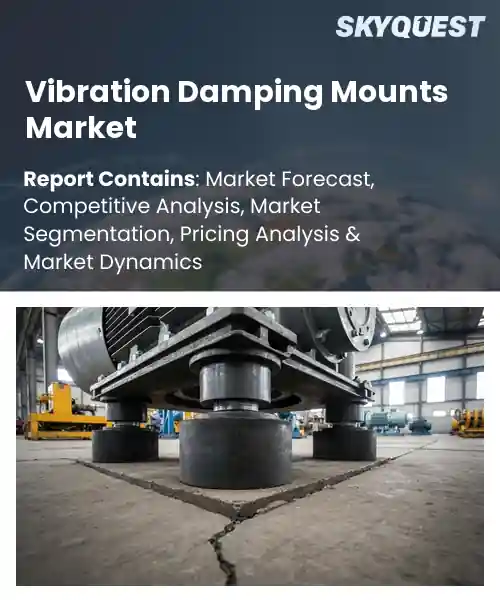
Vibration Damping Mounts Market
Report ID: SQMIG20B2132
Report ID: SQMIG20B2132
[email protected]
USA +1 351-333-4748
Report ID:
SQMIG20B2132 |
Region:
Global |
Published Date: February, 2026
Pages:
157
|Tables:
118
|Figures:
77


Global Vibration Damping Mounts Market size was valued at USD 663.5 Million in 2024 and is poised to grow from USD 711.94 Million in 2025 to USD 1250.95 Million by 2033, growing at a CAGR of 7.3% during the forecast period (2026-2033).
The vibration damping mounts growth is driven by rapidly growing needs to reduce noise, vibration and harshness (NVH) mainly in the automotive sector but also with the use of industrial machinery or home consumer products; thus leading to the evolving relative importance of component design. Vibration damping mounts are intended products: to isolate, absorb and dissipate mechanical energy, thereby protecting your equipment; enhancing your comfort; and extending service life. As vehicles moved to tighter tolerances (increased precision) and as vehicle electrification increased cabin noise levels, it has become increasingly important to develop vibration damping mount technologies that provide a means for reducing cabin noise levels in passenger vehicles.
A key trend driving the global vibration damping mounts sector dynamics is the rapid electrification of transport and the rise of high-speed rotating equipment, which create distinct vibration spectra that conventional mounts cannot fully mitigate, driving demand for specialized solutions. The automotive industry faces increased vibration frequencies from electric drive systems and requires unique mounts with predetermined rigidity and damping to keep passengers comfortable and protect battery components. As a result suppliers are designing mounts using multiple materials and tuned-mass concepts. Robots in the factory and tools used in the manufacturing of semiconductors will need sub-micron isolation, so there is investment in smart mounts that have built-in sensors for predictive maintenance.
How is IoT Improving Performance Monitoring in the Vibration Damping Mounts Market?IoT is transforming performance monitoring for vibration damping mounts by embedding sensors and secure connectivity into mounts so that vibration signatures are captured continuously. This lets engineers track condition in real time, compare behavior against expected baselines, and detect early signs of wear or misalignment. The present marketplace is shifting away from periodic inspection toward Condition Based Maintenance (CBM), extending the life of their equipment while minimizing unexpected downtime. Use cases include providing remote diagnostic capabilities for industrial pumps, improving ride comfort through adaptive tuning for vehicle mounts, and speedier root cause analysis due to analyzing mount data correlated with system level signals through cloud-based analytics.
Trelleborg in May 2025 expanded its innovation and automation capabilities in Minnesota which supports faster development of sensor integrated mounts, and this investment helps accelerate IoT enabled product testing and deployment so customers gain improved uptime and more efficient condition monitoring.
Market snapshot - (2026-2033)
Global Market Size
USD 663.5 Million
Largest Segment
Rubber Mounts
Fastest Growth
Polymeric Mounts
Growth Rate
7.3% CAGR
To get more insights on this market click here to Request a Free Sample Report
Global vibration damping mounts market is segmented by product type, application, end user, distribution channel and region. Based on product type, the market is segmented into rubber mounts, metal mounts, polymeric mounts and others. Based on application, the market is segmented into industrial equipment, automotive, aerospace and others. Based on end user, the market is segmented into manufacturing, automotive industry and construction. Based on distribution channel, the market is segmented into online sales and offline sales. Based on region, the market is segmented into North America, Europe, Asia Pacific, Latin America and Middle East & Africa.
Based on the global vibration damping mounts market forecast, rubber mounts segment dominates because its intrinsic elastomeric properties deliver broad spectrum vibration isolation and noise attenuation across diverse equipment classes. Familiar manufacturing processes and established supplier networks reduce adoption friction, while cost effective production and straightforward installation encourage specification by OEMs and maintenance teams. Excellent durability will provide consistent reliability over an extended period which will lead to continual demand for new replacements and renovations in the industry.
However, polymeric mounts are emerging as the most rapidly expanding area due to advances in engineered polymers that enable lighter, shape optimized designs with tailored damping characteristics. Improved chemical and thermal durability and greater compatibility with integrated assemblies will increase the use of electrified vehicles and compact industrial systems, resulting in new design-driven opportunities for product placements at higher price points.
Automotive segment dominates because continuous focus on ride comfort and noise vibration harshness management makes mounts essential in vehicle design and aftersales maintenance. OEMs want to reduce weight, improve packing efficiency and work with different engine types, so manufacturers get involved early in product engineering cycles. The result is that manufacturers need to place a lot of orders for mounts as they replace them, which increases their overall number of orders from the OEMs. As more of the automotive industry moves toward electric cars and has increasingly high expectations for in-car comfort, it is clear that the automotive industry has had a major influence over the specifications of these products and manufacturer roadmaps.
Meanwhile, aerospace is witnessing the strongest growth momentum as designers prioritize extreme weight performance, fatigue resistance and stringent qualification regimes that favor advanced mount technologies. The increasing number of companies adopting new types of platforms and the added pressure to provide high-quality reliability (by both integrators and suppliers) are both contributing to the increase in innovation that is creating premium-priced products as well as providing an increase in service options and retrofit options.
To get detailed segments analysis, Request a Free Sample Report
As per the global vibration damping mounts market analysis, Asia Pacific commands the industry through a convergence of industrial depth, manufacturing specialization, and concentrated demand from multiple end use sectors. The existing automotive and electronics industry clusters enable a large-scale integration of advanced mounting systems, while component manufacturers also gain access to well-established and mature supply chains and extensive supplier networks. Material innovation and the ability to engineer materials for regional uses are accelerated by research institutions and targeted engineering expertise. Industrial expansion is stimulated by stable and well-structured policy frameworks that provide for infrastructure investment. Rapid prototyping and local/regionalized production are made possible by proximity to large original equipment manufacturers and by low-cost environments. Together, these factors create a synergistic environment where product development, scale, and supply chain resilience support and enhance leadership within the global vibration isolation/ damped mounts industry.
Vibration damping mounts market in Japan reflects advanced engineering and high precision manufacturing with strong collaboration between automakers and component suppliers. A rising need exists for precision mounts that achieve exact performance requirements due in part to the growing requirements for miniaturization and reliability. Domestic firms use deep R&D and materials science expertise to create high performance solutions. Rigorous quality systems and continuous improvement sustain premium product positioning and steady adoption across industrial and mobility applications and exports.
Vibration damping mounts market in South Korea is driven by strong electronics and shipbuilding industries that demand high performance isolation solutions. Rapid design integration and iterative development are accomplished through strong relationships with primary original equipment manufacturers. Strong supplier networks help move toward scaling production and implementing quality assurance processes enhance the credibility of the market and allow for wider adoption across multiple sectors and export opportunities.
North America is experiencing rapid expansion in the vibration damping mounts market due to a combination of technological modernization across industries, demand for improved machinery uptime, and emphasis on systems reliability. Strong aerospace and defense industry's demand for high performance isolation solutions is further complemented by advanced manufacturing plants in need of modular/maintainable mounts for complicated machinery. Various service related companies and aftermarket specialists enhance lifecycle management as well as retrofit possibilities for all industry types. The higher emphasis placed on regulatory compliance and testing rules has raised this technical bar, which has led to the increased use of engineered mounts throughout the manufacturing process. Collaborative relationships between manufacturers / distributors and consumers will grow and provide support for customizing mounts, while the growth of nearshoring will push investment into domestic manufacturing capacity and providing support to local suppliers thus strengthening their position in the manufacturer's market throughout the region.
Vibration damping mounts market in United States is anchored by demand from aerospace, defense, and advanced manufacturing sectors seeking certified, reliable isolation solutions. Robust research institutions and supplier networks support material and design innovation, while suppliers collaborate with OEMs for tailored integrations. Service providers concentrate on maintenance, retrofitting, and aftermarket possibilities throughout their product life cycle, while Quality Certification issued at that time, along with higher standards of product testing for these types of applications, will create trust in the services offered by service providers and increase usage in both the industrial and transportation sectors.
Vibration damping mounts market in Canada is shaped by demand from resource extraction, rail, and industrial equipment sectors that require durable, heavy duty isolation solutions. The close proximity of their trading partners also allows for smooth coordination within the supply chain and a quick transfer of technology. Manufacturers have been able to grow through their service and retrofit programs, while their continued emphasis on customisation and quality assurance helps build a high level of trust in suppliers from one sector to another.
Europe is strengthening its position in the vibration damping mounts market through a combination of regulatory rigor, engineering expertise, and cross sector collaboration. Refined isolation elements to meet new automotive and railway modernization programs’ stringent safety and performance criteria, and new renewable energy and industrial automation applications are increasing the number of technical use cases. Regional innovation clusters and University Industry Partnerships will aid the development of lightweight, recyclable materials; and in designing precision components. Harmonized testing standards and certification pathways will create a clearer path for suppliers to differentiate themselves based on proven performance and boost market transparency. The focus on sustainability and life cycle management, plus strong aftermarket services to support long-term adoption of a product, is helping position Europe as a leader in high-quality, technologically advanced vibration damping solutions.
Vibration damping mounts market in Germany is driven by precision engineering and strong ties to automotive and industrial machinery sectors demanding robust, high performance isolation solutions. To provide custom product development & manufacturing capabilities, manufacturers work closely with OEMs. Additionally, the focus on energy savings and refined raw material use, as well as developing export-oriented supply chains will further solidify Germany's established reputation as a supplier of state-of-the-art and reliable mounting solutions.
Vibration damping mounts market in United Kingdom benefits from a strong aerospace and rail engineering base that demands high performance, lightweight isolation components. There are also many aftermarket opportunities created through retrofitting and predictive maintenance, which provide added service value. Research institutions and industry partners work collaboratively to create rapid prototypes and validate products to reinforce both the supplier's capabilities and confidence within many different sectors.
Vibration damping mounts market in France reflects strong ties to automotive and industrial equipment manufacturers that require tailored isolation and vibration control solutions. French suppliers focus on the latest technologies in the fields of materials science and sound performance when developing products. Many of the smaller and medium-sized businesses collaborate with OEMs creating custom built mounts and complete assemblies. Product testing and validation are supported by active testing and validating facilities that offer product certifications.
To know more about the market opportunities by region and country, click here to
Buy The Complete Report
Rising Demand From Automotive Sector
There is increased production of vibration damping mounts in the auto industry due to manufacturers and suppliers wanting to help with better experience for passengers while also protecting electronic systems and sensitive parts from vibration damage. Growing emphasis on electric vehicles and advanced driver assistance systems increases the need for reliable isolation of vibrations to maintain sensor performance and cabin quietness, prompting manufacturers to specify tailored mounts and collaborate on material and design innovations that support broader market expansion.
Expansion In Industrial Machinery Applications
Industrial sectors are increasingly integrating vibration damping mounts into machinery and equipment to preserve precision, extend equipment life, and reduce unplanned maintenance, which supports higher operational efficiency and lower lifecycle costs. As manufacturing moves toward automation and elevated equipment sensitivity, mounts provide essential isolation that protects delicate components and control systems from vibration-induced degradation. This Personnel Role supports advanced procurement types of mounts, stimulates supplier's innovative developments in materials and designs, and stimulates collaboration between the manufacturer and end-user to accomplish performance requirements for a specific-use application.
High Material And Production Costs
Due to high costs associated with vibration-damping mounts, such as custom elastomers and precision manufacturing, these mounts are being limited in adoption due to their higher final prices which makes them less attractive to buyers that are cost-sensitive and result in lower penetration in the lower-price market segment. Procurement teams and OEMs weigh trade-offs between performance benefits and procurement budgets, which can favor lower-cost alternatives or integrated solutions that reduce component-level spend. These cost pressures slow the global vibration damping mounts market growth by encouraging conservative purchasing, lengthening qualification cycles for new suppliers, and reducing the willingness of some end users to specify higher-performance mounts.
Stringent Certification And Compliance Requirements
Diverse and stringent certification, testing, and regulatory expectations across industries and regions increase time and resource demands for manufacturers, slowing product introduction and limiting rapid scaling. Suppliers must meet varied safety, environmental, and performance standards to gain approval from OEMs and regulators, which can extend development timelines and raise barriers to entry for smaller firms. The effects of certification requirements slow innovation, hinder experimentation with materials or designs, could inhibit customers from adopting products until they prove they meet all regulations/certifications, and limit supplier flexibility by removing the ability to ship product across borders.
Request Free Customization of this report to help us to meet your business objectives.
Competition in the global vibration damping mounts market outlook mixes large Tier- suppliers and nimble specialists responding to EV and precision-manufacturing NVH demands, driving consolidation, supplier partnerships, and rapid product commercialization. For example, HyperDamping partnered with Kinetics Noise Control to take a new isolator to market, while university spinouts and AM-enabled firms commercialize active-mass and inherent-damping technologies to challenge traditional elastomeric mounts.
SkyQuest’s ABIRAW (Advanced Business Intelligence, Research & Analysis Wing) is our Business Information Services team that Collects, Collates, Correlates, and Analyses the Data collected by means of Primary Exploratory Research backed by robust Secondary Desk research.
As per SkyQuest analysis, the key driver behind the global vibration damping mounts industry is growing demand for noise vibration and harshness mitigation across automotive and industrial sectors, and a second driver is rapid electrification and higher speed rotating equipment that require tailored mounts. The restraint is high material and production costs which can limit adoption and slow qualification. Asia Pacific is the leading region for rubber mounts due to the high number of manufacturers there, which is supplemented by the OEMs situated nearby and the competitive price of these parts. Rubber mounts provide a tried-and-true solution for elastomeric performance, are low cost, easy to use and are extremely reliable. There will be new opportunities from suppliers and original equipment manufacturers as advancements continue in terms of polymers, intelligent sensor technology, and IoT enabled predictive maintenance.
| Report Metric | Details |
|---|---|
| Market size value in 2024 | USD 663.5 Million |
| Market size value in 2033 | USD 1250.95 Million |
| Growth Rate | 7.3% |
| Base year | 2024 |
| Forecast period | (2026-2033) |
| Forecast Unit (Value) | USD Million |
| Segments covered |
|
| Regions covered | North America (US, Canada), Europe (Germany, France, United Kingdom, Italy, Spain, Rest of Europe), Asia Pacific (China, India, Japan, Rest of Asia-Pacific), Latin America (Brazil, Rest of Latin America), Middle East & Africa (South Africa, GCC Countries, Rest of MEA) |
| Companies covered |
|
| Customization scope | Free report customization with purchase. Customization includes:-
|
To get a free trial access to our platform which is a one stop solution for all your data requirements for quicker decision making. This platform allows you to compare markets, competitors who are prominent in the market, and mega trends that are influencing the dynamics in the market. Also, get access to detailed SkyQuest exclusive matrix.
Table Of Content
Executive Summary
Market overview
Parent Market Analysis
Market overview
Market size
KEY MARKET INSIGHTS
COVID IMPACT
MARKET DYNAMICS & OUTLOOK
Market Size by Region
KEY COMPANY PROFILES
Methodology
For the Vibration Damping Mounts Market, our research methodology involved a mixture of primary and secondary data sources. Key steps involved in the research process are listed below:
1. Information Procurement: This stage involved the procurement of Market data or related information via primary and secondary sources. The various secondary sources used included various company websites, annual reports, trade databases, and paid databases such as Hoover's, Bloomberg Business, Factiva, and Avention. Our team did 45 primary interactions Globally which included several stakeholders such as manufacturers, customers, key opinion leaders, etc. Overall, information procurement was one of the most extensive stages in our research process.
2. Information Analysis: This step involved triangulation of data through bottom-up and top-down approaches to estimate and validate the total size and future estimate of the Vibration Damping Mounts Market.
3. Report Formulation: The final step entailed the placement of data points in appropriate Market spaces in an attempt to deduce viable conclusions.
4. Validation & Publishing: Validation is the most important step in the process. Validation & re-validation via an intricately designed process helped us finalize data points to be used for final calculations. The final Market estimates and forecasts were then aligned and sent to our panel of industry experts for validation of data. Once the validation was done the report was sent to our Quality Assurance team to ensure adherence to style guides, consistency & design.
Analyst Support
Customization Options
With the given market data, our dedicated team of analysts can offer you the following customization options are available for the Vibration Damping Mounts Market:
Product Analysis: Product matrix, which offers a detailed comparison of the product portfolio of companies.
Regional Analysis: Further analysis of the Vibration Damping Mounts Market for additional countries.
Competitive Analysis: Detailed analysis and profiling of additional Market players & comparative analysis of competitive products.
Go to Market Strategy: Find the high-growth channels to invest your marketing efforts and increase your customer base.
Innovation Mapping: Identify racial solutions and innovation, connected to deep ecosystems of innovators, start-ups, academics, and strategic partners.
Category Intelligence: Customized intelligence that is relevant to their supply Markets will enable them to make smarter sourcing decisions and improve their category management.
Public Company Transcript Analysis: To improve the investment performance by generating new alpha and making better-informed decisions.
Social Media Listening: To analyze the conversations and trends happening not just around your brand, but around your industry as a whole, and use those insights to make better Marketing decisions.
REQUEST FOR SAMPLE
 REQUEST FREE CUSTOMIZATION
Global Vibration Damping Mounts Market size was valued at USD 663.5 Million in 2024 and is poised to grow from USD 711.94 Million in 2025 to USD 1250.95 Million by 2033, growing at a CAGR of 7.3% during the forecast period (2026-2033).
Competition in the global vibration damping mounts market mixes large Tier-1 suppliers and nimble specialists responding to EV and precision-manufacturing NVH demands, driving consolidation, supplier partnerships, and rapid product commercialization. For example, HyperDamping partnered with Kinetics Noise Control to take a new isolator to market, while university spinouts and AM-enabled firms commercialize active-mass and inherent-damping technologies to challenge traditional elastomeric mounts. 'Lord Corporation', 'vibration damping mounts', 'Boge Rubber & Plastics', 'P.S.P. SpA', 'Fabreeka International', 'A.V. Mounts Ltd.', 'Getzner Werkstoffe', 'Hexpol Compounding', 'Isolatek International', 'C.S. Unitec, Inc.', 'Kinetics Noise Control', 'Shock Tech, Inc.', 'Thordon Bearings', 'Romer Labs', 'TSUBAKI KABELSCHLEPP', 'CBI Pty Ltd', 'ACE Controls Inc.', 'Vibration Control, Inc.', 'Mace Industries', 'Rodon Group LLC'
The automotive industry’s intensified focus on ride comfort, noise reduction, and component longevity has driven stronger adoption of vibration damping mounts, as OEMs and suppliers prioritize solutions that protect electronic systems and sensitive components while improving passenger experience. Growing emphasis on electric vehicles and advanced driver assistance systems increases the need for reliable isolation of vibrations to maintain sensor performance and cabin quietness, prompting manufacturers to specify tailored mounts and collaborate on material and design innovations that support broader market expansion.
Advanced Polymer And Composite Materials: Manufacturers are increasingly adopting advanced polymers and lightweight composite materials to enhance damping performance while reducing weight and improving design flexibility. These materials enable tailored stiffness and inherent energy absorption, support complex geometries, and facilitate integration with structural components. Suppliers focus on material science partnerships and process innovations to optimize durability and longevity in varied operating environments. This trend expands application possibilities across automotive, industrial machinery, and consumer electronics, driving design-centric differentiation and fostering collaboration between OEMs and material developers.
As per the global vibration damping mounts market analysis, Asia Pacific commands the industry through a convergence of industrial depth, manufacturing specialization, and concentrated demand from multiple end use sectors.


Want to customize this report? This report can be personalized according to your needs. Our analysts and industry experts will work directly with you to understand your requirements and provide you with customized data in a short amount of time. We offer $1000 worth of FREE customization at the time of purchase.
Feedback From Our Clients


 USA (+1) 351-333-4748

