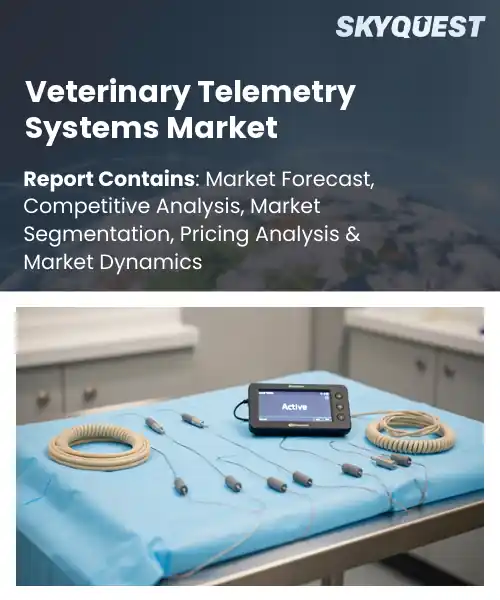
Veterinary Telemetry Systems Market
Report ID: SQMIG35G2393
Report ID: SQMIG35G2393
[email protected]
USA +1 351-333-4748
Report ID:
SQMIG35G2393 |
Region:
Global |
Published Date: May, 2026
Pages:
157
|Tables:
179
|Figures:
79


Global Veterinary Telemetry Systems Market size was valued at USD 1.2 Billion in 2024 and is poised to grow from USD 1.29 Billion in 2025 to USD 2.26 Billion by 2033, growing at a CAGR of 7.3% during the forecast period (2026-2033).
The global veterinary telemetry systems market growth arises from the convergence of technological miniaturization and an increase in the demand for animal healthcare. veterinary telemetry employs both wireless & wired telemetry devices to monitor continuously physiological parameters including ecg, respiratory rate, and temperature, and real-time data from telemetry supports improved diagnostics and patient outcomes regardless of whether the veterinary practice is clinical, research, or field-based. The market has transformed from large laboratory equipment to small, wireless, portable telemetry devices typically used in the clinic or equine events and will include surgeons utilizing ecg and capnography during complex surgical procedures, and research centers utilizing multi-lead telemetry for longtube, longitudinal studies. The introduction of cloud analytics to connected devices is also a growth driver, as it provides low-cost monitoring and actionable intelligence for clinicians and herd managers.
The combination of increased sensor sensitivity and the availability of mobile networks enables the earlier detection of subtle physiological changes, allowing veterinarians to intervene sooner and reduce lengths of hospitalization and limit disease transmission in a production setting. For example, dairy farms utilizing rumination and activity monitors report fewer cases of mastitis and equine programs utilizing gps in conjunction with cardiac telemetry can optimize their training loads. Such outcomes drive demand for subscription-based software programs, offer opportunities for partnerships between manufacturers and telehealth providers, and have opened regulatory acceptance of remote monitoring technologies.
How is IoT Transforming the Veterinary Telemetry Systems Market?
Veterinary telemetry has been significantly impacted by IoT's integration of sensors and other devices connected via cloud-based systems which allow for ongoing monitoring and real time alerts. Wearable sensors and/or in-clinic diagnostic equipment that collect vital signs and animal behavior are key components of veterinary telemetry as they provide secure connectivity and filtering of noise with the help of edge analytical tools. Edge analytical tools enable integration with the veterinary practice workflow for more timely diagnosis and preventive care.
The market has evolved from an episodic check-based care delivery model to an ongoing, longitudinal data-based care delivery model. Examples of how this shift is happening include the introduction of smart collars that measure physical activity to monitors located in the veterinary hospital that stream ECG and temperature information to veterinary hospitals and veterinary professionals.
In February 2026, at CES, Metrani demonstrated the introduction of its Sentra vitamin K collar as an example of how IoT-enabled multimodal telemetry combines physiological sensor data with behavioral sensor data, along with cloud-based analytics, to provide connected devices that assist with diagnosis, facilitate remote follow-up, and create ongoing service-driven care environments that allow for market growth and increased efficiency for veterinary clinics.
Market snapshot - (2026-2033)
Global Market Size
USD 1.2 Billion
Largest Segment
Wearable Veterinary Telemetry Systems
Fastest Growth
Remote Monitoring Software Platforms
Growth Rate
7.3% CAGR
To get more insights on this market click here to Request a Free Sample Report
Global veterinary telemetry systems market is segmented by by product type, by animal type, by application, by technology, by end user, by deployment type and region. Based on by product type, the market is segmented into Wearable Veterinary Telemetry Systems, Implantable Veterinary Telemetry Systems, Remote Monitoring Software Platforms, Wireless Data Acquisition Systems and Others. Based on by animal type, the market is segmented into Companion Animals, Livestock Animals and Research Animals. Based on by application, the market is segmented into Cardiology Monitoring, Neurology Monitoring, Respiratory Monitoring, Activity & Behavior Monitoring, Post-surgical Monitoring, Research & Drug Development and Others. Based on by technology, the market is segmented into Radio Frequency Telemetry, Bluetooth-enabled Telemetry, Wi-Fi-enabled Telemetry and Cloud-connected Telemetry Systems. Based on by end user, the market is segmented into Veterinary Hospitals & Clinics, Animal Research Laboratories, Livestock Farms, Academic & Research Institutes and Others. Based on by deployment type, the market is segmented into On-premises Systems and Cloud-based Systems. Based on region, the market is segmented into North America, Europe, Asia Pacific, Latin America and Middle East & Africa.
As per global veterinary telemetry systems market analysis, Wearable Veterinary Telemetry Systems segment dominates due to the ability of wearables to provide continuous and non-invasive data on the vital signs and activity of pets alike; this is important because it provides easy access to real-time, continuous data that is aligned with routine clinics workflows and comfort for animals. In addition to easy use, these devices can be easily integrated with existing monitoring dashboards making it possible for clinicians to readily use them in the future for ambulatory care, chronic disease monitoring, and preventative screening. Recent architecture improvements in sensors and batteries have also decreased procedural burden making these devices more popular within the community of veterinarians and thus, increasing investment in these devices and their interoperability.
As per global veterinary telemetry systems market forcast, the Remote Monitoring Software Platform is also influence by how quickly the physician's have access too Cloud Analytics, the ability to customize alerts and to do so using Telehealth services, which accelerate the purchase and in turn the use across the veterinary faculty's. The need for integrated dashboards and devices to collect and analyze data agnostically are driving the vendors towards subscription-based models and open API's generating new revenue streams while also providing greater opportunity for Scalably managing remote patients by veterinary providers.
As per global veterinary telemetry systems market share, Radio Frequency Telemetry is the forerunner in this area because of its proven long distance capabilities combined with reliable signal penetration makes it optimal for long term tracking of wildlife in numerous types of environments where gene flow can occur. Its established methods and low power consumption leads to decreased infrastructure requirements for long term wildlife tracking in addition to continuous tracking of multiple animals over time without frequent user interventions. The robust nature of the technology against motion and changing conditions instills great confidence from suppliers leading to widespread usage of this technology for research or field applications where reliable connectivity and quality of data are essential for the success of clinical or study outcome.
In contrast, Bluetooth Telemetry is the fastest growing segment and is being driven mainly by low power interoperability protocols, easy pairing with handheld devices and rapid integration into clinics. The availability of numerous consumer devices and the minaturization of those devices is creating increased use of Bluetooth telemetry for companion animal tracking and other near distance clinical applications. As a result, manufacturers are investing more in their respective ecosystems of devices and software to enable the use of telemedicine and point-of-care data services.
To get detailed segments analysis, Request a Free Sample Report
As per global veterinary telemetry systems market regional analysis, with an established mature veterinary care system and an extensive number of research institutions, North America is a global leader in the market. Coupled with significant investment from both private and institutional sources, the rate of adoption will continue to grow due to the effectiveness of existing distribution systems and the integration of telemetry systems into clinical workflows. Increased awareness among pet owners and farm managers, combined with collaboration between technology vendors and veterinary specialists, will continue to deepen this market. The clarity of regulatory guidelines and reimbursement mechanisms in key markets will further help to create an environment where it is difficult to adopt new products but will also allow for future improvements to products and broader acceptance of products used for veterinary telemetry by the veterinary community. In addition, the presence of a large number of veterinary colleges and specialty clinics in North America creates a robust training infrastructure for veterinarians in how to properly utilize this technology, as well as validate the use of this technology in an animal's clinical practice. Some of the largest companies in this industry are placing an emphasis on post-sale support, integration of data analytics, and interoperability with practice management and medical record systems, thus enhancing the overall value proposition of their products and services. Cross-industry collaboration with human medical device manufacturers will continue to accelerate innovation and the transfer of technology and scale in order to create new telemetry systems.
In the U.S., the Veterinary Telemetry Systems Market is supported by a strong network of referral hospitals, research institutions, and technology vendors that are driving the rapid adoption and acceptance of these systems into clinical practice. The abundance of private investments into veterinary healthcare and collaborative projects between academia and industry are facilitating the development of these systems and their integration with electronic health record (EHR) systems. With most providers acquainted with advanced forms of monitoring and emerging animal welfare initiatives, vendors are motivated to offer service-related models, training programs, and localized support.
In Canada, the Veterinary Telemetry Systems Market is being developed by an established network of mixed animal and specialty animal practice providers that have a significant interest in using telemetry systems to support patient care to both companion and agricultural animals. Provincial government funding programs and collaborative research centres are creating an incentive for implementing and conducting research into veterinary telemetry systems. To accommodate varying environmental conditions and enhance the potential profitability of these systems, vendors are developing ruggedized telemetry systems that are usable in multiple climates. Vendors are also concentrating their efforts on providing bilingual customer support, forming partnerships with Canadian veterinary colleges and supporting veterinarians in developing their confidence in the veterinary telemetry system's ability to provide quality monitoring of animals throughout patient care. In addition to developing and deploying the infrastructures necessary to support the use of veterinary telemetry systems, service-related business models and regional distributors are also decreasing the accessibility of veterinary telemetry systems in both rural and urban practice environments.
Veterinary telemetry systems are rapidly expanding across Europe due to superior clinical skill sets, integrated animal health networks, and strong regulatory pressure for improved standards of care. The growing number of veterinary specializations, an increased focus on animal welfare, and the emergence of telemedicine programs have led to clinics deciding to add remote monitoring and data-driven decision-making capabilities. Pan European cooperation between research institutions, product manufacturers, and distribution companies are supporting the effort to develop standardization and interoperability. New and entry-level companies utilize localized service offerings, multilingual platforms, and partnerships with cooperative agribusinesses to cater to the diverse needs of food-producing animals and pets. Ongoing investment in clinician training and demonstration projects is further reducing barriers to the implementation of veterinary telemetry systems and validating clinical outcomes across different types of veterinary practices. The active involvement of professional associations and credentialing organizations in supporting best practices is creating an environment of confidence in the use of veterinary telemetry systems based on the manufacturers’ commitment to secure data management and system integration into practice workflows. Post-implementation training and regional service centers are supporting long-term utility and facilitating wider acceptance of the use of practice telemedicine systems.
The Veterinary Telemetry Systems Market in Germany has a history of integration between veterinary universities, industrial manufacturers, and specialist clinics based on the principles of scientific rigor. The providers of these systems emphasize high-quality engineering, regulatory compliance, and comprehensive service agreements. There are many collaborative research programs and consortia in the veterinary field that foster the development of pilot studies in both the livestock and companion animal sectors. The adoption of interoperable systems and certified workflows increases the level of clinical adoption of veterinary telemetry systems and builds confidence among practitioners and institutions.
The Veterinary Telemetry Systems Market in the United Kingdom is growing due to a large number of exciting start-ups, integration with telehealth services, and engagement with the use of digital tools by clinicians. Service providers are providing solutions with an emphasis on user experience and interoperability to both mixed practice and urban specialty clinics. Validation of these systems is being accelerated through collaborative pilot programs with animal welfare organizations and stakeholders in agriculture. Continued focus on clinician training; responsive support; and scalable implementation will enhance momentum in this market and increase the level of confidence veterinarians and practitioners have in their regions with veterinary telemetry systems.
France veterinary telemetry systems market is expanding rapidly due to the increasing interest shown by companion animal hospitals and laboratories as they attempt to improve monitoring and traceability capabilities. National veterinary associations and research institutes have initiated demonstration projects to demonstrate the clinical and operational advantages of telemetry systems for veterinarians. Manufacturers are modifying their products for language and regulatory differences, while focusing on providing user friendly systems that can be implemented quickly and easily. Creating partnerships with local distributors and service providers will help build confidence and allow them to spread the usage of their product to new customers.
As per global veterinary telemetry systems market regional forecast, Asia-Pacific is playing a key role in the market with increased investment in the training of veterinarians, improved digital health infrastructure and greater collaboration between local and global technology vendors. The rapid modernization of large scale agricultural production and increased focus on the health of companion animals have driven the innovation and implementation of technologies to allow for the remote monitoring of animal health through data analytics. Regional clusters will provide the opportunity to develop innovation hubs to adapt to local clinical workflows and environmental conditions. Cost effective design, multilingual capabilities, and post sale service networks will enable the development of practical solutions in many differing economies. In addition to developing and certifying strategic partnerships, pilot programs with academic institutions, will provide further validation of technologies and support to the broader acceptance of these technologies. Regulatory alignment improvements and investments in manufacturing capacity will give rise to greater local production and customization. As a result of the proliferation of mobile telecommunications technology and the maturation of telemedicine ecosystems, remote data transmission and real time interaction between veterinarians and their patients will be facilitated while the implementation of training initiatives will improve the technical capabilities of veterinarians.
Japan Veterinary Telemetry Systems market continues to grow due to its well-established electronics manufacturing sector, established legislations and regulations, and the substantial expectation that veterinary clinicians have for the quality of their products. Many of the local companies work together with academic veterinary centers to further develop and improve sensor technology and analytics for both the care of companion and production animals. The focus on miniaturization, development of user friendly interfaces and integration with existing practice management software have helped lead to increased adoption rates. Many of the vendors offer comprehensive education and maintenance training to allow veterinarians to maintain the high clinical standards expected by consumers.
In South Korea, the Veterinary Telemetry Systems sector is experiencing growth through active technology companies, innovative development programs and positive attitudes by the clinical community toward digital monitoring solutions. The community is able to take advantage of their technological strengths in areas of wireless communication and data platforms for the edition of telemetry devices that support intensive livestock production and companion animal practices. In addition to working with the veterinary community for product development, several manufacturers have also begun to develop fast delivery programs, provide local language support and framework for measuring and monitoring animals, and integrate their devices into the National Animal Health Database. The training programs and the availability of after sales service help to build clinician confidence in both the devices and developing relationships between the clinician and manufacturer.
To know more about the market opportunities by region and country, click here to
Buy The Complete Report
Rising Demand For Remote Monitoring
Veterinarians and animals' owners are increasingly preferring remote monitoring; therefore, we review the effect of this on the growing demand for telemetry solutions that allow for continuous health observation of the animal outside of the clinical setting. This has caused many providers to begin to integrate wearable and implantable devices with their software platforms in order to provide ongoing monitoring, improve preventive care and provide teleconsultation services. The main driver for product development and deployment in this sector has been the perceived advantage of detecting health problems earlier and coordinating better care for the animal. Thus, the investment in developing new telemetry products, deploying them, and making them available continues to expand, making telemetry more integrated with veterinary practices.
Advances In Sensor And Connectivity
High Initial Investment Requirements
The high costs upfront for telemetry hardware, the software required to run it and training the staff may well discourage many small veterinary practices or field-based operations from adopting these systems. The complexity of procurement and uncertainties regarding longer-term value lead most decision makers to continue using traditional methods rather than investing in new technology to monitor their patients. Ongoing concerns about the integration of telemetry into existing workflows as well as the need for dedicated management support resources further decrease the willingness of organizations to deploy these solutions broadly which limits the availability of telemetry systems to large institutions with sufficient capital and organizational capacity to afford the initial investment.
Regulatory Compliance Complexity
Request Free Customization of this report to help us to meet your business objectives.
There is a lot of consolidation and product development occurring in the veterinary telemetry systems industry. Companies that already exist are acquiring telemetry companies (e.g., Zomedica acquiring Assisi) to build out their telemetry lines such as the rollout of the VetGuardian zero touch monitor (with enhanced audio capabilities). There are many startups that offer telemedicine and wearable devices in niche markets and apply pressure to established players in these markets by developing distribution agreements and technical partnerships that aid in the adoption of their products and allow for more interoperability with existing products.
SkyQuest’s ABIRAW (Advanced Business Intelligence, Research & Analysis Wing) is our Business Information Services team that Collects, Collates, Correlates, and Analyses the Data collected by means of Primary Exploratory Research backed by robust Secondary Desk research.
As per SkyQuest analysis, the global veterinary telemetry systems market is driven primarily by technological miniaturization paired with rising demand for improved animal healthcare, enabling compact wearables and implantables to deliver continuous physiologic data. A secondary driver is integration of connected devices with cloud analytics, which supports remote monitoring, actionable insights and subscription services. Adoption is led by North America where mature veterinary ecosystems and research institutions accelerate uptake. Wearable veterinary telemetry systems dominate the market due to noninvasive continuous monitoring and ease of clinical integration. A notable restraint remains high upfront investment and integration costs that can deter smaller practices from adopting comprehensive telemetry solutions despite clear clinical benefits.
| Report Metric | Details |
|---|---|
| Market size value in 2024 | USD 1.2 Billion |
| Market size value in 2033 | USD 2.26 Billion |
| Growth Rate | 7.3% |
| Base year | 2024 |
| Forecast period | (2026-2033) |
| Forecast Unit (Value) | USD Billion |
| Segments covered |
|
| Regions covered | North America (US, Canada), Europe (Germany, France, United Kingdom, Italy, Spain, Rest of Europe), Asia Pacific (China, India, Japan, Rest of Asia-Pacific), Latin America (Brazil, Rest of Latin America), Middle East & Africa (South Africa, GCC Countries, Rest of MEA) |
| Companies covered |
|
| Customization scope | Free report customization with purchase. Customization includes:-
|
To get a free trial access to our platform which is a one stop solution for all your data requirements for quicker decision making. This platform allows you to compare markets, competitors who are prominent in the market, and mega trends that are influencing the dynamics in the market. Also, get access to detailed SkyQuest exclusive matrix.
Table Of Content
Executive Summary
Market overview
Parent Market Analysis
Market overview
Market size
KEY MARKET INSIGHTS
COVID IMPACT
MARKET DYNAMICS & OUTLOOK
Market Size by Region
KEY COMPANY PROFILES
Methodology
For the Veterinary Telemetry Systems Market, our research methodology involved a mixture of primary and secondary data sources. Key steps involved in the research process are listed below:
1. Information Procurement: This stage involved the procurement of Market data or related information via primary and secondary sources. The various secondary sources used included various company websites, annual reports, trade databases, and paid databases such as Hoover's, Bloomberg Business, Factiva, and Avention. Our team did 45 primary interactions Globally which included several stakeholders such as manufacturers, customers, key opinion leaders, etc. Overall, information procurement was one of the most extensive stages in our research process.
2. Information Analysis: This step involved triangulation of data through bottom-up and top-down approaches to estimate and validate the total size and future estimate of the Veterinary Telemetry Systems Market.
3. Report Formulation: The final step entailed the placement of data points in appropriate Market spaces in an attempt to deduce viable conclusions.
4. Validation & Publishing: Validation is the most important step in the process. Validation & re-validation via an intricately designed process helped us finalize data points to be used for final calculations. The final Market estimates and forecasts were then aligned and sent to our panel of industry experts for validation of data. Once the validation was done the report was sent to our Quality Assurance team to ensure adherence to style guides, consistency & design.
Analyst Support
Customization Options
With the given market data, our dedicated team of analysts can offer you the following customization options are available for the Veterinary Telemetry Systems Market:
Product Analysis: Product matrix, which offers a detailed comparison of the product portfolio of companies.
Regional Analysis: Further analysis of the Veterinary Telemetry Systems Market for additional countries.
Competitive Analysis: Detailed analysis and profiling of additional Market players & comparative analysis of competitive products.
Go to Market Strategy: Find the high-growth channels to invest your marketing efforts and increase your customer base.
Innovation Mapping: Identify racial solutions and innovation, connected to deep ecosystems of innovators, start-ups, academics, and strategic partners.
Category Intelligence: Customized intelligence that is relevant to their supply Markets will enable them to make smarter sourcing decisions and improve their category management.
Public Company Transcript Analysis: To improve the investment performance by generating new alpha and making better-informed decisions.
Social Media Listening: To analyze the conversations and trends happening not just around your brand, but around your industry as a whole, and use those insights to make better Marketing decisions.
REQUEST FOR SAMPLE
 REQUEST FREE CUSTOMIZATION
Global Veterinary Telemetry Systems Market size was valued at USD 1.2 Billion in 2024 and is poised to grow from USD 1.29 Billion in 2025 to USD 2.26 Billion by 2033, growing at a CAGR of 7.3% during the forecast period (2026-2033).
Competition in veterinary telemetry is driven by consolidation, product innovation, and channel partnerships. Established firms pursue acquisitions to add telemetry lines, for example Zomedica’s acquisition of Assisi and rollout of the VetGuardian zero touch monitor with enhanced audio capabilities. Startups pressure incumbents with niche telemedicine and wearable devices, prompting distribution agreements and technical partnerships that accelerate clinical adoption and interoperability. 'Data Sciences International', 'Bionet America', 'Midmark Corporation', 'Masimo', 'Nonin Medical', 'Vetland Medical', 'Telemetry Research', 'Lepu Medical', 'Mindray Animal Medical', 'Esaote', 'Biopac Systems', 'Kent Scientific', 'Emka Technologies', 'iWorx Systems', 'PaceTech', 'Avante Animal Health', 'Digicare Biomedical Technology', 'M3-Diagnostics', 'Smiths Medical', 'Nihon Kohden'
Growing preference for remote monitoring among veterinarians and animal owners stimulates demand for telemetry solutions that enable continuous health observation outside clinical settings. This shift encourages providers to integrate wearable and implantable devices with software platforms to maintain ongoing oversight, enhance preventive care, and support teleconsultations. The perceived benefits of earlier detection of health issues and improved care coordination drive investment in product development and deployment, expanding solution availability and making telemetry an increasingly integral component of modern veterinary practice.
Remote Monitoring Adoption Surge: Veterinary practices and animal owners increasingly prioritize continuous remote monitoring to improve welfare and streamline care delivery. Portable telemetry devices and cloud platforms provide visibility into physiological and behavioral metrics, supporting preventive interventions and post-operative oversight. This shift strengthens connectivity between clinics and caretakers, expands service models such as remote consultations, and creates demand for interoperable systems that integrate with practice management workflows. Market momentum reflects a focus on timely insights and improved clinical outcomes across diverse animal care segments.
North America Dominate the Global Veterinary Telemetry Systems Market


Want to customize this report? This report can be personalized according to your needs. Our analysts and industry experts will work directly with you to understand your requirements and provide you with customized data in a short amount of time. We offer $1000 worth of FREE customization at the time of purchase.
Feedback From Our Clients


 USA (+1) 351-333-4748

