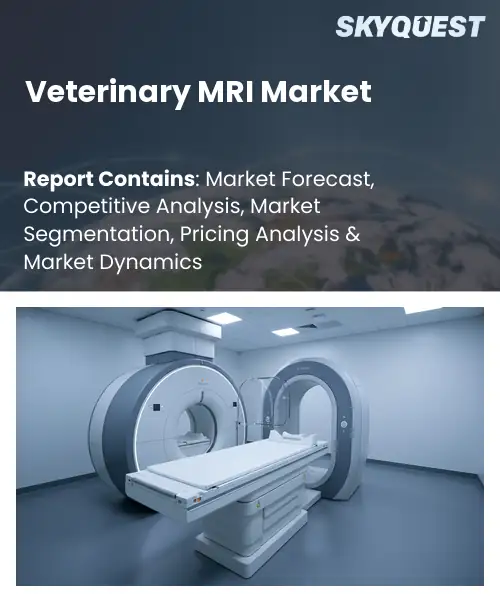
Veterinary MRI Market
Report ID: SQMIG35A3554
Report ID: SQMIG35A3554
[email protected]
USA +1 351-333-4748
Report ID:
SQMIG35A3554 |
Region:
Global |
Published Date: May, 2026
Pages:
157
|Tables:
143
|Figures:
78


Global Veterinary Mri Market size was valued at USD 182.5 Million in 2024 and is poised to grow from USD 198.23 Million in 2025 to USD 382.4 Million by 2033, growing at a CAGR of 8.62% during the forecast period (2026-2033).
Primary driver of the veterinary MRI market is accelerating demand for advanced diagnostic imaging as pet owners expect human-grade care and the veterinary profession expands specialty services. The market includes manufacturers, service providers, and hospitals that supply and use MRI systems for companion and equine patients, and it matters because MRI reveals soft tissue and neurologic diseases that radiographs and ultrasound miss. Historically the field moved from scarce low-field units at teaching hospitals to wider adoption of mid- and high-field systems alongside mobile MRI services and teleradiology. For example, specialty clinics perform MRI-guided neurosurgery and cancer staging, proving clinical value.
Building on clinical validation, the key trend driving the global veterinary MRI sector growth is improved accessibility as lower-cost systems and mobile units reduce financial and logistical barriers for clinics. As manufacturers create affordable portable low field MRI scanners along with rental programs, many general health care systems are adding MRI, therefore increasing the number of referrals to specialty imaging centers. The revenue generated from these referrals can then be used to purchase additional equipment. For example, MRI clinics can use mobile MRI vans to provide rural equine veterinarians the ability to obtain neurologic diagnostics on-site while urban hospitals utilizing MRI can provide advanced orthopaedic imaging with minimal capital expenditure.
How is AI Improving Diagnostic Accuracy in the Veterinary MRI Market?
AI is improving diagnostic accuracy in veterinary MRI by automating image enhancement and interpretation and by standardizing scans across patients. Key aspects include AI powered denoising and reconstruction, automated segmentation of anatomy, and pattern recognition tuned for orthopedic and neurologic conditions. Today referral centers and specialty practices integrate AI into image management and workflow to reduce reader variability and to speed case triage. Practical instances include AI driven image quality checks, automated measurements and diagnostic suggestions that highlight subtle lesions and support clinicians in reaching more confident diagnoses and in planning more targeted interventions.
In February 2026, Hallmarq alliance expanded access to AI supported diagnostics across MRI and CT and will help scale integrated software that speeds reads and improves consistency, supporting market growth and efficiency by enabling more practices to adopt advanced imaging and by streamlining referral workflows.
Market snapshot - (2026-2033)
Global Market Size
USD 182.5 Million
Largest Segment
Low/Mid-Field MRI (Below 1.0T)
Fastest Growth
High-Field MRI (Above 1.0T)
Growth Rate
8.62% CAGR
To get more insights on this market click here to Request a Free Sample Report
Global veterinary mri market is segmented by field strength, application, animal, end-user, distribution and region. Based on field strength, the market is segmented into High-Field MRI (Above 1.0T) and Low/Mid-Field MRI (Below 1.0T). Based on application, the market is segmented into Neurological Disorders, Musculoskeletal, Oncology and Soft Tissue Imaging. Based on animal, the market is segmented into Small Animals (Dogs, Cats) and Large Animals (Horses). Based on end-user, the market is segmented into Veterinary Hospitals, Veterinary Schools and Research Institutes. Based on distribution, the market is segmented into Direct Sales and Distributors. Based on region, the market is segmented into North America, Europe, Asia Pacific, Latin America and Middle East & Africa.
Based on the global veterinary MRI market growth, high-field MRI segment dominates because it delivers superior image resolution and contrast critical for complex diagnostic cases in veterinary practice. Increased power of field allows for improved protocols and rapid capture of data, leading to clinician preference for detailed neuro and cancer testing. Increased ability to see subtle pathology reduces diagnostic uncertainty and supports referral center workflows, thus reinforcing hospital and research center investment looking to provide high quality imaging and surgical planning solutions.
However, low/mid-field MRI is the most rapidly expanding area, driven by lower acquisition and operating costs and a smaller footprint that suits general practices. Easier installation and growing vendor focus on compact systems and tailored protocols accelerate adoption across clinics, widening access to MRI diagnostics and creating new clinical and commercial opportunities.
Neurological disorders segment leads because the need for high-resolution brain and spinal cord imaging drives primary demand for veterinary MRI. Increased power of field allows for improved protocols and rapid capture of data, leading to clinician preference for detailed neuro and cancer testing. Increased ability to see subtle pathology reduces diagnostic uncertainty and supports referral center workflows, thus reinforcing hospital and research center investment looking to provide high quality imaging and surgical planning solutions.
Meanwhile, oncology is the most rapidly expanding area due to growing demand for tumor staging and treatment monitoring in veterinary care. Improvements in contrast and functional imaging enhance tumor characterization, encouraging adoption of MRI in oncology workflows. This drives development of dedicated protocols, collaborative trials, and expanded clinical services that broaden market opportunity.
To get detailed segments analysis, Request a Free Sample Report
As per the global veterinary MRI market share, North America dominates due to a confluence of clinical, technological, and commercial strengths. A dense network of specialty veterinary hospitals, academic centres, and imaging referral centres enables early adoption of high-field and dedicated veterinary MRI systems. Through strong partnerships amongst manufacturing, clinical research, and veterinarian researchers, new advanced technologies are being developed and validated for more complicated animal cases. The availability of established training programs, a skilled workforce, and the use of advanced imaging on an everyday basis provide the framework necessary for using advanced imaging. The regulatory and reimbursement environment coupled with the desire of clients to invest in high-quality care creates an atmosphere that allows innovative products to transition quickly from research to clinical practice, which enhances the competitiveness of the global market.
Veterinary MRI market in United States features a dense network of specialty hospitals and veterinary schools that drive clinical demand and device refinement. Close collaboration between manufacturers and clinicians produces tailored systems with service support. A developed financing and maintenance ecosystem enables deployment across private and referral practices. Training programs and research translation into clinical workflows sustain advanced imaging use and make the country hub for product development and clinical validation.
Veterinary MRI market in Canada is characterized by concentration of advanced imaging in regional referral centres that support complex workups. The collaboration between clinical teams and equipment manufacturers results in customized setups for machinery and distant management options that meet the needs of clinics that don't have the same types of patients or types of services. Training and inter-facility referral networks increase the level of clinical ability of both the training facilities and the clinics throughout the nation.
Based on global veterinary MRI regional forecast, rapid expansion in Europe is driven by a combination of rising clinical capability, coordinated academic and industry partnerships, and growing demand for advanced diagnostic services. Cross border collaboration and harmonization of clinical protocols facilitate multicentre studies and standardization of imaging practices. Active engagement by global and regional equipment vendors, together with tailored service models and localized training, reduces deployment barriers. Increasing awareness among veterinarians and animal owners about the value of high resolution imaging, plus incentives for translational research and clinical validation across prominent markets, accelerate integration of MRI into routine veterinary workflows and elevate regional market momentum. Lastly, veterinary associations and continuing education programs are both enhancing the ability and confidence that veterinary professionals have when utilizing MRI technology to diagnose patients.
Veterinary MRI market in Germany is anchored by university clinics and specialty practices that drive demand for advanced imaging. Collaboration between clinical researchers and equipment suppliers supports validation and tailored technology offerings. A strong service network supports uptime for referral centres. The focus of this community on training and integrated networks allows them to continue developing high-level imaging protocols, while simultaneously providing Germany with a reputable location to develop and validate products and provide expertise in veterinary MRI.
Veterinary MRI market in United Kingdom is growing as specialty clinics expand and vendors increase tailored service offerings. The success of these collaborations is driven by the effort made to provide clinical education to qualified professionals and build confidence among practitioners using advanced imaging. Collaborative working between manufacturers and clinical centers supports rapid introduction of products into the marketplace and new services to allow for increased usage of MRI throughout the country as part of everyday diagnostic and surgical processes.
Veterinary MRI market in France is emerging through expansion of regional referral centres and ties between university clinics and private practices. As veterinarians and pet owners become more aware of the need to use selective adoption for difficult cases, there is a growing understanding that local vendors will provide sufficient support and service to meet the requirements of the veterinarians in each region. Educating practitioners, conducting collaborative studies, and creating unified referral networks will also help to promote the development of imaging capabilities and the incorporation of MRI technology into standard veterinary practice.
As per global veterinary MRI regional outlook, Asia Pacific is strengthening its market position through strategic investments in clinical infrastructure, enhanced collaboration between technology providers and veterinary institutions, and targeted development of service networks to support advanced imaging. Areas have access to excellence centres, with clinical use and research being combined, which allows localization of MRI applications for both companion and specialty animals. Manufacturers are developing product lines and service models to accommodate various sized practices and geographic challenges. Training initiatives, practical workshops and trans-border clinical exchanges provide practitioners with the ability and confidence to use MRI. A growing vendor presence and proactive partnerships support after-sales service and maintenance, while steadily increasing awareness among veterinarians and animal owners drives MRI integration into diagnostic pathways among multiple markets.
Veterinary MRI market in Japan pairs advanced imaging technology with strong veterinary clinical capacity, supporting adoption across university clinics and referral hospitals. Clinical teams collaborate with vendors to customize their systems to meet local requirements and connect their practice models to successful outcomes. Strong service networks and practitioner training enable doctors to routinely provide clinical services. Focused research partnerships develop new imaging technologies, which are then adapted into veterinary medical protocols to further solidify Japan’s place as the centre for MRI excellence within Asia/Pacific and globally.
Veterinary MRI market in South Korea benefits from integration of medical technology and veterinary practice, enabling rapid adaptation of imaging solutions for local needs. Referral centres and specialty clinics drive demand for advanced diagnostics while manufacturers provide tailored service and maintenance. Clinician education, collaborative research, and vendor training create a better environment for practitioners to develop their expertise. Collectively, these components will facilitate clinical adoption of this machine, and establish South Korea as a regional center of expertise in veterinary MRI.
To know more about the market opportunities by region and country, click here to
Buy The Complete Report
Rising Companion Animal Care Services
Technological Advancements In MRI
High Equipment And Maintenance Costs
Shortage Of Trained Personnel
Request Free Customization of this report to help us to meet your business objectives.
Competitive landscape in global veterinary MRI market outlook is driven by technology differentiation and access models, with firms competing on specialized coils, AI denoising and financing. Concrete strategies include Hallmarq’s zero helium small animal high field systems and Imaging as a Service subscription, Siemens Healthineers’ veterinary MAGNETOM adaptations, and OEM partnerships that integrate veterinary AI and positioning solutions.
Top Player’s Company Profile
Recent Developments
SkyQuest’s ABIRAW (Advanced Business Intelligence, Research & Analysis Wing) is our Business Information Services team that Collects, Collates, Correlates, and Analyses the Data collected by means of Primary Exploratory Research backed by robust Secondary Desk research.
As per SkyQuest analysis, a key driver is accelerating demand for advanced diagnostic imaging as pet owners seek human-grade care, with a second driver being improved accessibility through lower-cost and mobile MRI solutions that expand clinic-level adoption and enable on-site equine and community services. High equipment and maintenance costs remain a key restraint, slowing uptake among smaller practices and limiting decentralized deployment. North America remains the dominating region due to dense specialty networks, strong clinician-manufacturer collaboration and mature financing and service ecosystems. The high-field magnetic resonance imaging (MRI) category has been identified as the leading segment due to its ability to produce high-resolution images for complicated neurological and oncological cases, thereby supporting the continued investment of these centers in their facilities and helping to maintain efficiencies in their advanced clinical operations.
| Report Metric | Details |
|---|---|
| Market size value in 2024 | USD 182.5 Million |
| Market size value in 2033 | USD 382.4 Million |
| Growth Rate | 8.62% |
| Base year | 2024 |
| Forecast period | (2026-2033) |
| Forecast Unit (Value) | USD Million |
| Segments covered |
|
| Regions covered | North America (US, Canada), Europe (Germany, France, United Kingdom, Italy, Spain, Rest of Europe), Asia Pacific (China, India, Japan, Rest of Asia-Pacific), Latin America (Brazil, Rest of Latin America), Middle East & Africa (South Africa, GCC Countries, Rest of MEA) |
| Companies covered |
|
| Customization scope | Free report customization with purchase. Customization includes:-
|
To get a free trial access to our platform which is a one stop solution for all your data requirements for quicker decision making. This platform allows you to compare markets, competitors who are prominent in the market, and mega trends that are influencing the dynamics in the market. Also, get access to detailed SkyQuest exclusive matrix.
Table Of Content
Executive Summary
Market overview
Parent Market Analysis
Market overview
Market size
KEY MARKET INSIGHTS
COVID IMPACT
MARKET DYNAMICS & OUTLOOK
Market Size by Region
KEY COMPANY PROFILES
Methodology
For the Veterinary MRI Market, our research methodology involved a mixture of primary and secondary data sources. Key steps involved in the research process are listed below:
1. Information Procurement: This stage involved the procurement of Market data or related information via primary and secondary sources. The various secondary sources used included various company websites, annual reports, trade databases, and paid databases such as Hoover's, Bloomberg Business, Factiva, and Avention. Our team did 45 primary interactions Globally which included several stakeholders such as manufacturers, customers, key opinion leaders, etc. Overall, information procurement was one of the most extensive stages in our research process.
2. Information Analysis: This step involved triangulation of data through bottom-up and top-down approaches to estimate and validate the total size and future estimate of the Veterinary MRI Market.
3. Report Formulation: The final step entailed the placement of data points in appropriate Market spaces in an attempt to deduce viable conclusions.
4. Validation & Publishing: Validation is the most important step in the process. Validation & re-validation via an intricately designed process helped us finalize data points to be used for final calculations. The final Market estimates and forecasts were then aligned and sent to our panel of industry experts for validation of data. Once the validation was done the report was sent to our Quality Assurance team to ensure adherence to style guides, consistency & design.
Analyst Support
Customization Options
With the given market data, our dedicated team of analysts can offer you the following customization options are available for the Veterinary MRI Market:
Product Analysis: Product matrix, which offers a detailed comparison of the product portfolio of companies.
Regional Analysis: Further analysis of the Veterinary MRI Market for additional countries.
Competitive Analysis: Detailed analysis and profiling of additional Market players & comparative analysis of competitive products.
Go to Market Strategy: Find the high-growth channels to invest your marketing efforts and increase your customer base.
Innovation Mapping: Identify racial solutions and innovation, connected to deep ecosystems of innovators, start-ups, academics, and strategic partners.
Category Intelligence: Customized intelligence that is relevant to their supply Markets will enable them to make smarter sourcing decisions and improve their category management.
Public Company Transcript Analysis: To improve the investment performance by generating new alpha and making better-informed decisions.
Social Media Listening: To analyze the conversations and trends happening not just around your brand, but around your industry as a whole, and use those insights to make better Marketing decisions.
REQUEST FOR SAMPLE
 REQUEST FREE CUSTOMIZATION
Global Veterinary Mri Market size was valued at USD 182.5 Million in 2024 and is poised to grow from USD 198.23 Million in 2025 to USD 382.4 Million by 2033, growing at a CAGR of 8.62% during the forecast period (2026-2033).
Competitive landscape in veterinary MRI is driven by technology differentiation and access models, with firms competing on specialized coils, AI denoising and financing. Concrete strategies include Hallmarq’s zero helium small animal high field systems and Imaging as a Service subscription, Siemens Healthineers’ veterinary MAGNETOM adaptations, and OEM partnerships that integrate veterinary AI and positioning solutions. 'Esaote SpA (dedicated vet MRI)', 'Hallmarq Veterinary Imaging', 'Siemens Healthineers', 'GE Healthcare', 'Philips Healthcare', 'Bruker Corporation', 'MR Solutions', 'Time Medical Systems', 'Imris (Deerfield Imaging)', 'Toshiba Medical (Canon)', 'Mindray Medical', 'Scil Animal Care', 'IDEXX Laboratories', 'Multiscan Technologies', 'Paramed Medical Systems', 'Proton MR International', 'Universal Medical Inc.', 'Triangle X-Ray', 'SciMed Ltd.', 'O'Brien Imaging'
Veterinary clinics and specialty hospitals increasingly prioritize advanced diagnostic capabilities to meet rising client expectations for comprehensive care, prompting investment in magnetic resonance imaging systems that offer superior soft tissue visualization and noninvasive diagnosis. As referring veterinarians favor facilities offering MRI, demand for installation and service increases, stimulating manufacturers to develop veterinary-focused models, training programs, and support services that simplify clinical integration. This virtuous cycle of improved diagnostics, practitioner confidence, and owner willingness to pursue advanced care directly supports expansion of the veterinary MRI market.
Integration With Telemedicine Services: The growing convergence of veterinary MRI and telemedicine is reshaping diagnostic workflows by enabling remote image interpretation, specialist consultations, and collaborative case management across practices. Cloud based image sharing and secure communication platforms facilitate faster decision making and continuity of care, improving client access to expert opinions. This trend encourages vendors to prioritize interoperability, reporting tools, and smooth data transfer, while fostering partnerships among imaging providers, telehealth platforms, and referral centers to broaden reach and optimize patient outcomes.
Why does North America Dominate the Global Veterinary MRI Market? |@12


Want to customize this report? This report can be personalized according to your needs. Our analysts and industry experts will work directly with you to understand your requirements and provide you with customized data in a short amount of time. We offer $1000 worth of FREE customization at the time of purchase.
Feedback From Our Clients


 USA (+1) 351-333-4748

