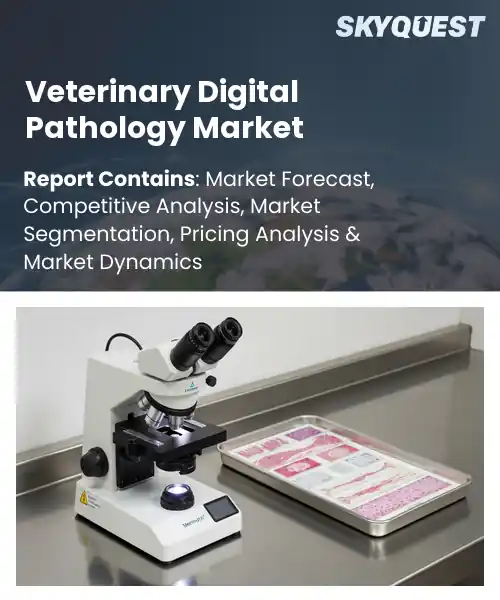
Veterinary Digital Pathology Market
Report ID: SQMIG35D2400
Report ID: SQMIG35D2400
[email protected]
USA +1 351-333-4748
Report ID:
SQMIG35D2400 |
Region:
Global |
Published Date: February, 2026
Pages:
157
|Tables:
119
|Figures:
77


Global Veterinary Digital Pathology Market size was valued at USD 426.1 Million in 2024 and is poised to grow from USD 486.9 Million in 2025 to USD 1506.2 Million by 2033, growing at a CAGR of 15.2% during the forecast period (2026-2033).
The global veterinary digital pathology market growth depends on three main components which include tissue slide digitization, image analysis algorithms, and cloud-based workflows that support remote diagnostics and research collaboration. The market exists because it speeds up test results, enhances prediction accuracy, and makes veterinary specialists more available to care for companionand production of animals, which helps both animal welfare and biosecurity. The veterinary field adopted technology beginning with the initial slide scanners and proprietary viewers and moved to fully interoperable whole-slide imaging systems which use AI-based tools through their implementation by veterinary teaching hospitals and referral centers. The university pathology department digitized its archives to support retrospective research and teleconsultation, which showed that digitization provided both cost savings and consistent results.
The world experiences growth because two factors, increasing digitization and cloud connectivity with AI-powered image analysis, drive business expansion as AI functions enhance both diagnostic accuracy and case handling capacity while reducing individual case expenses. Pathologists who use algorithm-based workflows enable laboratories to handle more cases and pharmaceutical researchers to speed up their toxicology and efficacy studies, which creates a requirement for unified platforms. Telepathology networks have demonstrated their public health value by enabling rural clinics to conduct zoonotic outbreak investigations while supporting remote medical consultations. Decreasing hardware costs together with subscription-based software licensing systems drive vendors to establish partnerships with ecosystem partners, which helps them create new SaaS revenue streams, while also enabling them to enter emerging veterinary markets at a faster pace.
How is AI Improving Diagnostic Accuracy in the Veterinary Digital Pathology Market?The global Veterinary digital pathology market outlook gets enhanced by AI technology which combines stable image analysis work with intelligent system management for improved diagnostic performance. Machine learning identifies small tissue alterations while it selects cases that need professional examination which leads to more accurate results. The tools work together with digital slide viewers and cloud review platforms to provide easier consultation processes which help to expedite diagnostic outcomes. The cytology and histology work in laboratories uses AI to find suspicious cells and create annotations which allows pathologists to concentrate on their more difficult cases. The vendors start to integrate their verified AI capabilities into veterinary procedures, which leads to better clinician trust while delivering more timely and relevant clinical results.
Market snapshot - (2026-2033)
Global Market Size
USD 453.4 Million
Largest Segment
Whole Slide Imaging (WSI) Systems
Fastest Growth
Image Analysis Software
Growth Rate
13.8% CAGR
To get more insights on this market click here to Request a Free Sample Report
The global veterinary digital pathology market is segmented by product type, application, animal type, end user, and region. Based on product type, the market is segmented into Whole Slide Imaging (WSI) Systems, Image Analysis Software, and Storage & Communication Systems. Based on application, the market is segmented into Diagnosis, Research, Education, and Drug Development & Preclinical Studies. Based on animal type, the market is segmented into Companion Animals, Livestock Animals, and Wildlife and Exotic Animals. Based on end user, the market is segmented into Veterinary Hospitals and Clinics, Veterinary Diagnostic Laboratories, Academic and Research Institutes, and Other End Users. Based on region, the market is segmented into North America, Europe, Asia Pacific, Latin America, and the Middle East & Africa.
As per the global veterinary digital pathology market analysis, the Whole Slide Imaging (WSI) Systems segment rules the market because WSI permits users to transform glass slides into digital formats which support remote assessment, telepathology operations, and diagnostic material preservation. The system delivers superior image quality together with familiar operational processes which lead institutions to buy the system for usage across their laboratories and clinics, thus creating a market for analytics, storage, and interoperability solutions that strengthen WSI’s primary role in the sector.
Whereas the image analysis software is anticipated to lead the market because machine learning technologies drive automated detection capabilities which enable both quantitative results and decision support systems through which pathologists can take on more work. The adoption of increasing clinical validation together with lab workflow integration, creates new service models which generate analytic revenue streams that expand market prospects.
According to the global veterinary digital pathology market forecast, veterinary digital pathology maintains its top market position because diagnosis procedures represent the main clinical advantage of this technology which directly influences treatment decisions for both companion and livestock animals. Pathologists and clinicians need dependable digital slide review systems that provide fast results, which drives organizations to spend money on imaging technology and software systems together with storage solutions. Vendors concentrate their attention on validated workflows while building interoperability systems, which results from clinical needs that create demand for diagnostic applications to become the main driver of market establishment and purchasing decisions.
Whereas the application area of Drug Development & preclinical studies now shows the highest growth rate because researchers increasingly use digital endpoints to conduct both translational studies and regulatory submissions. The combination of standardized digital workflows and advanced image analytics together with pharmaceutical collaborations, creates a marketplace that pharmaceutical companies can use to establish high-value service offerings and operational partnerships which enable them to create new revenue streams that extend beyond their standard clinical diagnostic services.
To get detailed segments analysis, Request a Free Sample Report
As per the veterinary digital pathology market regional forecast, North America has achieved its current position because of its extensive infrastructure systems and its advanced laboratory network and its extensive use of digital workflows throughout both clinical and research environments. The veterinary industry achieves quick adoption of image analysis and digital archiving technologies through the strong partnerships between technology providers and academic institutions and specialized veterinary hospitals. The major markets invest in high quality diagnostic platforms and training because the reimbursement frameworks together with the regulatory clarity create an environment that supports their efforts. The digital tools can be implemented into routine veterinary practice because of the existing workforce of pathologists and veterinary specialists who possess advanced skills. The combination of research funding and industry-academic collaborations enables organizations to validate digital diagnostics through telepathology training programs which enhance veterinary clinician knowledge. The local area possesses multiple solution vendors who provide service support to create product improvements which sustain technology implementation in both companion animal practices and equine practices.
The United States veterinary digital pathology sector shows specific characteristics through its widespread clinical use and its extensive network of specialized laboratories and its strong vendor presence which enables complete service delivery. The implementation of telepathology together with advanced imaging systems establishes an essential part of standard diagnostic procedures which medical practitioners need to understand. Academic institutions work together with business partners to create verification processes which support the introduction of new platform features as veterinary hospital networks buy these products to enhance their animal care services.
The veterinary digital pathology industry in Canada demonstrates targeted adoption through its referral networks and university laboratory operations which receive backing from clinic and research institution and supplier collaborations. The system focuses on achieving interoperability through service partnerships which support both diagnostic workflows and remote consultation processes. Pathology companies have built a strong connection with veterinary institutions which helps clinicians learn digital skills. The pilot programs and local vendor support create a framework which helps veterinary practices move toward implementing companion animal processes as standard practice.
Europe is growing rapidly because its healthcare systems operate together with its veterinary schools to provide strong educational programs, and its public research institutes work together with private technology companies. The laboratories require both interoperability and standardization to facilitate international diagnostic procedures which rely on common reference datasets. The clinical acceptance of digital pathology increases through its adoption by teaching hospitals and specialty clinics which use digital pathology systems to offer their services. The exhibitors and regional distributors create a network of support which enables businesses to implement their products while obtaining technical assistance. The markets establish proof of concept projects to validate their systems through verification studies which help establish clinical functions. The increasing adoption of remote consultation methods by clinicians together with the growing partnerships between vendors and diagnostic laboratories have created a strong movement in both companion animal and production animal diagnostics. The member markets benefit from regulatory alignment together with translational research funding which creates paths for commercial product development.
The veterinary digital pathology market share in Germany enhances through its advanced laboratory system and its strong research partnerships and its active collaboration between research universities and industrial organizations. The standards and interoperability requirements enable laboratories to share their data with each other while conducting verification studies across multiple centers. The Kenyan Referral Centers experience accelerated acceptance of digital workflows through the high level of clinician involvement with academic institutions. The local vendor system together with the dedicated service companies creates a framework which enables enterprises to implement their systems while receiving operational assistance in both companion animal and equine testing environments.
The United Kingdom veterinary digital pathology market shows high adoption rates through its academic hospitals and specialty clinics which receive strong support from both clinical professionals and startup companies. The system enables remote diagnostics to be performed on a broad scale through its focus on interoperability together with cloud-based consultation systems. The partnerships between vendors and teaching institutions speed up the process of verifying products for practical use. The digital workflow adoption process is supported by local service networks which provide training programs to help clinicians adopt digital technology across both companion animal and referral environments.
The veterinary digital pathology market in France is currently developing through its focused efforts at university hospitals and diagnostic centers which test pilot programs to show their medical effectiveness. The research laboratories work with solution providers to create local verification processes which allow platforms to meet both regulatory standards and operational requirements. The training programs which service partnerships provide increasingly help practitioners become familiar with their respective roles. The referral centers and specialized clinics create initial implementations which pave the way for future adoption in companion animal facilities.
Asia Pacific is expanding its market position through dedicated financial backing for diagnostic facilities and its growing scientific cooperation activities and the rising participation from local technology companies. Market systems boost their laboratory functions through telepathology technology, which bridges distance obstacles to facilitate distant medical consultations between their scattered clinical facilities. Specialized training programs together with international partner networks create the necessary capacity building framework which enables healthcare professionals to reach certification and validation status. The local innovation hubs develop custom solutions which address regional requirements for language and workflow, while the distributors and service partners deliver essential support for system deployment.
The veterinary digital pathology market in Japan combines modern imaging facilities with valuable academic hospital partnerships which connect both diagnostic and hospital systems. The adoption of image analysis tools together with precise diagnosis methods has gained traction at centers which offer advanced medical services and academic research laboratories. The vendors and clinical institutions establish partnerships which lead to both localized validation research and successful regulatory compliance. The training programs together with service-oriented vendors enable pathologists and clinicians to become familiar with digital workflows which will help them transition to companion animal practices.
The veterinary digital pathology market in South Korea progresses forward through its advanced technological framework which enables research teams to develop solutions that fit actual clinical workflows. The university hospitals and referral centers have adopted imaging platforms which work with analytics and remote consultation tools. The veterinary institutions develop local validation methods through their technology partnerships which provide clinician training programs. The implementation of digital workflows at companion animal practices receives assistance from service execution and vendor support.
To know more about the market opportunities by region and country, click here to
Buy The Complete Report
Integration with Telemedicine Platforms
Veterinarians and pathologists can conduct remote consultations and share their diagnostic results through telemedicine platforms because these platforms provide direct access to high-quality digital slides which can be viewed and shared without needing physical transfers. The system interoperability enhances work processes between veterinary clinics which adopt digital pathology systems to expand their diagnostic services, while it also strengthens institutional partnerships with technology providers and raises clinical value perception, thus driving the regional demand for digital solutions.
Advancements in Image Analysis Algorithms
Digital pathology platforms now automatically enhance and segment and annotate tissue images through their upgraded image analysis algorithms which save time and provide consistent interpretation across multiple cases. Better software capabilities approach digital solutions which veterinary practitioners prefer through their ability to connect with laboratory information systems for easy case handling. Vendors can show greater clinical value through their products because users find the interfaces easier to navigate and the algorithms produce better results, which leads to higher adoption rates and operational efficiency gains, thus increasing veterinary market potential and vendor investments.
High Initial Technology Costs
The initial technology expenses prohibit many veterinary practices from accessing necessary medical equipment because they need to allocate substantial resources to acquire both slide scanners and image management platforms and integration services. The most demanding clinical requirements take precedence over the need for clinics and individual doctors to invest in costly digital upgrades which results in limited system adoption despite their acknowledged advantages. The requirement for skilled personnel and ongoing maintenance further increases perceived financial risk, which delays procurement decisions because stakeholders prefer to stay at their current development stage between partial digital upgrades and complete system installations.
Regulatory and Data Privacy Concerns
Digital pathology platforms face adoption obstacles because regulatory agencies and data privacy rules create uncertainty about how to handle data storage and transmission and ownership rights in cloud-based services. Veterinary practices and laboratories will not transfer their sensitive clinical images until they receive clear guidelines which will protect their legal status during vendor selection and contract negotiations. The regulatory ambiguity which exists currently creates higher procurement risks for organizations because it extends the procurement process while bringing about conservative decision-making patterns which lead institutions to postpone full-scale digital implementations until governance and compliance requirements reach a more stable condition.
Request Free Customization of this report to help us to meet your business objectives.
The global veterinary digital pathology market runs its competitive operations through strategic partnership agreements, new product introductions, and targeted business purchases which help organizations expand their service offerings and increase customer base. Zoetis established a partnership with artificial intelligence and imaging technology companies to develop automated diagnostic solutions while the company completed its business divestment process, which resulted in new ownership for laboratory services. Vendors are launching vet-focused subsidiaries and point of care offerings to pressure service speed and platform integration.
AI-enabled Diagnostic Insights: AI image analysis together with machine learning technology transformation case evaluation by revealing detailed morphological patterns and crucial diagnostic elements. The tools enable pathologists to improve their diagnostic work while helping them identify different medical conditions and create uniform medical reports for various medical facilities. AI technology enables veterinarians to conduct reliable evaluations across different animal species and sample materials enabling doctors and lab technicians to reach agreements more quickly. The ongoing development of algorithms together with the use of specific training data sets enhances clinical significance which results in diagnostic laboratories and academic institutions and specialty medical centers accepting the system more widely.
Cloud-driven Collaborative Platforms: Veterinary pathologists and clinicians and researchers can work together easily because cloud-based systems and protected image storage solutions provide them with uninterrupted access to their essential work materials. The system enables remote access to whole slide images which supports consultative networks and second opinions and distributed workflow management thus enhancing educational opportunities together with case throughput. The system enables laboratories to exchange data with other systems through its communication functions and data standardization features which allow laboratory information systems to work with practice management software systems. The cloud service model provides healthcare facilities of all sizes with access to cutting edge digital pathology solutions which results in knowledge sharing across clinical and research and educational sectors.
SkyQuest’s ABIRAW (Advanced Business Intelligence, Research & Analysis Wing) is our Business Information Services team that Collects, Collates, Correlates, and Analyses the Data collected by means ofPrimary Exploratory Research backed by robust Secondary Desk research.
As per SkyQuest analysis, the global veterinary digital pathology market grows through better image analysis algorithms that enhance diagnostic precision and processing speed, while telemedicine integration enables more people to access specialist consultations. Smaller clinics face challenges in adopting technology because they must deal with expensive initial costs which restrict their ability to purchase technology. North America remains the leading market because it has established research facilities and extensive vendor networks and operates multiple distribution centers while Whole Slide Imaging systems serve as the main technology for transforming physical slides into digital form which supports telepathology operations. Veterinary hospitals and diagnostic labs and research centers will increase their use of cloud-based systems and AI technology because these tools have received validation through effective performance testing.
| Report Metric | Details |
|---|---|
| Market size value in 2024 | USD 453.4 Million |
| Market size value in 2033 | USD 1451.32 Million |
| Growth Rate | 13.8% |
| Base year | 2024 |
| Forecast period | (2026-2033) |
| Forecast Unit (Value) | USD Million |
| Segments covered |
|
| Regions covered | North America (US, Canada), Europe (Germany, France, United Kingdom, Italy, Spain, Rest of Europe), Asia Pacific (China, India, Japan, Rest of Asia-Pacific), Latin America (Brazil, Rest of Latin America), Middle East & Africa (South Africa, GCC Countries, Rest of MEA) |
| Companies covered |
|
| Customization scope | Free report customization with purchase. Customization includes:-
|
To get a free trial access to our platform which is a one stop solution for all your data requirements for quicker decision making. This platform allows you to compare markets, competitors who are prominent in the market, and mega trends that are influencing the dynamics in the market. Also, get access to detailed SkyQuest exclusive matrix.
Table Of Content
Executive Summary
Market overview
Parent Market Analysis
Market overview
Market size
KEY MARKET INSIGHTS
COVID IMPACT
MARKET DYNAMICS & OUTLOOK
Market Size by Region
KEY COMPANY PROFILES
Methodology
For the Veterinary Digital Pathology Market, our research methodology involved a mixture of primary and secondary data sources. Key steps involved in the research process are listed below:
1. Information Procurement: This stage involved the procurement of Market data or related information via primary and secondary sources. The various secondary sources used included various company websites, annual reports, trade databases, and paid databases such as Hoover's, Bloomberg Business, Factiva, and Avention. Our team did 45 primary interactions Globally which included several stakeholders such as manufacturers, customers, key opinion leaders, etc. Overall, information procurement was one of the most extensive stages in our research process.
2. Information Analysis: This step involved triangulation of data through bottom-up and top-down approaches to estimate and validate the total size and future estimate of the Veterinary Digital Pathology Market.
3. Report Formulation: The final step entailed the placement of data points in appropriate Market spaces in an attempt to deduce viable conclusions.
4. Validation & Publishing: Validation is the most important step in the process. Validation & re-validation via an intricately designed process helped us finalize data points to be used for final calculations. The final Market estimates and forecasts were then aligned and sent to our panel of industry experts for validation of data. Once the validation was done the report was sent to our Quality Assurance team to ensure adherence to style guides, consistency & design.
Analyst Support
Customization Options
With the given market data, our dedicated team of analysts can offer you the following customization options are available for the Veterinary Digital Pathology Market:
Product Analysis: Product matrix, which offers a detailed comparison of the product portfolio of companies.
Regional Analysis: Further analysis of the Veterinary Digital Pathology Market for additional countries.
Competitive Analysis: Detailed analysis and profiling of additional Market players & comparative analysis of competitive products.
Go to Market Strategy: Find the high-growth channels to invest your marketing efforts and increase your customer base.
Innovation Mapping: Identify racial solutions and innovation, connected to deep ecosystems of innovators, start-ups, academics, and strategic partners.
Category Intelligence: Customized intelligence that is relevant to their supply Markets will enable them to make smarter sourcing decisions and improve their category management.
Public Company Transcript Analysis: To improve the investment performance by generating new alpha and making better-informed decisions.
Social Media Listening: To analyze the conversations and trends happening not just around your brand, but around your industry as a whole, and use those insights to make better Marketing decisions.
REQUEST FOR SAMPLE
 REQUEST FREE CUSTOMIZATION
Global Veterinary Digital Pathology Market size was valued at USD 453.4 Million in 2024 and is poised to grow from USD 515.97 Million in 2025 to USD 1451.32 Million by 2033, growing at a CAGR of 13.8% during the forecast period (2026-2033).
Competitive landscape in global veterinary digital pathology is driven by targeted partnerships, product launches, and selective acquisitions that accelerate adoption and broaden service portfolios. Examples include Zoetis partnering with AI and imaging vendors to commercialize automated diagnostics and recent corporate divestments that reshaped lab service ownership. Vendors are launching vet-focused subsidiaries and point of care offerings to pressure service speed and platform integration. 'IDEXX Laboratories', 'VetePath', 'Antech Diagnostics', 'PathAI', 'VetPath', 'Vetscan', 'PetDX', 'Histovet', 'VCP Pathology', 'ProPath Veterinary', 'VetConnect', 'Laboklin', 'Neogen Corporation', 'Vetology', 'Zoetis', 'Genex Services', 'Blueline Veterinary Pathology', 'VetMedPath', 'Animal Health Diagnostics', 'Veterinary Diagnostic Services'
Integration with telemedicine platforms enables seamless remote consultations and collaborative diagnostics by allowing veterinarians and pathologists to view, share, and discuss high-quality digital slides without physical transfer, which reduces logistical barriers and expands access to specialist opinion. This interoperability improves workflow efficiency, encourages veterinary clinics to adopt digital pathology systems to offer broader diagnostic services, supports partnerships between institutions and technology providers, and enhances perceived clinical value, thereby driving demand for digital pathology solutions across diverse veterinary practice settings regionally.
Ai Enabled Diagnostic Insights: AI enabled image analysis and machine learning are redefining case interpretation by extracting complex morphological patterns and highlighting diagnostically relevant features. These tools augment pathologist expertise, support differential diagnoses, and standardize reporting across institutions. In veterinary settings, AI fosters consistent assessments across diverse species and sample types, enabling faster consensus building between clinicians and laboratories. Continued refinement of algorithms and curated training datasets enhances clinical relevance, driving broader acceptance among diagnostic laboratories, academic centers, and specialty practices.
As per the veterinary digital pathology market regional forecast, North America has achieved its current position because of its extensive infrastructure systems and its advanced laboratory network and its extensive use of digital workflows throughout both clinical and research environments.


Want to customize this report? This report can be personalized according to your needs. Our analysts and industry experts will work directly with you to understand your requirements and provide you with customized data in a short amount of time. We offer $1000 worth of FREE customization at the time of purchase.
Feedback From Our Clients


 USA (+1) 351-333-4748

