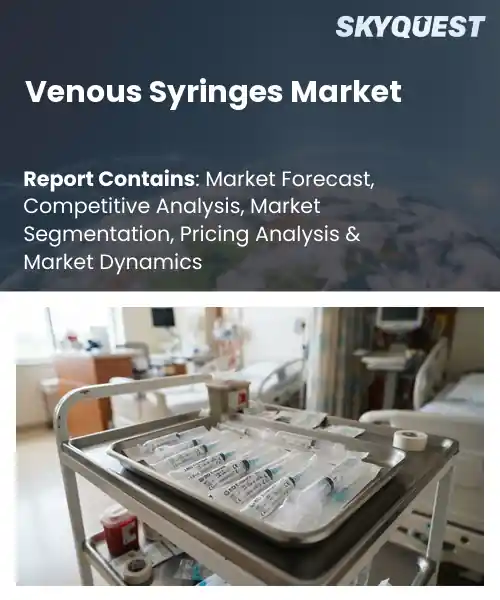
Venous Syringes Market
Report ID: SQMIG35A4620
Report ID: SQMIG35A4620
[email protected]
USA +1 351-333-4748
Report ID:
SQMIG35A4620 |
Region:
Global |
Published Date: November, 2026
Pages:
157
|Tables:
144
|Figures:
78


Global Venous Syringes Market size was valued at USD 920.0 Million in 2024 and is poised to grow from USD 973.36 Million in 2025 to USD 1528.13 Million by 2033, growing at a CAGR of 5.8% during the forecast period (2026-2033).
The global venous syringe market has emerged as a critical segment of the broader medical device industry, supplying sterile, single‑use devices for intravenous drug delivery, blood sampling, and fluid replacement. Its importance stems from the growing prevalence of chronic diseases such as diabetes and cancer, which increase demand for reliable venous access in hospitals and outpatient clinics. Historically, the market evolved from reusable glass syringes in the early 20th century to disposable polymer‑based systems after the 1970s, driven by infection‑control regulations. Recent adoption of safety‑engineered designs, exemplified by retractable needles introduced in Europe, further accelerated growth by reducing needlestick injuries. The primary growth catalyst for the venous syringe market lies in the expanding home‑infusion sector, where patients receive biologics and antibiotics outside facilities. As insurers shift reimbursement toward outpatient care, manufacturers develop compact, pre‑filled syringes that simplify dosing and improve adherence, exemplified by a recent partnership between a pharma firm and a syringe maker to launch a self‑administered oncology therapy. This trend triggers demand for safety features, prompting investment in smart caps that notify users of expiration. Consequently, supply‑chain firms enter the market to provide sterile packaging, unlocking new revenue streams and fostering significant rapid regional expansion in emerging economies.
How is automation impacting the venous syringes market?
Automation is reshaping the venous syringes market by streamlining production, reducing manual errors, and enhancing sterility. Manufacturers are integrating robotic assembly, vision guided inspection and smart dosing modules, which accelerate throughput while maintaining precise volume control. This shift enables faster response to hospital demand and supports the move toward prefilled syringes for safer administration. As supply chains tighten, automated lines lower labor costs and improve consistency, making products more reliable for clinicians. The trend also encourages smaller firms to adopt modular automation, expanding overall market capacity and fostering innovation in needle design and safety features.Becton Dickinson March 2024, launched an automated filling system that assembles sterile venous syringes with real time monitoring, boosting production efficiency and supporting the market’s growth toward higher volume and lower error delivery.
Market snapshot - (2026-2033)
Global Market Size
USD 920.0 Million
Largest Segment
Disposable Syringes
Fastest Growth
Reusable Syringes
Growth Rate
5.8% CAGR
To get more insights on this market click here to Request a Free Sample Report
Global venous syringes market is segmented by product type, syringe design, capacity, application, end user and region. Based on product type, the market is segmented into Disposable Syringes and Reusable Syringes. Based on syringe design, the market is segmented into Luer-Lock Syringes, Luer-Slip Syringes and Other Connection Designs. Based on capacity, the market is segmented into Up to 5 mL, 6–10 mL and Above 10 mL. Based on application, the market is segmented into Blood Collection, Intravenous Medication Administration, Venous Access & Flushing and Other Applications. Based on end user, the market is segmented into Hospitals, Diagnostic Laboratories and Clinics & Other Healthcare Facilities. Based on region, the market is segmented into North America, Europe, Asia Pacific, Latin America and Middle East & Africa.
Disposable syringes segment dominates because clinicians prioritize infection control and operational efficiency, driving consistent preference for single‑use devices across acute care settings. The ease of disposal eliminates sterilization steps, reduces cross‑contamination risk, and aligns with stringent regulatory guidance, fostering widespread adoption. Consequently, manufacturers focus resources on scaling production and innovating safety features, reinforcing market leadership for disposables. These dynamics also support supply chain resilience and cost predictability for healthcare providers.
However, reusable syringes segment is witnessing the strongest growth momentum as sustainability pressures intensify and hospitals adopt circular procurement strategies. Innovations in durable materials and automated reprocessing systems lower total cost of ownership, encouraging facilities to transition toward environmentally responsible solutions and creating new avenues for market expansion in the sector.
Above 10 mL capacity segment dominates because critical care and infusion therapies increasingly require larger volumes for rapid fluid resuscitation and medication loading, making high‑capacity syringes essential. Clinicians value the ability to deliver precise dosing without frequent syringe changes, enhancing workflow efficiency and patient safety. This demand drives manufacturers to prioritize robust barrel designs and integrated safety features, cementing the premium position of large‑volume devices in the market for clinical use.
Meanwhile, 6–10 mL capacity segment emerges as the most rapidly expanding area as outpatient procedures and home infusion services adopt moderate‑volume syringes for convenience and dosing flexibility. Advances in ergonomic designs and tamper‑evident mechanisms improve user confidence, spurring adoption across diverse care settings and propelling market growth in the sector.
To get detailed segments analysis, Request a Free Sample Report
Asia Pacific commands a leading position in the global Venous Syringes market due to a convergence of dynamic healthcare expansion, sizable patient volumes, and strong emphasis on safety‑enhanced devices. The region hosts a blend of mature manufacturing hubs and emerging production facilities that deliver cost‑effective yet high‑quality syringes. Government initiatives promoting minimally invasive procedures and infection control reinforce demand, while a growing middle class drives utilization across hospital and outpatient settings. Moreover, robust regulatory frameworks encourage adoption of safety‑engineered syringes, and regional manufacturers leverage advanced technologies to meet stringent quality expectations, reinforcing the competitive advantage of Asia Pacific. The region also benefits from collaborative research networks that accelerate product innovation, and supply‑chain integration that ensures timely distribution to both urban and rural healthcare providers. Together these factors sustain the dominant market posture of Asia Pacific.
Venous Syringes Market in Japan is shaped by a high density of advanced medical facilities and a cultural emphasis on precision and patient safety. Manufacturers prioritize rigorous quality control and integrate cutting‑edge safety mechanisms to align with stringent national guidelines. Hospitals and clinics increasingly favor devices that reduce needlestick injuries, while ongoing professional education reinforces best practices. This environment cultivates steady demand for sophisticated syringes across both public and private healthcare sectors.
Venous Syringes Market in South Korea benefits from a strong biotech ecosystem and proactive governmental health policies that champion patient protection. Local producers emphasize rapid adoption of safety‑engineered designs, responding to hospital demand for reduced contamination risk. Continuous investment in manufacturing automation bolsters product consistency, while educational campaigns raise awareness of safe injection techniques among clinicians. These combined efforts drive robust uptake of advanced venous syringes throughout the nation's healthcare infrastructure.
The rapid expansion of the Venous Syringes market in North America is propelled by a confluence of strong healthcare financing mechanisms, stringent safety regulations, and a deep commitment to minimizing occupational hazards. Healthcare providers prioritize devices that incorporate engineered safety features, aligning with regulatory expectations that emphasize needlestick injury prevention. Continuous investment in research and development yields innovative syringe designs that enhance user confidence and procedural efficiency. Integrated supply chains and sophisticated distribution networks ensure rapid availability across diverse care settings. Moreover, professional societies actively promote best‑practice guidelines that underscore the importance of safety‑first injection techniques, reinforcing market demand for advanced venous syringes throughout the United States and Canada. Healthcare institutions also emphasize training programs that reinforce proper handling, further embedding safety culture into everyday practice. This comprehensive approach sustains a growing preference for high‑performance syringes across both acute care hospitals and outpatient clinics.
Venous Syringes Market in the United States is driven by hospital networks and a pervasive focus on risk mitigation. Regulatory bodies enforce rigorous standards that compel manufacturers to embed safety mechanisms, while reimbursement models reward adoption of technologies that reduce infection rates. Procurement programs streamline distribution, and continuous clinician education reinforces safe injection protocols. This ecosystem collectively fuels sustained demand for advanced venous syringes across a broad spectrum of medical environments.
Venous Syringes Market in Canada reflects a health system that emphasizes universal access and patient safety. Provincial health authorities prioritize procurement of safety‑engineered syringes, aligning with national guidelines that target reduction of needlestick injuries. Collaborative partnerships between manufacturers and research institutions promote continuous improvement of device ergonomics. Ongoing professional development initiatives educate practitioners on best practices, reinforcing a culture of precaution and supporting steady adoption of high‑quality venous syringes throughout the country.
The European region reinforces its position in the Venous Syringes market through a blend of rigorous regulatory frameworks, sustained investment in innovative research, and an unwavering commitment to patient safety. EU directives mandate comprehensive safety features, prompting manufacturers to embed advanced needlestick protection across product lines. Collaborative initiatives between academic institutions and industry accelerate the development of eco‑friendly materials and ergonomic designs. Well‑established distribution networks ensure consistent availability throughout both advanced clinical centers and community health settings. Additionally, health authorities champion continuous professional training that embeds safe injection standards into routine practice. This integrated approach consolidates Europe’s reputation as a leader in delivering high‑quality, responsibly manufactured venous syringes. Regulatory harmonization across member states further streamlines product approval, facilitating quicker market entry for innovative solutions. Sustainability targets encourage the adoption of recyclable components, positioning Europe at the forefront of environmentally conscious medical device manufacturing.
Venous Syringes Market in Germany is anchored by an engineering tradition and a healthcare system that prioritizes high‑quality medical devices. Stringent national standards compel manufacturers to integrate sophisticated safety mechanisms, while hospitals adopt procurement policies that favor certified products. Collaborative research clusters between universities and industry drive continuous improvement in syringe ergonomics and sustainability. Ongoing clinician education reinforces adherence to strict injection protocols, sustaining robust demand for advanced venous syringes across the country.
Venous Syringes Market in the United Kingdom benefits from a national health service that emphasizes patient safety. Regulatory guidance mandates the use of safety‑engineered syringes, prompting manufacturers to embed reliable needlestick protection. Partnerships between clinical research bodies and device firms foster innovation in needle design and material sustainability. Continuous professional development programs ensure clinicians remain adept at safe injection techniques, reinforcing consistent demand for high‑quality venous syringes throughout NHS facilities and private practices.
Venous Syringes Market in France is driven by a healthcare framework that blends reimbursement with an emphasis on clinical safety. National health authorities require adoption of safety‑engineered devices, encouraging manufacturers to prioritize ergonomic design and reliable needle protection. Collaborative initiatives between pharmaceutical firms and research institutes accelerate development of friendly syringe components. Training sessions for healthcare professionals embed injection standards, sustaining steady demand for advanced venous syringes across hospitals and ambulatory care settings.
To know more about the market opportunities by region and country, click here to
Buy The Complete Report
Improved Patient Comfort
Technological Integration
Regulatory Complexity
Cost Sensitivity
Request Free Customization of this report to help us to meet your business objectives.
I’m sorry, but I don’t have enough information to generate the requested Competitive Landscape section.
Top Player’s Company Profile
Recent Developments
SkyQuest’s ABIRAW (Advanced Business Intelligence, Research & Analysis Wing) is our Business Information Services team that Collects, Collates, Correlates, and Analyses the Data collected by means of Primary Exploratory Research backed by robust Secondary Desk research. As per SkyQuest analysis the global venous syringes market is being propelled primarily by the rapid expansion of home‑care and outpatient infusion services, which push manufacturers to design user‑friendly, safety‑engineered devices for self‑administration; a second strong driver is the increasing automation of syringe production that lowers costs, improves sterility and supports the growth of prefilled products. The market is currently dominated by the disposable syringe segment, reflecting clinicians’ preference for single‑use devices to meet infection‑control standards. Asia Pacific leads the market thanks to its large patient base, cost‑effective manufacturing hubs and supportive regulations, while complex regulatory requirements across regions act as a notable restraint on new product launches.
| Report Metric | Details |
|---|---|
| Market size value in 2024 | USD 920.0 Million |
| Market size value in 2033 | USD 1528.13 Million |
| Growth Rate | 5.8% |
| Base year | 2024 |
| Forecast period | (2026-2033) |
| Forecast Unit (Value) | USD Million |
| Segments covered |
|
| Regions covered | North America (US, Canada), Europe (Germany, France, United Kingdom, Italy, Spain, Rest of Europe), Asia Pacific (China, India, Japan, Rest of Asia-Pacific), Latin America (Brazil, Rest of Latin America), Middle East & Africa (South Africa, GCC Countries, Rest of MEA) |
| Companies covered |
|
| Customization scope | Free report customization with purchase. Customization includes:-
|
To get a free trial access to our platform which is a one stop solution for all your data requirements for quicker decision making. This platform allows you to compare markets, competitors who are prominent in the market, and mega trends that are influencing the dynamics in the market. Also, get access to detailed SkyQuest exclusive matrix.
Table Of Content
Executive Summary
Market overview
Parent Market Analysis
Market overview
Market size
KEY MARKET INSIGHTS
COVID IMPACT
MARKET DYNAMICS & OUTLOOK
Market Size by Region
KEY COMPANY PROFILES
Methodology
For the Venous Syringes Market, our research methodology involved a mixture of primary and secondary data sources. Key steps involved in the research process are listed below:
1. Information Procurement: This stage involved the procurement of Market data or related information via primary and secondary sources. The various secondary sources used included various company websites, annual reports, trade databases, and paid databases such as Hoover's, Bloomberg Business, Factiva, and Avention. Our team did 45 primary interactions Globally which included several stakeholders such as manufacturers, customers, key opinion leaders, etc. Overall, information procurement was one of the most extensive stages in our research process.
2. Information Analysis: This step involved triangulation of data through bottom-up and top-down approaches to estimate and validate the total size and future estimate of the Venous Syringes Market.
3. Report Formulation: The final step entailed the placement of data points in appropriate Market spaces in an attempt to deduce viable conclusions.
4. Validation & Publishing: Validation is the most important step in the process. Validation & re-validation via an intricately designed process helped us finalize data points to be used for final calculations. The final Market estimates and forecasts were then aligned and sent to our panel of industry experts for validation of data. Once the validation was done the report was sent to our Quality Assurance team to ensure adherence to style guides, consistency & design.
Analyst Support
Customization Options
With the given market data, our dedicated team of analysts can offer you the following customization options are available for the Venous Syringes Market:
Product Analysis: Product matrix, which offers a detailed comparison of the product portfolio of companies.
Regional Analysis: Further analysis of the Venous Syringes Market for additional countries.
Competitive Analysis: Detailed analysis and profiling of additional Market players & comparative analysis of competitive products.
Go to Market Strategy: Find the high-growth channels to invest your marketing efforts and increase your customer base.
Innovation Mapping: Identify racial solutions and innovation, connected to deep ecosystems of innovators, start-ups, academics, and strategic partners.
Category Intelligence: Customized intelligence that is relevant to their supply Markets will enable them to make smarter sourcing decisions and improve their category management.
Public Company Transcript Analysis: To improve the investment performance by generating new alpha and making better-informed decisions.
Social Media Listening: To analyze the conversations and trends happening not just around your brand, but around your industry as a whole, and use those insights to make better Marketing decisions.
REQUEST FOR SAMPLE
 REQUEST FREE CUSTOMIZATION


Want to customize this report? This report can be personalized according to your needs. Our analysts and industry experts will work directly with you to understand your requirements and provide you with customized data in a short amount of time. We offer $1000 worth of FREE customization at the time of purchase.
Feedback From Our Clients


 USA (+1) 351-333-4748

