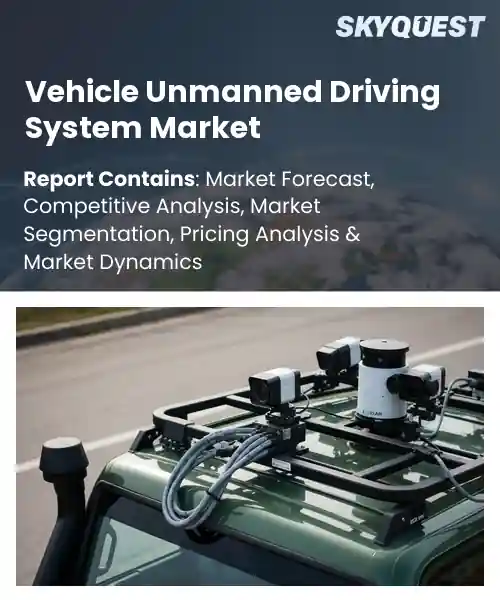
Vehicle Unmanned Driving System Market
Report ID: SQMIG20U2024
Report ID: SQMIG20U2024
[email protected]
USA +1 351-333-4748
Report ID:
SQMIG20U2024 |
Region:
Global |
Published Date: February, 2026
Pages:
157
|Tables:
97
|Figures:
76


Global Vehicle Unmanned Driving System Market size was valued at USD 11.8 Billion in 2024 and is poised to grow from USD 12.06 Billion in 2025 to USD 14.35 Billion by 2033, growing at a CAGR of 2.2% during the forecast period (2026-2033).
Advances in machine learning, sensor fusion and onboard computing have been the primary driver of the vehicle unmanned driving system market, transforming research into widely deployable products. The market comprises integrated hardware and software stacks that enable vehicles to perceive surroundings, plan trajectories and act autonomously, and it matters because the promise of fewer accidents, lower operating expenses and new mobility models can reshape urban transport and logistics. Over the past decade the sector shifted from ADAS features like adaptive cruise control and lane keeping toward pilot programs for Level 4 autonomy, exemplified by Waymo, Cruise and Mobileye, while OEMs and startups funded pilots.The accumulation of fleet learning data stands out as the key factor driving global market growth because richer datasets improve perception models and reduce failure rates, accelerating regulatory acceptance and commercial deployment. As companies collect millions of miles from piloted taxis and delivery bots, ML models grow more robust, enabling Waymo’s robo-taxi operations in Phoenix and Nuro to scale local deliveries while demonstrating lower per-trip costs and stronger safety metrics. Those outcomes lower barriers for logistics and ride-hailing operators, creating opportunities for software platforms, HD mapping providers, retrofit kits and teleoperation services to capture predictable operational savings and investor returns.
How is AI enhancing safety in the vehicle unmanned driving system market?
AI improves safety in unmanned vehicle systems by enabling clearer perception, better prediction of other road users, safer decision making, and ongoing learning from real world driving. Key aspects include sensor fusion that blends camera radar and lidar inputs, scenario testing that exposes rare events, and runtime monitoring that flags anomalies. The market is shifting from pilot projects to broader deployments so layered validation and auditability shape operator choices and regulation. Vendors now stress explainable models and redundant systems to manage failures. For example fleet teams rely on AI driven simulation and redundant on vehicle models to reduce risk in complex urban settings.Deepen AI January 2026, announced safety first data infrastructure that improves sensor fusion calibration and scenario testing. This AI powered platform speeds validation and creates auditable safety evidence, helping lower deployment risk and boosting operator confidence which supports market growth.
Market snapshot - (2026-2033)
Global Market Size
USD 11.8 Billion
Largest Segment
Level 2 (Partial Automation)
Fastest Growth
Level 4 (High Automation)
Growth Rate
2.2% CAGR
To get more insights on this market click here to Request a Free Sample Report
Global vehicle unmanned driving system market is segmented by level, technology, application and region. Based on level, the market is segmented into Level 1 (Driver Assistance), Level 2 (Partial Automation), Level 3 (Conditional Automation), Level 4 (High Automation) and Level 5 (Full Automation). Based on technology, the market is segmented into LiDAR-Based Systems, Radar-Based Systems, Camera-Based Systems, Ultrasonic Sensor Systems and Others. Based on application, the market is segmented into Personal Transportation, Ride-Hailing & Taxi Services, Logistics & Freight Transport, Public Transportation, Mining & Construction Vehicles and Others. Based on region, the market is segmented into North America, Europe, Asia Pacific, Latin America and Middle East & Africa.
Level 4 (High Automation) segment leads because it enables sustained driverless operation within defined operational domains, driving large-scale fleet deployments and commercial investment. Its maturity in sensor fusion, redundancy architectures, and operational safety cases reduces operational uncertainty, attracting OEMs and fleet operators seeking predictable operating costs and service models, which in turn encourages ecosystem partners to prioritize technologies and regulatory pathways that support broader autonomy rollouts and long term commercialization plans.
However, Level 3 (Conditional Automation) is emerging as the most rapidly expanding area because automotive manufacturers can integrate conditional autonomy into existing vehicle platforms, enabling earlier consumer exposure and iterative regulatory engagement. Focused investments in driver monitoring, deterministic failover strategies, and validated software stacks accelerate practical deployment, creating near term commercial opportunities and new service models across multiple vehicle applications.
LiDAR based systems segment dominates because it provides high fidelity three dimensional perception that underpins reliable object classification and precise localization in complex driving environments. The clarity of range and shape data simplifies sensor fusion and supports advanced motion planning, prompting OEMs and tier one suppliers to adopt LiDAR into their autonomous stacks and to prioritize investments in miniaturization, long range performance, production grade robustness, and manufacturability for volume deployment.
However, radar based systems are emerging as the fastest growing area because advancements in high resolution radar and signal processing deliver robust performance in adverse weather and low visibility. Their relative affordability and ease of integration within existing vehicle electrical architectures accelerate adoption by OEMs, enabling scaled deployments and expanding safety critical use cases across a broad range of applications.
To get detailed segments analysis, Request a Free Sample Report
North America dominance reflects a comprehensive ecosystem that brings together established vehicle manufacturers, technology firms, and a mature supplier base with deep expertise in sensors, software, and systems integration. The region benefits from a strong investment environment that accelerates development and commercialization, alongside abundant technical talent drawn from leading research institutions and industry centers. Coordinated public private collaborations and permissive testing environments enable extensive validation across varied operational design domains, while robust standards and cybersecurity capabilities support safe deployment. Integration with mobility services, insurance innovation, and aftermarket support further cements a full value chain that attracts global partnerships and drives ongoing leadership in unmanned driving technologies.
Vehicle Unmanned Driving System Market in United States benefits from a dense innovation ecosystem combining leading automotive manufacturers, software developers, and sensor suppliers with active testing corridors and capital availability. Collaborative programs between industry and research institutions accelerate system validation, while strong service provider networks and early consumer engagement support pilot deployments. Regulatory frameworks that enable controlled trials further reinforce commercialization pathways and attract global partnerships and talent concentration nationwide.
Vehicle Unmanned Driving System Market in Canada is characterized by collaborative research hubs and pilot environments that emphasize safety validation and operational resilience. Provincial initiatives support trials across diverse climates, enabling sensor and software calibration under varied conditions. Strong ties between academia, suppliers, and international partners facilitate technology transfer and regulatory alignment. Public sector engagement and a skilled engineering talent base contribute to commercialization and deployment of unmanned driving solutions.
Asia Pacific rapid expansion is propelled by a convergence of domestic automotive strength, advanced electronics manufacturing, and proactive public policy that together create a fertile environment for unmanned driving innovation. Regional OEMs are integrating autonomous capabilities with established production ecosystems while leading suppliers leverage semiconductor and sensor expertise to lower barriers to system development. Dense urban centers and a strong appetite for mobility services drive demand for automated solutions, encouraging pilot programs and commercial trials. Governments and city planners often prioritize smart mobility initiatives and public private collaboration, facilitating infrastructure readiness and regulatory pathways. Cross border partnerships and competitive manufacturing costs further position the region as a critical hub for scaling technology and delivering market specific adaptations. Local talent pools and research centers accelerate innovation.
Vehicle Unmanned Driving System Market in Japan reflects a synthesis of automotive engineering excellence and robotics expertise, with major manufacturers and component suppliers focusing on reliability and precision. Testing programs emphasize system safety and deployment, aligning with cautious regulatory pathways and municipal collaboration. Strong research institutions and supplier ecosystems support sensor development and vehicle integration. Emphasis on interoperability with public transport and urban mobility contributes to pragmatic safety focused commercialization.
Vehicle Unmanned Driving System Market in South Korea is driven by an electronics and semiconductor ecosystem that supplies sensors, processors, and connectivity components. Domestic manufacturers and technology firms collaborate to integrate hardware and software for high performance perception and control. Urban testbeds and smart city initiatives facilitate validation, while government programs and private sector investment encourage commercialization and export development. Emphasis on connectivity and system integration supports scalable deployments nationwide.
Europe is strengthening its position through a combination of rigorous regulatory frameworks, deep automotive engineering heritage, and coordinated cross border initiatives that promote safety driven innovation. Leading manufacturers and specialized suppliers prioritize reliable system architectures and high quality sensor integration, supported by established engineering clusters. Cross national testing corridors and urban pilot programs enable comparative validation under diverse conditions, while strong emphasis on sustainability and multimodal integration fosters solutions aligned with public transport and city planning objectives. Policy focus on data governance and interoperability encourages transparent development and user trust. Public private partnerships and standardization efforts further align industry stakeholders, enabling harmonized deployment strategies and reinforcing Europe as a resilient center for unmanned driving advancement.
Vehicle Unmanned Driving System Market in Germany is grounded in a strong engineering tradition that drives rigorous system development and validation. Major vehicle manufacturers and tier suppliers focus on architectures, high reliability, and precise sensor fusion. Extensive testing networks and industry research centers enable trials across diverse driving contexts. Coordination between regulators, industry associations, and academic institutions supports standards development and fosters scale readiness for advanced unmanned driving solutions broadly.
Vehicle Unmanned Driving System Market in United Kingdom benefits from a dynamic technology and research environment that emphasizes software development, mapping, and regulatory experimentation. Specialized startups and established suppliers collaborate with vehicle manufacturers and telecom providers to refine connectivity and design domains. Test regions and regulatory sandboxes allow controlled validation, while academic centers support human factors and safety research. Close industry government engagement fosters deployment pathways and international collaboration effectively.
Vehicle Unmanned Driving System Market in France emphasizes integrated mobility solutions and urban pilot deployments that connect unmanned systems with public transport and city planning. A vibrant ecosystem of technology companies, suppliers, and research institutions supports sensor development, systems integration, and design. Public sector initiatives and city test programs encourage validation, while collaboration across industry and government fosters regulatory clarity and promotes adoption of safe, context aware unmanned driving solutions.
To know more about the market opportunities by region and country, click here to
Buy The Complete Report
Advanced Sensor Integration
Advanced Artificial Intelligence
Regulatory and Policy Fragmentation
High Development and Integration Costs
Request Free Customization of this report to help us to meet your business objectives.
Competition in the global vehicle unmanned driving system market is driven by OEM alignments, software differentiation and deployment scale, with rivals pursuing ownership restructurings, strategic partnerships and production ready tech to secure commercialization pathways. For example Motional restructured ownership with Hyundai and Aptiv to strengthen OEM ties and fleet partnerships, while DeepRoute.ai pursued automaker strategic funding and map free end to end system innovation to accelerate OEM integrations.
Top Player’s Company Profile
Recent Developments
SkyQuest’s ABIRAW (Advanced Business Intelligence, Research & Analysis Wing) is our Business Information Services team that Collects, Collates, Correlates, and Analyses the Data collected by means of Primary Exploratory Research backed by robust Secondary Desk research. As per SkyQuest analysis, one key driver is advances in machine learning and sensor fusion that enhance perception and decision making, and a second driver is the accumulation of fleet learning data which improves model robustness and accelerates commercialization. A significant restraint remains regulatory and policy fragmentation that raises compliance complexity and slows cross border scaling. North America dominates the market thanks to its deep supplier base, investment environment and permissive testing ecosystem, while the Level 4 high automation segment leads because it enables sustained driverless operation within defined operational design domains and attracts fleet deployments and OEM investment. Overall growth will depend on harmonized regulation and cost reductions.
| Report Metric | Details |
|---|---|
| Market size value in 2024 | USD 11.8 Billion |
| Market size value in 2033 | USD 14.35 Billion |
| Growth Rate | 2.2% |
| Base year | 2024 |
| Forecast period | (2026-2033) |
| Forecast Unit (Value) | USD Billion |
| Segments covered |
|
| Regions covered | North America (US, Canada), Europe (Germany, France, United Kingdom, Italy, Spain, Rest of Europe), Asia Pacific (China, India, Japan, Rest of Asia-Pacific), Latin America (Brazil, Rest of Latin America), Middle East & Africa (South Africa, GCC Countries, Rest of MEA) |
| Companies covered |
|
| Customization scope | Free report customization with purchase. Customization includes:-
|
To get a free trial access to our platform which is a one stop solution for all your data requirements for quicker decision making. This platform allows you to compare markets, competitors who are prominent in the market, and mega trends that are influencing the dynamics in the market. Also, get access to detailed SkyQuest exclusive matrix.
Table Of Content
Executive Summary
Market overview
Parent Market Analysis
Market overview
Market size
KEY MARKET INSIGHTS
COVID IMPACT
MARKET DYNAMICS & OUTLOOK
Market Size by Region
KEY COMPANY PROFILES
Methodology
For the Vehicle Unmanned Driving System Market, our research methodology involved a mixture of primary and secondary data sources. Key steps involved in the research process are listed below:
1. Information Procurement: This stage involved the procurement of Market data or related information via primary and secondary sources. The various secondary sources used included various company websites, annual reports, trade databases, and paid databases such as Hoover's, Bloomberg Business, Factiva, and Avention. Our team did 45 primary interactions Globally which included several stakeholders such as manufacturers, customers, key opinion leaders, etc. Overall, information procurement was one of the most extensive stages in our research process.
2. Information Analysis: This step involved triangulation of data through bottom-up and top-down approaches to estimate and validate the total size and future estimate of the Vehicle Unmanned Driving System Market.
3. Report Formulation: The final step entailed the placement of data points in appropriate Market spaces in an attempt to deduce viable conclusions.
4. Validation & Publishing: Validation is the most important step in the process. Validation & re-validation via an intricately designed process helped us finalize data points to be used for final calculations. The final Market estimates and forecasts were then aligned and sent to our panel of industry experts for validation of data. Once the validation was done the report was sent to our Quality Assurance team to ensure adherence to style guides, consistency & design.
Analyst Support
Customization Options
With the given market data, our dedicated team of analysts can offer you the following customization options are available for the Vehicle Unmanned Driving System Market:
Product Analysis: Product matrix, which offers a detailed comparison of the product portfolio of companies.
Regional Analysis: Further analysis of the Vehicle Unmanned Driving System Market for additional countries.
Competitive Analysis: Detailed analysis and profiling of additional Market players & comparative analysis of competitive products.
Go to Market Strategy: Find the high-growth channels to invest your marketing efforts and increase your customer base.
Innovation Mapping: Identify racial solutions and innovation, connected to deep ecosystems of innovators, start-ups, academics, and strategic partners.
Category Intelligence: Customized intelligence that is relevant to their supply Markets will enable them to make smarter sourcing decisions and improve their category management.
Public Company Transcript Analysis: To improve the investment performance by generating new alpha and making better-informed decisions.
Social Media Listening: To analyze the conversations and trends happening not just around your brand, but around your industry as a whole, and use those insights to make better Marketing decisions.
REQUEST FOR SAMPLE
 REQUEST FREE CUSTOMIZATION


Want to customize this report? This report can be personalized according to your needs. Our analysts and industry experts will work directly with you to understand your requirements and provide you with customized data in a short amount of time. We offer $1000 worth of FREE customization at the time of purchase.
Feedback From Our Clients


 USA (+1) 351-333-4748

