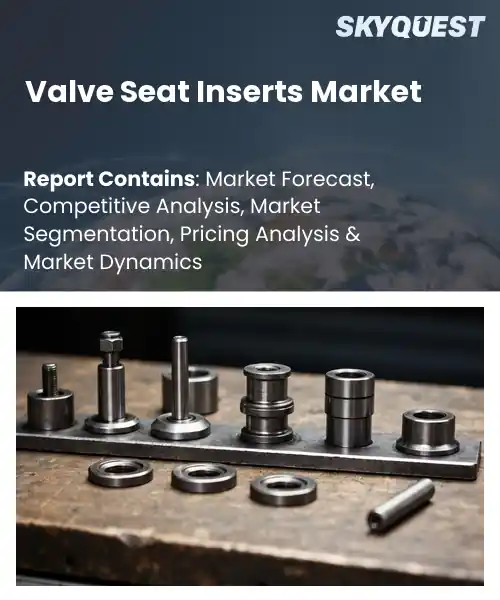
Valve Seat Inserts Market
Report ID: SQMIG25A2841
Report ID: SQMIG25A2841
[email protected]
USA +1 351-333-4748
Report ID:
SQMIG25A2841 |
Region:
Global |
Published Date: July, 2026
Pages:
157
|Tables:
156
|Figures:
78


Global Valve Seat Inserts Market size was valued at USD 5.94 Billion in 2024 and is poised to grow from USD 6.25 Billion in 2025 to USD 9.18 Billion by 2033, growing at a CAGR of 5.2% during the forecast period (2026-2033).
Valve seat inserts are engineered components that are located between the valve stem and valve body and provide a sealing surface capable of withstanding temperatures and abrasive media. There is an increasing market demand from the automotive, oil-and-gas and power-generation industries for these inserts because they require reliable shut-off mechanisms with minimum downtime that can hold increasing pressure differentials. The industry has historically used cast-iron seats, but the move to carbide-based and ceramic-coated inserts began in the early 2000s as plants looked for service intervals and emissions limits. To meet Euro 6 rules, diesel makers fitted tungsten-carbide seats, illustrating how regulation triggered innovation and market growth.
Another important factor affecting the global valve seat inserts market is the increased development of materials along with strict environmental regulations that create a cycle of demand and innovation. Manufacturers are turning to ceramic composites to meet the increasing pressure demands of offshore wind farms and hydrogen projects. The composites provide corrosion resistance and can withstand cycling stresses to extend service life and reduce operating costs. That change reduces the amount of unexpected shutdowns in refineries, and as a result plant owners are investing money into retrofitting old valves with high-quality inserts. Consequently, suppliers that certify compliance and deliver performance data capture a growing share of contracts in energy sectors.
How is AI-driven Automation Improving Performance In The Valve Seat Inserts Market?
AI automation is driving change in the valve seat insert market through a seamless loop of design, production and quality control. Machine learning models can learn wear patterns and material behavior, enabling engineers to design optimized geometries that resist erosion and ensure sealing integrity. In the factory, AI tells CNC machines how to change cutting parameters on the fly, reducing scrap and cycle times. Deep learning powered vision systems can spot surface defects faster than human inspectors, making sure every insert meets tight tolerance. These capabilities cut costs, improve reliability and speed time to market, making manufacturers more responsive to demands for engine efficiency.
Tenneco March 2024 has launched an AI enabled production line that automatically tunes machining feeds for valve seat inserts, reducing setup time and improving surface finish. The roll out has sped up delivery schedules and secured the company’s position as a technology forward supplier in the sector.
Market snapshot - 2026-2033
Global Market Size
USD 840.12 Million
Largest Segment
Steel Alloy
Fastest Growth
Nickel-Based Alloy
Growth Rate
4.3% CAGR
To get more insights on this market click here to Request a Free Sample Report
Global valve seat inserts market is segmented by material type, engine type, application, sales channel, end user and region. Based on material type, the market is segmented into Steel Alloy, Cast Iron, Nickel-Based Alloy, Copper-Based Alloy and Others. Based on engine type, the market is segmented into Gasoline Engines, Diesel Engines and Alternative Fuel Engines (CNG, LNG, LPG, Hydrogen, etc.). Based on application, the market is segmented into Passenger Vehicles, Commercial Vehicles, Motorcycles & Powersports, Off-Highway Equipment, Marine Engines, Industrial Engines, Power Generation Engines and Aerospace Engines. Based on sales channel, the market is segmented into Original Equipment Manufacturer (OEM) and Aftermarket. Based on end user, the market is segmented into Automotive Industry, Industrial Equipment Manufacturers, Marine Industry, Aerospace Industry and Energy & Power Sector. Based on region, the market is segmented into North America, Europe, Asia Pacific, Latin America and Middle East & Africa.
Steel alloy segment is expected to dominate the market as the high strength, wear resistance and cost efficiency offered by steel alloys make them the preferred choice for most of the valve seat insert applications. Manufacturers like steel because of its well-established processing routes and compatibility with standard engine designs. This material provides dependable sealing performance at normal combustion pressures, guaranteeing its continued application across a broad spectrum of engine platforms and cementing its market leadership in the global supply chain.
However, the segment of nickel based alloy is witnessing the highest growth momentum owing to its superior high temperature stability and corrosion resistance to meet the stringent requirements of modern high efficiency and low emission engines. These high-tech inserts are in increasing demand as manufacturers increase development of turbocharged and alternative fuel powertrains. New opportunities for market expansion.
The diesel engine segment is anticipated to dominate the market due to its enhanced torque characteristics and the sustained prevalence of diesel in commercial and heavy-duty vehicles, which generates a consistent demand for robust valve seat inserts. Diesel powerplants operate at higher compression ratios, demanding inserts that can endure higher thermal and mechanical stresses. The proven reliability of diesel engines strengthens the preference for proven insert solutions, cementing this segment’s central role in the market throughout the product lifecycle and maintenance.
The alternative fuel engine segment is the largest high growth area, according to the report. Rising regulations and consumer demand for propulsion are driving the adoption of CNG, LNG, LPG and hydrogen engines. These powertrains need valve seat inserts with material compatibility and sealing precision, which urges manufacturers to innovate and scale up supply, thus driving market expansion.
To get detailed segments analysis, Request a Free Sample Report
Asia pacific is home to a number of world-leading automotive manufacturers, who are dedicated to precision engineering and performance optimisation. A strong industrial infrastructure enables high-volume production, while tough emissions standards drive constant material development. Collaborative research ecosystems between manufacturers, universities and component suppliers accelerate the development of advanced alloys and coatings. A mature supply chain provides a reliable source of high quality raw materials, reducing lead time for OEMs. Also, the strong domestic demand for passenger and commercial vehicles fuels a steady stream of new engine designs, which in turn drives a steady demand for robust valve seat solutions. All these factors together strengthen the role of Asia Pacific as the key driver of global valve seat insert activity.
The valve seat inserts market in Japan is driven by a tradition of precision manufacturing and a culture of continuous quality improvement. Stringent performance requirements are driven by leading automotive firms, which drive suppliers to adopt cutting-edge metallurgy and surface-treatment techniques. OEMs and component makers collaborate closely enabling fast prototyping and customization, while an efficient distribution network guarantees timely delivery of orders to assembly plants. Constant improvements in durability and thermal resistance of the valve seat are also driven by the demand for improved fuel economy and lower emissions.
The South Korea Valve Seat Inserts Market is driven by a vigorous automotive industry emphasizing high-output powertrains and emerging electric-hybrid technologies. Intensive R&D investment produces innovative composite materials that improve heat dissipation and wear resistance. The government’s strong support for advanced manufacturing encourages the use of automated production lines, which improves consistency and the ability to produce more. Export potential is enhanced by collaborations with global OEMs, and the market for premium valve seat solutions is thriving due to domestic demand for performance-oriented vehicles.
The market benefits from heightened regulatory pressure to lower emissions combined with a sizable fleet of older vehicles requiring aftermarket upgrades. Engine manufacturers are increasingly prioritising durability and efficiency, prompting the development of superior valve seat designs that withstand higher combustion pressures. Consumer demand for reliable performance in diverse climate conditions fuels interest in premium replacement parts. Active collaboration among research institutions, material specialists, and automotive firms accelerates the introduction of novel alloys and coating processes. A well‑developed distribution landscape and strong aftermarket service network further amplify market reach, ensuring that both new‑equipment manufacturers and repair shops have ready access to advanced valve seat solutions.
Valve Seat Inserts Market in the United States is characterised by a vast network of original equipment manufacturers and a robust aftermarket sector. Emphasis on high‑performance engines for both passenger and heavy‑duty applications drives continuous material advancement. Collaborative initiatives between automotive engineers and material scientists foster the adoption of coatings that enhance wear resistance. A sophisticated logistics framework ensures rapid supply to assembly lines and service centres, while consumer expectations for longevity sustain demand for premium valve seat replacements.
Valve Seat Inserts Market in Canada reflects a blend of original equipment production and a thriving service‑oriented aftermarket. Stricter emission regulations encourage manufacturers to integrate more resilient valve seat technologies into new models. Cold‑climate performance requirements stimulate the development of alloys that maintain structural integrity under thermal stress. Close ties between local suppliers and major automotive firms enable responsive adaptation to market needs, while a well‑organized parts distribution system supports timely availability for maintenance and repair activities.
Europe leverages its strong commitment to sustainability and stringent emission standards to advance valve seat technology. Collaborative research programmes across borders unite leading universities, specialized material firms, and automotive manufacturers, fostering innovation in high‑temperature resistant alloys and environmentally friendly coating processes. The region’s emphasis on fuel‑efficient engine design propels the integration of durable valve seat solutions that minimise wear and improve overall engine performance. Well‑established supply chains and a mature aftermarket infrastructure ensure consistent product availability, while regulatory incentives encourage the adoption of next‑generation components. This cohesive approach consolidates Europe’s growing influence in the global valve seat inserts arena.
Valve Seat Inserts Market in Germany is driven by a reputation for engineering excellence and a focus on high‑precision powertrain components. Automotive leaders demand superior wear resistance and thermal stability, prompting suppliers to invest in sophisticated alloy development. Strong ties between research institutes and industry accelerate the rollout of innovative coating technologies. A comprehensive network of tier‑one and tier‑two suppliers supports seamless integration of advanced valve seat solutions into both new vehicle production and aftermarket services.
Valve Seat Inserts Market in the United Kingdom benefits from a dynamic blend of traditional engineering expertise and emerging green‑technology initiatives. Collaborative projects between universities and automotive firms target the creation of lightweight, high‑temperature resistant valve seats that align with emission reduction goals. A vibrant aftermarket sector responds to the demand for reliable replacement components, while a well‑structured supply chain ensures prompt delivery to service centres. Ongoing investment in materials research sustains the market’s competitive edge.
Valve Seat Inserts Market in France is characterised by a strong focus on innovative material science and a commitment to reducing environmental impact. Partnerships between automotive manufacturers and specialized research labs drive the development of novel composite alloys that enhance durability and heat tolerance. An established network of component distributors facilitates efficient market penetration, both for new vehicle applications and for aftermarket refurbishment. Regulatory emphasis on cleaner engines further motivates the adoption of high‑performance valve seat technologies.
To know more about the market opportunities by region and country, click here to
Buy The Complete Report
Rising Demand for Energy Efficiency
Advancements In Material Technology
High Initial Capital Expenditure
Stringent Regulatory Compliance Requirements
Request Free Customization of this report to help us to meet your business objectives.
The Valve Seat Inserts Market shows a moderately consolidated competitive landscape, led by established players such as MAHLE, Federal-Mogul (Tenneco), Mitsubishi Materials, BorgWarner, and Rheinmetall, alongside niche specialists like SSV Valves, Tucker Valve Seat Company, TPR, SMB Engine Valves, DK Machine, and AVR (Vikram) Valves. Competition centers on continuous product-design innovation and manufacturing-process improvements, with companies pursuing ceramic and metal matrix composite materials for superior heat resistance and durability compared to traditional cast-iron inserts. Firms increasingly focus on sintered alloys and specialized coatings, alongside materials like Stellite and Nimonic, to meet demands from higher-power, higher-efficiency internal combustion engines. Competitive advantage increasingly stems from metallurgical R&D, co-engineering partnerships with OEMs during platform design, and compliance with stringent quality/traceability standards like IATF 16949. Strategic partnerships and heavy R&D investment define the landscape, particularly in North America and Europe, where sustainability regulations push innovation. Leading firms also leverage extensive global supply chains, distribution networks, and manufacturing capabilities to defend share, while smaller players carve out niches through specialization, sustaining ongoing price and innovation-driven competition industry-wide.
SkyQuest’s ABIRAW (Advanced Business Intelligence, Research & Analysis Wing) is our Business Information Services team that Collects, Collates, Correlates, and Analyses the Data collected by means of Primary Exploratory Research backed by robust Secondary Desk research.
As per SkyQuest analysis, the valve seat inserts market is propelled primarily by rising demand for energy efficiency as manufacturers seek components that reduce leakage and lower operational consumption, while a second important driver is rapid advancement in material technology that delivers superior wear resistance and thermal stability. The steel‑alloy segment remains the dominant material choice because of its cost‑effectiveness and reliability, and Asia Pacific leads the global market due to its dense automotive base, strong R&D networks and mature supply chains. However, high initial capital expenditure for specialized equipment and rigorous certification processes act as a notable restraint, tempering faster adoption especially among smaller producers.
| Report Metric | Details |
|---|---|
| Market size value in 2024 | USD 5.94 Billion |
| Market size value in 2033 | USD 9.18 Billion |
| Growth Rate | 5.2% |
| Base year | 2024 |
| Forecast period | 2026-2033 |
| Forecast Unit (Value) | USD Billion |
| Segments covered |
|
| Regions covered | North America (US, Canada), Europe (Germany, France, United Kingdom, Italy, Spain, Rest of Europe), Asia Pacific (China, India, Japan, Rest of Asia-Pacific), Latin America (Brazil, Rest of Latin America), Middle East & Africa (South Africa, GCC Countries, Rest of MEA) |
| Companies covered |
|
| Customization scope | Free report customization with purchase. Customization includes:-
|
To get a free trial access to our platform which is a one stop solution for all your data requirements for quicker decision making. This platform allows you to compare markets, competitors who are prominent in the market, and mega trends that are influencing the dynamics in the market. Also, get access to detailed SkyQuest exclusive matrix.
Table Of Content
Executive Summary
Market overview
Parent Market Analysis
Market overview
Market size
KEY MARKET INSIGHTS
COVID IMPACT
MARKET DYNAMICS & OUTLOOK
Market Size by Region
KEY COMPANY PROFILES
Methodology
For the Valve Seat Inserts Market, our research methodology involved a mixture of primary and secondary data sources. Key steps involved in the research process are listed below:
1. Information Procurement: This stage involved the procurement of Market data or related information via primary and secondary sources. The various secondary sources used included various company websites, annual reports, trade databases, and paid databases such as Hoover's, Bloomberg Business, Factiva, and Avention. Our team did 45 primary interactions Globally which included several stakeholders such as manufacturers, customers, key opinion leaders, etc. Overall, information procurement was one of the most extensive stages in our research process.
2. Information Analysis: This step involved triangulation of data through bottom-up and top-down approaches to estimate and validate the total size and future estimate of the Valve Seat Inserts Market.
3. Report Formulation: The final step entailed the placement of data points in appropriate Market spaces in an attempt to deduce viable conclusions.
4. Validation & Publishing: Validation is the most important step in the process. Validation & re-validation via an intricately designed process helped us finalize data points to be used for final calculations. The final Market estimates and forecasts were then aligned and sent to our panel of industry experts for validation of data. Once the validation was done the report was sent to our Quality Assurance team to ensure adherence to style guides, consistency & design.
Analyst Support
Customization Options
With the given market data, our dedicated team of analysts can offer you the following customization options are available for the Valve Seat Inserts Market:
Product Analysis: Product matrix, which offers a detailed comparison of the product portfolio of companies.
Regional Analysis: Further analysis of the Valve Seat Inserts Market for additional countries.
Competitive Analysis: Detailed analysis and profiling of additional Market players & comparative analysis of competitive products.
Go to Market Strategy: Find the high-growth channels to invest your marketing efforts and increase your customer base.
Innovation Mapping: Identify racial solutions and innovation, connected to deep ecosystems of innovators, start-ups, academics, and strategic partners.
Category Intelligence: Customized intelligence that is relevant to their supply Markets will enable them to make smarter sourcing decisions and improve their category management.
Public Company Transcript Analysis: To improve the investment performance by generating new alpha and making better-informed decisions.
Social Media Listening: To analyze the conversations and trends happening not just around your brand, but around your industry as a whole, and use those insights to make better Marketing decisions.
REQUEST FOR SAMPLE
 REQUEST FREE CUSTOMIZATION
Global Valve Seat Inserts Market size was valued at USD 840.12 Million in 2024 and is poised to grow from USD 876.25 Million in 2025 to USD 2.86 Million by 2033, growing at a CAGR of 4.3% during the forecast period (2026-2033).
I’m sorry, but I don’t have sufficient information to complete this request. 'Federal-Mogul Powertrain', 'Mahle GmbH', 'Bleistahl GmbH & Co. KG', 'Nippon Piston Ring Co. Ltd.', 'SinterShop', 'TP Premium', 'Dura-Bond Bearing Company', 'L.E. Jones Company', 'Tucker Valve Seat LLC', 'Winsert Inc.', 'Sintercom India Limited', 'Riken Corporation', 'TPR Co. Ltd.', 'Anwar Metallic Craft', 'Paranjape Autocast Pvt. Ltd.', 'Cooper Corporation Pvt. Ltd.', 'SSV Valves', 'Penta Daewon', 'Asimco Technologies', 'Jianhe'
Manufacturers are adopting Valve Seat Inserts that Provide Superior Sealing and Reduced Leakage, Which Directly Contributes To Lower Energy Consumption Across Process Industries. This Focus on Conserving Energy aligns With Corporate Sustainability Goals and Incentivizes Investment In Advanced Inserts. As Plants Seek To Minimize Operational Costs While Meeting Environmental Targets, The Preference For High‑Performance Valve Components Accelerates Market Expansion and encourages Continuous Innovation In Design And Material Selection. Thereby Fostering Adoption Across Sectors Such As Oil and Gas, Power Generation, and Chemical Processing, Which Strengthens Demand For Valve Seat Solutions.
Advanced Ceramic Materials Adoption: Manufacturers are increasingly replacing traditional metal seat inserts with high‑performance ceramic composites, driven by the need for superior wear resistance, thermal stability, and reduced maintenance cycles. These materials enable engines to operate at higher temperatures while maintaining dimensional integrity, supporting the shift toward more efficient combustion designs. Suppliers are investing in proprietary ceramic formulations and partnering with OEMs to certify performance, positioning ceramic inserts as a standard choice for next‑generation powertrains across automotive, aerospace, and industrial sectors global supply chains.
Why does Asia Pacific Dominate the Global Valve Seat Inserts Market? |@12


Want to customize this report? This report can be personalized according to your needs. Our analysts and industry experts will work directly with you to understand your requirements and provide you with customized data in a short amount of time. We offer $1000 worth of FREE customization at the time of purchase.
Feedback From Our Clients


 USA (+1) 351-333-4748

