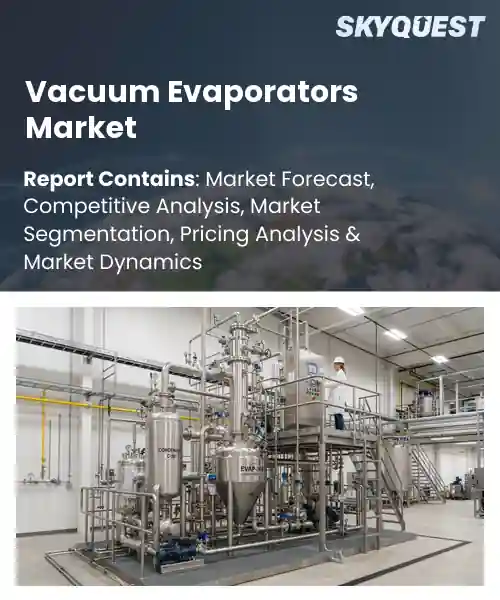
Vacuum Evaporators Market
Report ID: SQMIG20I3751
Report ID: SQMIG20I3751
[email protected]
USA +1 351-333-4748
Report ID:
SQMIG20I3751 |
Region:
Global |
Published Date: August, 2026
Pages:
157
|Tables:
120
|Figures:
77


Global Vacuum Evaporators Market size was valued at USD 3.46 Billion in 2024 and is poised to grow from USD 3.71 Billion in 2025 to USD 6.43 Billion by 2033, growing at a CAGR of 7.12% during the forecast period (2026-2033).
Rising demand for sustainable processing drives the vacuum evaporators market because manufacturers aim to lower carbon footprints while preserving product quality. Tightening emissions standards and higher energy costs cause firms to replace conventional batch dryers with vacuum systems that recycle heat and run at lower temperatures. In pharmaceuticals, companies such as Pfizer use vacuum evaporation to concentrate active ingredients, achieving up to 30 % energy savings and faster batch cycles, which improves profitability. Growth in the food‑beverage sector, fueled by consumer preference for minimally processed items, creates opportunities for compact evaporators that integrate into lines, expanding the market in emerging economies.
How are AI and IoT technologies enhancing performance in the vacuum evaporators market?
AI and IoT are reshaping vacuum evaporator operations by delivering real time visibility and intelligent decision making. Sensors placed on condensers, heaters and pumps feed continuous data streams to cloud platforms where machine learning models detect performance deviations before they become faults. Predictive maintenance reduces unexpected downtime and extends equipment life. AI optimized control loops balance temperature and pressure automatically, improving evaporation efficiency while cutting energy waste. IoT connectivity enables remote monitoring and seamless integration with plant management systems, allowing operators to fine tune processes from a central dashboard. These capabilities are raising the overall reliability of vacuum evaporators and supporting the market’s expansion.Veolia North America March 2026, launched a high efficiency vacuum evaporator system that uses AI driven control algorithms and IoT sensors to continuously adjust operating conditions, reducing energy consumption and improving water recovery, illustrating how these technologies drive market growth across industrial wastewater treatment plants and supporting sustainability goals.
Market snapshot - (2026-2033)
Global Market Size
USD 3.46 Billion
Largest Segment
Centrifugal EC Fans
Fastest Growth
Axial EC Fans
Growth Rate
7.12% CAGR
To get more insights on this market click here to Request a Free Sample Report
Global vacuum evaporators market is segmented by product type, capacity, application, end user and region. Based on product type, the market is segmented into Rotary Vacuum Evaporators, Falling Film Vacuum Evaporators, Rising Film Vacuum Evaporators, Forced Circulation Vacuum Evaporators and Other Vacuum Evaporators. Based on capacity, the market is segmented into Small-Scale, Medium-Scale and Large-Scale. Based on application, the market is segmented into Chemical Processing, Pharmaceutical Processing, Food & Beverage Processing, Wastewater Treatment and Other Applications. Based on end user, the market is segmented into Industrial and Research & Laboratory. Based on region, the market is segmented into North America, Europe, Asia Pacific, Latin America and Middle East & Africa.
Rotary vacuum evaporators segment dominates because they offer robust mechanical simplicity, reliable performance, and adaptability across diverse process conditions. Their proven track record in handling high viscosity feeds and ease of maintenance makes them the preferred choice for manufacturers seeking cost effective, long lasting equipment. This reliability drives widespread adoption, reinforcing their leadership in the vacuum evaporators market. Additionally, their compatibility with modern control systems and efficient energy use further enhances their appeal to process engineers.
However, falling film vacuum evaporators segment emerges as the most rapidly expanding area because their thin film design enables superior heat transfer efficiency and gentle handling of heat sensitive materials. Growing demand for high purity products and continuous processing drives adoption, positioning this technology as a catalyst for future market expansion.
Pharmaceutical processing segment dominates because stringent purity requirements and tight regulatory oversight compel manufacturers to adopt highly controlled evaporation solutions. Vacuum evaporators provide the necessary low temperature operation to preserve active ingredient stability while achieving precise solvent removal. Their ability to meet validation standards and integrate with cleanroom environments makes them indispensable for drug formulation, driving consistent demand and cementing their leadership in the market. This ensures compliance and product quality.
On the other hand, food and beverage processing segment is witnessing the strongest growth momentum because consumer demand for natural and low calorie products drives the need for gentle concentration techniques. Vacuum evaporators enable retention of flavor and nutritional value while reducing energy consumption, prompting manufacturers to invest in modern equipment and expanding market opportunities.
To get detailed segments analysis, Request a Free Sample Report
North America leads the vacuum evaporators market because it combines a mature industrial ecosystem with deep investment in research and development. The region benefits from a concentration of large‑scale chemical, pharmaceutical and food processing firms that require reliable high‑efficiency evaporation solutions. Strong engineering talent and a well‑established supply chain enable rapid integration of advanced vacuum technologies. Regulatory frameworks that emphasize product quality and environmental stewardship further encourage adoption of energy‑saving equipment. Access to capital and a culture of continuous improvement drive manufacturers to upgrade to sophisticated vacuum evaporator systems, reinforcing the region’s dominant position in the global vacuum evaporators landscape.
Vacuum Evaporators Market in the United States is driven by a strong demand from high‑value sectors such as pharmaceuticals, specialty chemicals and food processing. Companies prioritize equipment that offers precise temperature control and energy efficiency to meet stringent quality standards. The presence of major technology providers and a well‑developed service network facilitates rapid adoption of advanced vacuum solutions, reinforcing the United States as a key hub for innovation and deployment.
Vacuum Evaporators Market in Canada benefits from an industrial base that includes pulp and paper, dairy processing and biotech clusters. Environmental regulations encourage the use of energy‑saving technologies, prompting manufacturers to invest in vacuum evaporation systems that reduce water usage and lower emissions. Local engineering expertise combined with close collaboration between equipment suppliers and end users supports customized solutions that address process requirements, strengthening Canada’s position in the regional market.
Europe’s vacuum evaporators market expands rapidly due to a confluence of stringent environmental directives and a strong emphasis on product purity across pharmaceutical, chemical and food sectors. Companies are motivated to adopt energy‑efficient vacuum technologies that lower operational costs while meeting rigorous quality standards. The region’s dense network of research institutions and industry clusters fosters continuous innovation, leading to advanced designs that improve throughput and reduce solvent loss. Collaborative funding programs encourage joint development between equipment manufacturers and end‑users, accelerating technology transfer. Additionally, a well‑established supply chain and a culture of sustainability drive firms to replace legacy equipment with modern vacuum evaporators, reinforcing Europe’s position as a leading growth market. Regulatory incentives for low‑carbon processes further stimulate investment, while the presence of major multinational manufacturers ensures access to cutting‑edge solutions tailored to regional specifications.
Vacuum Evaporators Market in Germany is anchored by a chemical and pharmaceutical industry that demands high‑precision evaporation solutions. The country’s engineering excellence and strong focus on automation drive the adoption of vacuum systems that enhance product consistency. Government initiatives supporting energy efficiency encourage manufacturers to upgrade legacy equipment, while close collaboration between research institutes and equipment suppliers accelerates the development of customized technologies, solidifying Germany’s leadership in the European market.
Vacuum Evaporators Market in the United Kingdom is growing as food and beverage manufacturers seek to improve process efficiency and reduce waste. The sector benefits from academic‑industry partnerships that drive adoption of innovative vacuum technologies. Incentives for low‑carbon operations motivate firms to replace older equipment with energy‑saving evaporators. A distribution network and after‑sales service enable market penetration, positioning the United Kingdom as a significant hub for vacuum evaporation continual advancement.
Vacuum Evaporators Market in France is emerging as chemical and cosmetics producers look to enhance product quality while minimizing resource consumption. Government programs that support efficient manufacturing encourage the adoption of vacuum evaporation technology. Collaboration between local equipment firms and research laboratories fosters the development of tailored solutions suited to niche applications. Growing awareness of sustainability benefits drives incremental investment, gradually expanding France’s footprint in the European vacuum evaporators landscape.
Asia Pacific is strengthening its position in the vacuum evaporators market through a combination of rapid industrial expansion and focused government support for advanced processing technologies. Growing demand for high‑value chemicals, pharmaceuticals and food products drives manufacturers to adopt vacuum evaporation systems that deliver superior energy efficiency and product quality. Countries such as Japan and South Korea invest heavily in research collaborations that accelerate the development of compact, high‑performance evaporators suited to space‑constrained facilities. Rising awareness of environmental impact encourages firms to replace conventional heating methods with vacuum‑based solutions that lower emissions and reduce water usage. An increasingly sophisticated supply chain and the presence of global equipment leaders further enhance the region’s capability to meet evolving market requirements. These dynamics position Asia Pacific as a pivotal growth engine for the global vacuum evaporators industry.
Vacuum Evaporators Market in Japan is driven by a chemical and electronics sector that requires precise moisture control and high purity. The country’s emphasis on technological innovation leads to the adoption of vacuum systems with automation features. Government initiatives promoting energy conservation encourage manufacturers to upgrade to efficient evaporators. Collaboration between research institutes and equipment suppliers results in customized solutions that address the rigorous quality standards of Japanese production environments.
Vacuum Evaporators Market in South Korea is propelled by a strong petrochemical and biotech industry that demands efficient moisture removal and solvent recovery. National policies encouraging low‑carbon manufacturing stimulate investment in vacuum evaporation equipment that reduces energy consumption. Close ties between universities and equipment manufacturers foster technology transfer, resulting in units suited to layouts. Growing emphasis on product purity and environmental compliance drives adoption of vacuum evaporators across Korean sectors.
To know more about the market opportunities by region and country, click here to
Buy The Complete Report
Increasing Pharmaceutical Demand
Advancements In Process Automation
High Capital Investment Costs
Stringent Environmental Regulations
Request Free Customization of this report to help us to meet your business objectives.
The vacuum evaporators market is shaped by intense competition as manufacturers pursue M&A, strategic partnerships, and technology upgrades. In 2023 a global process equipment leader acquired a niche vacuum technology firm to broaden its product portfolio, while another major player partnered with a pharmaceutical company to integrate continuous evaporation solutions, accelerating adoption across high‑value sectors.
Top Player’s Company Profile
Recent Developments
SkyQuest’s ABIRAW (Advanced Business Intelligence, Research & Analysis Wing) is our Business Information Services team that Collects, Collates, Correlates, and Analyses the Data collected by means of Primary Exploratory Research backed by robust Secondary Desk research. As per SkyQuest analysis, the global vacuum evaporators market is projected to reach $6.43 billion by 2033, driven primarily by rising pharmaceutical demand that pushes manufacturers toward low‑temperature, energy‑efficient evaporation, while high capital investment costs temper adoption, especially among smaller players. North America remains the dominant region thanks to its mature industrial base and strong R&D spending, and rotary vacuum evaporators continue to lead the segment landscape due to their reliability and cost‑effectiveness. A second key driver is the rapid advancement of process automation, with AI and IoT enabling predictive maintenance and smarter control, further accelerating market growth across diverse end‑user applications worldwide.
| Report Metric | Details |
|---|---|
| Market size value in 2024 | USD 3.46 Billion |
| Market size value in 2033 | USD 6.43 Billion |
| Growth Rate | 7.12% |
| Base year | 2024 |
| Forecast period | (2026-2033) |
| Forecast Unit (Value) | USD Billion |
| Segments covered |
|
| Regions covered | North America (US, Canada), Europe (Germany, France, United Kingdom, Italy, Spain, Rest of Europe), Asia Pacific (China, India, Japan, Rest of Asia-Pacific), Latin America (Brazil, Rest of Latin America), Middle East & Africa (South Africa, GCC Countries, Rest of MEA) |
| Companies covered |
|
| Customization scope | Free report customization with purchase. Customization includes:-
|
To get a free trial access to our platform which is a one stop solution for all your data requirements for quicker decision making. This platform allows you to compare markets, competitors who are prominent in the market, and mega trends that are influencing the dynamics in the market. Also, get access to detailed SkyQuest exclusive matrix.
Table Of Content
Executive Summary
Market overview
Parent Market Analysis
Market overview
Market size
KEY MARKET INSIGHTS
COVID IMPACT
MARKET DYNAMICS & OUTLOOK
Market Size by Region
KEY COMPANY PROFILES
Methodology
For the Vacuum Evaporators Market, our research methodology involved a mixture of primary and secondary data sources. Key steps involved in the research process are listed below:
1. Information Procurement: This stage involved the procurement of Market data or related information via primary and secondary sources. The various secondary sources used included various company websites, annual reports, trade databases, and paid databases such as Hoover's, Bloomberg Business, Factiva, and Avention. Our team did 45 primary interactions Globally which included several stakeholders such as manufacturers, customers, key opinion leaders, etc. Overall, information procurement was one of the most extensive stages in our research process.
2. Information Analysis: This step involved triangulation of data through bottom-up and top-down approaches to estimate and validate the total size and future estimate of the Vacuum Evaporators Market.
3. Report Formulation: The final step entailed the placement of data points in appropriate Market spaces in an attempt to deduce viable conclusions.
4. Validation & Publishing: Validation is the most important step in the process. Validation & re-validation via an intricately designed process helped us finalize data points to be used for final calculations. The final Market estimates and forecasts were then aligned and sent to our panel of industry experts for validation of data. Once the validation was done the report was sent to our Quality Assurance team to ensure adherence to style guides, consistency & design.
Analyst Support
Customization Options
With the given market data, our dedicated team of analysts can offer you the following customization options are available for the Vacuum Evaporators Market:
Product Analysis: Product matrix, which offers a detailed comparison of the product portfolio of companies.
Regional Analysis: Further analysis of the Vacuum Evaporators Market for additional countries.
Competitive Analysis: Detailed analysis and profiling of additional Market players & comparative analysis of competitive products.
Go to Market Strategy: Find the high-growth channels to invest your marketing efforts and increase your customer base.
Innovation Mapping: Identify racial solutions and innovation, connected to deep ecosystems of innovators, start-ups, academics, and strategic partners.
Category Intelligence: Customized intelligence that is relevant to their supply Markets will enable them to make smarter sourcing decisions and improve their category management.
Public Company Transcript Analysis: To improve the investment performance by generating new alpha and making better-informed decisions.
Social Media Listening: To analyze the conversations and trends happening not just around your brand, but around your industry as a whole, and use those insights to make better Marketing decisions.
REQUEST FOR SAMPLE
 REQUEST FREE CUSTOMIZATION


Want to customize this report? This report can be personalized according to your needs. Our analysts and industry experts will work directly with you to understand your requirements and provide you with customized data in a short amount of time. We offer $1000 worth of FREE customization at the time of purchase.
Feedback From Our Clients


 USA (+1) 351-333-4748

