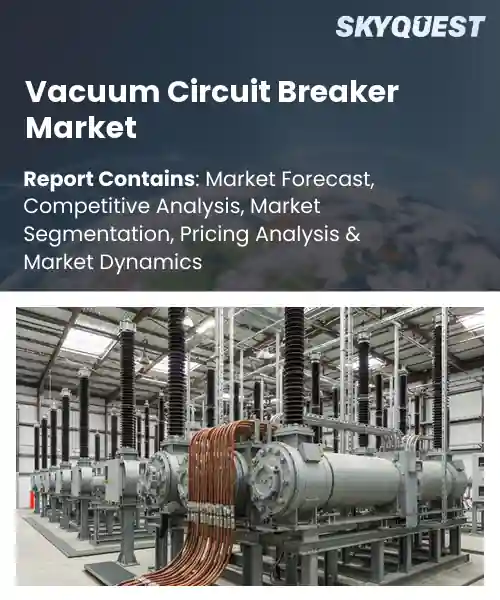
Vacuum Circuit Breaker Market
Report ID: SQMIG20E2204
Report ID: SQMIG20E2204
[email protected]
USA +1 351-333-4748
Report ID:
SQMIG20E2204 |
Region:
Global |
Published Date: June, 2026
Pages:
157
|Tables:
116
|Figures:
72


Global Vacuum Circuit Breaker Market size was valued at USD 4.52 Billion in 2024 and is poised to grow from USD 4.85 Billion in 2025 to USD 8.52 Billion by 2033, growing at a CAGR of 7.22% during the forecast period (2026-2033).
The primary driver of the global vacuum circuit breaker market is the accelerating demand for reliable, compact, and low-maintenance medium-voltage protection in expanding power networks. Vacuum circuit breakers interrupt current in vacuum bottles, reducing arcing and maintenance compared with oil or air technologies; this advantage matters as utilities and industrial users prioritize uptime and safety. Historical development moved from bulky oil-filled designs to sealed vacuum interrupters in the late twentieth century, and modular factory-assembled units recently. For example, urban distribution grids adopted vacuum breakers to handle increasing load density, while renewable integration required robust fault isolation, which further propelled adoption.Building on that adoption, the pivotal factor shaping future growth is grid modernization driven by renewable integration and decentralized generation, which creates specific operational demands that favor vacuum circuit breakers. As distributed energy resources introduce variable flows and higher short-circuit currents, network operators must deploy compact, fast-interrupting devices to isolate faults quickly, and vacuum breakers meet these needs with minimal maintenance and long service intervals. Consequently utilities retrofit distribution feeders in urban centers, renewable sites use vacuum breakers in collector systems to protect inverters, and industrial campuses standardize vacuum solutions, opening market opportunities for modular, sensor-enabled products and aftermarket services.
How is IoT enhancing predictive maintenance in the vacuum circuit breaker market?
IoT is transforming predictive maintenance for vacuum circuit breakers by turning static switches into instrumented assets. Key aspects include sensors that monitor contact wear, vacuum integrity, temperature and vibration, local gateways that stream data to cloud platforms, and analytics that flag anomalies and forecast maintenance needs. The current state sees utilities and industrial operators shifting from routine schedules to condition based strategies to reduce unexpected outages and extend asset life. Manufacturers are embedding thermal monitoring and digital logbooks and offering scalable monitoring services, so operators can prioritize interventions and keep critical distribution networks running with less disruption.Chengxi Electric Group February 2026, described smart vacuum circuit breaker designs with embedded sensors and remote monitoring that feed cloud analytics. This real world development shows IoT surfacing early fault signatures and enabling targeted condition based servicing to boost uptime and reduce on site maintenance.
Market snapshot - (2026-2033)
Global Market Size
USD 4.52 Billion
Largest Segment
Medium Voltage (1-36 kV)
Fastest Growth
High Voltage (>36 kV)
Growth Rate
7.22% CAGR
To get more insights on this market click here to Request a Free Sample Report
Global vacuum circuit breaker market is segmented by voltage, installation, application, end-user and region. Based on voltage, the market is segmented into Medium Voltage (1-36 kV) and High Voltage (>36 kV). Based on installation, the market is segmented into Indoor and Outdoor. Based on application, the market is segmented into Power Generation, Transmission & Distribution, Industrial and Rail & Transportation. Based on end-user, the market is segmented into Utilities, Industrial and Commercial Buildings. Based on region, the market is segmented into North America, Europe, Asia Pacific, Latin America and Middle East & Africa.
Medium Voltage (1-36 kV) segment dominates because its characteristics align with the operational needs of distribution networks, offering compact interrupter design, frequent switching capability, and favorable lifecycle economics that simplify deployment across utility feeders and industrial power systems. Mature manufacturing processes and established standards reduce integration complexity, encouraging widespread replacement and maintenance practices that reinforce supplier ecosystems and sustain product reliability expectations.
However, High Voltage (>36 kV) is witnessing the strongest growth momentum in the Vacuum Circuit Breaker Market as transmission nodes require greater interrupting capacity and extended asset lifetimes. Advances in contact materials and insulation, together with increasing retrofit programs and evolving specifications, are driving manufacturers to develop high capacity vacuum designs, creating new product development and specialist installation opportunities that expand market reach.
Transmission & Distribution segment dominates because it imposes stringent performance and interoperability requirements on switching equipment, prompting manufacturers to emphasize fault interruption precision, protection coordination, and robust control integration in vacuum breaker design. System planners prioritize technologies that reduce outage severity and integrate seamlessly with protection schemes, so product roadmaps focus on modularity, remote operability, and consistent interface standards that drive supplier alignment and upgrade adoption.
Conversely, Rail & Transportation is emerging as the key high growth area in the Vacuum Circuit Breaker Market as electrified networks demand compact, high reliability switching with rapid cycling and strong vibration tolerance. Tight safety rules and expanding tram and metro projects are stimulating customized vacuum solutions and aftermarket services, generating new design requirements and profitable niches for specialized manufacturers and service providers.
To get detailed segments analysis, Request a Free Sample Report
Asia Pacific dominates due to concentrated industrial electrification initiatives, mature manufacturing capabilities, and sustained investment in transmission and distribution infrastructure. Regional producers combine technological specialization in medium and high voltage vacuum interrupter design with broad supply chain depth, enabling cost competitive production and rapid deployment. Policy emphasis on grid reliability and urbanization trends drives large scale replacement and expansion programs. Collaborative ecosystems among utilities, manufacturers, and research institutions accelerate adaptation of advanced materials and compact modular designs. Growing regional aftermarket and maintenance services reinforce lifecycle value capture, while export-oriented manufacturing hubs funnel innovations into global markets, sustaining leadership in product variety, delivery efficiency, and competitive pricing. Intensive domestic demand for reliable power equipment and strategic focus on export competitiveness foster continuous R and D collaboration, standards harmonization, and enhanced after sales networks, creating barriers to entry for new competitors and anchoring regional dominance across both established and emerging market segments.
Vacuum Circuit Breaker Market in Japan benefits from advanced manufacturing ecosystems, deep electrical engineering expertise, and strong supplier networks that support precision vacuum interrupter production. Domestic utilities demand high reliability and compact designs suitable for urban substations, encouraging innovation in materials and control integration. Close collaboration between research institutes and manufacturers accelerates product refinement, while established export channels extend influence across regional and global markets and specialized service ecosystems worldwide.
Vacuum Circuit Breaker Market in South Korea leverages heavy electrical equipment manufacturing capacity, close ties to utility modernization programs, and emphasis on compact, high performance interrupter assemblies. Manufacturers align product development with stringent quality standards and systems integration requirements demanded by customers. Robust supplier networks and focus on export competitiveness enable scaling of advanced designs. Strategic partnerships with technology providers enhance service offerings and support lifecycle management across regional markets.
Expansion in Europe is being driven by a convergence of grid modernization agendas, stringent reliability expectations from utilities, and a push for standardized, compact switchgear that aligns with decentralized generation and urban distribution constraints. Demand is supported by strong engineering services, proven vendors with localized production, and effective regulatory frameworks that favor safety and interoperability. Investment in retrofit programs, coupled with growing interest in intelligent protection and remote monitoring integration, elevates replacement cycles and aftermarket activity. Cross border collaboration on technical standards and harmonized certification processes reduces market entry friction and enables vendors to scale solutions across multiple national systems. This environment favors suppliers that combine robust engineering, localized service networks, and adaptable modular product families. Financial mechanisms and public private partnerships further accelerate project execution and technology adoption across utility segments.
Vacuum Circuit Breaker Market in Germany is characterized by strong industrial demand, rigorous technical standards, and deep integration with transmission modernization programs. German manufacturers emphasize engineering excellence, high quality manufacturing processes, and close cooperation with utilities and system integrators. The market favors solutions that combine robustness with advanced protection schemes, and established service networks support extensive aftermarket offerings. Strong export orientation and participation in international standardization amplify Germany influence regionally.
Vacuum Circuit Breaker Market in United Kingdom is experiencing growth driven by utility focus on grid resilience, retrofit activity in distribution networks, and adoption of intelligent protection features. Local suppliers and international vendors compete to deliver modular solutions that facilitate integration with automation platforms. Investment in pilot programs and strengthened after sales ecosystems supports faster product iteration and deeper service footprints, widening opportunities across industrial and distribution segments more broadly.
Vacuum Circuit Breaker Market in France is emerging as focus grows on upgrading legacy infrastructure and enhancing distribution resilience. Domestic and international suppliers provide retrofit offerings and tailored service agreements. Regulatory emphasis on safety and interoperability supports standardized products, while pilots for intelligent protection introduce advanced control capabilities. Rising aftermarket demand for maintenance and localized support positions France as an important market for refined vacuum circuit breaker solutions moving forward.
North America is strengthening its position through targeted renovation of aging transmission and distribution assets, a strong focus on grid resilience, and growing adoption of intelligent protection and remote monitoring technologies. Local manufacturers and global suppliers collaborate to deliver solutions adapted to regional standards and utility operating practices, while expanded service networks improve lifecycle management and total cost of ownership considerations. Emphasis on interoperability and modularity enables quicker upgrades and simplifies maintenance. Utility-driven procurement strategies and strengthened domestic supply chains enhance responsiveness to demand spikes and support long term partnerships. Together, these factors foster a market environment that rewards technical reliability, robust after sales service, and suppliers capable of tailoring solutions to complex system requirements. Increasing coordination between utilities and technology providers supports scalable deployment and strengthens regional competitiveness for advanced vacuum circuit breaker offerings.
Vacuum Circuit Breaker Market in United States is shaped by utility modernization programs, emphasis on grid resilience, and demand for equipment compatible with advanced protection and automation systems. Domestic and international manufacturers tailor products to meet stringent standards and integration requirements. Extensive service networks and vendor partnerships support retrofit and lifecycle management. Procurement strategies favor reliable, maintainable solutions, creating opportunities for suppliers that combine engineering robustness with after sales support.
Vacuum Circuit Breaker Market in Canada focuses on robust solutions for transmission and remote distribution networks and resource requirements. Utilities prioritize equipment reliability under harsh environmental conditions and maintenance ease in territories. Manufacturers adapt designs for rugged operation and work with local providers to deliver aftermarket support. Cross border supplier relationships and emphasis on lifecycle performance drive adoption of modular, maintainable vacuum circuit breaker platforms suited to regional system needs.
To know more about the market opportunities by region and country, click here to
Buy The Complete Report
Rising Demand For Power Infrastructure
Vacuum circuit breakers are increasingly chosen as utilities expand and modernize transmission and distribution networks because they offer reliable interruption of fault currents, compact installation profiles, and reduced maintenance needs compared with older technologies; this combination supports accelerated specification and procurement of vacuum products by grid operators and industrial end users seeking operational resilience and lower lifecycle disruption. As project planners prioritize equipment that minimizes downtime and integrates with evolving grid architectures, demand for vacuum circuit breakers grows across new and retrofit applications.
Emphasis On Safety And Reliability
Vacuum circuit breakers are favored in many installations because their contactless arc quenching and sealed interrupter design reduce the risk of fire, gas emissions, and equipment damage, aligning with stricter safety standards and operator expectations; this enhances trust among utilities and industrial customers and encourages specification of vacuum solutions. Manufacturers respond by highlighting reliability and low failure modes during procurement cycles, and end users adopt these devices to improve workforce safety and asset protection, thereby reinforcing procurement decisions and expanding market uptake.
High Initial Equipment Costs
Higher upfront capital requirements for vacuum circuit breaker procurement and integration can deter buyers with constrained budgets or short procurement cycles, as project owners and facility managers must prioritize cost-effective options that align with immediate capital planning; this financial barrier slows specification and deployment in price-sensitive segments despite long-term operational advantages. Budget allocation practices and conservative procurement policies often favor familiar or lower-cost alternatives, limiting market penetration until total cost of ownership benefits are more widely recognized or financing mechanisms are adapted.
Availability Of Skilled Maintenance Personnel
Limited availability of technicians and engineers trained specifically in installation, diagnostics, and long-term maintenance of vacuum circuit breakers can constrain deployment, as asset owners anticipate operational risks and potential service delays when skilled support is scarce; this lack of local expertise increases dependence on external vendor service, elevates perceived logistical complexity, and discourages rapid scale-up in certain regions. Training gaps and uneven aftermarket ecosystems therefore act as a restraint by affecting confidence in sustained performance and increasing the operational overhead associated with equipment adoption.
Request Free Customization of this report to help us to meet your business objectives.
Competitive landscape in the global vacuum circuit breaker market is shaped by incumbents racing to commercialize SF6 free vacuum switching and by consolidation through strategic mergers and acquisitions and regional manufacturing investments. Example strategies include Hitachi's acquisition of ABB Power Grids, Mitsubishi Electric and Meidensha launching SF6 free vacuum breakers for utilities, and incumbents expanding local production and partnerships to win utility procurement.
Top Player’s Company Profile
Recent Developments
SkyQuest’s ABIRAW (Advanced Business Intelligence, Research & Analysis Wing) is our Business Information Services team that Collects, Collates, Correlates, and Analyses the Data collected by means of Primary Exploratory Research backed by robust Secondary Desk research. As per SkyQuest analysis, the vacuum circuit breaker market is being propelled by accelerating demand for reliable, compact medium-voltage protection as a key driver, and further driven by grid modernization and renewable integration as a second driver, while high initial equipment costs act as a meaningful restraint. Asia Pacific dominates the global market and the Medium Voltage 1-36 kV segment is the leading application, favored by utilities and industrial users for its compact footprint and low maintenance. Manufacturers emphasizing IoT-enabled predictive maintenance, SF6-free designs and modular, serviceable platforms are best placed to capture retrofit and new-build opportunities as operators prioritize uptime, safety and lifecycle cost reductions.
| Report Metric | Details |
|---|---|
| Market size value in 2024 | USD 4.52 Billion |
| Market size value in 2033 | USD 8.52 Billion |
| Growth Rate | 7.22% |
| Base year | 2024 |
| Forecast period | (2026-2033) |
| Forecast Unit (Value) | USD Billion |
| Segments covered |
|
| Regions covered | North America (US, Canada), Europe (Germany, France, United Kingdom, Italy, Spain, Rest of Europe), Asia Pacific (China, India, Japan, Rest of Asia-Pacific), Latin America (Brazil, Rest of Latin America), Middle East & Africa (South Africa, GCC Countries, Rest of MEA) |
| Companies covered |
|
| Customization scope | Free report customization with purchase. Customization includes:-
|
To get a free trial access to our platform which is a one stop solution for all your data requirements for quicker decision making. This platform allows you to compare markets, competitors who are prominent in the market, and mega trends that are influencing the dynamics in the market. Also, get access to detailed SkyQuest exclusive matrix.
Table Of Content
Executive Summary
Market overview
Parent Market Analysis
Market overview
Market size
KEY MARKET INSIGHTS
COVID IMPACT
MARKET DYNAMICS & OUTLOOK
Market Size by Region
KEY COMPANY PROFILES
Methodology
For the Vacuum Circuit Breaker Market, our research methodology involved a mixture of primary and secondary data sources. Key steps involved in the research process are listed below:
1. Information Procurement: This stage involved the procurement of Market data or related information via primary and secondary sources. The various secondary sources used included various company websites, annual reports, trade databases, and paid databases such as Hoover's, Bloomberg Business, Factiva, and Avention. Our team did 45 primary interactions Globally which included several stakeholders such as manufacturers, customers, key opinion leaders, etc. Overall, information procurement was one of the most extensive stages in our research process.
2. Information Analysis: This step involved triangulation of data through bottom-up and top-down approaches to estimate and validate the total size and future estimate of the Vacuum Circuit Breaker Market.
3. Report Formulation: The final step entailed the placement of data points in appropriate Market spaces in an attempt to deduce viable conclusions.
4. Validation & Publishing: Validation is the most important step in the process. Validation & re-validation via an intricately designed process helped us finalize data points to be used for final calculations. The final Market estimates and forecasts were then aligned and sent to our panel of industry experts for validation of data. Once the validation was done the report was sent to our Quality Assurance team to ensure adherence to style guides, consistency & design.
Analyst Support
Customization Options
With the given market data, our dedicated team of analysts can offer you the following customization options are available for the Vacuum Circuit Breaker Market:
Product Analysis: Product matrix, which offers a detailed comparison of the product portfolio of companies.
Regional Analysis: Further analysis of the Vacuum Circuit Breaker Market for additional countries.
Competitive Analysis: Detailed analysis and profiling of additional Market players & comparative analysis of competitive products.
Go to Market Strategy: Find the high-growth channels to invest your marketing efforts and increase your customer base.
Innovation Mapping: Identify racial solutions and innovation, connected to deep ecosystems of innovators, start-ups, academics, and strategic partners.
Category Intelligence: Customized intelligence that is relevant to their supply Markets will enable them to make smarter sourcing decisions and improve their category management.
Public Company Transcript Analysis: To improve the investment performance by generating new alpha and making better-informed decisions.
Social Media Listening: To analyze the conversations and trends happening not just around your brand, but around your industry as a whole, and use those insights to make better Marketing decisions.
REQUEST FOR SAMPLE
 REQUEST FREE CUSTOMIZATION


Want to customize this report? This report can be personalized according to your needs. Our analysts and industry experts will work directly with you to understand your requirements and provide you with customized data in a short amount of time. We offer $1000 worth of FREE customization at the time of purchase.
Feedback From Our Clients


 USA (+1) 351-333-4748

