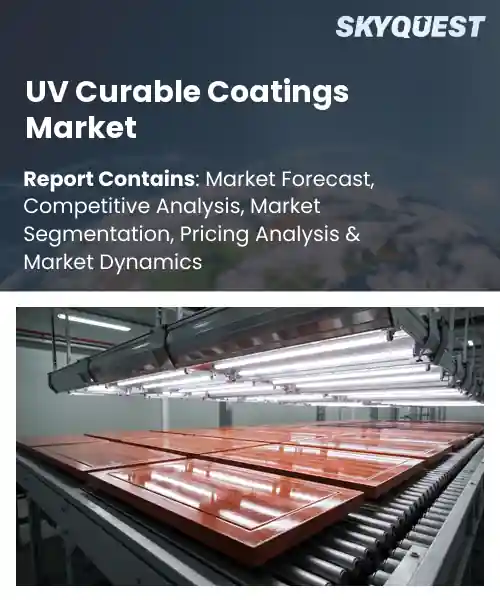
UV Curable Coatings Market
Report ID: SQMIG15A2712
Report ID: SQMIG15A2712
[email protected]
USA +1 351-333-4748
Report ID:
SQMIG15A2712 |
Region:
Global |
Published Date: May, 2026
Pages:
157
|Tables:
183
|Figures:
79


Global Uv Curable Coatings Market size was valued at USD 9.7 Billion in 2024 and is poised to grow from USD 10.14 Billion in 2025 to USD 14.42 Billion by 2033, growing at a CAGR of 4.5% during the forecast period (2026-2033).
Rapid production needs, and tightening environmental regulations, are the main push for the UV curable coatings market growth, because they force companies to use technologies that cure coatings almost right away , while also cutting volatile organic compound emissions. The market is built around coatings that polymerize under ultraviolet light to make strong films , and it matters because faster curing boosts throughput, reduces energy consumption, and supports safer operations.
Moreover, the key factor enhancing the UV curable coatings market penetration is the wide uptake of UV-LED curing. Its lower energy usage and reduced heat output widen end-use options, and the economics improve quite a lot. Since LED lamps cure at lower temperatures, they let manufacturers print and coat heat-sensitive substrates, which can be seen often in flexible packaging and plastics. That supports faster uptake by converters who want higher line speeds and less scrap. On top of that, improvements in photoinitiators and oligomer chemistries have helped reduce yellowing and strengthen adhesion, so furniture and automotive OEMs have started specifying UV formulations. That, in turn, creates openings for equipment retrofits, specialty resin sales, and higher margin custom blends.
AI is basically accelerating the whole formulation process by merging predictive models with high throughput experiments and lab automation, and it does this in practical steps. One part is predicting cure behavior, another is optimizing reactive diluent and photoinitiator combinations, and also doing virtual screening to weigh trade offs, like adhesion versus flexibility, and weathering performance. Today, the overall shift is away from trial and error and toward data driven design , where machine learning helps choose the most promising experiments, and it can uncover composition effects that would be hard to spot. This cuts down iteration cycles , while also expanding the range of chemistries that work for industrial and packaging uses, so UV formulations end up more robust , and easier to scale.
Market snapshot - (2026-2033)
Global Market Size
USD 9.7 Billion
Largest Segment
Urethane Acrylates
Fastest Growth
Silicone Acrylates
Growth Rate
4.5% CAGR
To get more insights on this market click here to Request a Free Sample Report
Global uv curable coatings market is segmented by by resin type, by composition, by application, by end-use industry, by technology, by distribution channel and region. Based on by resin type, the market is segmented into Epoxy Acrylates, Urethane Acrylates, Polyester Acrylates, Silicone Acrylates and Others. Based on by composition, the market is segmented into Water-based UV Curable Coatings, Solvent-based UV Curable Coatings, Powder UV Curable Coatings and 100% Solid UV Curable Coatings. Based on by application, the market is segmented into Wood Coatings, Plastic Coatings, Metal Coatings, Paper & Packaging Coatings, Electronics Coatings, Automotive Coatings, Optical Fiber Coatings and Others. Based on by end-use industry, the market is segmented into Furniture Industry, Automotive Industry, Electronics Industry, Packaging Industry, Construction Industry, Healthcare Industry and Others. Based on by technology, the market is segmented into UV LED Curing, Mercury Lamp UV Curing and Electron Beam Curing. Based on by distribution channel, the market is segmented into Direct Sales, Distributors & Dealers and Online Sales. Based on region, the market is segmented into North America, Europe, Asia Pacific, Latin America and Middle East & Africa.
As per the UV curable coatings market analysis, the Epoxy Acrylates segment dominates, because its combination of really strong adhesion, chemical and abrasion resistance, plus a high crosslink density, produces films that are durable and very high-performance, and that also line up with tough industrial needs. Their fast UV cure and compatibility with diverse substrates help the production flow a lot, so cycle times go down, and costs also come down. Formulators tend to favor epoxy acrylates since the results are more predictable, and the chemistry is easier to modify, which explains why they get specified so often for wood, metal, electronics, and industrial coating uses.
However, the Urethane Acrylates segment is showing up as the fastest growing side of this market, largely due to superior flexibility, toughness, and weather resistance, which fits automotive and flexible plastic applications. Recent improvements in low viscosity oligomers and adhesion chemistries broaden what surfaces can be coated, and when you pair that with energy-efficient curing technologies, adoption speeds up, and it opens new use cases.
According to the UV curable coatings market forecast, the 100% Solid UV curable Coatings segment basically dominates, because its solvent-free build removes volatile carriers, leading to denser, high-build films with notable hardness and chemical resistance, fitted for industrial finishing. After that, quick curing on exposure lets lean manufacturing happen, and almost no additional post-treatment, which sounds appealing to OEMs that are after durable, low-emission solutions. There is also this regulatory push around emissions, and the fact that it can deliver steady optical plus mechanical traits across different substrates, which overall supports wide use in higher performance applications.
However, the Water-based UV Curable Coatings category is predicted to have the largest UV curable coatings market share as formulators pursue lower-emission and lower-odor options for furniture, packaging, and consumer goods. Improvements in photoinitiators and co-solvent systems enhance cure performance in aqueous matrices, while brand owners prioritize sustainable credentials, driving R&D and commercial scale-up that unlocks new applications and procurement mandates.
To get detailed segments analysis, Request a Free Sample Report
As per the UV curable coatings market regional forecast, Asia Pacific is leading the market, due to advanced manufacturing ecosystems, concentrated demand from electronics and automotive, plus established supply chain networks that help speed up material development and then deployment. There are strong industrial clusters in certain countries, and they push collaboration between formulators, equipment makers and end users, which makes UV technology adoption go faster, especially for high performance and quick-curing jobs. Meanwhile, a mature base of specialty chemical producers, together with polymer researchers keeps churning out new ideas for photoinitiators and oligomer systems. Moreover, downstream industries are already integrated so demand stays steady for durable, high throughput coatings. Market players tend to get an edge from cost effective production, closeness to big consumer electronics fabs, and smart investments in application engineering, all of that together kind of locks in regional leadership for UV curable coatings.
Japan UV Curable Coatings Market
The UV curable coatings sector in Japan is known for high technical sophistication and a tight fit with precision electronics and advanced vehicle manufacturing. Key materials science institutions, along with specialty chemical producers, help craft formulations that fit tricky use cases. There’s collaborative development between equipment suppliers and end users, and it tends to speed up the adoption of new photoinitiator systems. A strong focus on miniaturization, surface quality, and production efficiency basically keeps demand alive for fast-curing, low-emission coatings across multiple industrial segments.
South Korea UV Curable Coatings Market
In South Korea, the UV curable coatings industry is supported by intense electronics manufacturing, with a notable focus on surface engineering for consumer gadgets and displays. Domestic producers often work with global formulators to adjust low-energy curing systems for local production realities. The emphasis is on rapid process cycles and throughput manufacturing, so interest builds around photoinitiators and coating chemistries. Close connections between research institutions and industry help keep refining formulations for durability and aesthetic performance, not just one but the whole package.
The rapid expansion of the UV curable coatings market in North America is largely driven by technology adoption across printing, packaging, medical devices, and industrial finishing. It also helps that manufacturers collaborate with research organizations pretty actively. There’s also this push for environmental compliance and low-volatile organic compound formulations, and because of that, companies shift toward energy curing solutions that can deliver faster throughput and less solvent use. Investments in application engineering, pilot facilities and customization for specific niche end uses let regional suppliers respond quicker to customer requirements. A reliable distribution network and skilled technical sales support helps scale new chemistries into production lines, while demand across electronics, transportation, and specialty packaging keeps the market diversified and moving forward. Regional centers of excellence and strong OEM partnerships make it easier to scale up formulations from lab stages to actual manufacturing, and then good customer service and aftermarket support reinforce long term adoption across a variety of applications.
United States UV Curable Coatings Market
In the United States, UV curable coatings benefit from broad adoption in industrial printing, packaging, and electronics assembly. This is pushed by the need for faster cycle times and better environmental profiles. There’s a strong presence of specialty chemical firms and equipment manufacturers, which helps with scaling up innovative chemistries quickly. Collaborative programs between OEMs and materials suppliers allow tailored solutions for high-performance use cases, while a mature technical service setup helps customers integrate processes with less hassle.
Canada UV Curable Coatings Market
The Canadian UV curable coatings market is shaped by a strong manufacturing base, and also by proximity to regional supply chains that make energy curing tech easier to adopt fast. Companies put emphasis on sustainable production habits and reducing solvent use, so low-emission formulations attract more attention. Joint efforts between academic research centers and chemical producers support application-specific development. Technical distributors also play a role in making implementation smoother across sectors like packaging, printing, and industrial equipment surface finishing.
Europe is strengthening its position in the UV curable coatings market, via a mix of tough environmental rules, deeper formulation investigations, and a fairly close back and forth between polymer scientists and the people building the equipment. There is a regional push for low-emission approaches and job safety, too, which nudges the industry toward solvent-free and energy-efficient curing solutions that are meant to fit local regulatory expectations. Research hubs that collaborate and university linkages speed up new material creation, while the long-standing industrial circles in coatings and automotive finishing keep the demand steady for high-performance surface treatments. There is also a notable tilt toward customization for specialty uses, and when reliable service networks and hands-on technical support are added, it makes new chemistries easier to commercialize quickly, and that reinforces Europe role as a hub for sustainable, high-quality UV coating solutions.
Germany UV Curable Coatings Market
The UV Curable Coatings Market in Germany leans on a strong industrial manufacturing base, with a focus on engineering excellence. Specialty chemical companies and coating equipment suppliers work together closely with the automotive and machinery sectors to build sturdy formulations. The emphasis on process reliability and energy efficiency helps UV curing move into production lines more readily. Technical service networks, together with application laboratories, let firms test faster and scale up tailored coating solutions for tough industrial applications.
United Kingdom UV Curable Coatings Market
The UV Curable Coatings Market in the United Kingdom takes momentum from a lively research ecosystem, and from demand that is especially visible in printing, packaging, and specialty manufacturing. Collaboration among universities, research centers, and coating formulators drives the development of low-emission and high-performance chemistries. A focus on flexible packaging and graphic uses keeps encouraging the adoption of fast-curing systems. Solid technical consultancy and pilot coating facilities also let manufacturers tune their processes and put tailored solutions in place in a more efficient way.
France UV Curable Coatings Market
The UV Curable Coatings Market in France benefits from strong chemical industry capabilities and a history of innovation in surface technologies. Close coordination between formulators and the luxury goods, automotive, and industrial design segments helps shape coatings that try to balance look and durability at the same time. Eco-friendly formulation ideas and process optimization are highlighted, which promote the uptake of solvent-free and fast-curing systems. Regional testing facilities and research centers further support the adjustment of solutions, so they match the real manufacturing needs in practice.
To know more about the market opportunities by region and country, click here to
Buy The Complete Report
Demand For Rapid Curing
Stringent Environmental Regulations
High Initial Equipment Costs
Technical Limitations In Some Applications
Request Free Customization of this report to help us to meet your business objectives.
The competitive landscape for the global UV curable coatings market is much shaped by consolidation, technology-driven differentiation, and a lot of application-focused partnerships that speed up the adoption of LED curing and low VOC chemistries. Big specialty chemical players keep leaning into targeted acquisitions, co-development agreements, and equipment collaborations, basically to secure formulation know-how and more dependable supply chains.
Top Player’s Company Profile
Recent Developments in the UV Curable Coatings Market
SkyQuest’s ABIRAW (Advanced Business Intelligence, Research & Analysis Wing) is our Business Information Services team that Collects, Collates, Correlates, and Analyses the Data collected by means of Primary Exploratory Research backed by robust Secondary Desk research.
As per SkyQuest analysis, overall, the global UV curable coatings market is being propelled by rapid production demands as a key driver, with tightening environmental regulations acting as a second driver. A restraint, though, is the high initial equipment costs, which slow adoption for smaller manufacturers. Regionally, Asia Pacific leads, and the Epoxy Acrylates segment dominates. The appeal here is superior adhesion, hardness, and rapid cure. As for opportunities, a lot is revolving around UV LED adoption, plus more sustainable 100% solid and water-based formulations and, in the same breath, AI-driven formulation optimization. The overall intent is to shrink development cycles and also widen the rollout across packaging, electronics, and automotive finishing, where it’s actually needed.
| Report Metric | Details |
|---|---|
| Market size value in 2024 | USD 9.7 Billion |
| Market size value in 2033 | USD 14.42 Billion |
| Growth Rate | 4.5% |
| Base year | 2024 |
| Forecast period | (2026-2033) |
| Forecast Unit (Value) | USD Billion |
| Segments covered |
|
| Regions covered | North America (US, Canada), Europe (Germany, France, United Kingdom, Italy, Spain, Rest of Europe), Asia Pacific (China, India, Japan, Rest of Asia-Pacific), Latin America (Brazil, Rest of Latin America), Middle East & Africa (South Africa, GCC Countries, Rest of MEA) |
| Companies covered |
|
| Customization scope | Free report customization with purchase. Customization includes:-
|
To get a free trial access to our platform which is a one stop solution for all your data requirements for quicker decision making. This platform allows you to compare markets, competitors who are prominent in the market, and mega trends that are influencing the dynamics in the market. Also, get access to detailed SkyQuest exclusive matrix.
Table Of Content
Executive Summary
Market overview
Parent Market Analysis
Market overview
Market size
KEY MARKET INSIGHTS
COVID IMPACT
MARKET DYNAMICS & OUTLOOK
Market Size by Region
KEY COMPANY PROFILES
Methodology
For the UV Curable Coatings Market, our research methodology involved a mixture of primary and secondary data sources. Key steps involved in the research process are listed below:
1. Information Procurement: This stage involved the procurement of Market data or related information via primary and secondary sources. The various secondary sources used included various company websites, annual reports, trade databases, and paid databases such as Hoover's, Bloomberg Business, Factiva, and Avention. Our team did 45 primary interactions Globally which included several stakeholders such as manufacturers, customers, key opinion leaders, etc. Overall, information procurement was one of the most extensive stages in our research process.
2. Information Analysis: This step involved triangulation of data through bottom-up and top-down approaches to estimate and validate the total size and future estimate of the UV Curable Coatings Market.
3. Report Formulation: The final step entailed the placement of data points in appropriate Market spaces in an attempt to deduce viable conclusions.
4. Validation & Publishing: Validation is the most important step in the process. Validation & re-validation via an intricately designed process helped us finalize data points to be used for final calculations. The final Market estimates and forecasts were then aligned and sent to our panel of industry experts for validation of data. Once the validation was done the report was sent to our Quality Assurance team to ensure adherence to style guides, consistency & design.
Analyst Support
Customization Options
With the given market data, our dedicated team of analysts can offer you the following customization options are available for the UV Curable Coatings Market:
Product Analysis: Product matrix, which offers a detailed comparison of the product portfolio of companies.
Regional Analysis: Further analysis of the UV Curable Coatings Market for additional countries.
Competitive Analysis: Detailed analysis and profiling of additional Market players & comparative analysis of competitive products.
Go to Market Strategy: Find the high-growth channels to invest your marketing efforts and increase your customer base.
Innovation Mapping: Identify racial solutions and innovation, connected to deep ecosystems of innovators, start-ups, academics, and strategic partners.
Category Intelligence: Customized intelligence that is relevant to their supply Markets will enable them to make smarter sourcing decisions and improve their category management.
Public Company Transcript Analysis: To improve the investment performance by generating new alpha and making better-informed decisions.
Social Media Listening: To analyze the conversations and trends happening not just around your brand, but around your industry as a whole, and use those insights to make better Marketing decisions.
REQUEST FOR SAMPLE
 REQUEST FREE CUSTOMIZATION
Global Uv Curable Coatings Market size was valued at USD 9.7 Billion in 2024 and is poised to grow from USD 10.14 Billion in 2025 to USD 14.42 Billion by 2033, growing at a CAGR of 4.5% during the forecast period (2026-2033).
The competitive landscape for the global UV curable coatings market is defined by consolidation, technology led differentiation and application focused partnerships that accelerate adoption of LED curing and low VOC chemistries. Major specialty chemical firms pursue targeted acquisitions, co development agreements and equipment partnerships to lock in formulation and supply chains, with recent moves around expanded UV capacity, LED optimized chemistries and resin business deals. 'PPG Industries', 'Akzo Nobel', 'Sherwin-Williams', 'BASF', 'Axalta Coating Systems', 'Allnex', 'Covestro', 'Arkema', 'DSM-Firmenich', 'Miwon Specialty Chemical', 'Toagosei', 'Red Spot Paint & Varnish', 'Dymax Corporation', 'IGM Resins', 'Wanhua Chemical', 'DIC Corporation', 'Hitachi Chemical', 'Sartomer', 'Nippon Paint Holdings', 'Jotun'
The ability of UV curable coatings to achieve near-instant cure times significantly shortens production cycles and enables higher throughput in manufacturing environments, which encourages their adoption across industries where time to market and operational efficiency are priorities. Faster curing reduces handling and storage needs, supports inline processing and automation, and lowers energy consumption compared with long dry times, collectively improving process economics and operational flexibility. These practical benefits translate into stronger demand from manufacturers seeking efficiency gains.
Sustainable Formulation Adoption: Demand for environmentally preferable UV curable coatings is driving investment in bio-based monomers, low-emission chemistries and recyclable formulations that reduce lifecycle impact. Brands and formulators prioritize materials that align with circular economy principles and consumer sustainability expectations, prompting collaboration across supply chains to reformulate products without compromising performance. Emphasis on solvent-free, energy-efficient curing and transparent sustainability claims strengthens market differentiation, while strategic partnerships enable scale-up of novel raw materials and promote industry transition toward greener coating solutions.
Why does Asia Pacific Dominate the Global UV Curable Coatings Market? |@12


Want to customize this report? This report can be personalized according to your needs. Our analysts and industry experts will work directly with you to understand your requirements and provide you with customized data in a short amount of time. We offer $1000 worth of FREE customization at the time of purchase.
Feedback From Our Clients


 USA (+1) 351-333-4748

