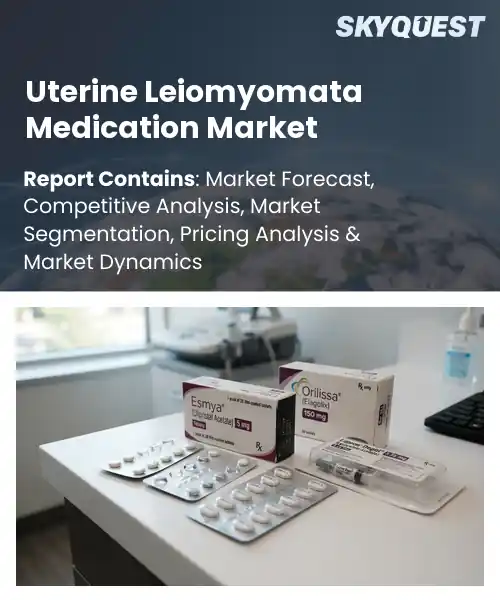
Uterine Leiomyomata Medication Market
Report ID: SQMIG35I3651
Report ID: SQMIG35I3651
[email protected]
USA +1 351-333-4748
Report ID:
SQMIG35I3651 |
Region:
Global |
Published Date: September, 2026
Pages:
157
|Tables:
117
|Figures:
77


Global Uterine Leiomyomata Medication Market size was valued at USD 1.15 Billion in 2024 and is poised to grow from USD 1.21 Billion in 2025 to USD 1.81 Billion by 2033, growing at a CAGR of 5.16% during the forecast period (2026-2033).
The uterine leiomyomata medication market includes drugs that shrink or ease fibroid symptoms, a benign tumor affecting up to 70 % of women of reproductive age. It derives from the condition’s high prevalence, surgery costs, and demand for fertility‑preserving care. The driver now is approval of oral GnRH antagonists that achieve volume reduction with fewer menopausal side effects than injectables. Since early 2000s, when the first GnRH agonist arrived, clinicians have moved from invasive myomectomy toward medical management, as shown by swift adoption of relugolix‑based combinations in North America and Europe. This shift reflects regulatory encouragement and patient preference for options.The integration of personalized therapy through biomarker research is reshaping the uterine leiomyomata medication market. When clinicians identify molecular signatures that forecast response to selective progesterone receptor modulators, they can prescribe agents such as ulipristal acetate only to patients likely to shrink tumors, improving cost‑effectiveness and lowering adverse events. This precision approach prompts insurers to reimburse targeted regimens, which fuels investment in companion‑diagnostic tools. Real‑world data from European registries indicate that biomarker‑guided treatment yields a 30 % faster symptom relief than standard care, creating a feedback loop that accelerates adoption of tailored drugs and expands market volume in the coming years.
How is AI-driven drug discovery influencing the uterine leiomyomata medication market?
AI‑driven drug discovery is reshaping the uterine leiomyomata medication market by shortening the time from target identification to clinical candidate. Machine learning models scan genomic and proteomic data to spot pathways that drive fibroid growth, allowing researchers to prioritize compounds that modulate those pathways. Companies now pair these insights with traditional medicinal chemistry, creating more focused pipelines and reducing costly trial‑and‑error. The approach also enables the design of oral agents that can selectively affect hormone receptors while sparing other tissues, addressing patient demand for convenient, less invasive treatments. As a result, investors view the segment as increasingly attractive and venture capital flows are rising to support AI‑enabled programs.In March 2023 Myovant Sciences announced FDA approval of Myfembree, an oral therapy for uterine fibroids, highlighting how AI‑assisted target validation accelerated its development and is driving market expansion.
Market snapshot - (2026-2033)
Global Market Size
USD 1.15 Billion
Largest Segment
Progesterone Receptor Modulators
Fastest Growth
GnRH Antagonists
Growth Rate
5.16% CAGR
To get more insights on this market click here to Request a Free Sample Report
Global uterine leiomyomata medication market is segmented by drug class, route, treatment plan, end user and region. Based on drug class, the market is segmented into GnRH Antagonists, GnRH Agonists, Progesterone Receptor Modulators, NSAIDs Antifibrinolytics and Others. Based on route, the market is segmented into Oral Tablets and Parenteral Injectables. Based on treatment plan, the market is segmented into Pre Surgical Therapeutics and Long Term Chronic Management. Based on end user, the market is segmented into Hospital Pharmacies, Retail Pharmacies and Online Specialty Pharmacies. Based on region, the market is segmented into North America, Europe, Asia Pacific, Latin America and Middle East & Africa.
GnRH antagonists segment dominates because it offers rapid and reversible control of estrogen production without the flare effect associated with agonists, aligning with surgeons’ need for pre‑operative shrinkage and patients’ preference for fertility preservation. Clinicians prioritize this class for its predictable pharmacodynamics, lower side‑effect profile, and compatibility with outpatient protocols, which together drive higher prescription volumes and solidify its market leadership. Moreover, recent guideline endorsements and insurance coverage expansions reinforce its preferential positioning across care pathways.
However, Progesterone Receptor Modulators segment is witnessing the strongest growth momentum as investigators explore its dual anti‑proliferative and anti‑inflammatory actions, which broaden therapeutic use beyond pre‑surgical shrinkage to long‑term disease control. Emerging evidence of symptom relief and personalized dosing is accelerating adoption, creating new market entry points for manufacturers.
Oral tablets segment dominates because it aligns with patient convenience and adherence preferences, eliminating the logistical challenges of clinic‑based injections while maintaining therapeutic efficacy. The ease of self‑administration supports chronic management strategies, reduces healthcare resource utilization, and fits within telehealth‑driven care models that are increasingly prevalent. These advantages drive clinician prescribing confidence and encourage broader insurance reimbursement, cementing oral formulations as the primary delivery choice.
Meanwhile, Parenteral injectables segment is emerging as the key high‑growth area as novel long‑acting formulations extend dosing intervals and improve surgical preparation outcomes. Advances in depot technology and patient‑controlled injection devices are mitigating historical compliance concerns, while specialist clinics are integrating these options into pre‑operative protocols. This innovation fuels demand, positioning injectables for rapid market expansion.
To get detailed segments analysis, Request a Free Sample Report
North America leads the global market due to a combination of advanced healthcare infrastructure, strong payer support, and a concentration of innovative pharmaceutical firms. The region benefits from well‑established clinical guidelines that encourage early diagnosis and evidence‑based pharmacologic management. Robust reimbursement mechanisms reduce financial barriers for patients and providers alike, while extensive physician networks ensure rapid diffusion of new therapeutic options. Highly regulated approval pathways foster confidence among clinicians and investors, encouraging sustained research and development investment. Moreover, a culture of collaborative research between academic centers and industry accelerates the introduction of novel agents. The presence of leading insurance models also facilitates broad patient access, while ongoing professional education programs keep clinicians abreast of evolving therapeutic paradigms. United States Uterine Leiomyomata Medication Market (subheading)
Uterine Leiomyomata Medication Market in the United States is propelled by a deep pipeline of innovative therapies and a highly specialized gynecologic community. Extensive insurance coverage and value‑based formularies streamline patient access, while leading academic institutions drive clinical trial activity. Patient advocacy groups raise awareness and support guideline adoption, reinforcing a treatment ecosystem that encourages rapid uptake of emerging pharmacologic options across diverse care settings throughout the national network and beyond.
Uterine Leiomyomata Medication Market in Canada benefits from a funded health system that emphasizes equitable drug access and evidence‑based prescribing. Collaborative provincial formularies streamline reimbursement decisions, while multidisciplinary care teams ensure comprehensive management of symptomatic patients. Strong academic networks contribute to ongoing research, fostering adoption of novel agents. Patient education initiatives and advocacy collaborations further reinforce clinician confidence, supporting widespread integration of pharmacologic therapies across urban and regional health authorities.
Europe’s market expansion is underpinned by a cohesive regulatory environment that facilitates cross‑border product registrations and encourages multinational clinical collaborations. Health systems across the region prioritize cost‑effective, minimally invasive treatments, prompting clinicians to adopt pharmacologic options that reduce surgical burden. Robust reimbursement frameworks, particularly in countries with centralized pricing mechanisms, improve patient affordability and accelerate market penetration. Growing patient advocacy networks raise disease awareness, influencing guideline revisions that favor medical therapy. Investment in translational research by leading academic hospitals and pharmaceutical partners drives a pipeline of innovative agents tailored to diverse patient profiles. Together, these elements create a fertile landscape where therapeutic adoption advances swiftly, positioning Europe as a dynamic hub of market growth. Germany Uterine Leiomyomata Medication Market (subheading)
Uterine Leiomyomata Medication Market in Germany is anchored by a strong pharmaceutical manufacturing base and extensive reimbursement coverage through statutory health insurance. National clinical guidelines endorse early medical intervention, fostering consistent prescribing patterns. Collaborative research institutions drive continuous evaluation of emerging therapies, while physician societies champion evidence‑based practice. Patient support programs and educational outreach further solidify acceptance, ensuring that innovative pharmacologic solutions achieve broad clinical integration throughout the country nationwide.
Uterine Leiomyomata Medication Market in the United Kingdom is propelled by a health system that emphasizes early diagnosis and treatment pathways. The National Health Service provides reimbursement pathways that support inclusion of novel agents in formularies. Active involvement of professional societies in guideline development promotes rapid clinician uptake. Patient advocacy groups contribute to heightened awareness, while ongoing clinical research collaborations ensure continual introduction of therapeutic options across secondary care settings.
Uterine Leiomyomata Medication Market in France is emerging as reimbursement schemes broaden to cover outpatient pharmacologic therapies. National health insurance encourages cost‑effective management, prompting clinicians to consider medication as first‑line option for symptomatic patients. Collaborative networks between academic hospitals and industry accelerate clinical evaluation of new agents. Patient education campaigns raise disease visibility, while professional societies integrate evidence into guideline updates, fostering gradual adoption of medical treatments across diverse care environments.
Asia Pacific is rapidly strengthening its market position through concerted efforts to modernize healthcare delivery and expand access to advanced therapeutics. Governments in key economies are revising reimbursement policies to include targeted pharmacologic options, reducing reliance on invasive surgery. Growing physician expertise in minimally invasive management, coupled with increasing patient awareness, drives higher adoption of medical therapy. Strategic partnerships between multinational pharmaceutical firms and local research institutes accelerate clinical development tailored to regional patient demographics. Investment in health technology assessment frameworks supports evidence‑based decision making, while digital health platforms facilitate remote monitoring and adherence support. These initiatives collectively enhance the region’s capability to deliver innovative uterine leiomyomata treatments at scale. Japan Uterine Leiomyomata Medication Market (subheading)
Uterine Leiomyomata Medication Market in Japan advances through a healthcare system that integrates universal coverage with drug reimbursement. Clinical practice guidelines prioritize organ‑preserving strategies, encouraging pharmacologic intervention. Strong research infrastructure and collaboration between university hospitals and industry foster rapid evaluation of novel agents. Patient advocacy organizations promote disease education, while digital health tools support adherence and outcome monitoring, ensuring that emerging therapies achieve widespread integration across tertiary and community care settings.
Uterine Leiomyomata Medication Market in South Korea benefits from a health insurance scheme that increasingly reimburses drug therapies. Clinical guidelines endorsed by obstetric societies highlight the value of medical management in reducing surgical burden. Emphasis on translational research within university hospitals accelerates clinical trials of emerging agents. Patient education initiatives and physician networks promote detection and treatment, while platforms enhance follow‑up care, supporting broader adoption of pharmacologic options throughout the healthcare system.
To know more about the market opportunities by region and country, click here to
Buy The Complete Report
Rising Awareness Of Fibroid Symptoms
Expansion Of Targeted Drug Delivery
High Cost Of Novel Medications
Regulatory Hurdles and Approval Delays
Request Free Customization of this report to help us to meet your business objectives.
Top Player’s Company Profile
Recent Developments
SkyQuest’s ABIRAW (Advanced Business Intelligence, Research & Analysis Wing) is our Business Information Services team that Collects, Collates, Correlates, and Analyses the Data collected by means of Primary Exploratory Research backed by robust Secondary Desk research. As per SkyQuest analysis, the market is being propelled primarily by rising awareness of fibroid symptoms which is driving earlier diagnosis and greater uptake of medical therapies, while the high cost of novel medications acts as a significant restraint limiting broader patient access. North America remains the dominant region, supported by advanced healthcare infrastructure and strong payer support. The GnRH antagonist segment leads the market thanks to its rapid, reversible estrogen control and favorable safety profile. A second important driver is the expansion of targeted drug‑delivery systems that improve uterine concentration and reduce systemic side effects, further encouraging clinician adoption and patient adherence.
| Report Metric | Details |
|---|---|
| Market size value in 2024 | USD 1.15 Billion |
| Market size value in 2033 | USD 1.81 Billion |
| Growth Rate | 5.16% |
| Base year | 2024 |
| Forecast period | (2026-2033) |
| Forecast Unit (Value) | USD Billion |
| Segments covered |
|
| Regions covered | North America (US, Canada), Europe (Germany, France, United Kingdom, Italy, Spain, Rest of Europe), Asia Pacific (China, India, Japan, Rest of Asia-Pacific), Latin America (Brazil, Rest of Latin America), Middle East & Africa (South Africa, GCC Countries, Rest of MEA) |
| Companies covered |
|
| Customization scope | Free report customization with purchase. Customization includes:-
|
To get a free trial access to our platform which is a one stop solution for all your data requirements for quicker decision making. This platform allows you to compare markets, competitors who are prominent in the market, and mega trends that are influencing the dynamics in the market. Also, get access to detailed SkyQuest exclusive matrix.
Table Of Content
Executive Summary
Market overview
Parent Market Analysis
Market overview
Market size
KEY MARKET INSIGHTS
COVID IMPACT
MARKET DYNAMICS & OUTLOOK
Market Size by Region
KEY COMPANY PROFILES
Methodology
For the Uterine Leiomyomata Medication Market, our research methodology involved a mixture of primary and secondary data sources. Key steps involved in the research process are listed below:
1. Information Procurement: This stage involved the procurement of Market data or related information via primary and secondary sources. The various secondary sources used included various company websites, annual reports, trade databases, and paid databases such as Hoover's, Bloomberg Business, Factiva, and Avention. Our team did 45 primary interactions Globally which included several stakeholders such as manufacturers, customers, key opinion leaders, etc. Overall, information procurement was one of the most extensive stages in our research process.
2. Information Analysis: This step involved triangulation of data through bottom-up and top-down approaches to estimate and validate the total size and future estimate of the Uterine Leiomyomata Medication Market.
3. Report Formulation: The final step entailed the placement of data points in appropriate Market spaces in an attempt to deduce viable conclusions.
4. Validation & Publishing: Validation is the most important step in the process. Validation & re-validation via an intricately designed process helped us finalize data points to be used for final calculations. The final Market estimates and forecasts were then aligned and sent to our panel of industry experts for validation of data. Once the validation was done the report was sent to our Quality Assurance team to ensure adherence to style guides, consistency & design.
Analyst Support
Customization Options
With the given market data, our dedicated team of analysts can offer you the following customization options are available for the Uterine Leiomyomata Medication Market:
Product Analysis: Product matrix, which offers a detailed comparison of the product portfolio of companies.
Regional Analysis: Further analysis of the Uterine Leiomyomata Medication Market for additional countries.
Competitive Analysis: Detailed analysis and profiling of additional Market players & comparative analysis of competitive products.
Go to Market Strategy: Find the high-growth channels to invest your marketing efforts and increase your customer base.
Innovation Mapping: Identify racial solutions and innovation, connected to deep ecosystems of innovators, start-ups, academics, and strategic partners.
Category Intelligence: Customized intelligence that is relevant to their supply Markets will enable them to make smarter sourcing decisions and improve their category management.
Public Company Transcript Analysis: To improve the investment performance by generating new alpha and making better-informed decisions.
Social Media Listening: To analyze the conversations and trends happening not just around your brand, but around your industry as a whole, and use those insights to make better Marketing decisions.
REQUEST FOR SAMPLE
 REQUEST FREE CUSTOMIZATION


Want to customize this report? This report can be personalized according to your needs. Our analysts and industry experts will work directly with you to understand your requirements and provide you with customized data in a short amount of time. We offer $1000 worth of FREE customization at the time of purchase.
Feedback From Our Clients


 USA (+1) 351-333-4748

