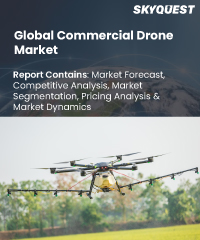
Commercial Drone Market
Report ID: SQMIG20A2044
Report ID: SQMIG20A2044
[email protected]
USA +1 351-333-4748
Report ID:
SQMIG20A2044 |
Region:
Global |
Published Date: July, 2025
Pages:
191
|Tables:
147
|Figures:
69


Global Commercial Drone Market size was valued at USD 6.1 Billion in 2024 and is poised to grow from USD 6.8 Billion in 2025 to USD 16.13 Billion by 2033, growing at a CAGR of 11.4% during the forecast period (2026–2033).
The global commercial drone market growth is attributed to the increasing enterprise use of drones across various industry verticals. Many drone manufacturers are always experimenting, creating, and refining solutions for various markets and applications, including filming and emergency response. Additionally, the use of modern technologies to offer better solutions is creating new growth opportunities for the commercial drone industry.
Their products are also in high demand for search and rescue operations, locating unstable roofs in dangerous and inaccessible areas, locating elevated infrastructure that might have damaged electrical cables, and other traditional uses like security, surveillance, and monitoring.
In the current digital era, businesses are looking into drone delivery for last-mile logistics, which has led several technology providers to focus on introducing new products into the market. For instance, in June 2024, Skydio, a drone manufacturer, unveiled new software designed specifically for construction workflows. This software's efficient 3D site mapping and progress tracking capabilities enable better project management and safety protocols. Autonomous data capture and automated 3D model generation save time and resources compared to manual surveying or data collection methods.
How is AI-Powered Navigation Transforming Commercial Drone Operations?
The incorporation of AI-powered autonomous navigation systems is one notable technological development in the commercial drone sector. These technologies increase the use of drones in surveillance, agriculture, and delivery by allowing them to fly beyond the visual line of sight (BVLOS) while dodging obstructions. Zipline's Platform 2 drones were introduced in the United States in January 2025. These drones are equipped with a "droid" for precise in-air product delivery to doorsteps and precise autonomous navigation. This technology significantly decreased delivery errors and increased the company's market share in the retail and healthcare industries. AI-driven autonomy is predicted to transform commercial drone operations as legal frameworks change, making them safer, more scalable, and more effective in challenging situations.
Market snapshot - 2026-2033
Global Market Size
USD 5.48 Billion
Largest Segment
Rotary Blade
Fastest Growth
Hybrid
Growth Rate
11.4% CAGR
To get more insights on this market click here to Request a Free Sample Report
The global commercial drone market is segmented into product, propulsion type, range, operating mode, end use, and region. By product, the market is classified into fixed wing, hybrid, and rotary blade. Depending on propulsion type, it is divided into gasoline, electric, and hybrid. According to the range, the market is categorized into visual line of sight (VLOS), extended visual line of sight (EVLOS), and beyond visual line of sight (BVLOS). As per operating mode, it is segregated into remotely piloted, partially piloted, and fully autonomous. On the basis of categorization by end use, the market is fragmented into agriculture, delivery & logistics, energy, media & entertainment, real estate & construction, and security & law enforcement. Regionally, it is analyzed across North America, Europe, Asia-Pacific, Latin America, and the Middle East & Africa.
What Makes Rotary Blade Drones the Top Choice for Commercial Applications?
As per the 2024 commercial drone market analysis, the rotary blade segment dominated the market with a revenue share of over 78.9%. The demand for rotary blade drones for inspection tasks is anticipated to rise due to their capacity to hover and execute agile maneuvering while maintaining a visual on a particular target for extended periods of time. For a variety of commercial applications, such as surveillance, filmmaking, photography, and monitoring, these drones are usually thought to be a good alternative. They are also easier to control than their hybrid and fixed-wing counterparts.
The hybrid category is expected to grow at a compound annual growth rate (CAGR) of over 18% over the course of the forecast period because of these commercial drones' advantages. These drones boost their power and efficiency by combining the capabilities of batteries and fuel. Additionally, these drones can fly for longer periods of time and carry heavier payloads, even in severe weather conditions. In addition to efficiently and quickly delivering packages for tech giants like Facebook and Amazon, hybrid drones enable internet access in remote locations.
How do Regulations Influence the Preference for VLOS Drone Flights?
As per the 2024 commercial drone market forecast, with a revenue share of over 69%, the visual line of sight (VLOS) segment held the largest share. The differences in the laws and regulations controlling the use of commercial drones are a significant factor for the market. Similarly, drones are well-liked due to their ease of flying within the visual line of sight and their ability to avoid obstructions. As a result, this market segment dominated the commercial drone market.
The beyond visual line of sight (BVLOS) segment is expected to grow at the fastest CAGR of over 11.2% during the forecast period. The use of commercial drones for complex and long-distance commercial tasks is expected to drive market expansion. Additionally, because these drones are autonomous, operators use them more often. These significant factors are responsible for the positive segment growth.
To get detailed segments analysis, Request a Free Sample Report
How is Regulatory Support Accelerating Drone Deployment in APAC?
As per the commercial drone market regional analysis, the Asia Pacific market had the largest share in 2024, accounting for 30.8% of the market. Regional dominance is attributed to the favorable regulatory environment, especially among industrialized nations. Several governments are continuously creating new regulations for commercial drone applications.
South Korea Commercial Drone Market
South Korea's commercial drone industry has expanded rapidly because of government investments in drone corridors and smart city technology. In March 2024, the Ministry of Land, Infrastructure, and Transport expanded the use of drones for delivery in places like Sejong City. Due to its favorable regulatory framework and emphasis on BVLOS testing, South Korea has attracted drone logistics and surveillance startups, strengthening its competitive advantage in the Asia-Pacific market.
Japan Commercial Drone Market
The commercial drone market in Japan is being driven by the country's aging population as well as the need for automation in sectors like agriculture and infrastructure. In July 2024, Japan's Civil Aviation Bureau relaxed rules governing drone operations overpopulated areas for purposes like inspection and delivery. With government-backed drone highways and AI integration projects, Japan is further establishing itself as a leader in commercial UAV innovation.
What Role Does Regulation Play in Boosting North America’s Drone Usage?
The North American commercial drone market is expected to grow at a noteworthy compound annual growth rate (CAGR) of 6.7% over the forecast period due to favorable government initiatives, company demand from a wide range of industries, and ongoing advancements in drone technology. To create more rational and consistent guidelines for the safe and legal use of UAVs in commercial areas, the Federal Aviation Administration (FAA) in the United States, for instance, has published new regulations. It is anticipated that these laws and regulations will promote further market expansion by lowering entry barriers and increasing product usage.
U.S. Commercial Drone Market
The U.S. commercial drone market is anticipated to grow at a compound annual growth rate (CAGR) of over 8% between 2025 and 2032. The country is expected to grow steadily due to developments in UAV technology, supportive government regulations, and growing demand from companies across a range of industries. To encourage more rational and consistent guidelines for the safe and legal use of UAVs in commercial areas, the Federal Aviation Administration (FAA) also published new regulations. It is anticipated that these rules and regulations will lower barriers to entry and encourage product use.
Canada Commercial Drone Market
Transportation in Canada Regular BVLOS operations in rural areas are permitted by Canada's well-organized regulatory framework, which also supports the country's commercial drone industry. In February 2025, Canada launched a pilot program in British Columbia to use drones for responding to wildfires. Due to strong tech partnerships and demand from the mining, forestry, and public safety industries, Canada remains a major player in the North American drone ecosystem.
Why are European Countries Fast-Tracking Urban and Industrial UAV Use?
The European Aviation Safety Agency (EASA) is coordinating its policymaking efforts to accelerate the adoption of commercial drones in Europe. In 2024, the EU expanded its U-Space drone air traffic management zones across multiple countries to support complex operations such as autonomous flights and BVLOS. From precision agriculture in France to infrastructure inspection in Germany and urban delivery trials in the UK, Europe's integrated approach fosters robust market growth across the region.
UK Commercial Drone Market
The UK is setting the standard for urban drone trials. In June 2024, the UK government extended Project Skyway, a drone superhighway project that connects Reading, Cambridge, Oxford, and other cities. The UK is at the forefront of drone technology development in Europe due to the progressive regulations of the Civil Aviation Authority, which have accelerated use cases in emergency response, infrastructure inspection, and medical delivery.
France Commercial Drone Market
The France commercial drone market is booming, with notable uses in agriculture, defense, and energy. In April 2024, EDF Group partnered with drone companies to inspect nuclear sites using AI-powered UAVs. The French Civil Aviation Authority is encouraging innovation and increasing operational efficiency by facilitating the use of UAVs in urban and industrial environments.
Germany Commercial Drone Market
Germany is a major player in the European commercial drone market, with an emphasis on engineering and automation. In October 2024, Deutsche Bahn was given permission by the German airspace authority to use more drones to monitor rail infrastructure. The country's friendly regulatory stance and partnerships with EU drone projects like U-Space have sped up adoption in logistics, surveying, and environmental monitoring.
To know more about the market opportunities by region and country, click here to
Buy The Complete Report
Commercial Drone Market Drivers
Growing Need for Aerial Data in Energy, Construction, and Agriculture
Integrating BVLOS Capabilities with Regulatory Assistance
Commercial Drone Market Restraints
Safety Issues and Airspace Management
High Skill Requirements and Initial Investment
Request Free Customization of this report to help us to meet your business objectives.
With companies like Parrot, Skydio, and senseFly focusing on automation and artificial intelligence and DJI setting the standard for hardware, the commercial drone market is incredibly dynamic. Businesses are setting themselves apart with industry-specific solutions, long-range autonomous capabilities, and distinctive software platforms. Acquisitions, such as AgEagle's acquisition of senseFly, and alliances with logistics and security companies are examples of strategic actions. In order to create lucrative, scalable service ecosystems, multinational firms are also utilizing edge AI and DaaS models.
SkyQuest’s ABIRAW (Advanced Business Intelligence, Research & Analysis Wing) is our Business Information Services team that Collects, Collates, Correlates, and Analyses the Data collected by means of Primary Exploratory Research backed by robust Secondary Desk research.
As per SkyQuest analysis, artificial intelligence, autonomy, and regulations are driving explosive growth in the commercial drone market. Drones are enabling sectors from energy, agriculture, logistics, and surveillance to operate with less cost and less time. Drone-as-a-service and real-time edge analytics are transforming how businesses source and use aerial intelligence. While there remain issues with airspace safety, regulatory harmonization, and prohibitive entrance costs, established players are branching out by integrating software and creating partnerships, while startups are innovating in niche markets like drone delivery and AI inspection. As infrastructure maturation and business use grows, the global commercial drone market penetration grows faster, which will have implications for future development in intelligent automation and aerial mobility.
| Report Metric | Details |
|---|---|
| Market size value in 2024 | USD 6.1 Billion |
| Market size value in 2033 | USD 16.13 Billion |
| Growth Rate | 11.4% |
| Base year | 2024 |
| Forecast period | 2026-2033 |
| Forecast Unit (Value) | USD Billion |
| Segments covered |
|
| Regions covered | North America (US, Canada), Europe (Germany, France, United Kingdom, Italy, Spain, Rest of Europe), Asia Pacific (China, India, Japan, Rest of Asia-Pacific), Latin America (Brazil, Rest of Latin America), Middle East & Africa (South Africa, GCC Countries, Rest of MEA) |
| Companies covered |
|
| Customization scope | Free report customization with purchase. Customization includes:-
|
To get a free trial access to our platform which is a one stop solution for all your data requirements for quicker decision making. This platform allows you to compare markets, competitors who are prominent in the market, and mega trends that are influencing the dynamics in the market. Also, get access to detailed SkyQuest exclusive matrix.
Table Of Content
Executive Summary
Market overview
Parent Market Analysis
Market overview
Market size
KEY MARKET INSIGHTS
COVID IMPACT
MARKET DYNAMICS & OUTLOOK
Market Size by Region
KEY COMPANY PROFILES
Methodology
For the Commercial Drone Market, our research methodology involved a mixture of primary and secondary data sources. Key steps involved in the research process are listed below:
1. Information Procurement: This stage involved the procurement of Market data or related information via primary and secondary sources. The various secondary sources used included various company websites, annual reports, trade databases, and paid databases such as Hoover's, Bloomberg Business, Factiva, and Avention. Our team did 45 primary interactions Globally which included several stakeholders such as manufacturers, customers, key opinion leaders, etc. Overall, information procurement was one of the most extensive stages in our research process.
2. Information Analysis: This step involved triangulation of data through bottom-up and top-down approaches to estimate and validate the total size and future estimate of the Commercial Drone Market.
3. Report Formulation: The final step entailed the placement of data points in appropriate Market spaces in an attempt to deduce viable conclusions.
4. Validation & Publishing: Validation is the most important step in the process. Validation & re-validation via an intricately designed process helped us finalize data points to be used for final calculations. The final Market estimates and forecasts were then aligned and sent to our panel of industry experts for validation of data. Once the validation was done the report was sent to our Quality Assurance team to ensure adherence to style guides, consistency & design.
Analyst Support
Customization Options
With the given market data, our dedicated team of analysts can offer you the following customization options are available for the Commercial Drone Market:
Product Analysis: Product matrix, which offers a detailed comparison of the product portfolio of companies.
Regional Analysis: Further analysis of the Commercial Drone Market for additional countries.
Competitive Analysis: Detailed analysis and profiling of additional Market players & comparative analysis of competitive products.
Go to Market Strategy: Find the high-growth channels to invest your marketing efforts and increase your customer base.
Innovation Mapping: Identify racial solutions and innovation, connected to deep ecosystems of innovators, start-ups, academics, and strategic partners.
Category Intelligence: Customized intelligence that is relevant to their supply Markets will enable them to make smarter sourcing decisions and improve their category management.
Public Company Transcript Analysis: To improve the investment performance by generating new alpha and making better-informed decisions.
Social Media Listening: To analyze the conversations and trends happening not just around your brand, but around your industry as a whole, and use those insights to make better Marketing decisions.
REQUEST FOR SAMPLE
 REQUEST FREE CUSTOMIZATION
Commercial Drone Market size was valued at USD 6.51 billion in 2021 and is poised to grow from USD 8.37 billion in 2022 to USD 62.54 billion by 2030, growing at a CAGR of 28.58% in the forecast period (2023-2030).
Key vendors in Commercial Drone Market are: 'DJI', 'Parrot SA', 'Yuneec International Co. Ltd', 'AeroVironment, Inc.', '3D Robotics, Inc.', 'PrecisionHawk, Inc.', 'Autel Robotics', 'senseFly SA', 'GoPro, Inc.', 'Ehang Inc.', 'Kespry Inc.', 'Insitu Inc.', 'Aeryon Labs Inc.', 'Aibotix GmbH', 'Aeronavics Ltd.', 'Cyberhawk Innovations Ltd.', 'Flyability', 'Gryphon Dynamics', 'Altavian, Inc.', 'Freefly Systems Inc.',
Global Commercial Drone Market size was valued at USD 6.1 Billion in 2024 and is poised to grow from USD 6.8 Billion in 2025 to USD 16.13 Billion by 2033, growing at a CAGR of 11.4% during the forecast period (2026–2033).
With companies like Parrot, Skydio, and senseFly focusing on automation and artificial intelligence and DJI setting the standard for hardware, the commercial drone market is incredibly dynamic. Businesses are setting themselves apart with industry-specific solutions, long-range autonomous capabilities, and distinctive software platforms. Acquisitions, such as AgEagle's acquisition of senseFly, and alliances with logistics and security companies are examples of strategic actions. In order to create lucrative, scalable service ecosystems, multinational firms are also utilizing edge AI and DaaS models. 'DJI (SZ DJI Technology Co., Ltd.)', 'Parrot SA', 'Skydio Inc.', 'AeroVironment, Inc.', 'senseFly (AgEagle Aerial Systems)', 'Insitu (a Boeing Company)', '3D Robotics', 'Yuneec International', 'Teledyne FLIR', 'Delair', 'PrecisionHawk'
In sectors like mining, construction, agriculture, and energy, drones are being used more for asset surveillance, crop monitoring, aerial mapping, and site inspection. These applications increase safety, lower labor costs, and improve operational effectiveness. Drones are a vital tool for contemporary industrial operations and precision-based management because of their capacity to deliver real-time, high-resolution data over wide areas, which speeds up decision-making and predictive analytics.
Models for Drone-as-a-Service (DaaS) Businesses: As Drone-as-a-Service follows developments in technology, businesses can now acquire drone capabilities without needing to make an investment in equipment or hire pilots. DaaS providers offer these capabilities along with the necessary data acquisition, processing, and analysis either on a project or ongoing subscription basis. As this model helps to reduce capital investment and technical burden, it provides a unique benefit for the media, agricultural, and infrastructure sectors. It also supports an increasing trend toward outsourced aerial operations and predictable revenue for drone services.
How is Regulatory Support Accelerating Drone Deployment in APAC?


Want to customize this report? This report can be personalized according to your needs. Our analysts and industry experts will work directly with you to understand your requirements and provide you with customized data in a short amount of time. We offer $1000 worth of FREE customization at the time of purchase.
Feedback From Our Clients


 USA (+1) 351-333-4748

