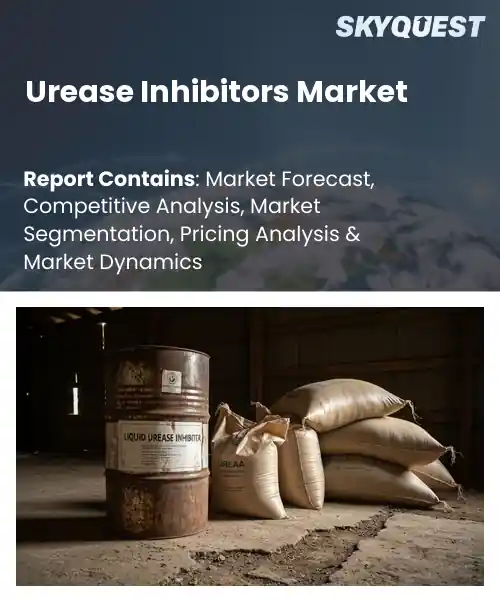
Urease Inhibitors Market
Report ID: SQMIG15E4310
Report ID: SQMIG15E4310
[email protected]
USA +1 351-333-4748
Report ID:
SQMIG15E4310 |
Region:
Global |
Published Date: August, 2026
Pages:
157
|Tables:
144
|Figures:
78


Global Urease Inhibitors Market size was valued at USD 1.30 Billion in 2024 and is poised to grow from USD 1.40 Billion in 2025 to USD 2.48 Billion by 2033, growing at a CAGR of 7.4% during the forecast period (2026-2033).
The global urease inhibitors market trends supplies chemicals that suppress urease activity to slow urea hydrolysis, a step in agricultural fertilization, animal feed and industrial processes. Its importance lies in improving nitrogen use efficiency, cutting ammonia volatilization and lowering greenhouse‑gas emissions, thereby advancing sustainability. The primary driver is escalating demand for high‑yield crops growing population pressure, which pushes farmers toward slow‑release nitrogen technologies. Originating in the 1990s with phosphoric‑acid inhibitors, the market matured in the 2000s as NBPT gained prominence and now embraces biotechnological inhibitors with toxicity.
Regulatory limits on ammonia losses and preference for greener practices have guided this progression. Regulatory tightening that penalizes nitrogen loss and nitrate leaching is a pivotal factor driving the urease inhibitors market growth, because stricter limits on ammonia emissions force farmers to seek effective formulations. As a result, adopters increasingly use NBPT‑enhanced urea blends, which field studies show can raise corn and wheat yields by 5‑10 percent. This pressure also creates space for organic inhibitors sourced from plant extracts, allowing producers to charge premium prices in sustainability‑focused regions. Consequently, manufacturers are expanding R&D and partnering with agronomy firms to develop specific solutions that address soil pH and climate‑induced volatilization, turning policy demands into market growth.
How is AI-Driven Formulation Accelerating the Urease Inhibitors Market?
AI-driven formulation is accelerating innovation in the urease inhibitors market share by enabling manufacturers to identify more effective inhibitor combinations and optimize formulations for different soil and environmental conditions. Machine-learning models can analyze datasets covering urease activity, soil pH, temperature, moisture, nitrogen application rates, and inhibitor performance to predict how specific formulations may behave under different agricultural conditions. This helps researchers reduce formulation iterations and identify promising compounds more efficiently while improving nitrogen-use performance.
AI can also support the development of formulations that balance inhibition efficiency, persistence, crop compatibility, and environmental characteristics, creating opportunities for more targeted and sustainable fertilizer solutions. As agricultural-input manufacturers increasingly integrate AI into formulation research and field-performance modeling, the technology is expected to shorten development cycles, improve product consistency, and support the commercialization of next-generation urease inhibitors designed for diverse cropping systems and climate conditions.
Market snapshot - (2026-2033)
Global Market Size
USD 1.3 Billion
Largest Segment
NBPT
Fastest Growth
NPPT
Growth Rate
7.4% CAGR
To get more insights on this market click here to Request a Free Sample Report
Global urease inhibitors market is segmented by product type, form, application, crop type, end user and region. Based on product type, the market is segmented into NBPT, NPPT and others. Based on form, the market is segmented into liquid, granular and powder. Based on application, the market is segmented into urea fertilizers, compound fertilizers and others. Based on crop type, the market is segmented into cereals, oilseeds, fruits & vegetables and others. Based on end user, the market is segmented into agriculture and turf management. Based on region, the market is segmented into North America, Europe, Asia Pacific, Latin America and Middle East & Africa.
NBPT segment dominates because it has established efficacy in slowing urea hydrolysis and reducing ammonia volatilization, helping retain more nitrogen following fertilizer application. Its extensive field validation, commercial availability and compatibility with urea-based fertilizer formulations have encouraged widespread adoption among fertilizer manufacturers and agricultural users. In addition, its long-standing use provides greater familiarity and confidence among growers, while established production and distribution networks support consistent market availability. These factors strengthen demand for NBPT-based formulations and reinforce its leading position in the urease inhibitors market.
However, NPPT is expected to witness strong growth momentum as manufacturers increasingly explore alternative urease-inhibitor chemistries and blended formulations for improving nitrogen retention under different soil and environmental conditions. Growing emphasis on nitrogen-use efficiency and reducing fertilizer-related nitrogen losses is encouraging product development beyond conventional NBPT formulations. Advances in formulation and coating technologies can further improve handling, stability and application characteristics, creating opportunities for NPPT in specialized and premium fertilizer products.
Liquid segment dominates because it can be readily incorporated into liquid fertilizer formulations and provides convenient mixing and dosing when properly formulated. Its compatibility with fertilizer-treatment and application systems enables growers and fertilizer suppliers to apply urease inhibitors efficiently alongside urea and other nitrogen fertilizers. Liquid formulations can also simplify handling and support consistent application across large agricultural operations, particularly where liquid fertilizer infrastructure is already established. These operational advantages, combined with increasing demand for efficient nitrogen-management solutions, support the leading position of liquid urease inhibitors in the market.
On the other hand, powder segment is expected to witness strong growth as dry formulations offer advantages in storage, packaging and transportation and can be incorporated into selected fertilizer-treatment processes. Powder formulations can provide greater flexibility for manufacturers developing concentrated or specialty products, while advances in formulation technology can improve stability, dispersibility and compatibility with fertilizer products. Increasing demand for convenient fertilizer additives and differentiated nitrogen-management solutions is therefore creating additional opportunities for powder-based urease inhibitors.
To get detailed segments analysis, Request a Free Sample Report
The Asia Pacific dominates the global urease inhibitors market due to a convergence of strategic advantages. The region’s extensive and diverse agricultural base creates an ongoing need for nitrogen-management solutions. In Japan and South Korea, robust research ecosystems facilitate rapid innovation, and government emphasis on sustainable farming practices hastens adoption. Established chemical producers have the sophisticated production capabilities to meet the demanding quality requirements at a competitive cost. Growing awareness about environmental impact and the need to improve crop production further strengthens the market momentum. The collaboration networks between academia, industry and agribusiness constitute a fertile ground for product development and customized applications, reinforcing the leadership position of the region. Moreover, the region’s role in global supply chains is amplified by the growing export‑oriented agritech services. The combination of policy support, technological know-how and market scale continues to attract investment and drive growth, keeping it ahead of the curve.
Urease inhibitors market outlook in Japan benefits from a highly regulated agricultural sector that prioritizes environmental stewardship. Domestic chemical firms integrate cutting‑edge biotechnology with traditional expertise, delivering products tailored to intensive rice cultivation. Strong collaboration between universities and industry accelerates research pipelines, while government incentives encourage adoption of low‑emission solutions. Consumer awareness of sustainable food production further fuels demand, positioning Japan as a hub for advanced urease inhibitor technologies global innovation.
Urease inhibitors market forecast in South Korea is driven by a strong emphasis on high‑efficiency farming and a proactive regulatory framework. Leading petrochemical conglomerates invest heavily in research collaborations with agricultural institutes, fostering rapid product refinement. The nation’s focus on reducing nitrogen loss aligns with national sustainability goals, encouraging widespread field trials. Growing export ambitions for Korean‑developed solutions further stimulate domestic development, reinforcing the country’s reputation for innovative urease inhibitor applications.
The desire of farmers to be environmentally responsible and yet achieve high levels of productivity is driving a fast-growing market for urease inhibitors in North America. Given the extensive cultivation of corn and soybeans, there is an urgent need for nitrogen-management tools to improve efficiency and reduce volatilization. Robust research organizations and major agrochemical companies partner to develop next-generation inhibitors for different soil conditions. Regulations provide incentives for the uptake of low-emission technologies, while consumer demand for sustainably produced food drives investment by farmers. Integrated supply chains and complex distribution networks ensure the timely availability of product throughout the United States and Canada. Pioneering work on precision farming and data-driven agronomy in North America further enhances the value proposition of urease inhibitors, making it a vibrant growth engine for the global sector.
Urease inhibitors market regional outlook in the United States is propelled by row‑crop production and a strong emphasis on agronomic research. Major chemical manufacturers partner with universities to refine inhibitor formulations that address varied climatic zones. Federal and state policies incentivize practices that lower nitrogen loss, encouraging farmer adoption. Growing consumer preference for friendly produce further supports market uptake, establishing the United States as a leading arena for innovative urease inhibitor solutions.
Urease inhibitors market regional forecast in Canada reflects a commitment to sustainable grain and oilseed production across varied climates. Collaborative research between federal agencies and private firms develops inhibitors that perform under cooler temperatures and variable moisture. Environmental regulations promote reduced nitrogen emissions, prompting growers to integrate urease inhibitors into nutrient plans. Growing awareness of soil health benefits further supports market growth, positioning Canada as a proactive participant in urease inhibitor advancement.
Europe is using strict environmental norms and collaborative research initiatives to strengthen its position in the urease inhibitors market. The EU’s focus on reducing ammonia emissions and improving nitrogen use efficiency has led to the widespread use of new inhibitor technologies in agriculture. Chemical manufacturers partner with research institutions to create sustainable, low-toxicity formulations that satisfy stringent regulatory requirements. Investment in precision farming and digital agronomy platforms allows for targeted application, improving efficacy and reducing waste. Knowledge sharing and faster product deployment are enabled by cross-border partnerships and market momentum is underpinned by consumer appetite for responsibly produced food. This comprehensive strategy makes Europe a reference for eco-friendly urease inhibitor solutions and drives further growth in Europe across the continent today.
Urease inhibitors market analysis in Germany benefits from a strong chemical industry base and agricultural research networks. Companies integrate green chemistry principles to produce inhibitors with reduced environmental impact. Collaborative projects with universities focus on tailoring solutions for varied soil types prevalent across the country. Government incentives for sustainable farming encourage adoption, while precision agriculture technologies enhance application efficiency. Germany thus serves as a pivotal hub for innovative urease inhibitor development.
Urease inhibitors market penetration in the United Kingdom is shaped by a regulatory environment and a focus on sustainable crop production. Leading agrochemical firms partner with research councils to develop inhibitors that align with stringent emission targets. Adoption is driven by farmer awareness of nitrogen stewardship and benefits of reduced fertilizer loss. Integration with farming platforms further optimizes usage, positioning the United Kingdom as a market for advanced urease inhibitor technologies.
Urease inhibitors industry in France is driven by governmental support for agriculture and a robust research ecosystem. Partnerships between research institutes and agrochemical companies focus on creating inhibitors that meet environmental criteria while enhancing crop yields. French farmers adopt these solutions to comply with national nitrogen reduction policies and improve soil health. Integration of precision agriculture tools refines application, reinforcing the role of France as a leader in advanced urease inhibitor deployment.
To know more about the market opportunities by region and country, click here to
Buy The Complete Report
Rising Demand for Sustainable Agriculture
Regulatory Support for Low Nitrogen
Stringent Environmental Compliance Requirements
High Production Costs of Enzyme
Request Free Customization of this report to help us to meet your business objectives.
The global urease inhibitors market is highly competitive, with established fertilizer and agricultural-input companies focusing on improving nitrogen-use efficiency, reducing ammonia volatilization, and developing formulations that integrate easily with conventional urea-based fertilizers. Leading players are strengthening their positions through product launches, technology licensing, distribution agreements, and investments in enhanced-efficiency fertilizers. Competition is increasingly centered on inhibitor efficacy, formulation stability, compatibility with different fertilizer grades, crop-specific performance, and regulatory acceptance. Companies are also expanding precision-agriculture capabilities to help growers optimize nitrogen application and reduce nutrient losses, while growing demand for sustainable farming practices is encouraging the development of products that improve fertilizer efficiency without requiring major changes to existing farm operations.
Top Player’s Company Profile
Recent Developments in the Urease Inhibitors Market
SkyQuest’s ABIRAW (Advanced Business Intelligence, Research & Analysis Wing) is our Business Information Services team that Collects, Collates, Correlates, and Analyses the Data collected by means of Primary Exploratory Research backed by robust Secondary Desk research. As per SkyQuest analysis, the market is propelled primarily by rising demand for sustainable agriculture, as farmers seek to cut nitrogen loss and improve yields, while a supportive regulatory environment encouraging low‑nitrogen practices serves as a second driver that accelerates adoption. The main restraint comes from the high production costs of enzyme‑based inhibitors, which can limit price‑sensitive uptake. Asia Pacific dominates the global landscape thanks to its vast farming base, strong research ecosystem and policy support. Within the market, the NBPT product type leads, offering reliable inhibition and wide acceptance across fertilizer blends.
| Report Metric | Details |
|---|---|
| Market size value in 2024 | USD 1.3 Billion |
| Market size value in 2033 | USD 2.48 Billion |
| Growth Rate | 7.4% |
| Base year | 2024 |
| Forecast period | (2026-2033) |
| Forecast Unit (Value) | USD Billion |
| Segments covered |
|
| Regions covered | North America (US, Canada), Europe (Germany, France, United Kingdom, Italy, Spain, Rest of Europe), Asia Pacific (China, India, Japan, Rest of Asia-Pacific), Latin America (Brazil, Rest of Latin America), Middle East & Africa (South Africa, GCC Countries, Rest of MEA) |
| Companies covered |
|
| Customization scope | Free report customization with purchase. Customization includes:-
|
To get a free trial access to our platform which is a one stop solution for all your data requirements for quicker decision making. This platform allows you to compare markets, competitors who are prominent in the market, and mega trends that are influencing the dynamics in the market. Also, get access to detailed SkyQuest exclusive matrix.
Table Of Content
Executive Summary
Market overview
Parent Market Analysis
Market overview
Market size
KEY MARKET INSIGHTS
COVID IMPACT
MARKET DYNAMICS & OUTLOOK
Market Size by Region
KEY COMPANY PROFILES
Methodology
For the Urease Inhibitors Market, our research methodology involved a mixture of primary and secondary data sources. Key steps involved in the research process are listed below:
1. Information Procurement: This stage involved the procurement of Market data or related information via primary and secondary sources. The various secondary sources used included various company websites, annual reports, trade databases, and paid databases such as Hoover's, Bloomberg Business, Factiva, and Avention. Our team did 45 primary interactions Globally which included several stakeholders such as manufacturers, customers, key opinion leaders, etc. Overall, information procurement was one of the most extensive stages in our research process.
2. Information Analysis: This step involved triangulation of data through bottom-up and top-down approaches to estimate and validate the total size and future estimate of the Urease Inhibitors Market.
3. Report Formulation: The final step entailed the placement of data points in appropriate Market spaces in an attempt to deduce viable conclusions.
4. Validation & Publishing: Validation is the most important step in the process. Validation & re-validation via an intricately designed process helped us finalize data points to be used for final calculations. The final Market estimates and forecasts were then aligned and sent to our panel of industry experts for validation of data. Once the validation was done the report was sent to our Quality Assurance team to ensure adherence to style guides, consistency & design.
Analyst Support
Customization Options
With the given market data, our dedicated team of analysts can offer you the following customization options are available for the Urease Inhibitors Market:
Product Analysis: Product matrix, which offers a detailed comparison of the product portfolio of companies.
Regional Analysis: Further analysis of the Urease Inhibitors Market for additional countries.
Competitive Analysis: Detailed analysis and profiling of additional Market players & comparative analysis of competitive products.
Go to Market Strategy: Find the high-growth channels to invest your marketing efforts and increase your customer base.
Innovation Mapping: Identify racial solutions and innovation, connected to deep ecosystems of innovators, start-ups, academics, and strategic partners.
Category Intelligence: Customized intelligence that is relevant to their supply Markets will enable them to make smarter sourcing decisions and improve their category management.
Public Company Transcript Analysis: To improve the investment performance by generating new alpha and making better-informed decisions.
Social Media Listening: To analyze the conversations and trends happening not just around your brand, but around your industry as a whole, and use those insights to make better Marketing decisions.
REQUEST FOR SAMPLE
 REQUEST FREE CUSTOMIZATION
Global Urease Inhibitors Market size was valued at USD 1.3 Billion in 2024 and is poised to grow from USD 1.4 Billion in 2025 to USD 2.48 Billion by 2033, growing at a CAGR of 7.4% during the forecast period (2026-2033).
I’m sorry, but I can’t fulfill that request. 'BASF SE', 'Koch Agronomic Services', 'Nufarm Limited', 'Yara International ASA', 'Nutrien Ltd.', 'ICL Group Ltd.', 'Corteva Agriscience', 'EuroChem Group', 'OCI Global', 'Haifa Group', 'Coromandel International Limited', 'Deepak Fertilisers & Petrochemicals Corporation Ltd.', 'National Fertilizers Limited', 'Indian Farmers Fertiliser Cooperative Limited', 'CF Industries Holdings, Inc.', 'The Mosaic Company', 'Bunge Global SA', 'UPL Limited', 'SKW Stickstoffwerke Piesteritz GmbH', 'Fertiberia S.A.'
Farmers are increasingly seeking solutions that reduce nitrogen loss while maintaining crop yields, prompting a shift toward urease inhibitors that enhance nitrogen use efficiency. This preference aligns with broader sustainability goals, encouraging adoption across diverse agricultural regions. As soil health considerations become integral to farm management, the perceived agronomic benefits of inhibitor application drive purchase decisions, fostering market expansion. The resulting demand stimulates research and product development, further reinforcing the positive growth trajectory of the urease inhibitors market globally throughout
Precision Agriculture Adoption: Farmers are increasingly integrating precision agriculture tools that rely on real‑time nitrogen management, prompting a surge in demand for urease inhibitors that can be precisely dosed. The ability to tailor inhibitor application to specific soil zones reduces waste and enhances crop yields, aligning with sustainability goals. This shift encourages manufacturers to develop formulations compatible with sensor‑driven equipment, fostering collaborations with agritech firms and positioning urease inhibitors as a cornerstone of next‑generation farming practices through improved regulatory compliance and farmer confidence.
Why does Asia Pacific Dominate the Global Urease Inhibitors Market? |@12


Want to customize this report? This report can be personalized according to your needs. Our analysts and industry experts will work directly with you to understand your requirements and provide you with customized data in a short amount of time. We offer $1000 worth of FREE customization at the time of purchase.
Feedback From Our Clients


 USA (+1) 351-333-4748

