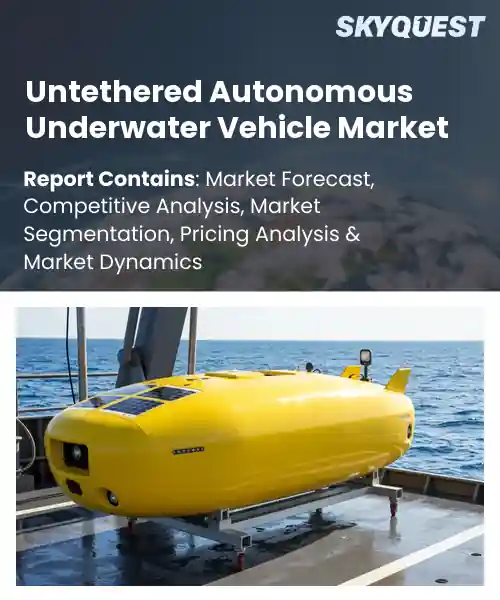
Untethered Autonomous Underwater Vehicle Market
Report ID: SQMIG20A2563
Report ID: SQMIG20A2563
[email protected]
USA +1 351-333-4748
Report ID:
SQMIG20A2563 |
Region:
Global |
Published Date: February, 2026
Pages:
157
|Tables:
122
|Figures:
77


Global Untethered Autonomous Underwater Vehicle Market size was valued at USD 560.0 Billion in 2024 and is poised to grow from USD 613.2 Billion in 2025 to USD 1267.4 Billion by 2033, growing at a CAGR of 9.5% during the forecast period (2026-2033).
The global untethered autonomous underwater vehicle market strategies is driven by escalating demand for high-resolution ocean data and by advances in onboard power and autonomy. Untethered AUVs are free-swimming robots that perform seabed mapping, pipeline inspection, environmental monitoring and defense missions without surface connections, and they matter because they reduce operational costs while enabling longer, riskier missions than tethered alternatives. Over the past two decades improvements in lithium-ion energy density, sensor miniaturization and AI navigation have converted prototypes into deployable systems, exemplified by Kongsberg’s HUGIN for surveys and Ocean Infinity’s coordinated searches, which illustrate how technical progress translates into commercial uptake now.
As improvements in battery energy density, autonomy, and sensor integration extend mission endurance, operators can execute longer, more complex tasks such as long-distance pipeline inspections and basin-scale environmental assessments without frequent recovery. This capability reduces expensive vessel time, which incentivizes oil and gas firms and offshore wind developers to commission AUV surveys, creating demand that encourages manufacturers to scale production and offer service contracts. The resulting economies of scale lower per-mission costs, which broadens use into seabed mineral exploration, fisheries assessment and naval mine countermeasures exemplified by deployments for mine hunting and habitat mapping, thereby generating a reinforcing growth cycle.
AI is enhancing operational autonomy in untethered autonomous underwater vehicles by moving critical sensing and decision making onto the vehicle. Key aspects are onboard perception and sensor fusion that turn sonar and environmental inputs into situational awareness, adaptive mission planning that lets vehicles reroute around hazards, and edge computing that reduces dependence on surface communications. The current market is shifting toward longer endurance, dual use platforms that can operate without constant ship support. By utilizing AI-based autonomous systems, operators can not only reduce their overall mission risk but also lessen the amount of time required to complete specific tasks. AI-enabled autonomous operations can include automatic piloting systems on AUVs that run synthetic aperture sonar and process data simultaneously in order to create usable survey results while the AUV is submerged.
Kongsberg in May 2024 demonstrated HUGIN AUVs with a new autonomous mission management system that improves situational awareness and decision making, supporting market growth by enabling longer unsupervised missions and reducing the need for surface support.
Market snapshot - 2026-2033
Global Market Size
USD 560.0 Billion
Largest Segment
Military/Defense AUVs
Fastest Growth
Commercial AUVs
Growth Rate
9.5% CAGR
To get more insights on this market click here to Request a Free Sample Report
Global untethered autonomous underwater vehicle market is segmented by product type, propulsion system, application, end-user and region. Based on product type, the market is segmented into military/defense AUVs, commercial AUVs and research & scientific AUVs. Based on propulsion system, the market is segmented into electric propulsion, hybrid propulsion and diesel-electric propulsion. Based on application, the market is segmented into military & defense, oil & gas exploration, scientific research & oceanography, environmental monitoring, underwater mapping & surveying and others. Based on end-user, the market is segmented into naval forces, oil & gas companies, research institutions & universities, environmental agencies and others. Based on region, the market is segmented into North America, Europe, Asia Pacific, Latin America and Middle East & Africa.
Based on the global untethered autonomous underwater vehicle market forecast, commercial AUVs segment dominates because commercial platforms have matured into versatile, cost-effective tools for subsea inspection, surveying, and asset integrity tasks, enabling broad industry adoption. The result of having lower costs per life-cycle, standardized payload interfaces, and well-established vendor ecosystems creates incentives for service providers and operators to have confidence in using AUVs as their provider of choice, leading to frequent procurement and larger deployments. This focus on the commercial aspect of AUVs will help to foster the integration of sensors, utilize data analytics, and shape the use of commercial AUVs as a critical aspect of the marketplace.
However, research & scientific AUVs are emerging as the fastest growing area due to expanding ocean science programs and demand for high resolution, modular platforms capable of deep and long duration data collection. Due to new developments in miniaturised sensors, collaborations between the academic and commercial sectors, as well as targeted funding , there is a drive to innovate at a faster pace which will provide more opportunities for creating platforms and services that are customised to specific requirements.
Electric propulsion segment dominates because quiet, efficient electric drive systems align closely with primary untethered AUV requirements for low acoustic signature, precise station keeping, and minimal maintenance. Advancements in battery energy density and management systems have provided greater run time and easier integration of electrical systems in many applications including, but not limited to, inspections, surveys, and environmental missions. Improved supply chain maturity and standardized electric systems have reduced complexity of operations and accelerated deployment of untethered electric propelled vehicles.
However, hybrid propulsion is witnessing the strongest growth momentum as operators seek platforms that combine battery efficiency with extended range enabled by auxiliary fuel based systems. Innovations in energy management, modular power packs, and flexible mission profiles drive adoption for long endurance surveys and rapid redeployment, unlocking new commercial and defense opportunities while easing battery limitations and enabling more complex sustained operations.
To get detailed segments analysis, Request a Free Sample Report
As per the global untethered autonomous underwater vehicle market analysis, North America dominates due to concentrated defense and research investments, a mature maritime and offshore industrial base, and the presence of leading original equipment manufacturers and component suppliers. A variety of resources such as a large number of tests, pre-existing partnerships with the federal government and universities, and commercially available capital will speed up the development of new technologies. The integration of new sensors, autonomous control algorithms, and data analysis methods are all being effectively used by the workforce and will be supported by private investment that makes it easier for them to sell. Commercial demand from energy, scientific and security sectors creates a deep ecosystem for systems integration, manufacturing and aftermarket services, while procurement practices and regulatory engagement encourage innovation adoption and global interoperability.
Untethered autonomous underwater vehicle market in United States benefits from a dense cluster of manufacturers, research laboratories and defense programs that drive advanced platform development. Integration of high fidelity sensors, autonomy software and robust communications is supported by a skilled maritime engineering workforce. Strong linkages between industry and academic institutions accelerate prototype testing and commercialization, while established service ecosystems and procurement channels sustain lifecycle support and global export opportunities across diverse mission profiles.
Untethered autonomous underwater vehicle market in Canada draws on a combination of ocean research institutions, specialized manufacturers and a growing services sector focused on Arctic and coastal operations. Emphasis on endurance, cold water reliability and environmental monitoring shapes platform design preferences. Collaboration with international partners and supportive procurement approaches encourage domestic capability building, while testing environments and skilled technical teams nurture adaptation of autonomy technologies for commercial and scientific missions.
Rapid expansion in Europe is driven by coordinated research programs, advanced shipbuilding and offshore engineering capabilities, and a growing emphasis on environmental monitoring and maritime security. The adoption of the advanced technologies by commercial operators and national navies is accelerating as companies and private-sector groups establish frameworks for technology transfer and increasing production capabilities through cross-border collaboration and industrial consortia. There are strong supply-chain networks for the sensors, the autonomy software, and the subsea communications that can support multiple types of missions, and regulation provides assurance regarding the safe deployment of the new technologies. Market momentum is reinforced by demand from offshore energy and infrastructure maintenance, scientific exploration needs, and an active start up community that partners with established manufacturers to commercialize innovative payloads and mission systems.
Untethered autonomous underwater vehicle market in Germany is characterized by an emerging industrial base that blends precision engineering, maritime manufacturing and applied research. The foundation of a solid platform, along with the use of existing modular sensors and a well-constructed system, complements shipyard capabilities and offshore engineering expertise. Joint ventures between technical universities and private sector companies help to create prototypes and provide opportunities to scale production through regulations and specific procurement initiatives to have a large supply chain.
Untethered autonomous underwater vehicle market in United Kingdom is experiencing rapid expansion driven by active naval interest, commercial demand from offshore energy and a vibrant innovation ecosystem. Prototypes can be developed more quickly when there is a close relationship between universities and private venture capitalists that work in the defense industry. Emphasizing the need for interoperability and versatility of use will help suppliers prepare to support production. Having direct access to Coastal Test Sites and procurement channels will aid in developing manufacturing capacity and provision of ready to deploy submarines.
Untethered autonomous underwater vehicle market in France benefits from a dominant industrial ecosystem that integrates major shipbuilders, defense program leadership and advanced research institutions. Focused capabilities in system integration, endurance platforms and mission engineering underpin broad deployment across defense, scientific and energy sectors. The procurement strategy, along with international partnerships, enhances the established international marketplaces. With a high-quality service delivery system in place for both mission planning and execution, these systems will continue to improve overall productivity and support the refine technology and improve productivity programs.
Asia Pacific is strengthening its position through concentrated technological expertise in robotics, electronics and maritime engineering, combined with growing industrial focus on autonomy and offshore services. Regional operational needs (deepwater exploration, coastal surveillance, infrastructure inspection) drive national and international manufacturers and research institutions to adapt platforms. Strategic partnerships with international suppliers, targeted testing facilities, and supportive industrial policies enable rapid capability development. A skilled engineering workforce and robust electronics supply chain facilitate the integration of sophisticated sensors and innovations in propulsion technology; and government initiatives that support maritime technology development together with increased venture investment and industrial collaboration are facilitating the transition from prototype to production and transferring knowledge. Investment in education/training provides operational expertise, while the focus on interoperability and standards integration increases the competitiveness of regions.
Untethered autonomous underwater vehicle market in Japan leverages advanced robotics, precision electronics and a strong manufacturing base to develop reliable, robust platforms. Coordination between research agencies and leading commercial developers speeds up advances in sensor fusion, autonomous algorithms and plans for deploying unmanned aerial systems (UAS). The emphasis on developing a single sensor configuration to meet different use cases for scientific exploration, infrastructure inspection and security has informed the design priorities for the sensor configurations.
Untethered autonomous underwater vehicle market in South Korea is strengthened by shipbuilding capabilities, advanced electronics manufacturing and defense research. By having well-established industrial connections and supplier networks, compact sensors, propulsion systems, and autonomous systems can better integrate with each other. Emphasizing designs and missions that can be exported to other countries will impact domestic development and encourage international cooperation. The partnerships between global technology companies will lead to more rapid improvements in capabilities.
To know more about the market opportunities by region and country, click here to
Buy The Complete Report
Advancements In Sensor Technology
Due to advances in compact, high-resolution sensors, autonomous sensors, navigation and obstacle avoidance continue to enhance capabilities of untethered vehicles that undertake longer, more complex missions with greater confidence and reliability. Enhanced sensor suites allow for precise data collection for scientific, commercial, and defence applications. Thus, AUVs have become increasingly valuable to operators requiring detailed underwater intelligence. As perception and localization become more robust, stakeholders are more willing to deploy untethered platforms for delicate tasks and extended surveys, which expands addressable use cases and encourages investment in vehicle development and operational deployment.
Rising Demand For Environmental Monitoring
There is a growing interest in monitoring and conserving our ocean environments, and possibly the perception of the usefulness of untethered autonomous platforms for long term, low impact observation of sensitive environments has also increased. Governments, research organizations and NGOs are adopting vehicles capable of repeat surveying of remote or hazardous sites, without the need for human presence to support ongoing long term trend analysis and rapid responses to ecological changes. By providing multiple opportunities for the collection of high quality environmental data in varying depths and conditions, AUV's have broadened the potential missions they can conduct, leading to increased purchasing and development of specialized sensors and mission planning tools.
High Initial Acquisition Costs
For many prospective customers, the initial investment associated with purchasing and then integrating untethered AUVs (the vehicle, the mission equipment on the vehicle, and the specialized support infrastructure) has created a significant barrier to entry. The financial constraints experienced by smaller research organizations, new commercial operators, and agencies with tight budgets are likely to cause potential purchasers to delay or cancel their planned acquisition because of either limited access to capital or uncertainty with regard to the timeline for realization of return on investment. In addition, the need for trained personnel as well as maintenance capabilities increase the total cost of ownership for potential purchasers, discouraging adoption and delaying broad-scale deployment despite recognised operational benefits or logistical issues.
Regulatory And Operational Complexity
Complex regulatory frameworks, maritime safety protocols, and evolving legal requirements for unmanned underwater operations constrain the global untethered autonomous underwater vehicle market growth. Operators must navigate diverse national and regional rules related to navigation rights, environmental protection, and data collection permissions, which can delay project approvals and increase administrative overhead. Compliance burdens and uncertainty about future regulatory changes make some stakeholders reluctant to commit to large-scale programs, impede standardized operating procedures, and discourage rapid technology adoption across international and commercial markets.
Request Free Customization of this report to help us to meet your business objectives.
Competitive landscape in the global untethered autonomous underwater vehicle market outlook is driven by defense procurement cycles and offshore energy monitoring needs that push firms into capability and cost competitions, prompting concrete M&A for capability absorption, industrial partnerships for platform scale, and disruptive product innovation from startups; examples include General Dynamics acquiring Bluefin for AUV and sonar capabilities, Boeing and Huntington Ingalls teaming on the Orca XLUUV program, and new entrants deploying low cost profiling AUVs such as Apeiron Labs.
SkyQuest’s ABIRAW (Advanced Business Intelligence, Research & Analysis Wing) is our Business Information Services team that Collects, Collates, Correlates, and Analyses the Data collected by means of Primary Exploratory Research backed by robust Secondary Desk research.
As per SkyQuest analysis, the global untethered autonomous underwater vehicle industry is propelled by growing demand for high-resolution ocean data and is further fueled by advancements in battery energy density and AI-driven autonomy that extend mission endurance. Commercial AUVs have established market leadership due to their lower lifetime costs, standardization of payload interfaces, and a pre-established vendor ecosystem. North America still leads in AUVs with substantial defense, research, and offshore industry investment. However, high initial acquisition and integration costs remain a barrier to smaller operators, while mission-specific modularization and collaborative swarm concepts are providing a scalable service model that will provide medium-term growth for AUV market.
| Report Metric | Details |
|---|---|
| Market size value in 2024 | USD 560.0 Billion |
| Market size value in 2033 | USD 1267.4 Billion |
| Growth Rate | 9.5% |
| Base year | 2024 |
| Forecast period | 2026-2033 |
| Forecast Unit (Value) | USD Billion |
| Segments covered |
|
| Regions covered | North America (US, Canada), Europe (Germany, France, United Kingdom, Italy, Spain, Rest of Europe), Asia Pacific (China, India, Japan, Rest of Asia-Pacific), Latin America (Brazil, Rest of Latin America), Middle East & Africa (South Africa, GCC Countries, Rest of MEA) |
| Companies covered |
|
| Customization scope | Free report customization with purchase. Customization includes:-
|
To get a free trial access to our platform which is a one stop solution for all your data requirements for quicker decision making. This platform allows you to compare markets, competitors who are prominent in the market, and mega trends that are influencing the dynamics in the market. Also, get access to detailed SkyQuest exclusive matrix.
Table Of Content
Executive Summary
Market overview
Parent Market Analysis
Market overview
Market size
KEY MARKET INSIGHTS
COVID IMPACT
MARKET DYNAMICS & OUTLOOK
Market Size by Region
KEY COMPANY PROFILES
Methodology
For the Untethered Autonomous Underwater Vehicle Market, our research methodology involved a mixture of primary and secondary data sources. Key steps involved in the research process are listed below:
1. Information Procurement: This stage involved the procurement of Market data or related information via primary and secondary sources. The various secondary sources used included various company websites, annual reports, trade databases, and paid databases such as Hoover's, Bloomberg Business, Factiva, and Avention. Our team did 45 primary interactions Globally which included several stakeholders such as manufacturers, customers, key opinion leaders, etc. Overall, information procurement was one of the most extensive stages in our research process.
2. Information Analysis: This step involved triangulation of data through bottom-up and top-down approaches to estimate and validate the total size and future estimate of the Untethered Autonomous Underwater Vehicle Market.
3. Report Formulation: The final step entailed the placement of data points in appropriate Market spaces in an attempt to deduce viable conclusions.
4. Validation & Publishing: Validation is the most important step in the process. Validation & re-validation via an intricately designed process helped us finalize data points to be used for final calculations. The final Market estimates and forecasts were then aligned and sent to our panel of industry experts for validation of data. Once the validation was done the report was sent to our Quality Assurance team to ensure adherence to style guides, consistency & design.
Analyst Support
Customization Options
With the given market data, our dedicated team of analysts can offer you the following customization options are available for the Untethered Autonomous Underwater Vehicle Market:
Product Analysis: Product matrix, which offers a detailed comparison of the product portfolio of companies.
Regional Analysis: Further analysis of the Untethered Autonomous Underwater Vehicle Market for additional countries.
Competitive Analysis: Detailed analysis and profiling of additional Market players & comparative analysis of competitive products.
Go to Market Strategy: Find the high-growth channels to invest your marketing efforts and increase your customer base.
Innovation Mapping: Identify racial solutions and innovation, connected to deep ecosystems of innovators, start-ups, academics, and strategic partners.
Category Intelligence: Customized intelligence that is relevant to their supply Markets will enable them to make smarter sourcing decisions and improve their category management.
Public Company Transcript Analysis: To improve the investment performance by generating new alpha and making better-informed decisions.
Social Media Listening: To analyze the conversations and trends happening not just around your brand, but around your industry as a whole, and use those insights to make better Marketing decisions.
REQUEST FOR SAMPLE
 REQUEST FREE CUSTOMIZATION
Global Untethered Autonomous Underwater Vehicle Market size was valued at USD 560.0 Billion in 2024 and is poised to grow from USD 613.2 Billion in 2025 to USD 1267.4 Billion by 2033, growing at a CAGR of 9.5% during the forecast period (2026-2033).
Competitive landscape in the global untethered AUV market is driven by defense procurement cycles and offshore energy monitoring needs that push firms into capability and cost competitions, prompting concrete M&A for capability absorption, industrial partnerships for platform scale, and disruptive product innovation from startups; examples include General Dynamics acquiring Bluefin for AUV and sonar capabilities, Boeing and Huntington Ingalls teaming on the Orca XLUUV program, and new entrants deploying low cost profiling AUVs such as Apeiron Labs. 'Ocean Infinity', 'Bluefin Robotics', 'Teledyne Marine', 'Aquabotix Technology Corporation', 'Kongsberg Gruppen', 'Saab Seaeye', 'ABB Marine & Ports', 'GKN Aerospace', 'Eelume', 'Subsea 7', 'Quantum Technologies', 'SeaRobotics', 'Hydronalix', 'Marine Technologies', 'Base Robotics', 'Ocean Aero', 'DeepOcean', 'Triton Submarines', 'OceanMega', 'Riptide Autonomous Solutions'
Advancements in miniaturized, high-resolution sensors have significantly improved autonomous sensing, navigation, and obstacle avoidance capabilities, enabling untethered vehicles to undertake longer, more complex missions with greater confidence and reliability. Enhanced sensor suites facilitate precise data acquisition across scientific, commercial, and defense applications, making AUVs more valuable to operators seeking detailed underwater intelligence. As perception and localization become more robust, stakeholders are more willing to deploy untethered platforms for delicate tasks and extended surveys, which expands addressable use cases and encourages investment in vehicle development and operational deployment.
Mission-Specific Platform Diversification: Manufacturers and system integrators are shifting toward tailored UUV variants optimized for distinct mission profiles, enabling operators to select vehicles configured for seabed mapping, pipeline inspection, or environmental monitoring. The emphasis is moving from one-size-fits-all systems to modular payload bays, interchangeable sensors, and adaptable energy systems that improve mission efficiency and reduce retrofit time. Vendors increasingly prioritize scalable architectures that simplify maintenance and accelerate deployment, expanding market appeal across scientific, energy, and defense customers seeking commercially viable specialized undersea capabilities.
As per the global untethered autonomous underwater vehicle market analysis, North America dominates due to concentrated defense and research investments, a mature maritime and offshore industrial base, and the presence of leading original equipment manufacturers and component suppliers.


Want to customize this report? This report can be personalized according to your needs. Our analysts and industry experts will work directly with you to understand your requirements and provide you with customized data in a short amount of time. We offer $1000 worth of FREE customization at the time of purchase.
Feedback From Our Clients


 USA (+1) 351-333-4748

