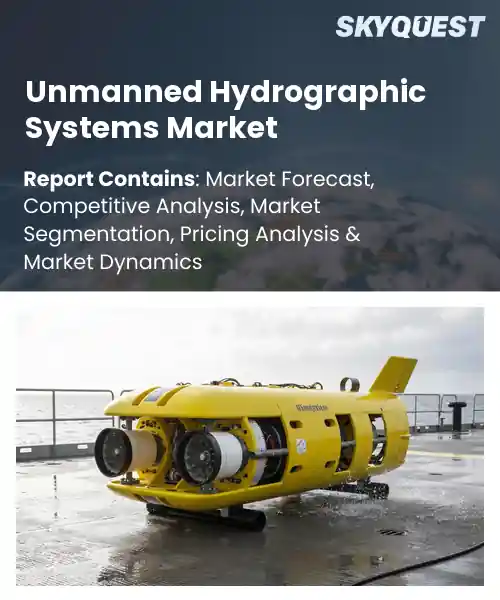
Unmanned Hydrographic Systems Market
Report ID: SQMIG20A2573
Report ID: SQMIG20A2573
[email protected]
USA +1 351-333-4748
Report ID:
SQMIG20A2573 |
Region:
Global |
Published Date: March, 2026
Pages:
157
|Tables:
181
|Figures:
79


Global Unmanned Hydrographic Systems Market size was valued at USD 4.54 Billion in 2024 and is poised to grow from USD 5.3 Billion in 2025 to USD 18.37 Billion by 2033, growing at a CAGR of 16.8% during the forecast period (2026-2033).
The primary driver of the unmanned hydrographic systems market is rising demand for high-resolution seabed data combined with technological advances that cut operational cost and risk. The advancement in hydrographic surveying is attributed to unmanned surface and submersible craft with multibeam sonar, sub-bottom profilers and highly accurate positioning systems. The result of technological advancements have been to allow the majority of hydrographic surveys to be conducted by small remotely operated vessels as opposed to larger and crewed vessels. Over two decades adoption accelerated as sensors shrank, autonomy matured and examples from port dredging to offshore wind surveys showed faster data acquisition at lower cost more widely.
Building on that wider adoption, a key trend driving the global unmanned hydrographic systems sector is maturation of autonomy, sensor fusion and cloud analytics, because they reduce labor and enable persistent, repeatable surveys. As autonomy cuts crew and vessel time, providers deliver more frequent bathymetry that supports time-sensitive uses like dynamic port navigation and offshore wind cable routing. For example, ports using unmanned surface vessels have shortened survey windows and reduced disruption, and energy developers employing coordinated AUVs accelerate site characterization, which boosts investor confidence and opens revenue streams for fleet operators and data-as-a-service firms and create opportunities in aquaculture monitoring and environmental assessment.
How is AI Enhancing Data Accuracy in the Unmanned Hydrographic Systems Market?
AI is improving data accuracy in unmanned hydrographic systems through sensor fusion, adaptive filtering and automated quality control. Key aspects are the blending of multibeam sonar, navigation and auxiliary sensors, machine learning driven noise suppression and automated anomaly detection. The market is moving toward on board AI processing on uncrewed surface and underwater vehicles so survey teams receive cleaner bathymetric maps and reduced manual post processing. This shift makes surveys more consistent in challenging environments and speeds up delivery of actionable seabed intelligence. Recent demonstrations show USVs streaming synchronized sensor data into AI enabled workflows to boost mapping fidelity.
Market snapshot - 2026-2033
Global Market Size
USD 4.54 Billion
Largest Segment
Sonar Systems
Fastest Growth
Power Systems
Growth Rate
16.8% CAGR
To get more insights on this market click here to Request a Free Sample Report
The unmanned hydrographic systems market is segmented by component, system type, deployment mode, control level, application area, end users and region. Based on component, the market is segmented into sonar systems, navigation and positioning systems, communication systems, payload sensors and power systems. Based on system type, the market is segmented into autonomous surface vehicles (ASVs), autonomous underwater vehicles (AUVs), remotely operated vehicles (ROVs), unmanned underwater gliders and hybrid unmanned systems. Based on deployment mode, the market is segmented into onshore, offshore and inland water. Based on control level, the market is segmented into fully autonomous systems, semi-autonomous systems and remotely operated systems.
Based on application area, the market is segmented into hydrographic surveying, marine research and exploration, oil & gas exploration, defense and security, environmental monitoring, coastal mapping and others. Based on end users, the market is segmented into government & defense, commercial survey companies, research institutions, oil & gas companies and environmental agencies. Based on region, the market is segmented into North America, Europe, Asia Pacific, Latin America and Middle East & Africa.
Based on the global unmanned hydrographic systems market growth, sonar systems segment dominates because sonar provides the fundamental sensing capability that determines bathymetric accuracy and seabed characterization quality across unmanned hydrographic operations. The established reliability of the system along with its ongoing innovation in both multibeam & side scan technologies instills operator confidence and reduces mission risk through an integrated workflow when processing sonar data. When evaluating sonar performance for the purchase and development of a mission, actionability of the survey data (outputs) and compliance with applicable regulations are top priorities.
However, navigation and positioning systems are the fastest growing sub-segment as precise georeferencing is critical for autonomous surveys. Advances in GNSS aided inertial units and acoustic positioning improve reliability in difficult environments and enable tighter data integration, driving adoption and opening opportunities for sensor fusion services.
Autonomous surface vehicles segment dominates because surface platforms offer a blend of straightforward deployment, flexible payload capacity and extended endurance that suits many hydrographic missions. Their reduced need for support vessels lowers logistical complexity and enables higher mission cadence, while effective integration with remote communications and sensor suites translates to more efficient data collection. Consequently, program planners favor surface autonomous solutions for routine and coastal survey tasks.
Meanwhile, autonomous underwater vehicles are emerging as the fastest growing area due to advances in onboard autonomy, battery technology and compact high resolution sensors that enable complex deepwater mapping. Rising demand for detailed seabed characterization and subsurface data is driving increased investment in advanced equipment, creating opportunities for custom-designed vehicles and specialized mapping services.
To get detailed segments analysis, Request a Free Sample Report
As per the global unmanned hydrographic systems market share, North America commands the global unmanned hydrographic systems market due to a combination of advanced technological innovation, mature maritime infrastructure, and coordinated public and private investment in oceanographic capabilities. The strong demand from the defense, offshore energy, and coastal management sectors have propelled the adoption of intelligent autonomous platforms and integrated sensor packages. These established manufacturers, along with research organizations, are partnering closely with users to validate their operational performance and to accelerate the commercialization process.
The regulatory framework and standards in the region provide clarity regarding how, when and where autonomous platforms may be deployed as well as how data generated from these systems will be governed; hence facilitating operations at scale. The presence of a robust ecosystem that includes numerous service providers, system integrators and skilled operators enables the rapid deployment and maintenance of the multiple complex fleets currently employed.
Unmanned hydrographic systems market in United States is characterized by a concentration of original equipment manufacturers, advanced sensor development, and broad operational testing across civilian and defense programs. Strong private sector participation and established procurement mechanisms facilitate trials and scaled deployments. Collaborative ties between industry and academic research centers accelerate innovation in autonomy, data processing, and mission planning, supporting comprehensive service offerings across coastal mapping, seabed characterization, and infrastructure inspection.
Unmanned hydrographic systems market in Canada emphasizes operational resilience in challenging coastal and Arctic-approaching environments, fostering platforms optimized for endurance and sensor robustness. Government research organizations and regional service providers collaborate to modify systems for ice-prone waters, remote survey logistics, and marine spatial planning; local integration capability and a developing pool of qualified operators are enabling custom survey solutions. International partnerships for procuring advanced autonomous technologies are also providing access to state-of-the-art equipment.
Europe is experiencing rapid expansion in unmanned hydrographic systems driven by concerted policy emphasis on sustainable maritime management, rising commercial activity in offshore renewables, and a tightening focus on coastal resilience and marine spatial planning. Using strong engineering capabilities and existing clusters in core markets to help quickly iterate on platform design and integrate sensors.
A growing demand from ports, environmental agencies, and energy developers creates sustainable survey contracts and long-term service delivery/operational models. The establishment of collaborative networks among start-ups, established manufacturers, and research institutions for practical testing and operational validation supports a rapid adoption of new technologies in different marine environments. Continued investment in digital infrastructure and data-sharing platforms at the regional level expands the value proposition associated with the scaling of commercial services.
Based on global unmanned hydrographic systems market regional forecast, unmanned hydrographic systems market in Germany benefits from strong industrial engineering, focused sensor research, and competitive manufacturing that enable rapid product development. Demand from ports, shipping, and offshore energy supports iterative improvements and local supply chains. Collaborative testbeds and public research programs promote operational validation and export orientation, contributing to Germany status as the fastest growing European market with expanding commercial service ecosystems and a skilled workforce.
Unmanned hydrographic systems market in United Kingdom is characterized by an extensive service provider base, deep maritime operational experience, and early operational adoption across civil and defense users. Strong infrastructure on ports along with focus on marine safety ensure strong predictable demand for unmanned surveys/inspections. Well-established procurement channels and service exports help achieve market leader position by providing a consistent pathway for the development of new autonomous technologies.
Unmanned hydrographic systems market in France is emerging through coordinated industry research, regional technology clusters, and targeted adoption by environmental agencies. Environmental monitoring, coastal restoration, and assistance for offshore development have led to new mission profiles for autonomous platforms. Increasing manufacturing capability and collaboration with international system developers provide custom solutions. Pilot programs and public procurement are stimulating more widespread commercial usage and developing an early service ecosystem as well as skill sets.
As per global unmanned hydrographic systems market regional outlook, Asia Pacific is strengthening its role in unmanned hydrographic systems through concentrated technology development, targeted industrial policy, and expanding commercial requirements for coastal management and offshore infrastructure. Governments and private firms in key markets are investing in platform development, sensor miniaturization, and localized maintenance capabilities to reduce dependence on imports and tailor solutions to regional maritime conditions.
More communication among system integrators, research institutions, and partners internationally will facilitate the transfer of knowledge and operational trials. Increased activity in the regional shipbuilding sector and the modernization of ports will continue to create a stable demand for surveying and inspection services. New regional centers of excellence and training programs are creating operational readiness and after-sale support networks within the immediate area.
Unmanned hydrographic systems market in Japan is anchored by advanced maritime technology firms and shipbuilding expertise focused on precise coastal mapping for port optimization. The most important qualities that domestic manufacturers place on these vessels are reliability, sensor integration, and autonomous navigation appropriate to perform in complex littoral conditions. Industry, Coast Guard, and research labs are working together to conduct rigorous testing and other aspects of operational refinement. Manufacturers after-sales engineering and support services are creating the foundation for developing export-focused commercial activity through sustainable service provision.
Unmanned hydrographic systems market in South Korea draws on electronics manufacturing, shipbuilding strength, and an export oriented base to advance autonomous survey platforms. Domestic integrators emphasize compact, high performance sensor suites and rugged vessels suited to regional conditions. Public procurement and partnerships with port authorities provide practical deployment opportunities. Collaboration with research institutes and international suppliers improves system interoperability, training, and after sales support, reinforcing commercial expansion and export readiness.
To know more about the market opportunities by region and country, click here to
Buy The Complete Report
Advancements In Autonomous Navigation
Demand For High-Resolution Bathymetry
Regulatory And Compliance Challenges
High Initial Investment Costs
Request Free Customization of this report to help us to meet your business objectives.
Competitive landscape in the global unmanned hydrographic systems market outlook is shaped by consolidation, strategic alliances and rapid product innovation, with competition driven by access to high quality sensors and cloud data services. Companies engage in mergers and acquisitions to obtain specialized sensing abilities, develop partnerships for growth, and support platform automation with their unique software; as in the NV5 purchase of Geodynamics, the Vaarst merger with Rovco to become Beam, and the WAM-Vs deployed by Ocean Power Technologies.
Autonomy Integration Boosting Efficiency
Data Fusion Enhancing Decision Making
SkyQuest’s ABIRAW (Advanced Business Intelligence, Research & Analysis Wing) is our Business Information Services team that Collects, Collates, Correlates, and Analyses the Data collected by means of Primary Exploratory Research backed by robust Secondary Desk research.
As per SkyQuest analysis, the global unmanned hydrographic systems industry is driven primarily by rising demand for high-resolution bathymetric data that enables safer navigation and offshore development, while a second major driver is rapid maturation of autonomy, sensor fusion and cloud analytics that reduce costs and increase survey frequency. Compliance and regulatory challenges frequently slow down deployment in some areas and are creating complications obtaining approvals for unmanned systems. North America dominates as a region due to the level of advanced technology used, an established maritime infrastructure, and the level of investment it provides. The sonar segment is the dominant segment, and sonar systems provide the primary sensing capability that ensures bathymetric accuracy and operator confidence in the use of unmanned survey platforms.
| Report Metric | Details |
|---|---|
| Market size value in 2024 | USD 4.54 Billion |
| Market size value in 2033 | USD 18.37 Billion |
| Growth Rate | 16.8% |
| Base year | 2024 |
| Forecast period | 2026-2033 |
| Forecast Unit (Value) | USD Billion |
| Segments covered |
|
| Regions covered | North America (US, Canada), Europe (Germany, France, United Kingdom, Italy, Spain, Rest of Europe), Asia Pacific (China, India, Japan, Rest of Asia-Pacific), Latin America (Brazil, Rest of Latin America), Middle East & Africa (South Africa, GCC Countries, Rest of MEA) |
| Companies covered |
|
| Customization scope | Free report customization with purchase. Customization includes:-
|
To get a free trial access to our platform which is a one stop solution for all your data requirements for quicker decision making. This platform allows you to compare markets, competitors who are prominent in the market, and mega trends that are influencing the dynamics in the market. Also, get access to detailed SkyQuest exclusive matrix.
Table Of Content
Executive Summary
Market overview
Parent Market Analysis
Market overview
Market size
KEY MARKET INSIGHTS
COVID IMPACT
MARKET DYNAMICS & OUTLOOK
Market Size by Region
KEY COMPANY PROFILES
Methodology
For the Unmanned Hydrographic Systems Market, our research methodology involved a mixture of primary and secondary data sources. Key steps involved in the research process are listed below:
1. Information Procurement: This stage involved the procurement of Market data or related information via primary and secondary sources. The various secondary sources used included various company websites, annual reports, trade databases, and paid databases such as Hoover's, Bloomberg Business, Factiva, and Avention. Our team did 45 primary interactions Globally which included several stakeholders such as manufacturers, customers, key opinion leaders, etc. Overall, information procurement was one of the most extensive stages in our research process.
2. Information Analysis: This step involved triangulation of data through bottom-up and top-down approaches to estimate and validate the total size and future estimate of the Unmanned Hydrographic Systems Market.
3. Report Formulation: The final step entailed the placement of data points in appropriate Market spaces in an attempt to deduce viable conclusions.
4. Validation & Publishing: Validation is the most important step in the process. Validation & re-validation via an intricately designed process helped us finalize data points to be used for final calculations. The final Market estimates and forecasts were then aligned and sent to our panel of industry experts for validation of data. Once the validation was done the report was sent to our Quality Assurance team to ensure adherence to style guides, consistency & design.
Analyst Support
Customization Options
With the given market data, our dedicated team of analysts can offer you the following customization options are available for the Unmanned Hydrographic Systems Market:
Product Analysis: Product matrix, which offers a detailed comparison of the product portfolio of companies.
Regional Analysis: Further analysis of the Unmanned Hydrographic Systems Market for additional countries.
Competitive Analysis: Detailed analysis and profiling of additional Market players & comparative analysis of competitive products.
Go to Market Strategy: Find the high-growth channels to invest your marketing efforts and increase your customer base.
Innovation Mapping: Identify racial solutions and innovation, connected to deep ecosystems of innovators, start-ups, academics, and strategic partners.
Category Intelligence: Customized intelligence that is relevant to their supply Markets will enable them to make smarter sourcing decisions and improve their category management.
Public Company Transcript Analysis: To improve the investment performance by generating new alpha and making better-informed decisions.
Social Media Listening: To analyze the conversations and trends happening not just around your brand, but around your industry as a whole, and use those insights to make better Marketing decisions.
REQUEST FOR SAMPLE
 REQUEST FREE CUSTOMIZATION
Global Unmanned Hydrographic Systems Market size was valued at USD 4.54 Billion in 2024 and is poised to grow from USD 5.3 Billion in 2025 to USD 18.37 Billion by 2033, growing at a CAGR of 16.8% during the forecast period (2026-2033).
Key vendors include Teledyne Marine, Kongsberg Maritime, Fugro, Saab AB, L3Harris Technologies, ECA Group, Ocean Infinity, Sonardyne International, iXblue, and ASV Global, competing through advanced technologies and global reach.
The key driver is the increasing demand for accurate seabed mapping and marine data, supported by offshore exploration, coastal development, and maritime safety needs.
A major trend is the growing adoption of autonomous and AI-enabled systems for real-time data collection, improved efficiency, and reduced operational risks.
North America accounted for the largest share, driven by strong defense spending, advanced marine technologies, and extensive offshore activities.


Want to customize this report? This report can be personalized according to your needs. Our analysts and industry experts will work directly with you to understand your requirements and provide you with customized data in a short amount of time. We offer $1000 worth of FREE customization at the time of purchase.
Feedback From Our Clients


 USA (+1) 351-333-4748

