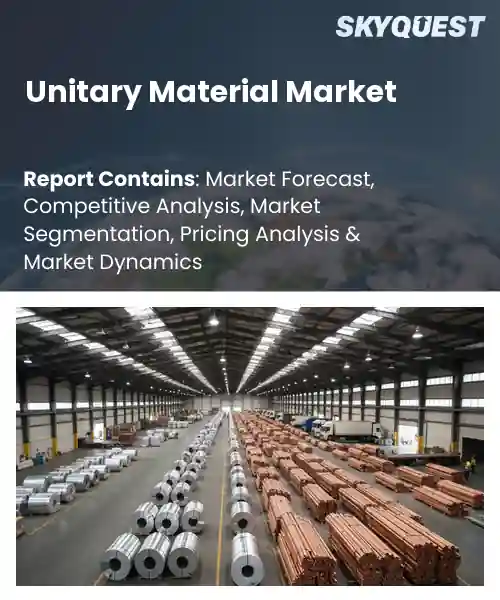
Unitary Material Market
Report ID: SQMIG15E3405
Report ID: SQMIG15E3405
[email protected]
USA +1 351-333-4748
Report ID:
SQMIG15E3405 |
Region:
Global |
Published Date: April, 2026
Pages:
157
|Tables:
116
|Figures:
77


Global Unitary Material Market size was valued at USD 929.8 Billion in 2024 and is poised to grow from USD 987.45 Billion in 2025 to USD 935.0 Billion by 2033, growing at a CAGR of 6.2% during the forecast period (2026-2033).
The primary driver of the global unitary material market is accelerating demand for compact, durable materials that enable integrated product architectures, and demand comes from consumer electronics, aerospace and medical device industries. A contextual overview shows the market covers engineered composites and monolithic substrates that replace assemblies of discrete parts, which matters because consolidation cuts weight, lowers costs and reduces failure points while enhancing thermal performance. The market has evolved from academic polymer metallurgy experiments into industrial scale production as additive manufacturing and solvent processing matured, exemplified by smartphones adopting monolithic housings and aircraft parts shifting to single piece designs.Building on the market's evolution, a pivotal factor driving the unitary material market is manufacturing scalability combined with material innovation, because when production methods lower per unit costs firms can replace assemblies with monolithic components. This drives growth in sectors like electric vehicles where single piece chassis components reduce weight and improve range, and in data centers where integrated thermal substrates enhance heat dissipation, thereby reducing cooling costs. Opportunities arise in aftermarket customization, circular material design and additive hubs that shorten supply chains, and as regulatory pressure for emissions reduction increases, demand for unitary materials with recyclability credentials accelerates adoption.
How is AI transforming product development in the unitary material market?
AI is reshaping product development in the unitary material market by automating discovery, guiding formulation, and accelerating scale up. Key aspects are materials informatics for candidate selection, predictive modeling for performance and durability, and generative design that proposes novel compositions. Companies are pairing lab automation with AI to shorten iteration cycles and align formulations to manufacturing constraints. In a market that spans single layer surfacing and battery components these tools improve reproducibility and reduce waste. Real world implementations include autonomous labs and proprietary AI platforms that suggest formulations and feed characterization data back into models.Dunia Innovations April 2026, announced a strategic partnership with Hitachi High Tech to combine AI driven characterization and automation. That development shows how integrated AI platforms shorten validation cycles and strengthen formulation robustness, enabling faster commercialization and greater production efficiency across the unitary material market.
Market snapshot - (2026-2033)
Global Market Size
USD 929.8 Billion
Largest Segment
Unitary Polymers & Composites
Fastest Growth
Advanced Unitary Metallic Alloys
Growth Rate
6.2% CAGR
To get more insights on this market click here to Request a Free Sample Report
Global unitary material market is segmented by material composition, functional application, end-use industry (strategic drivers), form factor and region. Based on material composition, the market is segmented into Unitary Polymers & Composites, Unitary Ceramic & Glass Compounds and Advanced Unitary Metallic Alloys. Based on functional application, the market is segmented into Structural & Load-bearing Components, Protective Coatings & Barriers and Insulation & Thermal Management. Based on end-use industry (strategic drivers), the market is segmented into Aerospace & Defense (Material Integrity), Automotive & Lightweight Engineering and Electronics & High-precision Tooling. Based on form factor, the market is segmented into Sheet/Plate Form and Custom Molded & Extruded Parts. Based on region, the market is segmented into North America, Europe, Asia Pacific, Latin America and Middle East & Africa.
[Unitary Polymers & Composites] segment dominates because its adaptable matrix chemistry and processing versatility enable tailored mechanical performance and integration across diverse applications. Their tunable stiffness, impact resistance, and compatibility with mass manufacturing cause widespread adoption for cost-effective lightweight solutions. Demand from design-driven industries and maturity of production methods drive economies of scale, further entrenching polymers and composites as the primary choice for unitary materials where balance of performance, manufacturability, and lifecycle considerations is essential.
However, Advanced Unitary Metallic Alloys are the most rapidly expanding due to breakthroughs in alloy design and additive manufacturing that open high-strength, temperature-resistant applications. Rising interest from sectors demanding durability and recyclability, along with innovations reducing production cost and enabling complex geometries, accelerates adoption and creates new market opportunities in performance-critical use cases.
[Structural & Load-bearing Components] segment dominates because these applications embody primary mechanical requirements that drive material selection across the Unitary Material Market. Their need for predictable strength, fatigue resistance, and damage tolerance forces material developers to prioritize reliability and certification pathways, which in turn channels investment into proven material systems. OEM preference for validated performance and lifecycle cost efficiency sustains demand for materials optimized for heavy load and safety-critical roles.
Meanwhile, Insulation & Thermal Management is witnessing the strongest growth driven by electrification and higher operational temperatures demanding advanced thermal control. Innovations in low-conductivity composites and integrated thermal interface designs expand application scope, while regulatory and efficiency pressures accelerate deployment. This creates opportunities for materials offering compact, reliable thermal solutions in next generation systems.
To get detailed segments analysis, Request a Free Sample Report
North American dominance stems from a confluence of established industrial capacity, deep research ecosystems, and mature supply chain infrastructures that together create a resilient market advantage. Robust manufacturing clusters and leading end users in aerospace, automotive, and healthcare demand high-performance materials, which in turn drive supplier sophistication and product differentiation. Access to diverse capital sources supports innovation and scale up, while collaborative linkages between industry, national laboratories, and universities accelerate commercialization of advanced formulations and processing methods. Regulatory frameworks and certification bodies provide predictable pathways for market entry, and well developed logistics and distribution networks enable regional firms to serve global customers efficiently. These structural strengths reinforce a competitive landscape where quality, reliability, and continuous improvement underpin market leadership.
Unitary Material Market in United States is characterized by a large industrial base and concentrated centers of materials research and development. Established supplier ecosystems support varied end uses such as aerospace and advanced manufacturing, and procurement practices favor proven performance and certification. Collaboration between private enterprises and research institutions fosters novel processing approaches, while access to diverse funding mechanisms enables scale up and commercialization. Strong testing infrastructure and quality standards reinforce buyer confidence and facilitate integration into complex value chains.
Unitary Material Market in Canada benefits from a research oriented ecosystem and close integration with neighboring industrial markets. Emphasis on resource processing, sustainability, and niche manufacturing creates opportunities for specialized material offerings. University and government research centers collaborate with industry to advance processing techniques, and export oriented clusters leverage geographic proximity to large customers. Strategic focus on energy, infrastructure, and environmental performance shapes material development priorities, while supportive innovation programs encourage pilot deployment and incremental scaling.
The rapid expansion in Europe is driven by a combination of advanced manufacturing demand, regulatory emphasis on sustainability and performance, and coordinated industrial strategies that prioritize material innovation. Strong end markets in automotive and industrial machinery require lightweighting, durability, and recyclability, prompting suppliers to develop high value formulations and processing capabilities. Cross border collaboration within the region enables knowledge transfer and supply chain optimization, while industry associations and standards bodies help harmonize specifications and accelerate adoption. Public policy initiatives and incentive programs support pilot projects and technology demonstration, encouraging startups and established firms to commercialize differentiated products. A skilled workforce and dense network of component manufacturers further enable scale up and integration into complex assemblies, reinforcing Europe as a dynamic and innovation focused market.
Unitary Material Market in Germany is anchored by precision engineering and a strong automotive and machinery base that demands consistent, high quality material solutions. Suppliers benefit from integrated manufacturing clusters, rigorous quality standards, and deep experience in industrial scale production. Close ties between manufacturers and research institutions support continuous improvement and application tailored formulations. The market favors proven reliability and process compatibility, enabling domestic firms to maintain leadership in specialized material segments and to serve multinational original equipment manufacturers.
Unitary Material Market in United Kingdom is notable for rapid commercialization and a vibrant innovation ecosystem driven by research intensive universities and dynamic startups. The market profile emphasizes advanced testing services, materials characterization, and supply chain agility that support quick scale up and market entry. Strong financial services and investor interest in deep tech facilitate growth of emerging suppliers, while logistics and professional services provide efficient commercialization pathways. Focus areas include lightweight structures, electrification, and applications where speed to market and adaptability are critical.
Unitary Material Market in France is emerging through a combination of specialty chemicals expertise and focused aerospace and defense demand that favors high performance and sustainable materials. Government supported innovation initiatives and collaborative research hubs enable pilot production and targeted commercialization. Domestic manufacturers leverage chemical industry strengths to develop differentiated formulations, while partnerships with research institutes facilitate translation from lab to application. The market trajectory is shaped by niche opportunities where regulatory alignment and strategic industrial planning support measured growth.
Asia Pacific is strengthening its market position through strategic investments in manufacturing capacity, concentrated technology clusters, and close alignment with high growth end markets such as electronics, automotive electrification, and energy storage. Regional players emphasize scale, process efficiency, and integration with sophisticated supply chains to offer competitive and reliable material solutions. Governments support industrial upgrading through targeted policies and funding for research, while corporations invest in advanced materials R&D and international collaborations. Emphasis on quality control and precision manufacturing in key markets enhances credibility with global customers, and the ability to rapidly commercialize innovations through established production networks accelerates regional influence. Cross border partnerships and growing expertise in functional and high performance materials contribute to a progressively stronger role on the global stage.
Unitary Material Market in Japan is defined by high precision manufacturing and deep expertise in functional materials suited to electronics and automotive applications. Longstanding relationships between material suppliers and original equipment manufacturers encourage incremental innovation and stringent quality control. Research institutions and corporate laboratories collaborate to refine formulations and processing methods, focusing on reliability and performance in demanding environments. The market emphasizes meticulous testing and certification pathways, enabling suppliers to meet strict application requirements and sustain premium positioning in global supply chains.
Unitary Material Market in South Korea is characterized by rapid commercialization and strong integration with electronics and battery manufacturing ecosystems. Large industrial conglomerates and agile suppliers invest in advanced composites and coatings tailored to high throughput production. Government and industry collaboration supports applied research and pilot scale facilities that shorten time to market, while export oriented strategies leverage established logistics and supplier networks. Focus on innovation, process optimization, and alignment with semiconductor and energy storage supply chains positions regional firms as competitive partners for global manufacturers.
To know more about the market opportunities by region and country, click here to
Buy The Complete Report
Growing Demand For Lightweight Materials
Advancements In Manufacturing Technologies
High Initial Development Costs
Material Performance Uncertainties
Request Free Customization of this report to help us to meet your business objectives.
Competitive dynamics in the global unitary material market are driven by vertical integration, regional production localization, and proprietary technology co development that reshape supplier position. Industry actors pursue acquisitions and strategic partnerships to secure feedstock and downstream anode capability, for example Imerys’ technology partnerships to produce synthetic graphite in Europe and consortium restructuring investments into Ningbo Shanshan that shifted strategic control and alliances.
Top Player’s Company Profile
Recent Developments
SkyQuest’s ABIRAW (Advanced Business Intelligence, Research & Analysis Wing) is our Business Information Services team that Collects, Collates, Correlates, and Analyses the Data collected by means of Primary Exploratory Research backed by robust Secondary Desk research. As per SkyQuest analysis, the global unitary material market is driven primarily by growing demand for lightweight, integrated materials that reduce part counts and improve performance, supported further by advancements in manufacturing technologies that enable scalable, complex monolithic components. Key restraint remains the high initial development and qualification costs required for tooling, testing and certification, which slows adoption especially among smaller firms. North America leads the market due to deep research ecosystems, established supply chains and strong aerospace and automotive demand, while unitary polymers and composites dominate product mix because of processing versatility, cost-effectiveness and suitability across diverse end uses. Opportunities center on circular design, AI-enabled development and thermal management solutions.
| Report Metric | Details |
|---|---|
| Market size value in 2024 | USD 929.8 Billion |
| Market size value in 2033 | USD 935.0 Billion |
| Growth Rate | 6.2% |
| Base year | 2024 |
| Forecast period | (2026-2033) |
| Forecast Unit (Value) | USD Billion |
| Segments covered |
|
| Regions covered | North America (US, Canada), Europe (Germany, France, United Kingdom, Italy, Spain, Rest of Europe), Asia Pacific (China, India, Japan, Rest of Asia-Pacific), Latin America (Brazil, Rest of Latin America), Middle East & Africa (South Africa, GCC Countries, Rest of MEA) |
| Companies covered |
|
| Customization scope | Free report customization with purchase. Customization includes:-
|
To get a free trial access to our platform which is a one stop solution for all your data requirements for quicker decision making. This platform allows you to compare markets, competitors who are prominent in the market, and mega trends that are influencing the dynamics in the market. Also, get access to detailed SkyQuest exclusive matrix.
Table Of Content
Executive Summary
Market overview
Parent Market Analysis
Market overview
Market size
KEY MARKET INSIGHTS
COVID IMPACT
MARKET DYNAMICS & OUTLOOK
Market Size by Region
KEY COMPANY PROFILES
Methodology
For the Unitary Material Market, our research methodology involved a mixture of primary and secondary data sources. Key steps involved in the research process are listed below:
1. Information Procurement: This stage involved the procurement of Market data or related information via primary and secondary sources. The various secondary sources used included various company websites, annual reports, trade databases, and paid databases such as Hoover's, Bloomberg Business, Factiva, and Avention. Our team did 45 primary interactions Globally which included several stakeholders such as manufacturers, customers, key opinion leaders, etc. Overall, information procurement was one of the most extensive stages in our research process.
2. Information Analysis: This step involved triangulation of data through bottom-up and top-down approaches to estimate and validate the total size and future estimate of the Unitary Material Market.
3. Report Formulation: The final step entailed the placement of data points in appropriate Market spaces in an attempt to deduce viable conclusions.
4. Validation & Publishing: Validation is the most important step in the process. Validation & re-validation via an intricately designed process helped us finalize data points to be used for final calculations. The final Market estimates and forecasts were then aligned and sent to our panel of industry experts for validation of data. Once the validation was done the report was sent to our Quality Assurance team to ensure adherence to style guides, consistency & design.
Analyst Support
Customization Options
With the given market data, our dedicated team of analysts can offer you the following customization options are available for the Unitary Material Market:
Product Analysis: Product matrix, which offers a detailed comparison of the product portfolio of companies.
Regional Analysis: Further analysis of the Unitary Material Market for additional countries.
Competitive Analysis: Detailed analysis and profiling of additional Market players & comparative analysis of competitive products.
Go to Market Strategy: Find the high-growth channels to invest your marketing efforts and increase your customer base.
Innovation Mapping: Identify racial solutions and innovation, connected to deep ecosystems of innovators, start-ups, academics, and strategic partners.
Category Intelligence: Customized intelligence that is relevant to their supply Markets will enable them to make smarter sourcing decisions and improve their category management.
Public Company Transcript Analysis: To improve the investment performance by generating new alpha and making better-informed decisions.
Social Media Listening: To analyze the conversations and trends happening not just around your brand, but around your industry as a whole, and use those insights to make better Marketing decisions.
REQUEST FOR SAMPLE
 REQUEST FREE CUSTOMIZATION


Want to customize this report? This report can be personalized according to your needs. Our analysts and industry experts will work directly with you to understand your requirements and provide you with customized data in a short amount of time. We offer $1000 worth of FREE customization at the time of purchase.
Feedback From Our Clients


 USA (+1) 351-333-4748

