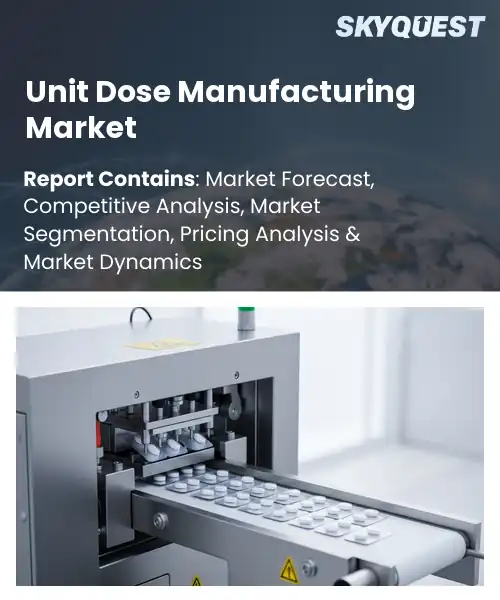
Unit Dose Manufacturing Market
Report ID: SQMIG20F2064
Report ID: SQMIG20F2064
[email protected]
USA +1 351-333-4748
Report ID:
SQMIG20F2064 |
Region:
Global |
Published Date: May, 2026
Pages:
157
|Tables:
187
|Figures:
79


Global Unit Dose Manufacturing Market size was valued at USD 81.4 Million in 2024 and is poised to grow from USD 90.03 Million in 2025 to USD 201.57 Million by 2033, growing at a CAGR of 10.6% during the forecast period (2026-2033).
Unit dose manufacturing or the manufacture of unit doses shapes the marketplace through the demand for improved, safe medication distribution and delivery by health industry; the requirements placed on packaging and distribution have evolved during the past several decades to react to increased expectations by suppliers and providers. A unit dose manufacturing facility produces individual, separate unit doses that are individually wrapped and provide for a decrease in misdoses, ease of inventory, and quicker dispensing at patients’ bedsides in hospitals and long-term care facilities. The importance of the market to unit dose manufacturers is largely the result of increasing regulatory pressures and the cost of reimbursement associated with medication misdosing, leading health care providers to seek unit dose options. Hospitals started to adopt unit doses for their pharmacy departments in the early 1990s, with growing use of automated dispensing, bar code scanning, and clean-room filling technologies, driven by the shift to automated packaged lines rather than manual repackaging of products.
While the safety-related aspects are still essential, the primary tendency that influences the global market for unit dose manufacturing is the increase in automation and regulatory tightening, which are producing scalable systems. Manufacturers are implementing new technologies such as automated filling, vision inspection, and serialisation to improve traceability and reduce medication errors, all while lowering the cost per unit for outpatient and homecare pharmacists. Hospitals that incorporate an automated unit dose supply chain report that they have experienced fewer adverse medication events and a decrease in inventory loss, resulting in contract packagers with sterile fill capabilities enjoying a competitive edge when it comes to procurement cycles. Consequently, opportunities expand for specialized contract manufacturers, regional packaging hubs and technology providers delivering validated high-throughput unit dose solutions worldwide.
How is AI Improving Quality Control In The Unit Dose Manufacturing Market?
The unit dose manufacturing industry is seeing improvements to quality control through automation and the use of data-driven processes. The unit dose package represents the single dosage or unit for administration in clinical use, so accuracy, traceability, and prevention of contamination are all essential for success in this market. Manufacturers are now combining surface and fill inspection with machine vision through anomaly detection and predictive analytics to identify process drift before any defect occurs. The integration of manufacturing execution and quality systems provides a means of enforcing label verification and batch traceability. Some of the real-life examples of these integrations include inline camera inspection of all manufactured product to help eliminate manual inspection processes and AI-assisted root cause analysis of product defects, which decreases the time it takes to implement corrective actions.
The new capabilities of manufacturers have lessened the manual workload of employees while increasing their readiness for regulatory inspections. BD (Becton Dickinson) and Sinteco have announced their partnership in March 2026 which includes the introduction of robotics for automated unit dose myriads along with integrated software to provide the capabilities of AI-enhanced imaging and analytics to create improvements in inspection accuracy and end-to-end traceability to support faster throughput and safer medication handling while helping the provider to scale up their operations consistent with their volume of business.
Market snapshot - (2026-2033)
Global Market Size
USD 81.4 Million
Largest Segment
Tablets
Fastest Growth
Injectable Unit Doses
Growth Rate
10.6% CAGR
To get more insights on this market click here to Request a Free Sample Report
Global unit dose manufacturing market is segmented by product type, dosage form technology, manufacturing type, application, end user, distribution channel and region. Based on product type, the market is segmented into Tablets, Capsules, Powders & Granules, Oral Liquids, Injectable Unit Doses, Inhalation Unit Doses, Topical & Transdermal Unit Doses and Others. Based on dosage form technology, the market is segmented into Blister Packaging, Sachets & Stick Packs, Ampoules & Vials, Prefilled Syringes, Unit-Dose Cups & Pouches, BFS (Blow-Fill-Seal) Technology and Others. Based on manufacturing type, the market is segmented into In-House Manufacturing and Contract Manufacturing (CMO/CDMO). Based on application, the market is segmented into Prescription Drugs, Over-the-Counter (OTC) Drugs, Nutraceuticals & Dietary Supplements, Biologics & Specialty Drugs, Vaccines and Others. Based on end user, the market is segmented into Pharmaceutical Companies, Biotechnology Companies, Hospitals & Clinics, Retail & Institutional Pharmacies, Contract Manufacturing Organizations (CMOs/CDMOs) and Nutraceutical Manufacturers. Based on distribution channel, the market is segmented into Direct Supply, Hospital Pharmacies, Retail Pharmacies, Online Pharmacies and Institutional Procurement. Based on region, the market is segmented into North America, Europe, Asia Pacific, Latin America and Middle East & Africa.
As per unit dose manufacturing market analysis, the tablets segment in the Unit Dose Manufacturing market (UDM) is more advanced than any other established unit-dose formats and is also the most flexible. Tablets allow for high-speed production with simple interface capabilities to automated blister and strip packaging. As a result, many manufacturers use only tablet unit-dose lines since they provide extensive prescription and OTC solutions using proven manufacturing processes and regulatory expertise.
As per unit dose manufacturing market forecast, the injectable unit-dose segment is growing faster than any other unit-dose format, the most rapid growth of injectable formats has occurred due to the increased need for sterile, single-use formats. In addition, manufacturers are investing heavily in sterile filling technologies. As a result, new technologies for handling vials and ampoules, increased standards regarding contamination control, and the growing importance of biologics will further stimulate the use of sterilized unit-dose capacity and services.
The blister packaging segment is the most prominent in the Unit Dose Manufacturing Market due to its ability to protect the contents from tampering, provide clear patient dosing instructions, and provide dose-level protection that meets the safety and regulatory needs of this market. The compatibility of blister packaging with automated systems, serialization and child-resistant features minimizes errors when dispensing products from inventory and reduces losses in the supply chain, making it possible for manufacturers to standardize their processes, shorten time-to-market, and improve end-user adherence through user-friendly dose container design.
As per unit dose manufacturing market outlook, the BFS (Blow-Fill-Seal) Technology segment is becoming a significant growth area as a result of the growing demand for sterile, preservative-free liquid unit doses as well as the growing complexity of biological compounds. With the capabilities of continuous aseptic filling systems, controlled human interaction and efficient use of materials, BFS technologies provide very low levels of contamination risk and much lower production costs; therefore, more and more companies are investing in additional BFS capacity and developing targeted new injectable and/or ophthalmic unit dose products.
To get detailed segments analysis, Request a Free Sample Report
The North American unit dose manufacturing market is the world leader because of well developed advanced manufacturing infrastructure, strong regulatory body with a focus on product quality and safety, good distribution systems to support healthcare systems in high demands. Manufacturers, Contract Development and Manufacturing Organization & Healthcare Providers work closely together to accelerate development of innovation in both packaging technology and formulation processes. Investment in automated systems and quality control systems improves production efficiency while decreasing chance of contamination. A mature pharmaceutical industry and an early adopter of PAT technology support scalability and reliability. Additionally, integrated supply chains and favorable reimbursement models create sustained growth for unit dose manufacturers with hospital, clinic and ambulatory care facilities. Close proximity to leading Research Institutions and an experienced workforce in manufacturing Sterile pharmaceuticals enhances capability to meet complex formulation requirements.
The unit dose manufacturing market in the United States is bolstered by a large number of manufacturers, contract service providers, and innovative packaging specialists. High-quality production is driven by emphasis on regulatory compliance, sterile processing expertise, and investments in automation. Integration with hospital systems and pharmacies allows for streamlined distribution and utilization of unit dose formats. Ongoing development of new materials and aseptic technology continues to improve both product safety and convenience.
The unit dose manufacturing market in Canada is supported by a focus on quality manufacturing methods; partnerships between academia and industry; and a well-trained workforce with experience producing sterile and small batch products. Regional contract manufacturers provide customized unit dose solutions for hospitals and community pharmacies. Focus on supply chain reliability and regulatory compliance with international standards supports collaboration among companies. Investment in innovative packaging and cleanroom technology enhance the ability of companies to serve domestic healthcare networks and global export markets alike.
Rapid expansion of the unit dose manufacturing market in Europe is driven by a combination of regulatory harmonization, emphasis on patient safety, and strategic investment by healthcare systems and manufacturers seeking to improve medication adherence and reduce medication errors. Well-established pharmaceutical clusters facilitate efficient technology transfer and scaling of aseptic and unit dose packaging capabilities. Growing demand from hospital networks for standardized, single-use dosing formats encourages adoption of automated filling and inspection systems. Cross-border collaboration among suppliers, contract manufacturers, and research institutions accelerates innovation in materials and tamper-evident designs. Market maturity in key countries and supportive procurement practices further enable broader rollout of unit dose solutions across clinical and outpatient settings. Enhanced focus on environmental packaging choices and compatibility with hospital workflows is shaping supplier strategies and investment priorities across the region.
Unit Dose Manufacturing Market in Germany benefits from an industrialized pharmaceutical sector, engineering expertise, collaboration between manufacturers and clinical institutions. Emphasis on automation, precision filling, and robust quality systems supports reliable unit dose production. Suppliers prioritize process validation and contamination control to meet exacting standards. Integrated supply chains and research partnerships enable prototyping of packaging concepts, while procurement practices encourage adoption of single-use dosing solutions across hospital and outpatient channels.
Unit Dose Manufacturing Market in the United Kingdom features agile contract manufacturing, strong adoption of innovative packaging, and emphasis on patient safety and efficient hospital workflows. Demand for single-dose formats prompts suppliers to prioritize rapid scale-up, digital traceability, and ergonomic dispensing systems. Policy measures and collaboration with research institutions support piloting of advanced unit dose concepts and integration with clinical practice across hospital and community care environments and outpatient channels.
Unit Dose Manufacturing Market in France is emerging as production capabilities modernize and contract manufacturing networks expand. Hospitals and regional health providers are adopting unit dose formats to improve medication management and reduce administration errors. Manufacturers invest in packaging innovation and aseptic processing to address clinical needs. Collaboration with academic centers and targeted pilot programs helps validate new formats and supports steady uptake across public hospitals and private healthcare facilities.
Asia Pacific is strengthening its position in the unit dose manufacturing market through strategic investments in advanced manufacturing capabilities, expansion of contract services, and targeted modernization of sterile production facilities. Governments and private investors are supporting capacity building that emphasizes automation, workforce training, and technology transfer from established markets. Manufacturers are adapting packaging and dosing formats to suit varied clinical and distribution environments across the region, while suppliers focus on scalable solutions that balance cost efficiency with regulatory compliance. Close cooperation between local firms and multinational companies accelerates knowledge exchange, and growing pharmaceutical research capabilities contributes to diversification of unit dose product portfolios tailored to hospital and outpatient care needs. Investment in regional training programs and quality systems is raising local manufacturing standards and enabling greater participation in international supply chains.
Unit Dose Manufacturing Market in Japan leverages precision engineering, strong regulatory frameworks, and experience in sterile production delivering high-quality unit dose solutions. Manufacturers emphasize compact automation, contamination control, and material innovation suited to hospital and outpatient workflows. Collaboration with research institutes and medical device firms fosters integrated dosing systems and smart packaging. Market participants prioritize reliability, traceability, and ergonomics to meet clinician and patient needs under stringent quality expectations consistently.
Unit Dose Manufacturing Market in South Korea is advancing through adoption of automation, packaging expertise, public-private collaboration to modernize pharmaceutical production. Companies focus on scalable aseptic filling, inspection, and novel barrier materials to enhance shelf life and usability. Linkages with technology firms support smart labeling and traceability solutions. Regulatory authorities and industry partners align quality standards to enable expanded manufacture of unit dose products for domestic and regional healthcare markets.
To know more about the market opportunities by region and country, click here to
Buy The Complete Report
Rising Demand For Personalized Therapies
Technological Advancements In Automation
Stringent Regulatory and Compliance
High Capital and Operational Costs
Request Free Customization of this report to help us to meet your business objectives.
Competitive pressure in global unit dose manufacturing centers on securing hospital ready barcode traceable formats and resilient supply lines, driving consolidation and platform launches. Firms execute targeted acquisitions and CDMO integrations such as Kindeva acquiring Summit Biosciences and Safecor Health buying Viatris unit dose assets, while platform entrants and distributors roll out hospital unit dose services to lock long term contracts and installable systems.
SkyQuest’s ABIRAW (Advanced Business Intelligence, Research & Analysis Wing) is our Business Information Services team that Collects, Collates, Correlates, and Analyses the Data collected by means of Primary Exploratory Research backed by robust Secondary Desk research.
As per SkyQuest analysis, the global unit dose manufacturing market is being principally driven by healthcare demand for safer, more efficient medication delivery, while a second driver is rapid adoption of automation and AI-enabled quality control that improves throughput and traceability. A significant restraint remains stringent regulatory and compliance requirements that raise time and cost to market. North America dominates the market due to advanced manufacturing infrastructure and integrated supply chains. The tablets segment leads product formats because of high throughput, stability and compatibility with automated blister packaging. These dynamics favor CDMO expansion and technology investment while keeping barriers for smaller entrants.
| Report Metric | Details |
|---|---|
| Market size value in 2024 | USD 81.4 Million |
| Market size value in 2033 | USD 201.57 Million |
| Growth Rate | 10.6% |
| Base year | 2024 |
| Forecast period | (2026-2033) |
| Forecast Unit (Value) | USD Million |
| Segments covered |
|
| Regions covered | North America (US, Canada), Europe (Germany, France, United Kingdom, Italy, Spain, Rest of Europe), Asia Pacific (China, India, Japan, Rest of Asia-Pacific), Latin America (Brazil, Rest of Latin America), Middle East & Africa (South Africa, GCC Countries, Rest of MEA) |
| Companies covered |
|
| Customization scope | Free report customization with purchase. Customization includes:-
|
To get a free trial access to our platform which is a one stop solution for all your data requirements for quicker decision making. This platform allows you to compare markets, competitors who are prominent in the market, and mega trends that are influencing the dynamics in the market. Also, get access to detailed SkyQuest exclusive matrix.
Table Of Content
Executive Summary
Market overview
Parent Market Analysis
Market overview
Market size
KEY MARKET INSIGHTS
COVID IMPACT
MARKET DYNAMICS & OUTLOOK
Market Size by Region
KEY COMPANY PROFILES
Methodology
For the Unit Dose Manufacturing Market, our research methodology involved a mixture of primary and secondary data sources. Key steps involved in the research process are listed below:
1. Information Procurement: This stage involved the procurement of Market data or related information via primary and secondary sources. The various secondary sources used included various company websites, annual reports, trade databases, and paid databases such as Hoover's, Bloomberg Business, Factiva, and Avention. Our team did 45 primary interactions Globally which included several stakeholders such as manufacturers, customers, key opinion leaders, etc. Overall, information procurement was one of the most extensive stages in our research process.
2. Information Analysis: This step involved triangulation of data through bottom-up and top-down approaches to estimate and validate the total size and future estimate of the Unit Dose Manufacturing Market.
3. Report Formulation: The final step entailed the placement of data points in appropriate Market spaces in an attempt to deduce viable conclusions.
4. Validation & Publishing: Validation is the most important step in the process. Validation & re-validation via an intricately designed process helped us finalize data points to be used for final calculations. The final Market estimates and forecasts were then aligned and sent to our panel of industry experts for validation of data. Once the validation was done the report was sent to our Quality Assurance team to ensure adherence to style guides, consistency & design.
Analyst Support
Customization Options
With the given market data, our dedicated team of analysts can offer you the following customization options are available for the Unit Dose Manufacturing Market:
Product Analysis: Product matrix, which offers a detailed comparison of the product portfolio of companies.
Regional Analysis: Further analysis of the Unit Dose Manufacturing Market for additional countries.
Competitive Analysis: Detailed analysis and profiling of additional Market players & comparative analysis of competitive products.
Go to Market Strategy: Find the high-growth channels to invest your marketing efforts and increase your customer base.
Innovation Mapping: Identify racial solutions and innovation, connected to deep ecosystems of innovators, start-ups, academics, and strategic partners.
Category Intelligence: Customized intelligence that is relevant to their supply Markets will enable them to make smarter sourcing decisions and improve their category management.
Public Company Transcript Analysis: To improve the investment performance by generating new alpha and making better-informed decisions.
Social Media Listening: To analyze the conversations and trends happening not just around your brand, but around your industry as a whole, and use those insights to make better Marketing decisions.
REQUEST FOR SAMPLE
 REQUEST FREE CUSTOMIZATION
Global Unit Dose Manufacturing Market size was valued at USD 81.4 Million in 2024 and is poised to grow from USD 90.03 Million in 2025 to USD 201.57 Million by 2033, growing at a CAGR of 10.6% during the forecast period (2026-2033).
Competitive pressure in global unit dose manufacturing centers on securing hospital ready barcode traceable formats and resilient supply lines, driving consolidation and platform launches. Firms execute targeted acquisitions and CDMO integrations such as Kindeva acquiring Summit Biosciences and Safecor Health buying Viatris unit dose assets, while platform entrants and distributors roll out hospital unit dose services to lock long term contracts and installable systems. 'Catalent', 'Recipharm', 'PCI Pharma Services', 'Sharp Services', 'Aenova Group', 'Baxter International', 'Becton Dickinson and Company', 'Gerresheimer', 'West Pharmaceutical Services', 'Amcor', 'Constantia Flexibles', 'SGD Pharma', 'Stevanato Group', 'Vetter Pharma', 'Lonza', 'Almac Group', 'Fareva', 'Nipro PharmaPackaging', 'Pfizer CentreOne', 'Patheon'
The shift toward personalized and precision medicines has increased the need for flexible, small-batch unit dose production that supports individualized dosing and reduces medication errors. Manufacturers invest in specialized equipment and processes to accommodate diverse formulations and patient-specific regimens, enabling faster transition from clinical to commercial stages and improving supply chain responsiveness. This adaptability fosters collaboration between pharma companies and contract manufacturers, expands service offerings, and encourages market entrants seeking to provide tailored solutions for specialized therapeutic areas, thereby driving broader market expansion.
Patient Centric Dose Customization: Demand for individualized therapies and smaller-batch production is prompting manufacturers to adopt flexible unit-dose platforms that enable diverse formats, changeovers, and precise dosing. Firms collaborate with healthcare providers and partners to co-design patient-focused packaging that supports adherence and minimizes medication errors. Focus on human factors, modular filling technologies, and integrated serialization improves traceability and end-user usability. This strategic shift expands service portfolios, strengthens contract partnerships, and aligns manufacturing capabilities with rising expectations for personalized medication administration in diverse care settings.
Why does North America Dominate the Global Unit Dose Manufacturing Market? |@12


Want to customize this report? This report can be personalized according to your needs. Our analysts and industry experts will work directly with you to understand your requirements and provide you with customized data in a short amount of time. We offer $1000 worth of FREE customization at the time of purchase.
Feedback From Our Clients


 USA (+1) 351-333-4748

