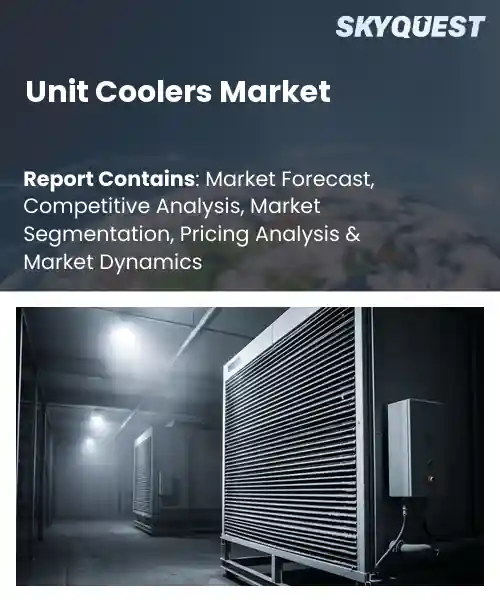
Unit Coolers Market
Report ID: SQMIG20I3335
Report ID: SQMIG20I3335
[email protected]
USA +1 351-333-4748
Report ID:
SQMIG20I3335 |
Region:
Global |
Published Date: July, 2026
Pages:
157
|Tables:
153
|Figures:
78


Global Unit Coolers Market size was valued at USD 1.9 Billion in 2024 and is poised to grow from USD 2.03 Billion in 2025 to USD 3.41 Billion by 2033, growing at a CAGR of 6.7% during the forecast period (2026-2033).
The global unit cooler market comprises compact, closed-loop chillers used to cool industrial equipment, HVAC systems and process water. This technology is important because many industries, such as food processing, pharmaceuticals and data centers, require effective thermal management, where the stability of the temperature is critical to the dependability of the system and the quality of the product.
In addition, the unit coolers market growth is mainly driven by the development of data-center infrastructure, which generates a cascade of downstream cooling needs. Server densities are increasing, and air-conditioning options are not enough. Operators are forced to build unit coolers on chilled-water loops that can remove heat more efficiently and with less energy. That causal relationship is the reason why so many manufacturers are building IoT-enabled monitoring systems that can provide predictive maintenance to reduce downtime in facilities such as hyperscale cloud farms. As digital traffic grows in Southeast Asia, and the grid’s capacity to handle it is limited, effective cooling is becoming a strategic necessity and opening up contracts for suppliers.
The Internet of Things (IoT) in unit coolers is the fusion of sensors, cloud platforms, and control algorithms to create a responsive refrigeration environment. “Essential are adaptive load management, predictive maintenance and remote monitoring. A lot of commercial and industrial sites are now instrumented with power meters and temperature probes that feed data into dashboards. Operators can adjust set points to meet demand, evaluate performance trends and receive alerts before a fault occurs. improves product safety, extends compressor life and reduces energy consumption. Smart units are becoming more common, as manufacturers are putting connectivity in their equipment, adding to the reliability and agility of the system as a whole.
Market snapshot - (2026-2033)
Global Market Size
USD 1.9 Billion
Largest Segment
Floor Mounted Unit Coolers
Fastest Growth
Ceiling Mounted Unit Coolers
Growth Rate
6.7% CAGR
To get more insights on this market click here to Request a Free Sample Report
The global unit coolers market is segmented by product type, refrigerant, application, end user, distribution channel and region. Based on product type, the market is segmented into Ceiling Mounted Unit Coolers, Floor Mounted Unit Coolers, Wall Mounted Unit Coolers, Dual Discharge Unit Coolers and Others. Based on refrigerant, the market is segmented into HFC Refrigerants, Ammonia, CO₂, Hydrocarbons and Others. Based on application, the market is segmented into Cold Storage, Food Processing, Pharmaceutical Storage, Logistics Warehouses and Others. Based on end user, the market is segmented into Food & Beverage Industry, Cold Chain Logistics, Pharmaceutical Industry, Retail and Others. Based on distribution channel, the market is segmented into OEM, HVAC & Refrigeration Distributors, Aftermarket and Others. Based on region, the market is segmented into North America, Europe, Asia Pacific, Latin America and Middle East & Africa.
As per the unit coolers market analysis, the largest segment is ceiling-mounted unit coolers because they fit with the existing overhead infrastructure and save significant floor space, making them ideal for congested storage areas. They are easy to setup and require less downtime. They improve the quality of the product by evenly distributing the cooled air. Manufacturers like this design because it can meet changing space constraints in cold storage and food processing plants, and operators like the energy efficiency that comes with less ductwork.
However, the floor-mounted unit coolers segment is growing at the fastest pace as retailers and logistics companies are seeking flexible placement options that can accommodate different ceiling heights. The design allows them to be retrofitted quickly in aisles, and improvements in modular coil designs have resulted in better performance, higher adoption and new opportunities for market growth.
According to the unit coolers market forecast, the CO2 Refrigerant segment accounts for the largest market share due to its low global warming potential and compliance with stringent environmental regulations. Therefore, manufacturers are focusing on natural refrigerants. Due to its thermodynamic characteristics, it can pass heat pretty efficiently while pressure stays lower, so it tends to consume less energy and ends up with reduced day-to-day operating costs. Industry stakeholders are satisfied about how well it plays with, existing compressor tech and they think this will drive more adoption in pharma settings and cold storage use cases, where sustainability as well as regulatory compliance, they both really matter.
Whereas the major high growth segment is the hydrocarbon refrigerant as manufacturers are taking advantage of the higher energy efficiency and lower cost for small scale units. Better safety measures and regulatory incentives for low-GWP options build confidence. This supports adoption in logistics and food processing plants where low operating costs and compact design are important and can unlock market expansion opportunities.
To get detailed segments analysis, Request a Free Sample Report
As per the unit coolers market regional forecast, Asia-Pacific dominated the market. Asia Pacific leads due to its sophisticated manufacturing skills, strong demand from rapidly expanding industrial sectors and calculated investment in energy-efficient cooling systems. There is a good base of suppliers in the area combining low-cost production methods with high-tech components. Cooling devices that are reliable and compact continue to be in high demand as urbanization and data center growth continue. Stricter environmental laws are pushing manufacturers to develop new refrigerants that have less potential to cause global warming. Collaborative research programs between academia and industry accelerate product development. A strong export infrastructure allows local business to serve growing markets. Collectively, these factors provide the Asia Pacific with a competitive advantage that maintains it at the forefront of unit cooler innovation and market share.
Japan Unit Coolers Market
The Japanese unit coolers sector is characterized by a mature manufacturing ecosystem, with a focus on high reliability and precision engineering. The domestic demand is driven by high-density metropolitan regions, production of sophisticated electronics, and a strong emphasis on energy efficiency in commercial buildings. The focus on export is strengthening the market landscape and staying globally competitive outside. The local businesses with strong R&D capabilities are leading the way for the creation of compact designs with stringent environmental regulations.
South Korea Unit Coolers Market
The South Korean unit coolers industry is driven by an integrated supply chain that combines the knowledge of reliable cooling technologies with advanced semiconductor manufacturing capabilities. The country’s emphasis on intelligent industries and high density data processing is generating a need for efficient and compact cooling units. Local producers are focusing on creating novel modular designs and environmentally friendly refrigerants that can encourage both domestic and international acceptance. This focus on technology leadership also contributes to a dynamic market environment and resilience even now.
Strong trends in industrial automation, a growing focus on energy efficiency and high demand for data center cooling are fueling the rapid North America unit coolers market penetration. In the manufacturing and high-performance computer environments, the dense network of technological hubs in the US and Canada requires reliable, mobile cooling solutions. Manufacturers are developing products with a smaller carbon footprint, and environmental regulations are pushing the industry toward low-impact refrigerants. Investment in renewable energy infrastructure drives ancillary cooling requirements in power conversion systems. Furthermore, the availability of a skilled engineering talent pool and a strong distribution network accelerates the adoption of advanced cooling modules, driving the market momentum across the continent. Further, across industries, there is a further driver of consumers preferring the flexibility of modular systems that can be scaled up with increasing operating loads.
United States Unit Coolers Market
Data center expansion and sustainability measures in the commercial sector are driving growth in the U.S. unit cooler market. Big IT companies are spending a lot of money on super-efficient cooling systems. These systems help them save on operating costs and comply with strict environmental regulations. Now, domestic manufacturers are adding IoT connectivity and smart monitoring to provide predictive maintenance capabilities. Innovation, scale and regulation all come together to make a dynamic industry that is constantly evolving to meet cooling demands.
Canada Unit Coolers Market
There is a strong demand from resource extraction industries and expanding cold-chain logistics networks. With the focus on low-impact refrigerants and climate issues, mining, oil and food processing facilities are being encouraged to use efficient cooling units. Canadian manufacturers are developing modular designs that can handle extreme temperature swings to meet local projects and export opportunities in neighboring regions. Also the emphasis on adaptability and environmental compliance is the basis for the market expansion.
Europe is expanding its unit coolers market share, with a strong focus on sustainability, high efficiency standards and collaborative innovation across borders. The need for low global warming potential refrigerants within regulatory frameworks forces manufacturers to produce more energy-efficient cooling strategies. A big network of engineering research universities in Germany, the UK and France are working together to develop modular, smart-connected unit cooler designs. Investment in renewable energy integration also increases cooling needs for power conversion and storage applications. Furthermore, European companies have a strong focus on quality control and a developed supply chain, which enables them to compete successfully in the global market and improves Europe’s image for reliability and for technological leadership. In addition, the emphasis on circular economy principles has prompted a rethinking of components for longer life cycles, thereby improving the overall marketability.
Germany Unit Coolers Market
Germany has a tradition of precision production and energy efficiency regulations in the unit coolers market. The automotive, chemical and electronics industries require dependable cooling solutions capable of functioning under challenging conditions. To comply with export laws, German companies thus focus on modular construction and environmentally friendly refrigerants. Industry 4.0 demands that collaboration with research centers will accelerate the roll-out of IoT-enabled smart coolers.
UK Unit Coolers Market
The growth of the UK unit coolers market is driven by the growth in the construction and data center industries. Regulatory pressure to limit carbon footprints is driving the uptake of high-efficiency cooling units using low-impact refrigerants. UK businesses are designing flexible solutions to upgrade new builds and historic buildings with new materials and digital controls. The UK is building a reputation as a hub for state-of-the-art cooling technology by working with European research consortia to develop pathways for innovation.
France Unit Coolers Market
An industrial base in food processing, pharmaceuticals and aerospace, and an energy transition commitment support French unit coolers market. National regulations to encourage the use of low-GWP refrigerants have manufacturers designing efficient, low-noise cooling units for both new installations and retrofits. The French companies are banking on modularity and integration with renewable energies to create demand for off-grid and hybrid solutions. Strong links with technical universities enable France to remain at the forefront of innovation and accelerate the optimization of AI performance.
To know more about the market opportunities by region and country, click here to
Buy The Complete Report
Rising Demand for Data Centers
The quick expansion of cloud computing and edge services is pushing new data center builds , and it’s also pulling along a higher need for better cooling solutions . As server densities go up , unit coolers become a must to keep the gear within the right temperature band, so it offers reliability and less downtime. In reaction, manufacturers have released small yet high-performing models that can actually work in limited space, which has sped up market take up across different geographic regions . These units feature advanced heat exchangers and variable speed fans for tighter efficiency, lower energy draw , and smart monitoring that can forecast maintenance, plus support higher uptime longer-term.
Energy Efficiency Regulations Favoring Coolers
Unit coolers are localized cooling solutions , and they’re frequently more energy efficient than centralized setups , which lines up with compliance objectives. One big market driver is regulatory pressure on manufacturers to move toward greener designs , for example low-loss compressors and environmentally safer refrigerants . At the same time, operators are upgrading older hardware to satisfy mandated performance targets and sustainability promises. These energy efficient units also help firms reach corporate carbon reduction goals , so it’s not just operational, it’s strategic too.
High Initial Capital Expenditure
The up front costs for unit coolers are expensive, and to cover large data centers adequately it often need many units. Organizations may end up delaying cooling upgrades because they have other priorities, plus the usual financial constraints . Specialized installation know-how and integration with the existing infrastructure further nudge project budgets upward, making stakeholders cautious . Because of that, the heavy capital requirement could slow market penetration, especially in price sensitive areas where budget approvals can be complicated and slower.
Technical Complexity of Integration
From an engineering standpoint, fitting unit coolers into existing cooling architectures can get tricky , mainly around airflow distribution and refrigerant loop compatibility . Those technical barriers typically require detailed system design, extended testing , and sometimes retrofitting hardware , which can lengthen timelines and raise risk . On top of that, maintenance routines and spare parts availability may also become stumbling blocks for operators who are not fully confident about these topics. So, the perceived integration complexity can act as a deterrent—meaning companies may be less willing to switch to unit cooler solutions , which then impedes overall market growth . There can also be additional increases in operating costs , tied to staff training and certification requirements.
Request Free Customization of this report to help us to meet your business objectives.
In the fiercely competitive global unit coolers market, manufacturers are leveraging strategic M&A, joint ventures and technology-driven product innovations to address the growing demand for energy-efficient cooling solutions. New alliances between hardware vendors and HVAC distributors have sped up product rollouts, while purchases of niche thermal-management firms have broadened product lines and geographic coverage, bolstering competitive positioning in several key regions.
Top Player’s Company Profile
Recent Developments in the Unit Coolers Market
March 2025: Baltimore Aircoil Company (BAC) continued to move forward in industrial and evaporative cooling technologies, offering energy-efficient parts and enhanced controls for process cooling and commercial refrigeration. The company concentrated on reducing water and energy use of cooling systems.
February 2025: The LU-VE Group has expanded its range of evaporators and unit coolers due to improvements in designs and technology for heat exchangers, fans and low-noise solutions for food storage, logistics and industrial refrigeration applications. The business said it was less expensive and more efficient.
January 2025: Guntner leaned into systems that use natural refrigerants such as CO2 and ammonia, so cold-chain operators can quickly spot sustainable refrigeration options and map out what fits best.
SkyQuest’s ABIRAW (Advanced Business Intelligence, Research & Analysis Wing) is our Business Information Services team that Collects, Collates, Correlates, and Analyses the Data collected by means of Primary Exploratory Research backed by robust Secondary Desk research.
As per SkyQuest analysis, the unit cooler market is being propelled by the swift growth of data-center infrastructure, which is generating a strong demand for compact, high-efficiency cooling units. Manufacturers are also encouraged by strict energy-efficiency standards to adopt low-GWP refrigerants and intelligent IoT controls. The ceiling-mounted unit cooler segment dominates the market because of the space-saving feature and uniform cooling. Asia Pacific is the largest market worldwide due to the strong manufacturing base and the rapidly growing industrial demand in the region. However, due to the large initial capital expenditure required for deployment, especially in cost-sensitive projects, adoption is limited in the forecasted period.
| Report Metric | Details |
|---|---|
| Market size value in 2024 | USD 1.9 Billion |
| Market size value in 2033 | USD 3.41 Billion |
| Growth Rate | 6.7% |
| Base year | 2024 |
| Forecast period | (2026-2033) |
| Forecast Unit (Value) | USD Billion |
| Segments covered |
|
| Regions covered | North America (US, Canada), Europe (Germany, France, United Kingdom, Italy, Spain, Rest of Europe), Asia Pacific (China, India, Japan, Rest of Asia-Pacific), Latin America (Brazil, Rest of Latin America), Middle East & Africa (South Africa, GCC Countries, Rest of MEA) |
| Companies covered |
|
| Customization scope | Free report customization with purchase. Customization includes:-
|
To get a free trial access to our platform which is a one stop solution for all your data requirements for quicker decision making. This platform allows you to compare markets, competitors who are prominent in the market, and mega trends that are influencing the dynamics in the market. Also, get access to detailed SkyQuest exclusive matrix.
Table Of Content
Executive Summary
Market overview
Parent Market Analysis
Market overview
Market size
KEY MARKET INSIGHTS
COVID IMPACT
MARKET DYNAMICS & OUTLOOK
Market Size by Region
KEY COMPANY PROFILES
Methodology
For the Unit Coolers Market, our research methodology involved a mixture of primary and secondary data sources. Key steps involved in the research process are listed below:
1. Information Procurement: This stage involved the procurement of Market data or related information via primary and secondary sources. The various secondary sources used included various company websites, annual reports, trade databases, and paid databases such as Hoover's, Bloomberg Business, Factiva, and Avention. Our team did 45 primary interactions Globally which included several stakeholders such as manufacturers, customers, key opinion leaders, etc. Overall, information procurement was one of the most extensive stages in our research process.
2. Information Analysis: This step involved triangulation of data through bottom-up and top-down approaches to estimate and validate the total size and future estimate of the Unit Coolers Market.
3. Report Formulation: The final step entailed the placement of data points in appropriate Market spaces in an attempt to deduce viable conclusions.
4. Validation & Publishing: Validation is the most important step in the process. Validation & re-validation via an intricately designed process helped us finalize data points to be used for final calculations. The final Market estimates and forecasts were then aligned and sent to our panel of industry experts for validation of data. Once the validation was done the report was sent to our Quality Assurance team to ensure adherence to style guides, consistency & design.
Analyst Support
Customization Options
With the given market data, our dedicated team of analysts can offer you the following customization options are available for the Unit Coolers Market:
Product Analysis: Product matrix, which offers a detailed comparison of the product portfolio of companies.
Regional Analysis: Further analysis of the Unit Coolers Market for additional countries.
Competitive Analysis: Detailed analysis and profiling of additional Market players & comparative analysis of competitive products.
Go to Market Strategy: Find the high-growth channels to invest your marketing efforts and increase your customer base.
Innovation Mapping: Identify racial solutions and innovation, connected to deep ecosystems of innovators, start-ups, academics, and strategic partners.
Category Intelligence: Customized intelligence that is relevant to their supply Markets will enable them to make smarter sourcing decisions and improve their category management.
Public Company Transcript Analysis: To improve the investment performance by generating new alpha and making better-informed decisions.
Social Media Listening: To analyze the conversations and trends happening not just around your brand, but around your industry as a whole, and use those insights to make better Marketing decisions.
REQUEST FOR SAMPLE
 REQUEST FREE CUSTOMIZATION
Global Unit Coolers Market size was valued at USD 1.9 Billion in 2024 and is poised to grow from USD 2.03 Billion in 2025 to USD 3.41 Billion by 2033, growing at a CAGR of 6.7% during the forecast period (2026-2033).
The global unit coolers market is shaped by intense competition as manufacturers pursue strategic M&A, joint ventures, and technology‑driven product innovations to capture growing demand for energy‑efficient cooling solutions. Recent partnerships between hardware suppliers and HVAC distributors have accelerated market entry, while acquisitions of niche thermal‑management firms have expanded product portfolios and geographic reach, reinforcing competitive positioning across key regions. 'Güntner GmbH & Co. KG', 'Kelvion Holding GmbH', 'LU-VE S.p.A.', 'EVAPCO, Inc.', 'Friga-Bohn (Lennox EMEA)', 'Alfa Laval AB', 'Baltimore Aircoil Company', 'Modine Manufacturing Company', 'Thermofin GmbH', 'Colmac Coil Manufacturing, Inc.', 'Heatcraft Worldwide Refrigeration', 'Carrier Global Corporation', 'Daikin Industries, Ltd.', 'Mitsubishi Electric Corporation', 'Panasonic Holdings Corporation', 'BITZER Kühlmaschinenbau GmbH', 'Ebm-papst Group', 'Systemair AB', 'Sanhua Holding Group Co., Ltd.', 'Zhejiang DunAn Artificial Environment Co., Ltd.'
Rapid expansion of cloud computing and edge services is driving the construction of new data centers, which in turn increases the need for efficient cooling solutions. As server densities rise, unit coolers become essential for maintaining optimal operating temperatures, ensuring equipment reliability, and reducing downtime. Manufacturers respond by developing compact, high-performance models that fit constrained spaces, thereby accelerating market adoption across diverse geographic regions. These units feature advanced heat exchangers and variable-speed fans, boosting efficiency while cutting power use, and smart monitoring helps predict maintenance, enhancing uptime.
Energy Efficient Refrigerants: Manufacturers are rapidly transitioning to low‑global‑warming‑potential refrigerants, driven by tightening environmental regulations and growing client demand for greener solutions. These alternatives deliver comparable cooling performance while reducing carbon footprints, enabling end‑users to meet sustainability targets. The shift also spurs collaborative innovation with chemical suppliers, fostering the development of proprietary blends optimized for unit cooler efficiency. As the regulatory landscape evolves, early adopters gain competitive advantage through enhanced brand reputation and alignment with corporate ESG commitments in the global market today.
Why does Asia Pacific Dominate the Global Unit Coolers Market? |@12


Want to customize this report? This report can be personalized according to your needs. Our analysts and industry experts will work directly with you to understand your requirements and provide you with customized data in a short amount of time. We offer $1000 worth of FREE customization at the time of purchase.
Feedback From Our Clients


 USA (+1) 351-333-4748

