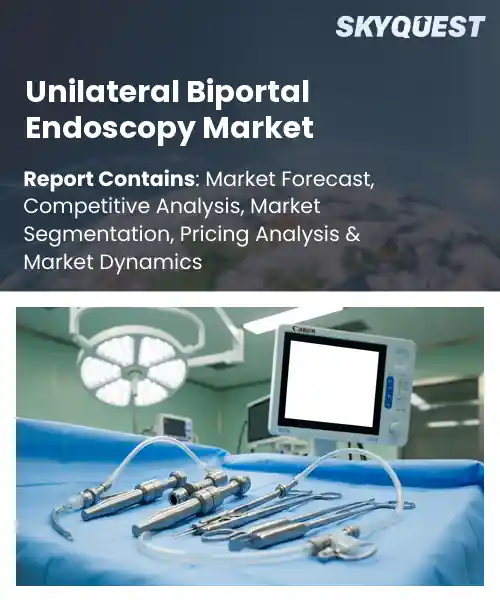
Unilateral Biportal Endoscopy Market
Report ID: SQMIG35A3446
Report ID: SQMIG35A3446
[email protected]
USA +1 351-333-4748
Report ID:
SQMIG35A3446 |
Region:
Global |
Published Date: May, 2026
Pages:
157
|Tables:
118
|Figures:
72


Global Unilateral Biportal Endoscopy Market size was valued at USD 382.5 Million in 2024 and is poised to grow from USD 425.03 Million in 2025 to USD 985.4 Million by 2033, growing at a CAGR of 11.12% during the forecast period (2026-2033).
The global unilateral biportal endoscopy market growth is primarily formed by the growing trend towards performing spinal surgeries with minimally invasive techniques in order to produce improved clinical results and quicker recovery times for patients. The ways in which a surgeon can perform UBE to visualize and manipulate instrumentation in a lumbar decompression or discectomy procedure (two different forms of surgery for certain back conditions) allow for reduced trauma to the surrounding soft tissues and shorter hospital stays compared to traditional (open) surgical techniques. The UBE technique was first introduced in South Korea, but it has since become a widely implemented and accepted surgical technique through physician training and tools that allow for guided instrumentation during the procedure. Because of ongoing efforts by manufacturers and surgeons/hospitals to provide cost-effective and satisfactory patient treatment options, surgeons and hospitals have been rapidly adopting UBE.
Moreover, the unilateral biportal endoscopy sector will continue to grow due to the combined effects of an aging and increasingly diverse population and the ongoing challenges surrounding the economic viability of providing sufficient quality-of-care options for all patients with less invasive surgical treatments. Age-related changes to the spine that cause degenerative disorders (i.e., herniated discs, spondylosis, spondylolisthesis) are common in the older population; thus, providing effective, and minimally invasive, treatments for them is essential. Therefore, UBE is preferred over traditional surgical methods because they produce minimal morbidity and allow for same-day discharge (outpatient) options. In response to this demand, UBE manufacturers are producing and introducing increasingly slim optics, dedicated and navigation adjunct instruments, into the marketplace. This will expand indications for surgery, allowing for more complex decompression and revision cases to be performed, also increasing demand for UBE services.In practice, surgeons perform ambulatory lumbar discectomies and bilateral decompressions through two portals, which lowers costs and improves throughput, reinforcing further adoption.
How is AI Enhancing Diagnostic Accuracy In The Unilateral Biportal Endoscopy Market?
AI is increasing the accuracy of diagnosing conditions using unilateral biportal endoscopy through improved visualization, pattern recognition and intraoperative decision support. Enhancement of the images, automated detection of anomalies and tracking of instruments have been used to assist surgeons with the identification of subtle pathology and confirmation of margins. As clinical pilots begin to implement navigation guided workflows and intelligent multimodal reconstruction, the consistency and variability between operators will be addressed. Examples of this technology include the provision of augmented visualization for tissue differentiation, and the use of AI to highlight anatomical landmarks and thereby decrease the learning curve.
Furthermore, the introduction of this technology into routine clinical practice will increase the safety of patient outcomes. In a multicenter study conducted by Olympus in February 2026, it was reported that their CADDIE AI system demonstrated improved detection rates of lesions. The use of this type of technology for real time computer-aided detection in unilateral biportal endoscopy will ultimately reduce the number of missed findings, accelerate the speed of interpretation and enhance surgeon confidence, which will ultimately result in greater rates of adoption and efficiencies within the surgical workflow.
Market snapshot - (2026-2033)
Global Market Size
USD 382.5 Million
Largest Segment
Visualization Systems
Fastest Growth
Visualization Systems
Growth Rate
11.12% CAGR
To get more insights on this market click here to Request a Free Sample Report
Global unilateral biportal endoscopy market is segmented by product type, application, end-user and region. Based on product type, the market is segmented into Endoscopes, Surgical Instruments and Visualization Systems. Based on application, the market is segmented into Lumbar Disc Herniation, Spinal Stenosis, Foraminal Stenosis and Others. Based on end-user, the market is segmented into Hospitals, Orthopedic Clinics and Spine Centers. Based on region, the market is segmented into North America, Europe, Asia Pacific, Latin America and Middle East & Africa.
As per global unilateral biportal endoscopy market analysis, the visualization systems division holds the leading position with valuable imaging systems providing real-time detail and three-dimensional vision, which are both vital for the safe performance of a unilateral biportal endoscopy. High-quality optics, integrated light sources and a seamless connection to both recording and navigation systems allow surgeons to have more confidence in their ability to handle tissue during surgery, as well as reducing uncertainty when working with tissues. The emphasis placed on promoting visualization will encourage hospitals to purchase and use these tools and will also facilitate the development of training programs that support the practice of using high-quality intraoperative feedback.
As per global unilateral biportal endoscopy market forecast, endoscope is the fastest growing segment. The proliferation of minimalisation and ergonomic redesign, combined with improvements to the irrigation system, make accessing the surgical site easier to achieve; these factors will also contribute to a decrease in the complexity of the surgical procedure. As well, as surgeons become more comfortable with the use of innovative devices there will be more opportunities to perform the technique and therefore greater utilisation of the devices will expedite the adoption of these technologies into the clinical setting.
As per global unilateral biportal endoscopy market outlook, the lumbar disc herniation segment is by far the most dominant sector as the need for targeted disc decompression via unilateral biportal endoscopy is aligned with how the technique is capable of providing direct access to the disc without disrupting surrounding muscle tissue. Lesion localization in this area is also well-defined and presents favorable recovery profiles which lead to an increase in surgeon utilization of the technique for surgical treatment of lumbar disc herniations; because of this, there has been an emphasis placed on developing devices specifically designed for this use, creating specialty training for the procedure, and firmly establishing standard pathways for performing these procedures.
Despite these underlying trends, there is currently a greater degree of momentum within the market for spinal stenosis than any other segment due to the fact that ongoing refinements made to the technique are allowing for successful multilevel decompressions without compromising the stability of the respective segments. As a result, the clinical acceptance of the technique continues to expand; there are multiple purpose-built instruments created for performing bony decompressions of this type and there is now more clinical evidence confirming the efficacy of using these instruments compared to the prior methods. Thus, surgical providers are becoming more familiar with and invested in the training and tools necessary to provide these procedures, thereby expanding their procedural volume and creating additional commercial opportunities.
To get detailed segments analysis, Request a Free Sample Report
As per global unilateral biportal endoscopy market regional outlook, global market is dominated by North America due to the presence of highly trained and experienced clinicians, the sophisticated and extensive healthcare system, and an ecosystem comprised of many suppliers of devices and services. The number of clinicians who have received training in this technique and the presence of a large number of centers of excellence enable the rapid adoption and improvement of the procedure. Support for new products in the market is bolstered by collaborative clinical studies and early involvement of regulatory bodies with regard to the introduction of new products to the marketplace. The availability of established distribution channels and partnerships between manufacturers and major hospitals also promotes access to the marketplace. High levels of consumer familiarity and interest regarding minimally invasive approaches to having the spine treated and continued investment in training of surgeons and staff further strengthen North America’s leadership and influence over the practice and technology standards globally. The availability of supportive reimbursement policies through proactive involvement by payers enhances the utilization of clinical practice and the availability of multiple opportunities to learn through professional organizations and through other venues for surgeons allows for accelerated education and training throughout the world.
The unilateral biportal endoscopy sectorin the USA is characterized by high levels of clinical and technological proficiency, an abundance of leading device manufacturers, and a wealth of clinical research conducted at the top academic centers in the country. There are strong hospital networks supporting the adoption of UBE procedures, as well as initiatives for training on UBE procedure techniques. Collaboration between industry and the clinical community supports the creation of guidelines and generation of real world clinical evidence to promote physician confidence in UBE, as well as to increase the number of referrals for UBE procedures. The commercial infrastructure and distributors provide access to UBE technology in multiple healthcare settings, ensuring that UBE procedures will be widely adopted by UBE surgeons.
The unilateral biportal endoscopy market in Canada is geared towards expanding access to UBE surgery by establishing regional surgery centres; developing integrated care pathways from primary care to specialty care; and creating training networks to promote the adoption of endoscopic spine surgery techniques. Provincial health systems and tertiary care hospitals are working with UBE manufacturers to develop surgeon training programs to promote the adoption of UBE surgical techniques. The emphasis on providing multidisciplinary care and developing pathway strategies for patients requires referrals for minimally invasive procedures. In addition to distributing UBE technology to UBE surgeons in all regions of Canada, UBE distributors also provide central purchasing support for UBE manufacturers.
As per global unilateral biportal endoscopy market regional analysis, the rapid growth of the market in Europe is attributable to several factors including the establishment and working of clinical standards, the availability of educational resources for practitioners, and the availability of comprehensive models for health care delivery. Professional societies promote the education of practitioners in techniques through the organization of specialist meetings and the provision of informal hands-on training. Additionally, financial incentives to use endoscopic techniques in a number of key European markets, combined with hospital adoption programs that are focused on getting hospitals to use endoscopic techniques consistently results in lower barriers to the use of endoscopic techniques clinically. The competitive nature of the medical device industry and the active collaboration between manufacturers and academic centers leads manufacturers to innovate and refine their tools and procedural protocols in the development process. Finally, European centers of excellence are sharing their experiences with others through cross border collaboration, and there is a growing awareness of minimally invasive spine surgery by various groups supporting these techniques, including multidisciplinary spine units. Furthermore, harmonization of regulatory guidelines and the coordination of procurement activities in Europe are supporting greater access to endoscopic techniques, and standards across Europe that will lead to the development of uniform clinical practices in the region. Finally, local training academies are directing surgeon training, and manufacturers are customizing instrumentation to meet the needs of the clinician, therefore will promote the utilization of UBE in the market.
The unilateral biportal endoscopy market in Germany benefits from strong connections between academic medical centers, specialized spine centers, and device manufacturers. Tertiary hospitals (those that perform the highest level of complex surgical procedures) help spinal surgeons learn how to use new technology as they refine their devices. Evidence-based clinical data from collaboration between hospitals and manufacturers support the creation of guidelines and standardized practices for performing surgical procedures. In addition, regional procurement networks and education academies support the development of spinal surgery skills for surgeons. The integrated nature of Germany’s healthcare system provides the foundation to support the adoption of advanced surgical techniques and establishes the country as an important reference market for the best practices used in spinal surgery.
The rate of adoption of unilateral biportal endoscopy in the United Kingdom is rising quickly as a result of increased training programs, new service models, and enhanced collaboration between hospitals and industry. Fellowship programs and workshops facilitate rapid skill acquisition by spinal surgeons. The implementation of minimally invasive pathways in the delivery of spinal services, along with emphasis on patient throughput, contributes significantly to the adoption of these technologies by hospitals. Collaborative pilots that involve spinal surgeon expertise and feedback to refine devices and improve outcomes will promote rapid adoption of these new technologies. Centralized professional networks and peer-to-peer learning also increase dissemination of knowledge and resources within care environments.
The Unilateral Biportal Endoscopy Market in the French territory is rapidly evolving due to different initiatives focused at the tertiary hospitals, pilot projects and increased collaboration between clinicians and device manufacturers. To date, early adopter centres are concentrating their efforts on creating procedural pathways and training modules for their staff. The national association forum and sub-specialty group meetings have incorporated technique training and clinical meetings on the topic of Unilateral Biportal Endoscopy. In addition, institutions have invested in surgeon education as well as selective purchasing by hospitals, all of which contribute to initial distribution and ultimately, to broadening the standardization of clinical practice and optimising the use of these devices.
The Unilateral Biportal Endoscopy market in Asia-Pacific is benefiting from growing investments in clinical training, product development tailored for the local market, and expanding the network of centres of excellence throughout the region. Many of the region's manufacturers and research institutions are working together to adapt instrumentations to both the local surgical preferences as well as their procedural workflows. Surgeon education programs that include both didactic and hands-on workshops, and fellowship exchanges have improved surgeon competence and accelerated the diffusion of this technique. Many public and private hospital systems in Asia-Pacific have begun to incorporate minimally invasive spinal surgery into their overall surgical offerings, while also leveraging cross-border educational collaborations to share and exchange knowledge. Enhanced distribution networks and targeted industry partnerships have increased the accessibility of these technologies within both urban and rural hospitals, establishing Asia-Pacific as a contributor to global clinical evidence and innovation in the development of new medical devices. The presence of supportive regulatory pathways, along with the establishment of regional conferences that highlight clinical outcomes, further demonstrate the rapid dissemination of the Unilateral Biportal Endoscopy technique by encouraging physicians to adopt best practices established by leading clinicians in their region through their roles as regional opinion leaders.
Unilateral Biportal Endoscopy Market in Japan has a strong driving force of a well-developed infrastructure, strong academic leadership, and focused R&D within the country. Primary training to assist surgeons develop the necessary skills for partaking in minimally invasive strategies is centered on surgery modeling, and much of the training occurs via structured training models of hospitals. The collaborative relationships between manufacturers and clinical teams assist in the customization and subsequent refinement of devices. To assist with the transfer of knowledge, the medical professional societies conduct regular meetings and ongoing educational workshops (studies) throughout the nation. As a result, due to their clinical expertise and manufacturers' capabilities, Japan serves as a major contributor to the development to technical innovation and maturation of these techniques, and the clinical leadership presence in the region.
Unilateral Biportal Endoscopy Market in South Korea is supported by its strong surgical expertise, agile manufacturing of devices, and focused surgical training programs within hospitals throughout South Korea. Clinical centers in South Korea focus on quick learning of procedures for surgeons through structured workshops and fellowships, while also collaborating with technology companies to assist with the implementation of similar programs. Additionally, national conferences and established peer-support are also provided for continuous knowledge dissemination. With both clinical and industrial capabilities combined, this has enhanced South Korea's ability to lead the adoption of these devices regionally, and help drive their evolution in the market.
To know more about the market opportunities by region and country, click here to
Buy The Complete Report
Surge In Minimally Invasive Preference
Healthcare providers are implementing unilateral biportal endoscopy because they are seeing a rise in both patient and clinician preference for less invasive procedures that minimize tissue disruption and provide faster functional recovery. Hospital facilities often see these services as a way to enhance their procedural offerings as well as to be more competitive; therefore, hospitals are investing in training programs, purchasing the necessary devices, and providing interdisciplinary support for their use. Surgeons who want better visualization, instrument maneuverability, and ergonomic workflow are more likely to implement unilateral biportal endoscopy into their practice, thus supporting the adoption and continued growth of the market.
Technological Advancements In Instrumentation
High Initial Capital Requirements
The initial use of specialized endoscopic towers and instruments, along with visualization equipment for performing unilateral biportal endoscopy, is often a deterring factor for hospitals and surgical centers to adopt these new technologies due to limited capital budgets and competing priorities of existing equipment to purchase. Therefore, procurement committees tend to purchase well-established, legacy technologies that can be used in ways other than for unilateral biportal endoscopy first, delaying their decisions on making these purchases for unilateral biportal endoscopy. Additionally, hospitals and surgical centers are not likely to invest in unilateral biportal endoscopic equipment with worries about the return on investment, complementary consumables required, or maintenance agreements; this leads to hospitals and surgical centers being cautious with their finances and is one of the reasons why unilateral biportal endoscopy has not rapidly expanded to meet the clinical interest in utilizing the technique.
Limited Surgeon Training Opportunities
Request Free Customization of this report to help us to meet your business objectives.
Due to the competitive nature of the current operating environment, leading visualization and implantation firms are entering into unilateral biportal endoscophy via mergers and acquisitions (M&A), integrated platforms and provided training for surgeons. Examples include: Karl Storz's acquisition of Asensus, Erbe's acquisition of Maxer, and the launch of joimax's iLESSYS biportal. This level of competition also drives competing companies to build partner networks with complementary technologies to facilitate efficient hospital adoption and training.
SkyQuest’s ABIRAW (Advanced Business Intelligence, Research & Analysis Wing) is our Business Information Services team that Collects, Collates, Correlates, and Analyses the Data collected by means of Primary Exploratory Research backed by robust Secondary Desk research
As per SkyQuest analysis, the unilateral biportal endoscopy market is driven primarily by the global shift toward minimally invasive spinal procedures that shorten recovery and reduce tissue trauma, while growth is restrained by high initial capital requirements for specialized towers and instruments. North America remains the dominating region thanks to advanced clinical expertise, reimbursement support and strong industry-hospital networks, and the lumbar disc herniation application is the dominating segment due to predictable lesion access and favorable recovery profiles. A second important driver is ongoing technological advancement in instrumentation and visualization platforms that improve operative clarity and expand indications, supporting broader adoption across hospitals and ambulatory centers.
| Report Metric | Details |
|---|---|
| Market size value in 2024 | USD 382.5 Million |
| Market size value in 2033 | USD 985.4 Million |
| Growth Rate | 11.12% |
| Base year | 2024 |
| Forecast period | (2026-2033) |
| Forecast Unit (Value) | USD Million |
| Segments covered |
|
| Regions covered | North America (US, Canada), Europe (Germany, France, United Kingdom, Italy, Spain, Rest of Europe), Asia Pacific (China, India, Japan, Rest of Asia-Pacific), Latin America (Brazil, Rest of Latin America), Middle East & Africa (South Africa, GCC Countries, Rest of MEA) |
| Companies covered |
|
| Customization scope | Free report customization with purchase. Customization includes:-
|
To get a free trial access to our platform which is a one stop solution for all your data requirements for quicker decision making. This platform allows you to compare markets, competitors who are prominent in the market, and mega trends that are influencing the dynamics in the market. Also, get access to detailed SkyQuest exclusive matrix.
Table Of Content
Executive Summary
Market overview
Parent Market Analysis
Market overview
Market size
KEY MARKET INSIGHTS
COVID IMPACT
MARKET DYNAMICS & OUTLOOK
Market Size by Region
KEY COMPANY PROFILES
Methodology
For the Unilateral Biportal Endoscopy Market, our research methodology involved a mixture of primary and secondary data sources. Key steps involved in the research process are listed below:
1. Information Procurement: This stage involved the procurement of Market data or related information via primary and secondary sources. The various secondary sources used included various company websites, annual reports, trade databases, and paid databases such as Hoover's, Bloomberg Business, Factiva, and Avention. Our team did 45 primary interactions Globally which included several stakeholders such as manufacturers, customers, key opinion leaders, etc. Overall, information procurement was one of the most extensive stages in our research process.
2. Information Analysis: This step involved triangulation of data through bottom-up and top-down approaches to estimate and validate the total size and future estimate of the Unilateral Biportal Endoscopy Market.
3. Report Formulation: The final step entailed the placement of data points in appropriate Market spaces in an attempt to deduce viable conclusions.
4. Validation & Publishing: Validation is the most important step in the process. Validation & re-validation via an intricately designed process helped us finalize data points to be used for final calculations. The final Market estimates and forecasts were then aligned and sent to our panel of industry experts for validation of data. Once the validation was done the report was sent to our Quality Assurance team to ensure adherence to style guides, consistency & design.
Analyst Support
Customization Options
With the given market data, our dedicated team of analysts can offer you the following customization options are available for the Unilateral Biportal Endoscopy Market:
Product Analysis: Product matrix, which offers a detailed comparison of the product portfolio of companies.
Regional Analysis: Further analysis of the Unilateral Biportal Endoscopy Market for additional countries.
Competitive Analysis: Detailed analysis and profiling of additional Market players & comparative analysis of competitive products.
Go to Market Strategy: Find the high-growth channels to invest your marketing efforts and increase your customer base.
Innovation Mapping: Identify racial solutions and innovation, connected to deep ecosystems of innovators, start-ups, academics, and strategic partners.
Category Intelligence: Customized intelligence that is relevant to their supply Markets will enable them to make smarter sourcing decisions and improve their category management.
Public Company Transcript Analysis: To improve the investment performance by generating new alpha and making better-informed decisions.
Social Media Listening: To analyze the conversations and trends happening not just around your brand, but around your industry as a whole, and use those insights to make better Marketing decisions.
REQUEST FOR SAMPLE
 REQUEST FREE CUSTOMIZATION
Global Unilateral Biportal Endoscopy Market size was valued at USD 382.5 Million in 2024 and is poised to grow from USD 425.03 Million in 2025 to USD 985.4 Million by 2033, growing at a CAGR of 11.12% during the forecast period (2026-2033).
The competitive landscape is shaped by established visualization and implant firms expanding into unilateral biportal endoscopy through M&A, platform integration and surgeon training—for example Karl Storz’s acquisition of Asensus, Erbe’s purchase of Maxer, and joimax’s iLESSYS biportal launch—while rivalries drive partner networks and targeted product rollouts that accelerate hospital adoption and training programmes. 'Richard Wolf GmbH', 'Karl Storz SE', 'Stryker Corporation', 'Joimax GmbH', 'Adeor Medical AG', 'Spinendos', 'Medtronic plc', 'NuVasive Inc.', 'Globus Medical', 'Olympus Corporation', 'Arthrex Inc.', 'Advanced Medical Systems', 'SpineCraft Medical', 'Vivos Inc.', 'Syard Endoscopy'
The rising patient and clinician preference for procedures that minimize tissue disruption and speed functional recovery encourages healthcare providers to adopt unilateral biportal endoscopy, because it aligns with goals of reduced postoperative pain and improved early mobility. Hospitals view such techniques as a way to enhance procedural offerings and remain competitive, prompting investment in training, device procurement, and interdisciplinary support. Surgeons seeking improved visualization, instrument maneuverability, and ergonomic workflows are more likely to incorporate these systems into practice, reinforcing adoption and supporting steady market expansion.
Shift To Ambulatory Care: The minimally invasive profile of unilateral biportal endoscopy is accelerating adoption in ambulatory surgical centers and same-day discharge. Stakeholders favor procedures that reduce perioperative morbidity and recovery time, prompting hospitals and outpatient facilities to prioritize workflows and instrumentation optimized for shorter stays. Device makers and providers are designing procedure kits, streamlined sterilization processes and tailored training that align with outpatient operational needs, while payers and providers increasingly support care models emphasizing efficiency, patient convenience and faster return to daily activities.
Why does North America Dominate the Global Unilateral Biportal Endoscopy Market? |@12


Want to customize this report? This report can be personalized according to your needs. Our analysts and industry experts will work directly with you to understand your requirements and provide you with customized data in a short amount of time. We offer $1000 worth of FREE customization at the time of purchase.
Feedback From Our Clients


 USA (+1) 351-333-4748

