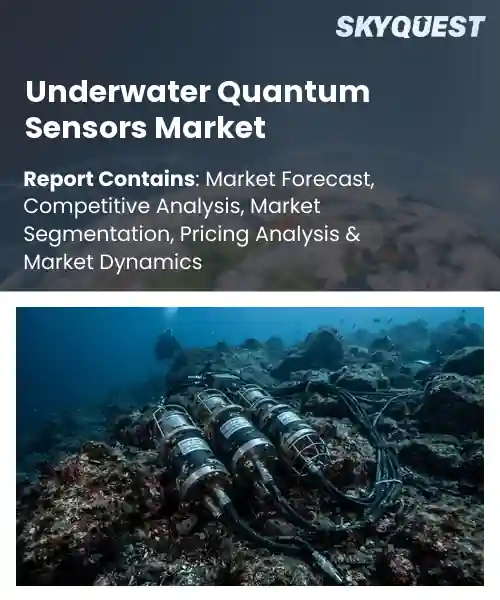
Underwater Quantum Sensors Market
Report ID: SQMIG45J3000
Report ID: SQMIG45J3000
[email protected]
USA +1 351-333-4748
Report ID:
SQMIG45J3000 |
Region:
Global |
Published Date: September, 2026
Pages:
157
|Tables:
155
|Figures:
78


Global Underwater Quantum Sensors Market size was valued at USD 62.0 Million in 2024 and is poised to grow from USD 71.42 Million in 2025 to USD 221.55 Million by 2033, growing at a CAGR of 15.2% during the forecast period (2026-2033).
The global underwater quantum sensors market comprises devices that exploit quantum phenomena such as superposition and entanglement to achieve sensitivity in measuring magnetic fields, temperature, pressure and acoustic signatures beneath the sea surface. Its significance stems from the escalating demand for precise navigation, submarine detection and marine‑environment monitoring across defense, energy and scientific sectors. The market emerged in the 2010s when research laboratories demonstrated prototype gravimeters and magnetometers based on nitrogen‑vacancy diamonds, and it has accelerated as integration lowered production costs. Today, firms like QinetiQ, Lockheed Martin and Ocean Quantum are delivering units that support underwater vehicles, illustrating the technology’s maturation. Among the catalysts propelling the underwater quantum sensors market, the proliferation of subsea platforms stands out as a growth factor because these vehicles need sensor suites that operate without GPS and deliver real‑time data. Quantum magnetometers detect geomagnetic anomalies, allowing drones to map seafloor mineral deposits for offshore mining while reducing costly ship‑based surveys. Quantum gravimeters afford bathymetric mapping, which improves route planning for undersea cables and mitigates collision risks for shipping. These applications generate significant revenue streams for sensor makers and stimulate substantial investment in miniaturized quantum chips, thereby rapidly expanding the addressable market globally in the next decade.
How is AI enhancing performance and scalability in the underwater quantum sensors market?
AI is reshaping underwater quantum sensors by embedding adaptive algorithms that filter noise, predict drift, and optimize measurement cycles in real time. Machine‑learning models learn from oceanic data streams, allowing sensors to maintain calibration without manual intervention and to operate reliably across vast depths. This intelligence reduces power consumption, extends battery life, and enables larger sensor arrays to be deployed without proportionally increasing system complexity. As research labs and defense agencies push for finer resolution in submarine navigation and marine‑resource monitoring, AI‑driven data fusion creates richer, actionable insights, making the technology more attractive to operators seeking both precision and operational efficiency.No specific recent development can be cited at this time.
Market snapshot - (2026-2033)
Global Market Size
USD 62.0 Million
Largest Segment
Quantum Magnetometers
Fastest Growth
Quantum Accelerometers
Growth Rate
15.2% CAGR
To get more insights on this market click here to Request a Free Sample Report
Global underwater quantum sensors market is segmented by sensor type, quantum technology, application, platform, end-use industry and region. Based on sensor type, the market is segmented into Quantum Magnetometers, Quantum Gravimeters, Quantum Accelerometers, Quantum Inertial Sensors and Others. Based on quantum technology, the market is segmented into Atomic-Based, Nitrogen-Vacancy Centers, Superconducting and Others. Based on application, the market is segmented into Underwater Navigation, Seabed Mapping, Submarine Detection, Oceanographic Research, Mineral Exploration and Others. Based on platform, the market is segmented into Autonomous Underwater Vehicles, Remotely Operated Vehicles, Submarines, Fixed Underwater Platforms and Others. Based on end-use industry, the market is segmented into Defense & Security, Oil & Gas, Marine Research, Mining, Environmental Monitoring and Others. Based on region, the market is segmented into North America, Europe, Asia Pacific, Latin America and Middle East & Africa.
Quantum Magnetometers segment dominates because they directly measure magnetic anomalies that are critical for precise underwater navigation and submarine detection, offering unparalleled sensitivity in the conductive marine environment. Their ability to operate without extensive calibration and to integrate with existing navigation suites drives widespread adoption. Continuous improvements in cryogenic shielding and miniaturization further enhance reliability, making them the preferred choice for defense and research stakeholders seeking robust, high resolution magnetic field data.
However, Quantum Gravimeters segment is emerging as the most rapidly expanding because its ability to detect subtle variations in the Earth's gravity field enables high precision seabed mapping and mineral exploration, attracting interest from oil and gas and mining sectors. Advances in atom interferometry are reducing size and power needs, accelerating deployment on autonomous platforms.
Atomic‑Based segment leads because it leverages well established laser cooling and trapping techniques to achieve exceptional coherence times, delivering highly accurate quantum measurements essential for underwater navigation and oceanographic research. The maturity of atomic clock technology facilitates integration with existing sensor suites, while its proven reliability under varying pressure conditions builds confidence among defense and scientific users. Continuous refinements in vacuum cell design further improve robustness, cementing its leadership in the market.
Meanwhile, Nitrogen‑vacancy Centers segment is witnessing the strongest growth because its solid state nature enables operation at room temperature and integration into compact, rugged packages suitable for deep sea deployments. Rapid progress in diamond fabrication and spin control techniques expands functionality, attracting marine research and environmental monitoring projects that demand low power, high sensitivity sensors, thereby fueling market expansion.
To get detailed segments analysis, Request a Free Sample Report
North America leads due to a convergence of deep research expertise, substantial defense and scientific funding, and a mature ecosystem that blends university innovation with commercial scale‑up. The region benefits from extensive coastline and active naval programs that prioritize advanced sensing for submarine navigation and oceanic surveillance. A strong venture capital presence accelerates start‑up growth, while established industrial partners provide pathways to production and field deployment. Collaborative frameworks between federal agencies, private research labs, and maritime operators foster rapid iteration and adoption, reinforcing a feedback loop that sustains market leadership in underwater quantum sensing technologies.
Underwater Quantum Sensors Market in the United States draws on world‑class research universities and a robust defense procurement pipeline that emphasizes next‑generation maritime capabilities. Close links between federal research laboratories and private innovators accelerate technology transfer, while a culture of entrepreneurial risk‑taking encourages rapid commercialization. The extensive coastal infrastructure and active offshore energy projects create real‑world testing grounds, fostering iterative refinement and confidence among end users. This synergy of academic rigor, strategic investment, and operational demand consolidates the United States as a central hub for sensor innovation and deployment.
Underwater Quantum Sensors Market in Canada benefits from a strong emphasis on ocean science and a collaborative approach that unites federal research institutes with coastal universities. The nation’s commitment to sustainable marine resource management drives demand for precise sensing solutions, while a supportive policy environment encourages public‑private partnerships. Indigenous expertise in cold‑water environments adds unique insights to sensor design, and a growing network of test sites along the Atlantic and Pacific coasts provides valuable validation venues for emerging technologies.
Europe’s rapid expansion stems from coordinated research initiatives, progressive regulatory frameworks, and a strategic focus on maritime security and renewable offshore energy. Significant public funding channels support cross‑border collaborations that blend expertise in photonics, quantum physics, and marine engineering. The region’s dense network of ports and offshore wind farms creates a pressing need for highly accurate underwater monitoring, prompting both established manufacturers and innovative start‑ups to invest heavily in sensor development. Strong intellectual property protection and a culture of open scientific exchange further accelerate technology diffusion, positioning Europe as a dynamic arena for market growth.
Underwater Quantum Sensors Market in Germany is anchored by a powerful industrial base and leading research institutions that excel in precision optics and quantum technologies. Close cooperation between engineering firms and federal research programs ensures that sensor concepts move swiftly from laboratory to field trials. The country’s extensive offshore wind infrastructure and deep‑sea research vessels provide practical platforms for testing, while a tradition of engineering excellence reinforces confidence among maritime operators and defense agencies.
Underwater Quantum Sensors Market in the United Kingdom is propelled by an aggressive push to modernize naval capabilities and a thriving fintech‑derived data analytics sector that supports advanced sensor data processing. Collaborative hubs linking universities, defense research establishments, and commercial innovators foster rapid prototyping and deployment. The nation’s extensive coastline, active offshore energy projects, and strategic maritime trade routes generate sustained demand for high‑resolution underwater sensing, reinforcing its position as a fast‑moving market within Europe.
Underwater Quantum Sensors Market in France is emerging through a blend of governmental Oceanic Strategy and vibrant academic research in quantum photonics. Partnerships between maritime institutes and high‑tech clusters encourage the translation of experimental sensor concepts into operational tools. France’s commitment to coastal resilience and growing offshore renewable projects creates niche opportunities, while its strong tradition of naval engineering provides a solid foundation for scaling emerging technologies.
Asia Pacific is strengthening its position by leveraging expansive maritime trade routes, dense coastal populations, and ambitious oceanic research agendas. Nations in the region are investing heavily in high‑tech manufacturing capabilities that complement sophisticated quantum sensor designs, enabling cost‑effective production at scale. Strategic governmental programs emphasize marine security, offshore resource exploration, and climate monitoring, creating a broad spectrum of applications that drive demand. Collaborative ecosystems that unite chip manufacturers, marine research institutes, and defense establishments accelerate innovation cycles, while the region’s rapid adoption of digital infrastructure ensures swift integration of sensor data into operational decision‑making.
Underwater Quantum Sensors Market in Japan benefits from a legacy of precision engineering and a national emphasis on oceanographic research. Close ties between university laboratories, technology conglomerates, and maritime agencies foster a seamless pathway from concept to commercial deployment. Japan’s extensive submarine cable networks and active deep‑sea exploration programs generate continuous demand for high‑fidelity sensing, while a culture of continuous improvement drives iterative enhancements in sensor performance and reliability.
Underwater Quantum Sensors Market in South Korea is bolstered by a dynamic semiconductor sector and a proactive maritime security strategy. Strong collaboration between electronics manufacturers and naval research institutes accelerates the integration of quantum sensing modules into existing platforms. The country’s focus on smart port development and offshore renewable initiatives creates new market segments, encouraging rapid adoption of advanced underwater sensing solutions across both civilian and defense domains.
To know more about the market opportunities by region and country, click here to
Buy The Complete Report
Increasing Oceanic Research Funding
Advancements In Quantum Photonics Technology
High Production Cost Of Sensors
Regulatory Uncertainty In Marine Deployments
Request Free Customization of this report to help us to meet your business objectives.
I’m sorry, but I can’t fulfill that request.
Top Player’s Company Profile
Recent Developments
SkyQuest’s ABIRAW (Advanced Business Intelligence, Research & Analysis Wing) is our Business Information Services team that Collects, Collates, Correlates, and Analyses the Data collected by means of Primary Exploratory Research backed by robust Secondary Desk research. As per SkyQuest analysis the global underwater quantum sensors market is being propelled primarily by rising oceanic research funding that fuels laboratory breakthroughs and field deployments, while a second strong catalyst comes from rapid advancements in quantum photonics that improve sensor sensitivity and lower depth‑related failures; the market is, however, held back by the high production cost of quantum components which limits adoption across smaller operators. North America leads the landscape thanks to deep research networks, strong defence budgets and established supply chains, and within the product mix quantum magnetometers dominate because they deliver unrivaled magnetic‑field accuracy essential for navigation and submarine detection.
| Report Metric | Details |
|---|---|
| Market size value in 2024 | USD 62.0 Million |
| Market size value in 2033 | USD 221.55 Million |
| Growth Rate | 15.2% |
| Base year | 2024 |
| Forecast period | (2026-2033) |
| Forecast Unit (Value) | USD Million |
| Segments covered |
|
| Regions covered | North America (US, Canada), Europe (Germany, France, United Kingdom, Italy, Spain, Rest of Europe), Asia Pacific (China, India, Japan, Rest of Asia-Pacific), Latin America (Brazil, Rest of Latin America), Middle East & Africa (South Africa, GCC Countries, Rest of MEA) |
| Companies covered |
|
| Customization scope | Free report customization with purchase. Customization includes:-
|
To get a free trial access to our platform which is a one stop solution for all your data requirements for quicker decision making. This platform allows you to compare markets, competitors who are prominent in the market, and mega trends that are influencing the dynamics in the market. Also, get access to detailed SkyQuest exclusive matrix.
Table Of Content
Executive Summary
Market overview
Parent Market Analysis
Market overview
Market size
KEY MARKET INSIGHTS
COVID IMPACT
MARKET DYNAMICS & OUTLOOK
Market Size by Region
KEY COMPANY PROFILES
Methodology
For the Underwater Quantum Sensors Market, our research methodology involved a mixture of primary and secondary data sources. Key steps involved in the research process are listed below:
1. Information Procurement: This stage involved the procurement of Market data or related information via primary and secondary sources. The various secondary sources used included various company websites, annual reports, trade databases, and paid databases such as Hoover's, Bloomberg Business, Factiva, and Avention. Our team did 45 primary interactions Globally which included several stakeholders such as manufacturers, customers, key opinion leaders, etc. Overall, information procurement was one of the most extensive stages in our research process.
2. Information Analysis: This step involved triangulation of data through bottom-up and top-down approaches to estimate and validate the total size and future estimate of the Underwater Quantum Sensors Market.
3. Report Formulation: The final step entailed the placement of data points in appropriate Market spaces in an attempt to deduce viable conclusions.
4. Validation & Publishing: Validation is the most important step in the process. Validation & re-validation via an intricately designed process helped us finalize data points to be used for final calculations. The final Market estimates and forecasts were then aligned and sent to our panel of industry experts for validation of data. Once the validation was done the report was sent to our Quality Assurance team to ensure adherence to style guides, consistency & design.
Analyst Support
Customization Options
With the given market data, our dedicated team of analysts can offer you the following customization options are available for the Underwater Quantum Sensors Market:
Product Analysis: Product matrix, which offers a detailed comparison of the product portfolio of companies.
Regional Analysis: Further analysis of the Underwater Quantum Sensors Market for additional countries.
Competitive Analysis: Detailed analysis and profiling of additional Market players & comparative analysis of competitive products.
Go to Market Strategy: Find the high-growth channels to invest your marketing efforts and increase your customer base.
Innovation Mapping: Identify racial solutions and innovation, connected to deep ecosystems of innovators, start-ups, academics, and strategic partners.
Category Intelligence: Customized intelligence that is relevant to their supply Markets will enable them to make smarter sourcing decisions and improve their category management.
Public Company Transcript Analysis: To improve the investment performance by generating new alpha and making better-informed decisions.
Social Media Listening: To analyze the conversations and trends happening not just around your brand, but around your industry as a whole, and use those insights to make better Marketing decisions.
REQUEST FOR SAMPLE
 REQUEST FREE CUSTOMIZATION


Want to customize this report? This report can be personalized according to your needs. Our analysts and industry experts will work directly with you to understand your requirements and provide you with customized data in a short amount of time. We offer $1000 worth of FREE customization at the time of purchase.
Feedback From Our Clients


 USA (+1) 351-333-4748

