Underwater Data Center Market
Report ID: SQMIG45D2227
Report ID: SQMIG45D2227
[email protected]
USA +1 351-333-4748
Report ID:
SQMIG45D2227 |
Region:
Global |
Published Date: June, 2026
Pages:
157
|Tables:
170
|Figures:
79


Global Underwater Data Center Market size was valued at USD 842.6 Million in 2024 and is poised to grow from USD 1084.43 Million in 2025 to USD 8162.6 Million by 2033, growing at a CAGR of 28.7% during the forecast period (2026-2033).
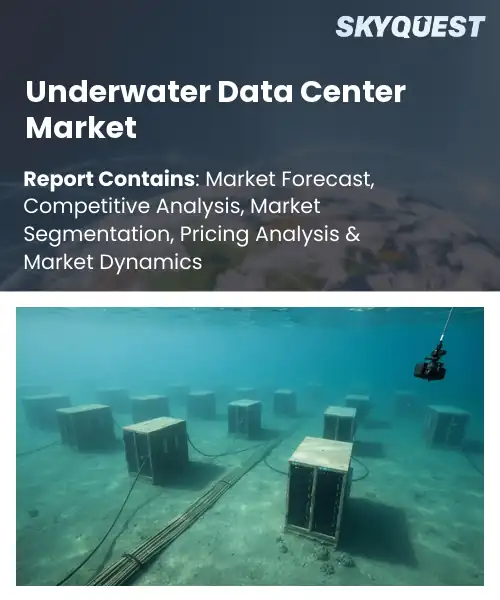
An underwater data center is an installation which entails immersing sealed server pods under water in order to utilize free cooling and renewable sources of power. The significance of such infrastructure arises from the need to counteract escalating energy prices as well as minimize carbon emissions of terrestrial centers, hence creating a more eco-friendly and cost-efficient solution. The concept emerged in the first decade of the millennium as a result of Microsoft's trial run of subsea platforms, becoming increasingly popular since the launch of Nautilus' floating facility near California in 2018.
Based on their proven energy efficiency, the key driver behind their growth is the combination of high-density computer requirements with a shortage of land near the coast, compelling companies to relocate their operations to open water areas. By submerging their servers, it eliminates the requirement of building big cooling facilities, thereby saving upfront costs and enabling fast scaling of edge computing for latency-sensitive applications like autonomous car mapping and data analysis for banks. Companies such as Equinix and Meta aim to build their containerized computing centers near offshore wind parks and establish a mutual power sharing arrangement, which results in even lower operational costs.
How is AI-driven Automation Enhancing Efficiency in the Underwater Data Center Market?
Automation driven by artificial intelligence is changing the face of underwater data centers by making complicated procedures simpler. Artificial intelligence software measures temperature, pressure, and electricity usage, enabling the cooling mechanism to be automated without any intervention from humans. The software learns about wear-and-tear on the components and makes it possible to schedule maintenance before anything fails, thus improving uptime. Workloads are also optimized for several units, and traffic is directed to the best performing unit to minimize inefficiencies in the process. All these make underwater data centers predictably affordable platforms for large compute that is more attractive to investors and operators.
Market snapshot - (2026-2033)
Global Market Size
USD 842.6 Million
Largest Segment
Fastest Growth
Growth Rate
28.7% CAGR
To get more insights on this market click here to Request a Free Sample Report
Global underwater data center market is segmented by data center type, deployment location, application, cooling method, end user, capacity and region. Based on data center type, no specific sub-segments were identified. Based on deployment location, no specific sub-segments were identified. Based on application, no specific sub-segments were identified. Based on cooling method, no specific sub-segments were identified. Based on end user, no specific sub-segments were identified. Based on capacity, no specific sub-segments were identified. Based on region, the market is segmented into North America, Europe, Asia Pacific, Latin America and Middle East & Africa.
The hyperscale segment is dominant as the huge scale of this segment fits into the economies of scale offered by the submergence infrastructure, allowing operators to distribute their high capital expenditure on large compute workloads. The consolidation of thousands of servers in one pod underwater eliminates the restrictions of land and uses the natural cooling property of sea water, directly reducing the cost of operations. This alignment is causing the attention of the industry towards the hyperscale segment as the growth driver.
On the other hand, the edge segment is experiencing the highest growth as companies are looking for low latency computing near the marine sensor network and offshores. The small form factor of edge pods makes them deployable in maritime environments.
The direct seawater cooling subsegment leads since it exploits the innate thermal efficiency of the marine environment and does not require any refrigeration process at all. Using the ambient seawater for cooling the heat exchangers in this way allows for almost complete removal of heat and reduction of the energy usage as well as the carbon footprints. It simplifies the whole process of operation and is a more convenient solution for companies that want sustainable and economical underwater operations.
At the same time, the closed loop of refrigerant cooling becomes one of the main areas of development due to the growing popularity of the closed systems of cooling that do not require contact with the ocean water. This solves environmental problems and allows for better temperature regulation needed for high-performance tasks, hence increasing popularity among clients.
To get detailed segments analysis, Request a Free Sample Report
Asia Pacific can utilize a very special synergy between natural conditions of the ocean, expertise in marine engineering, and government support towards sustainability in infrastructure development. Oceanic depths create a stable environment for cooling, and active scientific research organizations contribute to advances in submersion enclosures. Strategic location close to routes carrying large volumes of data ensures low latency for cloud service providers. Ecosystems that link up technology companies, maritime businesses, and environmental authorities make the process faster and serve as a standard for the industry.
Japan Underwater Data Center Market is driven by innovative research related to marine technology and expertise in offshore construction. The focus on building resilience towards natural occurrences ensures high design standards, and policy support helps carry out pilot projects near the coastal research centers. Connectivity to high-speed fiber-optic network allows for smooth data transfer, making it attractive for global cloud providers.
Market for Underwater Data Center in South Korea is boosted by its rich history of shipbuilding, along with governmental initiatives that target greener digital infrastructure. Joint projects of telecommunications companies and marine engineers help to quickly develop prototypes of underwater data centers. Focus on energy-efficient cooling is fully consistent with governmental policies, and hence, South Korea is a suitable destination for such data centers.
The development of North America is characterized by a combination of factors such as high-density demand for data, availability of rich coastal areas, and the innovative atmosphere which promotes the use of renewable energy. High-quality infrastructure in terms of fiber and advanced cloud ecosystems make a good foundation for building underwater facilities which can help reduce the costs of operation through natural cooling. Research institutions provide new information about pressure resistant material. Private investments drive the process of developing the prototype into commercial activity.
Market for Underwater Data Centers in the United States benefits from the huge stretch of its coastline and from cloud services companies that are leaders in their field and are looking to cut down on energy usage. There is ample venture capital funding available for those companies interested in developing marine-grade equipment, while at the same time, government-funded research projects investigate cooling methods. Being close to major internet hubs guarantees fast connection.
Canada Underwater Data Center Market is based on ample availability of cold water and focus of the nation on sustainable technologies. Cooperation between native people living in the coastal regions and the companies allows developing socially responsible models of implementation. Incentives of the government towards green solutions promote further development of underwater facilities, along with using renewable energy grids of the country.
Advantages are gained for Europe via the coherent approach to environmentalism, cooperation across borders, and high standards of resilient design. With the high density of underwater cables and its carbon-neutral aspirations, the European Union has become a promising place for the construction of sub-aquatic facilities rather than traditional data halls. The policy is oriented toward circular economy practices and material reuse as well as proper decommissioning of obsolete facilities. In addition, the consortia of European scientists to develop innovative corrosion-resistant composite structures and autonomous systems of monitoring.
Market for Underwater Data Center in Germany derives an advantage because of its strong engineering heritage and its readiness to adopt green technologies. Platforms for collaboration between big industries and marine research organizations contribute to a quick emergence of pressure-resistant containers. The commitment of Germany to renewable energy coordination allows underwater data centers to receive energy from offshore wind turbines.
United Kingdom Underwater Data Centers Market is driven by the presence of a robust fintech ecosystem as well as vast knowledge of offshore technology owing to the presence of the oil and gas industry. The government's initiatives towards green technology promote the use of decommissioned platforms as underwater data centers, while the coastal data centers ensure low latency connections to Europe.
The French Underwater Data Center Market uses the coasts of the Atlantic Ocean and the Mediterranean Sea to develop different sub‑marine applications. The national research institutions are concentrating on bio-inspiration cooling systems for better energy efficiency. Collaboration between telecom companies and marine engineering organizations leads to development of scalable modules for underwater centers to satisfy increasing need for sustainable data processing in the region.
To know more about the market opportunities by region and country, click here to
Buy The Complete Report
Rising Demand for Sustainable Computing
The growing trend towards lowering carbon footprints means that data centers will consider cooling methods that use the power of seawater to save more on energy consumption and reduce emissions. The location of data centers in water will allow for the utilization of constant temperatures, thus eliminating the need for traditional air-conditioning systems. This eco-friendly technology is bound to be used widely by cloud providers and enterprises due to their desire to build green IT infrastructures.
Advancements in Subsea Power Transmission
Current advancements in subsea cable technology at high voltages reduce energy loss and ease the process of connecting to existing coastal grids, thus making sure that power is delivered effectively to distant underwater stations. Improved insulation and advanced monitoring technologies ensure constant work without maintenance needs, which are typical for conventional worries. This makes operations easier and cheaper, thus attracting investors to such projects. As soon as reliability problems become less serious, the market becomes more confident in its future and develops further underwater data centers.
High Initial Capital Expenditure
The considerable amount of money that must be invested in building special hulls, pressure-proof containers, and marine-grade networking hardware constitutes an economic impediment for most potential users. The process of getting the necessary financing may take much time and include risk assessment and various approvals. Small cloud computing companies and businesses may not have enough financial assets to make this investment, leading to slower adoption. Thus, the high-cost level reduces the speed of the solution implementation.
Regulatory and Environmental Compliance Challenges
Uncertainty is another key challenge associated with compliance with difficult maritime regulations and environmental impact assessment in the development of underwater data centers. The authorities sometimes insist on thorough investigation of marine ecosystem interference, noise pollution, and anchoring impact. There is additional complexity associated with complying with international agreements related to offshore facilities. This increases the risk of operations and deters investment in projects that guarantee reliable return on investment, thus limiting the growth rate of the market globally.
Request Free Customization of this report to help us to meet your business objectives.
The global underwater data center market is highly competitive. Companies are focusing on securing strategic ocean locations to support future deployments. Competition is driven by mergers and acquisitions, joint ventures, and investments in advanced cooling technologies. Market participants are also working to reduce power consumption and meet the growing infrastructure requirements of AI applications. Recent competitive developments include a collaboration between an entrepreneur-backed startup and a marine engineering company to advance underwater data center solutions. In addition, a Chinese consortium acquired coastal leasing rights to support the large-scale deployment of submerged data center racks.
Submarine Cooling Efficiency Gains: Immersing server racks in the water of the ocean uses the inherent heat dissipation properties of the ocean. This technique significantly cuts dependence on conventional chillers and energy-consuming cooling systems. There is a noticeable increase in the life span of the hardware since the temperature variations are limited by the constant temperature at sea. As a result, such facilities cut down on costs and carbon dioxide emissions. They remain efficient despite high loads in peak hours in different parts of the world.
Strategic Coastal Data Partnerships: Joint ventures involving telecommunications companies, cloud providers, and owners of submarine cable networks have been formed to collocate data centers in conjunction with subsea cable landing stations. The formation of such partnerships allows the cost of investments to be shared, a permitting process to be made easier, and bandwidth to be allocated all at the place of entry. This model not only increases the speed of market adoption but allows content delivery from a local source while also increasing resiliency in case of terrestrial network failures.
SkyQuest’s ABIRAW (Advanced Business Intelligence, Research & Analysis Wing) is our Business Information Services team that Collects, Collates, Correlates, and Analyses the Data collected by means of Primary Exploratory Research backed by robust Secondary Desk research.
As per SkyQuest analysis, the growth of the underwater data center market can be attributed mainly to increasing preference for green computing among users who aim to reduce energy consumption and carbon footprints using natural seawater cooling. Another major driver in the underwater data center market is the technological advancement in sub-sea power transmission technology that helps reduce energy losses and grid connection ease. Hyperscale data center represents the largest market in terms of share as the heavy computing requirement of the segment leverages the benefits offered by underwater data centers the most. Asia-Pacific is the leading regional market due to deep water availability, advanced maritime engineering capabilities,and favorable policies.
| Report Metric | Details |
|---|---|
| Market size value in 2024 | USD 842.6 Million |
| Market size value in 2033 | USD 8162.6 Million |
| Growth Rate | 28.7% |
| Base year | 2024 |
| Forecast period | (2026-2033) |
| Forecast Unit (Value) | USD Million |
| Segments covered |
|
| Regions covered | North America (US, Canada), Europe (Germany, France, United Kingdom, Italy, Spain, Rest of Europe), Asia Pacific (China, India, Japan, Rest of Asia-Pacific), Latin America (Brazil, Rest of Latin America), Middle East & Africa (South Africa, GCC Countries, Rest of MEA) |
| Companies covered |
|
| Customization scope | Free report customization with purchase. Customization includes:-
|
To get a free trial access to our platform which is a one stop solution for all your data requirements for quicker decision making. This platform allows you to compare markets, competitors who are prominent in the market, and mega trends that are influencing the dynamics in the market. Also, get access to detailed SkyQuest exclusive matrix.
Table Of Content
Executive Summary
Market overview
Parent Market Analysis
Market overview
Market size
KEY MARKET INSIGHTS
COVID IMPACT
MARKET DYNAMICS & OUTLOOK
Market Size by Region
KEY COMPANY PROFILES
Methodology
For the Underwater Data Center Market, our research methodology involved a mixture of primary and secondary data sources. Key steps involved in the research process are listed below:
1. Information Procurement: This stage involved the procurement of Market data or related information via primary and secondary sources. The various secondary sources used included various company websites, annual reports, trade databases, and paid databases such as Hoover's, Bloomberg Business, Factiva, and Avention. Our team did 45 primary interactions Globally which included several stakeholders such as manufacturers, customers, key opinion leaders, etc. Overall, information procurement was one of the most extensive stages in our research process.
2. Information Analysis: This step involved triangulation of data through bottom-up and top-down approaches to estimate and validate the total size and future estimate of the Underwater Data Center Market.
3. Report Formulation: The final step entailed the placement of data points in appropriate Market spaces in an attempt to deduce viable conclusions.
4. Validation & Publishing: Validation is the most important step in the process. Validation & re-validation via an intricately designed process helped us finalize data points to be used for final calculations. The final Market estimates and forecasts were then aligned and sent to our panel of industry experts for validation of data. Once the validation was done the report was sent to our Quality Assurance team to ensure adherence to style guides, consistency & design.
Analyst Support
Customization Options
With the given market data, our dedicated team of analysts can offer you the following customization options are available for the Underwater Data Center Market:
Product Analysis: Product matrix, which offers a detailed comparison of the product portfolio of companies.
Regional Analysis: Further analysis of the Underwater Data Center Market for additional countries.
Competitive Analysis: Detailed analysis and profiling of additional Market players & comparative analysis of competitive products.
Go to Market Strategy: Find the high-growth channels to invest your marketing efforts and increase your customer base.
Innovation Mapping: Identify racial solutions and innovation, connected to deep ecosystems of innovators, start-ups, academics, and strategic partners.
Category Intelligence: Customized intelligence that is relevant to their supply Markets will enable them to make smarter sourcing decisions and improve their category management.
Public Company Transcript Analysis: To improve the investment performance by generating new alpha and making better-informed decisions.
Social Media Listening: To analyze the conversations and trends happening not just around your brand, but around your industry as a whole, and use those insights to make better Marketing decisions.
REQUEST FOR SAMPLE
 REQUEST FREE CUSTOMIZATION
Global Underwater Data Center Market size was valued at USD 842.6 Million in 2024 and is poised to grow from USD 1084.43 Million in 2025 to USD 8162.6 Million by 2033, growing at a CAGR of 28.7% during the forecast period (2026-2033).
The competitive landscape is shaped by a race to secure oceanic sites, with firms leveraging strategic M&A, joint ventures, and proprietary cooling technologies to lower energy costs and meet AI‑driven demand; recent examples include a high‑profile partnership between a billionaire‑backed startup and a marine engineering firm, and a state‑backed Chinese consortium acquiring coastal lease rights to deploy large‑scale submerged racks. 'Microsoft Corporation', 'Nautilus Data Technologies, Inc.', 'Subsea Cloud Inc.', 'NetworkOcean Co.', 'Keppel Data Centres Holding Pte. Ltd.', 'Global Marine Group', 'Alcatel Submarine Networks', 'SubCom, LLC', 'NEC Corporation', 'Fujitsu Limited', 'Schneider Electric SE', 'ABB Ltd.', 'Siemens AG', 'Nokia Corporation', 'Equinix, Inc.', 'Digital Realty Trust, Inc.', 'China Telecom Corporation Limited', 'KDDI Corporation', 'NTT DATA Group Corporation', 'Orange Marine SAS'
The increasing emphasis on reducing carbon footprints drives data center operators to explore cooling solutions that leverage natural seawater, enabling substantial energy savings and lower emissions. By situating facilities underwater, companies can capitalize on stable temperature environments, decreasing reliance on conventional air‑conditioning systems. This sustainable approach aligns with corporate responsibility goals and regulatory pressures, fostering broader adoption across cloud providers and enterprise users seeking greener infrastructure, thereby expanding market demand for underwater data center technologies through innovative design principles globally.
Submarine Cooling Efficiency Gains: The immersion of server racks in seawater exploits the ocean’s natural thermal capacity, dramatically reducing reliance on traditional chillers and power‑intensive cooling cycles. Operators report extended hardware lifespans as temperature fluctuations are mitigated by the stable deep‑sea environment. By harnessing this passive heat dissipation, facilities achieve lower operating expenses and a smaller carbon footprint, aligning with sustainability mandates while delivering consistent performance even during peak demand periods across multiple continents and supporting emerging edge‑computing workloads worldwide with resilient network latency.
Why does Asia Pacific Dominate the Global Underwater Data Center Market? |@12


Want to customize this report? This report can be personalized according to your needs. Our analysts and industry experts will work directly with you to understand your requirements and provide you with customized data in a short amount of time. We offer $1000 worth of FREE customization at the time of purchase.
Feedback From Our Clients


 USA (+1) 351-333-4748

