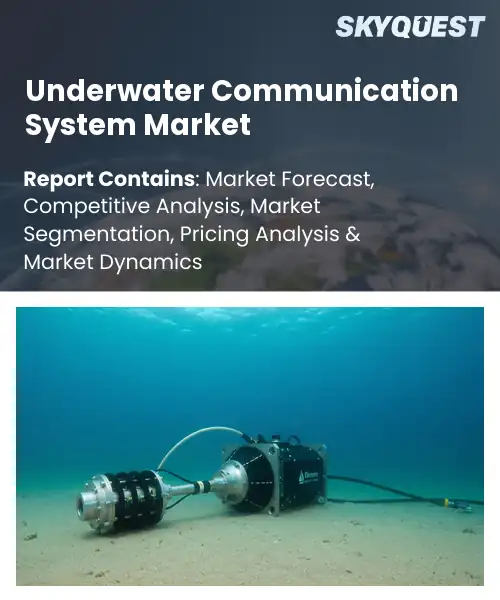
Underwater Communication System Market
Report ID: SQMIG45H2171
Report ID: SQMIG45H2171
[email protected]
USA +1 351-333-4748
Report ID:
SQMIG45H2171 |
Region:
Global |
Published Date: May, 2026
Pages:
157
|Tables:
178
|Figures:
79


Global Underwater Communication System Market size was valued at USD 4.2 Billion in 2024 and is poised to grow from USD 4.61 Billion in 2025 to USD 9.66 Billion by 2033, growing at a CAGR of 9.7% during the forecast period (2026-2033).
The primary driver of the underwater communication system market growth is the accelerating need for reliable, high-bandwidth subsea data exchange driven by expanding offshore industries and maritime security requirements. The market includes acoustic, optical, and electromagnetic hardware, software protocols, and integrated network solutions that connect autonomous underwater vehicles, remotely operated vehicles, subsea sensors, and platforms. It matters because translating dispersed ocean observations into timely intelligence reduces operational risk for energy firms, enables naval situational awareness, and supports climate science.
Historically the sector moved from narrowband acoustic modems in 1990s oilfield surveys to hybrid networks blending optical bursts with acoustic long-range links.Building on this evolution, a dominant factor shaping global market growth is technological convergence in acoustic modulation, optical lasers, and low-power networking, which causes broader deployment of persistent subsea sensor networks and autonomous vehicle fleets. Consequently operators can conduct continuous pipeline integrity monitoring and real-time environmental surveillance, reducing downtime, regulatory costs, and enabling predictive maintenance. Naval forces employ encrypted channels for cooperative unmanned missions while researchers deploy dense sensor arrays that improve oceanographic models. These demand signals create commercial opportunities for communication-as-a-service, intelligent edge processing, and relay infrastructure that lower costs and accelerate adoption across energy, defense, and scientific sectors.
How is AI Improving Reliability And Data Throughput In The Underwater Communication System Market?
Communication underwater is limited by constrained acoustic channels, multipath distortion and narrow available bandwidth. The main consideration for underwater communication is channel estimation, adaptive waveform selection, error resilience and energy aware operations. Artificial intelligence is now being employed to predict the quality of the link, select robust modulation schemes, reorganise corrupted packets in real time and provide prioritised meanings for transmitting fewer bits during one transmission. The market requirements dictate that offshore energy, defence and environmental monitoring require longer deployments and more dependable telemetry systems. Additionally, there is a shift away from traditional models of processing where processing was performed off-board, into modem and on-board vehicle-based processing capability; allowing for self-tuning and coordinating of networks to decrease the effort associated with retries while improving throughput efficiencies as the networks operate under real world conditions.
Sonardyne, in March of 2026, introduced Observer, which has analytics built into the onboard equipment and supports AI enabled coordination functionality for prioritising data and providing for scheduled data offloads. In doing so, this innovation has helped improve market efficacy for end to end reliability and increased usable data throughput over extended periods of time for subsea monitoring.
Market snapshot - (2026-2033)
Global Market Size
USD 4.2 Billion
Largest Segment
Hardware
Fastest Growth
Software
Growth Rate
9.7% CAGR
To get more insights on this market click here to Request a Free Sample Report
Global underwater communication system market is segmented by component, communication technology, connectivity type, platform, application, end user and region. Based on component, the market is segmented into Hardware, Software and Services. Based on communication technology, the market is segmented into Acoustic Communication, Optical Communication and Radio Frequency Communication. Based on connectivity type, the market is segmented into Wired Underwater Communication and Wireless Underwater Communication. Based on platform, the market is segmented into Autonomous Underwater Vehicles (AUVs), Remotely Operated Vehicles (ROVs), Submarines, Surface Support Vessels and Fixed Underwater Sensor Networks. Based on application, the market is segmented into Environmental Monitoring, Oceanographic Data Collection, Offshore Oil & Gas Operations, Defense & Surveillance, Underwater Exploration, Disaster Prevention & Warning Systems and Aquaculture Monitoring. Based on end user, the market is segmented into Defense & Naval Organizations, Oil & Gas Industry, Marine Research Organizations, Commercial Marine Operators and Environmental Agencies. Based on region, the market is segmented into North America, Europe, Asia Pacific, Latin America and Middle East & Africa.
As per underwater communication system market analysis, the acoustic communication portion has the dominant share of the market due to the capability of acoustic waves to travel long distances with minimal degradation, as well as their ability to penetrate turbid waters (e.g., water with particles or minerals suspended in it). This makes acoustic-based communication systems the default technology for establishing persistent, long-range links and executing command and control functions within the underwater domain. In addition to these capabilities, when combined with the mature and compatible integration of existing vehicles and sensor architectures, acoustic systems give rise to much fewer integration barriers, thus providing an incentive for hardware purchases, protocol development and service model creation. Finally, this reliability is the foundation for mission-critical applications, and has a direct impact on the procurement priorities of operators (who prioritize endurance as well as coverage).
As per underwater communication system market forecast, optical communication technologies are emerging as the fastest growing segment. Advances in optical communication technology (e.g., advancements in lasers, modulation, beam steering, etc.) are creating very high-bandwidth, low-latency links that can be used for short-haul, high-volume data transfer applications such as real-time video and high-definition images, along with burst data offloads from autonomous platforms. Therefore, demand for these applications, along with innovations in transceivers and adaptive pointing technologies, are opening up new commercial and scientific applications for optical communication technologies and will continue to create new supplier and service model opportunities.
Autonomous Underwater Vehicles (AUVs) are the most popular in the market because they use complex, dependable systems to send and receive data via telemetry while on a mission or working in tandem with multiple devices being operated from a distance by a single command post. Since AUVs require multiple systems on their way to being completed as a fully functional vehicle, manufacturers create each manufacturing facility to accommodate their new manufacturing capability. Although AUVs are much smaller than ROV devices currently on the market, their size still creates the need for custom-designed high-performance hardware; low-cost software for managing serial communications to the AUV; and a comprehensive list of lifecycle management services, which transform how AUVs will be deployed for use in maritime research, commercial operations, and defense operations.
As per underwater communication system market outlook, ROV are experiencing the highest growth as a result of operators who are demanding increasingly sophisticated tethered or hybrid remote communications systems for performing complex inspections and working in support of attempts at conducting an operation remotely. As the number of industrial inspections continues to increase, the demand for remote operations also creates opportunities for innovation in tethered and hybrid systems using high-performance technology; acoustic, optically coupled hybrid tethered systems; and real-time operator interfaces for conducting remote operations. This growing use of tethered and hybrid systems in the market for ROVs creates new opportunities for service integration and specialized hardware to extend the reach of manufacturers.
To get detailed segments analysis, Request a Free Sample Report
As per underwater communication system market regional analysis, Asia Pacific is the leading region globally because of a convergence of industrial capabilities, strategic goals, and technology ecosystems that support rapid growth and innovation. Established offshore construction centres, along with sophisticated electronic manufacturing capabilities, provide a local supply chain for developing and deploying underwater communications systems at scale. Increased focus on marine security, coupled with increased interest in exploring offshore resources, has created a strong and continuous demand for reliable underwater communication solutions. There is extensive collaboration among defence entities, academic institutions, and commercial businesses to drive technology maturation through shared research, which helps accelerate the rate at which technologies reach full capabilities. The ability of regional system integrators to design and create solutions tailored to specific conditions in various types of water and to meet the operational demands of customers has also been a positive contributor to the underwater communications systems marketplace. Additionally, close integration of system components with autonomous platforms and sensor networks dramatically improves operational effectiveness; reasonable regulatory frameworks and focused funding programmes have reduced the barriers associated with commercialising technologies. Overall, combined with the above-mentioned factors, these elements have created a resilient marketplace for developing and implementing underwater communications systems that will support Asia Pacific’s continued leadership position within the global market space.
The Underwater Communication System Market in Japan has a well-established relationship between manufacturers of advanced electronics and companies that do maritime engineering. This type of relationship allows for the development of highly dependable products for very complicated environments, including coastal and deepwater areas. Additionally, due to their close proximity to both shipyards and active research facilities, manufacturers are able to continually test and develop their products by going through an iterative process of testing and integration. Other contributing factors include the continued emphasis on security, the high level of activity in both the commercial and military offshore markets, and local suppliers' focus on developing smaller, more energy-efficient, and highly interoperable solutions that can be utilized by both autonomous platforms and other industries.
In South Korea, the Underwater Communication System Market relies heavily on the strong shipbuilding capacity and advanced semiconductor and sensor industries of the country to produce resilient and ultra-durable underwater communication systems that can perform at very demanding levels. In addition to having strong relationships between defence integrators and commercial developers in South Korea, there is also an emphasis on rapid prototyping and field validating all of the systems that are being developed. This focus on producing highly reliable systems, highly compact designs, and developing integrated networked solutions provides for flexible solutions for use in a wide variety of marine environments as well as providing for potential partnerships with many different international integrators.
As per underwater communication system market regional outlook, the market in North America is expanding drastically due to multiple factors, such as increased research capacities, willingness from offshore entities to buy products used for underwater communications, and a need to modernize defence capabilities through more effective maritime domain awareness. An extensive network of technology start-ups, aerospace and naval defence contractors (current suppliers) and major universities/research institutions within the area will greatly contribute to the further development of these technologies through collaboration and innovation in the area of underwater communications. The growth of the marketplace will also be increased by the move towards autonomous systems, through the development of subsea infrastructure and the need for reliable data solutions, as well as integrated sensor networks. By placing emphasis on standardization, interoperability and enhancing service-oriented business models, more companies will be encouraged to adopt solutions with an emphasis on creating strategic partnerships between the integrators, operators and the North American underwater communications system market, as a means of facilitating large-scale deployment of underwater communication systems that have continuously evolving capabilities while being able to operate in diverse operational environments. The North American region has excellent access to testing ranges and collaborative funding sources that allow companies to validate underwater communication systems in any environment in a timely manner and strong relationships with the offshore wind and underwater cleaning industries, ego. This allows them to establish a clear path towards commercialising their products after validation. Lastly, the North American underwater communications systems market has a mature supply chain combined with many systems integrators, thereby providing a means for companies to transition their laboratory advancements into operational systems quickly and effectively, through strong enforcement by governments.
The Underwater Communication System Market for the USA is being driven by a concentration of research capabilities, testing infrastructures, and defense/commercial procurement sources that require long-term, scalable, secure connectivity solutions. An ecosystem of both startups and established contractors facilitates development and system integration. Interoperability, mission assurance, and lifecycle support are emphasized when deploying these technologies. Collaborative relationships between academia, service providers, and operators facilitate field validation efforts and assist in tailoring these technologies to the specific needs of complex coastal missions and deepwater missions.
The Underwater Communication System Market for Canada has the following characteristics: a wealth of cold water and Arctic operational experience, a high level of collaborative efforts between academia and industry, and a subsea services sector that places a high value on reliability and environmental sustainability. Research centres and system integrators provide adaptable solutions that can perform in extreme conditions such as sensor fusion and autonomous platform integration. The procurement of underwater communication systems from both commercial offshore operators and government agencies supports the deployment, refinement, and improvement of technologies capable of operating effectively in challenging coastal and offshore environments.
Through collaborative research initiatives that transcend borders, Europe is enhancing its capacity within the underwater communications systems sector. There is also increased attention being given to interoperable standards between hardware and software components, which will promote integration across multiple platforms at an ease that was previously unimaginable. A strong emphasis is placed upon using marine science, renewable energy sources offshore, and defence technologies for developing systems that have been specifically designed for the differing environmental conditions of coastal and deep-water areas. The presence of a dynamic network of small-to-medium sized innovators, well-established engineering companies, and companies offering specialized integration services encourages the production of modular designs that consume less energy and are appropriate for both commercial and scientific missions. Public and private sector stakeholders continue to prioritize environmental monitoring and multi-use infrastructure, encouraging the development of solutions that balance performance, sustainability and operational resilience and therefore facilitate broad market penetration across national boundaries. In addition, the development of shared test facilities, and targeted funding opportunities by both the public and private sector, promotes expedited field validation, and connectivity with the offshore wind and sub-sea service industries establishes clear pathways for commercialisation. The harmonised regulatory framework and focus on readiness for export provides a competitive advantage to European suppliers in a variety of global markets.
Germany has a strong engineering tradition, industrial automation, and collaborative partnerships between research bodies and maritime integrators that will fuel the Underwater Communication System market. German manufacturers/designers focus on developing rugged (industrial grade) communications systems due to their need to meet the stringent reliability and scalability of the offshore energy and defense sectors. German manufacturers also emphasize developing modular and integrated systems that are rigorously tested to ensure that they can be adopted by commercial operators and government authorities that require dependable connectivity for performing complex subsea operations in a wide variety of marine environments.
The UK has an established heritage for naval/maritime engineering and so has a large number of companies that design, manufacture, and provide undersea communication systems. The UK also has established research organizations that focus on developing innovative acoustical technologies for subsea communications. Today, the UK is also home to a significant number of small-to-medium-sized enterprises that deliver subsea connectivity solutions. In addition, there is a close relationship between the UK Maritime/Defence and Offshore Energy programs, which continue to drive demand for adaptable and interoperable communications systems. Furthermore, there is a strong focus in the UK on developing effective methods to test undersea communications systems before they enter operations or are exported to help ensure their suitability for use in complex coastal, continental shelf, and deep-water operations.
Underwater Communication System Market in France draws on strong marine science institutions, specialized acoustics expertise, and close collaboration between defense electronics firms and commercial innovators. Focus on multimission platforms, environmental monitoring, and integration with autonomous systems drives development of versatile connectivity solutions. Regional industrial clusters support rigorous testing, modular design, and service oriented delivery models, enabling suppliers to meet diverse operator requirements across coastal research, offshore energy, and maritime security applications.
To know more about the market opportunities by region and country, click here to
Buy The Complete Report
Advanced Acoustic Modem Technologies
In addition to greater reliability, better data throughput, and so on, modern acoustic modem technology has made use of advanced signal processing techniques, modulation methods, and error correction codes to provide reliable data connections over long distances and low power consumption for longer missions and greater practicality in the deployment of submerged communications systems. Improvements in technological areas such as link stability (an improvement from previous technologies) have reduced the number of retransmissions that must be performed, resulting in lower operating costs, as well as expanding the number of applications for submerged communication systems across both the scientific & commercial/defense community. As a result of these improvements, submerged communications systems now have greater interoperability with surface and subsea platforms, stimulating investment and integration of these systems by customers seeking reliable, continuous data exchanges.
Expansion Of Subsea Data Networks
Signal Attenuation and Range Limitations
Aqua environments are subject to inherent signal attenuation, scattering, and multipath effects which limit the communication effective range, degrade the reliability of the connection, restrict the practical reach of underwater systems, and limit applications to a narrow range of scenarios. In addition, creating solutions for these physical propagation obstacles requires complex signal processing, careful placement of relay nodes, and acceptance of reduced data rates increasing both overall system complexity and the deployment planning burden. The performance limitations on underwater communications for long distances or at high bandwidth levels lessen interest in investment in these types of communications as they slow the adoption and expand use to certain commercial as well as scientific.
High Deployment Costs
Request Free Customization of this report to help us to meet your business objectives.
One of the most significant influences on the global underwater communications competitive environment is the impact consolidating through strategic mergers and acquisitions; this has been best illustrated by Teledyne's series of major acquisitions. Differentiation through technology is often used to distinguish companies in this space; for example, Sonardyne's BlueComm optical modems and CSignum's HydroFi surface penetrating radio demonstrate this form of differentiation. Consequently, competition has increased due to the demand from end users/operators for increased bandwidth and real-time data from the subsea environment for offshore wind, aquaculture and Autonomous Underwater Vehicle (AUV) operations; thus, there has been an increase in partnership activity and niche product launches to meet these growing requirements.
SkyQuest’s ABIRAW (Advanced Business Intelligence, Research & Analysis Wing) is our Business Information Services team that Collects, Collates, Correlates, and Analyses the Data collected by means of Primary Exploratory Research backed by robust Secondary Desk research.
As per SkyQuest analysis, the global underwater communication system market is propelled by the accelerating need for reliable high-bandwidth subsea data exchange driven by expanding offshore industries and maritime security requirements, while growth is restrained by signal attenuation and range limitations inherent to underwater propagation. Asia Pacific leads the market thanks to strong shipbuilding, electronics manufacturing, and maritime programs. Acoustic communication remains the dominant segment because of its long-range reliability and integration with existing platforms. A secondary growth driver is technological convergence across acoustic modulation, optical lasers, and low-power networking that enables persistent sensor networks and smarter autonomous operations.
| Report Metric | Details |
|---|---|
| Market size value in 2024 | USD 4.2 Billion |
| Market size value in 2033 | USD 9.66 Billion |
| Growth Rate | 9.7% |
| Base year | 2024 |
| Forecast period | (2026-2033) |
| Forecast Unit (Value) | USD Billion |
| Segments covered |
|
| Regions covered | North America (US, Canada), Europe (Germany, France, United Kingdom, Italy, Spain, Rest of Europe), Asia Pacific (China, India, Japan, Rest of Asia-Pacific), Latin America (Brazil, Rest of Latin America), Middle East & Africa (South Africa, GCC Countries, Rest of MEA) |
| Companies covered |
|
| Customization scope | Free report customization with purchase. Customization includes:-
|
To get a free trial access to our platform which is a one stop solution for all your data requirements for quicker decision making. This platform allows you to compare markets, competitors who are prominent in the market, and mega trends that are influencing the dynamics in the market. Also, get access to detailed SkyQuest exclusive matrix.
Table Of Content
Executive Summary
Market overview
Parent Market Analysis
Market overview
Market size
KEY MARKET INSIGHTS
COVID IMPACT
MARKET DYNAMICS & OUTLOOK
Market Size by Region
KEY COMPANY PROFILES
Methodology
For the Underwater Communication System Market, our research methodology involved a mixture of primary and secondary data sources. Key steps involved in the research process are listed below:
1. Information Procurement: This stage involved the procurement of Market data or related information via primary and secondary sources. The various secondary sources used included various company websites, annual reports, trade databases, and paid databases such as Hoover's, Bloomberg Business, Factiva, and Avention. Our team did 45 primary interactions Globally which included several stakeholders such as manufacturers, customers, key opinion leaders, etc. Overall, information procurement was one of the most extensive stages in our research process.
2. Information Analysis: This step involved triangulation of data through bottom-up and top-down approaches to estimate and validate the total size and future estimate of the Underwater Communication System Market.
3. Report Formulation: The final step entailed the placement of data points in appropriate Market spaces in an attempt to deduce viable conclusions.
4. Validation & Publishing: Validation is the most important step in the process. Validation & re-validation via an intricately designed process helped us finalize data points to be used for final calculations. The final Market estimates and forecasts were then aligned and sent to our panel of industry experts for validation of data. Once the validation was done the report was sent to our Quality Assurance team to ensure adherence to style guides, consistency & design.
Analyst Support
Customization Options
With the given market data, our dedicated team of analysts can offer you the following customization options are available for the Underwater Communication System Market:
Product Analysis: Product matrix, which offers a detailed comparison of the product portfolio of companies.
Regional Analysis: Further analysis of the Underwater Communication System Market for additional countries.
Competitive Analysis: Detailed analysis and profiling of additional Market players & comparative analysis of competitive products.
Go to Market Strategy: Find the high-growth channels to invest your marketing efforts and increase your customer base.
Innovation Mapping: Identify racial solutions and innovation, connected to deep ecosystems of innovators, start-ups, academics, and strategic partners.
Category Intelligence: Customized intelligence that is relevant to their supply Markets will enable them to make smarter sourcing decisions and improve their category management.
Public Company Transcript Analysis: To improve the investment performance by generating new alpha and making better-informed decisions.
Social Media Listening: To analyze the conversations and trends happening not just around your brand, but around your industry as a whole, and use those insights to make better Marketing decisions.
REQUEST FOR SAMPLE
 REQUEST FREE CUSTOMIZATION
Global Underwater Communication System Market size was valued at USD 4.2 Billion in 2024 and is poised to grow from USD 4.61 Billion in 2025 to USD 9.66 Billion by 2033, growing at a CAGR of 9.7% during the forecast period (2026-2033).
Competitive landscape in global underwater communication is shaped by consolidation through strategic M&A such as Teledyne’s historic acquisitions, and by technology led differentiation exemplified by Sonardyne’s BlueComm optical modems and CSignum’s HydroFi surface penetrating radio. Competition is driven by operator demand for higher bandwidth and real time subsea data for offshore wind, aquaculture and AUV operations, prompting partnerships and niche product launches. 'Kongsberg Gruppen ASA', 'Teledyne Marine Technologies Incorporated', 'L3Harris Technologies, Inc.', 'Thales Group', 'Ultra Maritime', 'Sonardyne International Ltd.', 'EvoLogics GmbH', 'Ocean Sonics Ltd.', 'Aquatec Group Ltd.', 'LinkQuest Inc.', 'Subnero Pte. Ltd.', 'Hydromea SA', 'DSPComm', 'Nortek Group', 'EdgeTech', 'Blueprint Subsea', 'Sea and Land Technologies Pte. Ltd.', 'Benthowave Instrument Inc.', 'Datasonics LLC', 'ATLAS ELEKTRONIK GmbH'
Advanced signal processing, modulation approaches, and error correction in modern acoustic modems enhance data throughput reliability and energy efficiency, enabling longer missions and more practical deployment of underwater communication systems. By improving link stability and reducing retransmissions, these technological improvements lower operational complexity and broaden application profiles across scientific, commercial, and defense sectors. The resulting performance gains make underwater communications more interoperable with surface and subsea platforms, encouraging investment and integration by stakeholders who prioritize dependable, sustained data exchange in challenging aquatic environments.
Autonomous Platform Integration: The proliferation of autonomous underwater vehicles and unmanned surface vessels is driving demand for interoperable communication frameworks that support plug and play sensor suites, mission level coordination, and adaptive networking. Stakeholders prioritize low latency, robust protocols and standardized interfaces to enable collaborative operations, remote supervision, and lifecycle management across heterogeneous fleets. Integration emphasis is elevating partnerships between system providers, navies, and research institutions to accelerate field trials, iterative design, and modular upgrades that reduce complexity and improve operational agility in diverse maritime contexts.
Why does Asia Pacific Dominate the Global Underwater Communication System Market? |@12


Want to customize this report? This report can be personalized according to your needs. Our analysts and industry experts will work directly with you to understand your requirements and provide you with customized data in a short amount of time. We offer $1000 worth of FREE customization at the time of purchase.
Feedback From Our Clients


 USA (+1) 351-333-4748

