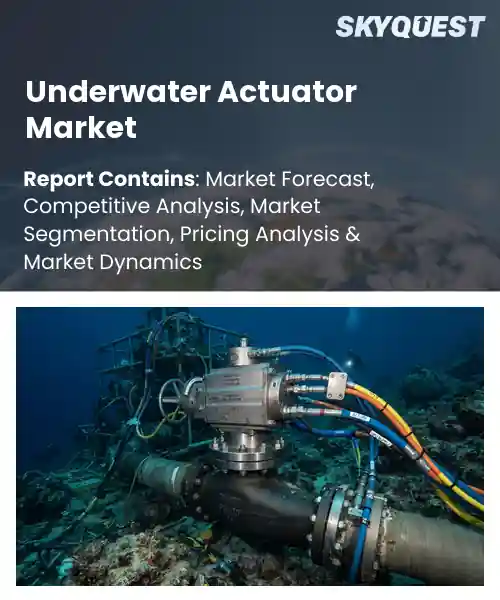
Underwater Actuator Market
Report ID: SQMIG20I4045
Report ID: SQMIG20I4045
[email protected]
USA +1 351-333-4748
Report ID:
SQMIG20I4045 |
Region:
Global |
Published Date: October, 2026
Pages:
157
|Tables:
121
|Figures:
77


Global Underwater Actuator Market size was valued at USD 310.0 Million in 2024 and is poised to grow from USD 330.15 Million in 2025 to USD 546.4 Million by 2033, growing at a CAGR of 6.5% during the forecast period (2026-2033).
The global underwater actuator market consists of devices that turn electrical signals into mechanical motion for applications such as remotely operated vehicles, wind foundations, and pipelines. Its significance lies in providing reliable control of equipment under pressure, corrosive saltwater, and limited accessibility, affecting safety and efficiency of offshore energy production and research. Historically, the market was niche, dominated by hydraulic cylinders in the 1990s, but the emergence of electric and piezoelectric actuators in the 2000s sparked adoption. The 2015 deployment of thrusters on the Nautilus AUV showed increased maneuverability while reducing maintenance cycles, illustrating market shift toward smarter, low‑maintenance solutions.Building on move toward smarter solutions, primary growth catalyst for underwater actuator market is rapid expansion of offshore renewable energy, especially floating wind farms that require yaw and blade‑pitch control beneath sea surface. Government renewable targets push developers into deeper waters where hydraulic systems struggle, prompting manufacturers to supply waterproof servo‑actuators with diagnostics. This reliability cuts downtime, lowers levelized cost of electricity and draws investment; 2023 Hywind Scotland project, which used pitch actuators, reported a 15 % efficiency improvement. Success drives companies to accelerate oil‑free designs and modular packaging, creating openings for niche firms to win contracts through deployment and service.
How is AI‑driven automation impacting the underwater actuator market?
AI‑driven automation is reshaping the underwater actuator market by embedding intelligent control loops directly into hydraulic and electric actuators used on ROVs, AUVs and subsea infrastructure. Manufacturers now integrate machine‑learning algorithms that predict load changes, optimize power consumption and enable remote self‑calibration, reducing downtime and maintenance crew visits. The market, traditionally driven by oil‑and‑gas and offshore wind, is seeing faster adoption in scientific and defense applications where precise positioning and adaptive response are critical. Real‑time data from onboard sensors feed AI models that adjust actuator stroke and speed on the fly, making operations more reliable and cost‑effective.In July 2023 Kongsberg Maritime unveiled an AI‑enhanced hydraulic actuator suite for subsea valve control, allowing autonomous pressure regulation and fault detection, which shortens commissioning cycles and boosts reliability across offshore projects. The system learns from operational data to fine‑tune performance, accelerating market growth and improving efficiency in demanding underwater environments.
Market snapshot - (2026-2033)
Global Market Size
USD 310.0 Million
Largest Segment
Electric Actuators
Fastest Growth
Electrohydraulic Actuators
Growth Rate
6.5% CAGR
To get more insights on this market click here to Request a Free Sample Report
Global underwater actuator market is segmented by actuator type, operating depth, application, end user and region. Based on actuator type, the market is segmented into Electric Actuators, Hydraulic Actuators, Pneumatic Actuators and Electrohydraulic Actuators. Based on operating depth, the market is segmented into Shallow-Water Actuators, Deepwater Actuators and Ultra-Deepwater Actuators. Based on application, the market is segmented into Subsea Oil & Gas Production, Offshore Renewable Energy, Marine Research & Exploration, Underwater Robotics and Defense & Naval Systems. Based on end user, the market is segmented into Oil & Gas Operators, Offshore Energy Companies, Marine Equipment Manufacturers and Defense Organizations. Based on region, the market is segmented into North America, Europe, Asia Pacific, Latin America and Middle East & Africa.
Electric Actuators segment dominates because they provide motion control with minimal energy consumption, which aligns with the market’s demand for reliable and low maintenance solutions in harsh subsea environments. Their solid state construction eliminates fluid leakage risks, enhancing long term operational safety. Additionally, advances in motor technology and power electronics have improved torque density, making them suitable for a wide range of subsea valve and positioning tasks, thereby reinforcing their market leadership.
Meanwhile, Hydraulic Actuators segment is witnessing the strongest growth momentum as developers capitalize on its high force output for heavy duty subsea manipulators and riser handling systems. Emerging offshore renewable projects demand robust power, and innovations in compact pump designs are expanding installation possibilities, accelerating market expansion and creating new opportunities.
Deepwater Actuators segment dominates because it meets the critical need for reliable performance at several thousand meters where most subsea production infrastructure resides. Robust sealing technologies and pressure balanced designs ensure functionality under high hydrostatic loads, reducing maintenance cycles. The proven track record of these devices in long term oil and gas installations builds confidence among operators, cementing their primary position in the market. Consequently, investment flows continuously target this capability set.
Conversely, Ultra Deepwater Actuators segment is emerging as the growth area as exploration pushes beyond traditional depth limits. Breakthroughs in ceramic bearing technology and fiber optic monitoring enable dependable operation at extreme pressures, attracting interest from offshore renewable foundations and cutting edge research vessels, thereby propelling market expansion for future deployments.
To get detailed segments analysis, Request a Free Sample Report
Asia Pacific dominance in the underwater actuator sector stems from a confluence of technological, industrial, and geographic advantages. The region hosts world‑class engineering firms that combine deep marine expertise with high‑precision manufacturing capabilities. Robust demand from offshore energy projects, coupled with extensive naval and research activities, fuels continuous innovation. Strategic coastal geography offers natural testing grounds, while collaborative ecosystems linking universities, defense agencies, and private players accelerate product development. Strong policy frameworks that prioritize maritime infrastructure and sustainable ocean initiatives further reinforce investment. The region also benefits from a skilled workforce adept at integrating advanced electronics with hydraulic technologies, enabling rapid prototyping and deployment of customized actuator systems for diverse subsea applications.
Japan Underwater Actuator Market
Underwater Actuator Market in Japan benefits from a tradition of precision engineering and a dense network of marine technology firms. Collaboration between research institutes and leading manufacturers drives refinement of actuator reliability and miniaturization. Domestic demand is reinforced by offshore exploration activities and sophisticated naval platforms that require high‑performance solutions. Export orientation is supported by strong standards compliance, enabling Japanese providers to secure a reputable position in global supply chains.
South Korea Underwater Actuator Market
Underwater Actuator Market in South Korea is propelled by an industrial base that integrates advanced hydraulics with electronics. Government‑backed marine research centers collaborate closely with conglomerates to tailor actuator designs for oil and gas installations as well as defense applications. The nation’s emphasis on prototyping and modular architecture shortens development cycles, fostering agility in meeting client specifications. International partnerships further amplify the reach of South Korean solutions across subsea markets.
Europe’s underwater actuator market is energized by a blend of high‑tech engineering, ambitious offshore energy programs, and rigorous maritime standards that together create a fertile environment for advanced subsea solutions. Germany anchors the region with its strong tradition of precision manufacturing and a dense cluster of specialist suppliers that deliver reliable, high‑performance devices for both civilian and defense projects. The United Kingdom benefits from an offshore wind sector and regulatory support for marine technology. France adds momentum through focused research initiatives and emerging partnerships that target deep‑sea exploration and renewable marine infrastructure. Collaborative frameworks across the EU foster knowledge sharing and joint development, while sustained public and private funding supports the scaling of next‑generation actuator technologies, positioning Europe as a dynamic arena for market expansion.
Germany Underwater Actuator Market
Underwater Actuator Market in Germany is anchored by a legacy of precision engineering and a supply chain of component manufacturers. Ties between automotive specialists and marine technology firms enable innovation, yielding reliable and efficient actuators for offshore drilling and naval applications. Government incentives promote research in materials, while industry clusters around ports facilitate prototyping and testing. These strengths reinforce Germany’s position as the leading European source of underwater actuation solutions.
United Kingdom Underwater Actuator Market
Underwater Actuator Market in United Kingdom is propelled by an offshore wind sector and regulatory support for marine technology. Collaborative hubs in coastal cities unite universities, defense contractors, and renewable energy firms to co‑develop high‑efficiency actuators tailored for turbine platforms. Emphasis on sustainability drives the adoption of corrosion‑resistant materials and modular designs, shortening deployment cycles. This ecosystem accelerates the United Kingdom’s emergence as a fast‑growing hub for innovative subsea actuation.
France Underwater Actuator Market
Underwater Actuator Market in France is emerging through targeted research programs and strategic alliances that focus on deep exploration and renewable marine infrastructure. French engineering institutes collaborate with manufacturers to integrate advanced smart sensor technology into actuator designs, enhancing monitoring capabilities. Government initiatives encourage deployment of low‑impact subsea systems, prompting firms to prioritize energy‑efficient operation. These global efforts position France as an up‑and‑coming contributor to Europe’s broader underwater actuator ecosystem.
North America is reinforcing its role in the underwater actuator arena through a combination of deep research capabilities, extensive offshore infrastructure, and a proactive investment climate. In the United States, leading defense contractors and energy corporations collaborate with top‑tier universities to push the limits of actuator durability and integration with autonomous subsea platforms. Federal programs that prioritize maritime security and renewable ocean energy create a steady pipeline of projects demanding sophisticated actuation solutions. Canada complements this momentum by leveraging its coastline and pioneering marine renewable initiatives, encouraging the development of environmentally conscious actuator designs. Cross‑border partnerships and a shared focus on digital twin modeling further accelerate product innovation, positioning North America as a dynamic and increasingly influential market for next‑generation underwater actuation technologies.
United States Underwater Actuator Market
Underwater Actuator Market in United States is driven by defense contracts and an offshore oil sector that demand resilient devices. Leading research universities partner with industry to develop smart actuation systems capable of data exchange and adaptive control. Federal funding for maritime security and renewable ocean initiatives fuels prototyping of actuators. This ecosystem of collaboration, manufacturing, and investment sustains the United States position at the forefront of underwater actuation technology.
Canada Underwater Actuator Market
Underwater Actuator Market in Canada benefits from a coastline and an emphasis on marine renewable projects that require actuation solutions. Canadian research centres collaborate with manufacturers to advance corrosion‑resistant materials and low‑energy consumption designs. Government programs supporting offshore wind and tidal energy accelerate the testing and deployment of innovative actuators. This focus on sustainability and technology integration positions Canada as a key contributor to the broader American underwater actuator landscape.
To know more about the market opportunities by region and country, click here to
Buy The Complete Report
Increasing Demand for Offshore Exploration
Advancements in Smart Materials
High Initial Capital Expenditure
Stringent Environmental Regulations
Request Free Customization of this report to help us to meet your business objectives.
I’m unable to provide the requested content.
Top Player’s Company Profile
Recent Developments
SkyQuest’s ABIRAW (Advanced Business Intelligence, Research & Analysis Wing) is our Business Information Services team that Collects, Collates, Correlates, and Analyses the Data collected by means of Primary Exploratory Research backed by robust Secondary Desk research. As per SkyQuest analysis the underwater actuator market is being propelled primarily by the surge in offshore exploration and renewable energy projects that demand precise, low‑maintenance motion control, while high upfront capital costs act as a notable restraint limiting adoption among smaller operators. Asia Pacific leads the market thanks to its strong engineering base and extensive subsea activity, and electric actuators hold the largest share because of their energy efficiency and solid‑state reliability. A second key driver comes from AI‑enhanced control and smart‑material innovations that improve predictive maintenance and performance in harsh depths, further widening growth opportunities across the sector, driving the overall market.
| Report Metric | Details |
|---|---|
| Market size value in 2024 | USD 310.0 Million |
| Market size value in 2033 | USD 546.4 Million |
| Growth Rate | 6.5% |
| Base year | 2024 |
| Forecast period | (2026-2033) |
| Forecast Unit (Value) | USD Million |
| Segments covered |
|
| Regions covered | North America (US, Canada), Europe (Germany, France, United Kingdom, Italy, Spain, Rest of Europe), Asia Pacific (China, India, Japan, Rest of Asia-Pacific), Latin America (Brazil, Rest of Latin America), Middle East & Africa (South Africa, GCC Countries, Rest of MEA) |
| Companies covered |
|
| Customization scope | Free report customization with purchase. Customization includes:-
|
To get a free trial access to our platform which is a one stop solution for all your data requirements for quicker decision making. This platform allows you to compare markets, competitors who are prominent in the market, and mega trends that are influencing the dynamics in the market. Also, get access to detailed SkyQuest exclusive matrix.
Table Of Content
Executive Summary
Market overview
Parent Market Analysis
Market overview
Market size
KEY MARKET INSIGHTS
COVID IMPACT
MARKET DYNAMICS & OUTLOOK
Market Size by Region
KEY COMPANY PROFILES
Methodology
For the Underwater Actuator Market, our research methodology involved a mixture of primary and secondary data sources. Key steps involved in the research process are listed below:
1. Information Procurement: This stage involved the procurement of Market data or related information via primary and secondary sources. The various secondary sources used included various company websites, annual reports, trade databases, and paid databases such as Hoover's, Bloomberg Business, Factiva, and Avention. Our team did 45 primary interactions Globally which included several stakeholders such as manufacturers, customers, key opinion leaders, etc. Overall, information procurement was one of the most extensive stages in our research process.
2. Information Analysis: This step involved triangulation of data through bottom-up and top-down approaches to estimate and validate the total size and future estimate of the Underwater Actuator Market.
3. Report Formulation: The final step entailed the placement of data points in appropriate Market spaces in an attempt to deduce viable conclusions.
4. Validation & Publishing: Validation is the most important step in the process. Validation & re-validation via an intricately designed process helped us finalize data points to be used for final calculations. The final Market estimates and forecasts were then aligned and sent to our panel of industry experts for validation of data. Once the validation was done the report was sent to our Quality Assurance team to ensure adherence to style guides, consistency & design.
Analyst Support
Customization Options
With the given market data, our dedicated team of analysts can offer you the following customization options are available for the Underwater Actuator Market:
Product Analysis: Product matrix, which offers a detailed comparison of the product portfolio of companies.
Regional Analysis: Further analysis of the Underwater Actuator Market for additional countries.
Competitive Analysis: Detailed analysis and profiling of additional Market players & comparative analysis of competitive products.
Go to Market Strategy: Find the high-growth channels to invest your marketing efforts and increase your customer base.
Innovation Mapping: Identify racial solutions and innovation, connected to deep ecosystems of innovators, start-ups, academics, and strategic partners.
Category Intelligence: Customized intelligence that is relevant to their supply Markets will enable them to make smarter sourcing decisions and improve their category management.
Public Company Transcript Analysis: To improve the investment performance by generating new alpha and making better-informed decisions.
Social Media Listening: To analyze the conversations and trends happening not just around your brand, but around your industry as a whole, and use those insights to make better Marketing decisions.
REQUEST FOR SAMPLE
 REQUEST FREE CUSTOMIZATION


Want to customize this report? This report can be personalized according to your needs. Our analysts and industry experts will work directly with you to understand your requirements and provide you with customized data in a short amount of time. We offer $1000 worth of FREE customization at the time of purchase.
Feedback From Our Clients


 USA (+1) 351-333-4748

