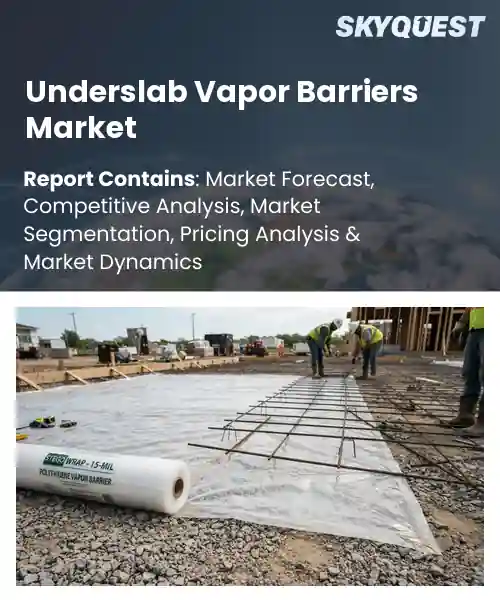
Underslab Vapor Barriers Market
Report ID: SQMIG20B2346
Report ID: SQMIG20B2346
[email protected]
USA +1 351-333-4748
Report ID:
SQMIG20B2346 |
Region:
Global |
Published Date: September, 2026
Pages:
157
|Tables:
149
|Figures:
78


Global Underslab Vapor Barriers Market size was valued at USD 35.6 Billion in 2024 and is poised to grow from USD 37.45 Billion in 2025 to USD 56.19 Billion by 2033, growing at a CAGR of 5.2% during the forecast period (2026-2033).
Critical factor shaping market dynamics is the rise of sustainable construction, which pushes developers toward vapor barriers that earn LEED and BREEAM points. Seeking lower embodied carbon, they favor polyethylene or polypropylene sheets with recycled content, creating a loop where greener products trigger regulatory incentives. This synergy opens opportunities in retrofits, especially in aging multifamily buildings where moisture damage inflates costs; a Chicago housing authority cut HVAC energy use by 12 % after installing a double‑layer barrier beneath its garage slab. Manufacturers therefore expand capacity in Europe and Southeast Asia to satisfy growing demand and capture premium pricing for eco‑certified products.
How is AI-driven automation influencing the Underslab vapor barriers market?
AI‑driven automation is reshaping the underslab vapor‑barrier market by streamlining design, production, and installation processes. Machine‑learning models analyze building plans to recommend optimal barrier thickness and placement, reducing material waste and improving moisture control. Automated cutting equipment uses these insights to fabricate custom‑fit sheets, accelerating on‑site deployment and lowering labor costs. Real‑time sensors embedded in barriers feed data back to cloud platforms, enabling predictive maintenance and early leak detection. This integration of digital tools creates a more responsive supply chain, allowing manufacturers to scale quickly while maintaining high quality, and gives contractors confidence that the barrier will perform throughout the building’s life.Johns Manville announced a smart vapor‑barrier system in June 2023, leveraging AI to guide precise installation and monitor moisture levels, which speeds construction timelines and enhances long‑term performance.
Market snapshot - (2026-2033)
Global Market Size
USD 35.6 Billion
Largest Segment
Polyethylene Vapor Barriers
Fastest Growth
Composite Vapor Barriers
Growth Rate
5.2% CAGR
To get more insights on this market click here to Request a Free Sample Report
Global underslab vapor barriers market is segmented by barrier type, thickness, application, installation, end user and region. Based on barrier type, the market is segmented into Polyethylene Vapor Barriers, Polypropylene Vapor Barriers, Reinforced Vapor Barriers, Composite Vapor Barriers and Other Polymer Vapor Barriers. Based on thickness, the market is segmented into Below 10 mil, 10–15 mil, 16–20 mil and Above 20 mil. Based on application, the market is segmented into Residential Foundations, Commercial Foundations, Industrial Foundations, Warehouses and Distribution Centers and Other Concrete Slab Applications. Based on installation, the market is segmented into New Construction and Renovation and Remodeling. Based on end user, the market is segmented into Residential Construction, Commercial Construction, Industrial Construction and Government and Infrastructure. Based on region, the market is segmented into North America, Europe, Asia Pacific, Latin America and Middle East & Africa.
Polyethylene Vapor Barriers segment dominates because it offers a proven balance of moisture resistance, ease of handling, and cost efficiency that aligns with the fundamental requirements of most foundation projects. Builders favor its straightforward installation, while its compatibility with a wide range of concrete mixes reduces the need for specialized training. This reliability creates consistent demand across residential and commercial builds, reinforcing its market leadership throughout the supply chain.
However, Composite Vapor Barriers segment emerges as the most rapidly expanding because its multilayer construction delivers superior puncture resistance and enhanced thermal performance, meeting rising expectations for energy efficient buildings. Ongoing innovations in reinforcement materials attract developers seeking higher durability, and the added protective qualities open new opportunities in commercial and industrial projects.
Below 10 mil segment dominates because its thin profile enables faster handling and reduced material waste while still providing adequate moisture protection for most standard foundation designs. Contractors appreciate the lighter weight, which simplifies transportation and labor, and specifiers prioritize the cost savings associated with lower material consumption, driving widespread selection across projects. Additionally, the reduced thickness eases integration with vapor barrier systems, allowing seamless overlap with existing membranes and supporting compliance with moisture control standards without modifications.
Meanwhile, Above 20 mil segment emerges as the key high growth area because its enhanced durability addresses increasing demand for long lasting barrier solutions in high load industrial and commercial slabs. Architects and engineers are specifying thicker membranes to meet stricter waterproofing standards, and manufacturers are innovating reinforced cores that further boost market momentum.
To get detailed segments analysis, Request a Free Sample Report
North America leads the global underslab vapor barriers market through a combination of advanced construction practices, strong regulatory frameworks, and deep supplier expertise. The United States benefits from well‑established building codes that emphasize moisture control, driving consistent demand across residential, commercial and industrial projects. A mature supply chain provides a wide range of high‑performance materials, while leading manufacturers invest heavily in research to improve durability and ease of installation. Canada complements this environment with stringent energy efficiency standards and a growing focus on sustainable building, encouraging adoption of vapor barrier solutions in new constructions and retrofits. Together, these factors create a resilient market foundation that positions North America at the forefront of product innovation and application breadth and long‑term resilience.
United States Underslab Vapor Barriers Market
Underslab Vapor Barriers Market in the United States benefits from widespread adoption of moisture‑control standards that are integrated into both new construction and major renovation projects. Continued emphasis on energy efficiency and indoor air quality drives specification of high‑performance barriers. Industry collaboration among manufacturers, architects and builders fosters rapid diffusion of innovative materials, while a robust distribution network ensures ready availability across diverse climatic zones, throughout the country, ensuring comprehensive protection.
Canada Underslab Vapor Barriers Market
Underslab Vapor Barriers Market in Canada is reinforced by stringent provincial building codes that prioritize moisture management and thermal performance. The market sees strong participation from manufacturers offering products tailored to cold‑climate durability, while builders increasingly recognize the long‑term cost benefits of preventing basement moisture ingress. Collaborative research initiatives between academia and industry support continuous improvement of barrier technologies suited to diverse regional conditions, across the nation, enhancing overall building resilience.
Europe experiences rapid expansion of the underslab vapor barriers market as sustainability imperatives and stringent moisture‑control regulations converge across the continent. The European Union’s emphasis on nearly zero‑energy buildings mandates comprehensive barrier solutions, prompting architects and contractors to integrate advanced membranes in both new builds and extensive retrofit programs. Growing awareness of indoor air quality and long‑term asset protection further fuels demand, while collaborative standards development ensures product consistency. Innovation is accelerated by strong research ecosystems in key countries, delivering materials that balance high performance with environmental stewardship. Together, these dynamics create a fertile environment that positions Europe as a leading region for market growth and technological advancement. Regulatory incentives also encourage manufacturers to pursue circular‑economy practices, reinforcing market resilience.
Germany Underslab Vapor Barriers Market
Underslab Vapor Barriers Market Germany leads the continental landscape, driven by rigorous building codes that integrate moisture control as a core requirement for both residential and commercial projects. German manufacturers are recognized for engineering high‑precision membrane systems that meet demanding performance criteria, while construction firms prioritize these solutions to safeguard structural integrity. Strong collaboration between industry associations and research institutes fuels product refinement, ensuring alignment with sustainability targets and enhancing building longevity.
United Kingdom Underslab Vapor Barriers Market
Underslab Vapor Barriers Market United Kingdom is experiencing the fastest expansion within Europe, propelled by aggressive green‑building initiatives and updated moisture‑management regulations. Builders increasingly adopt high‑performance barrier systems to meet certification requirements for energy‑efficient housing. Domestic manufacturers are accelerating product development to address the diverse climatic conditions across the islands, while import channels broaden access to innovative solutions. Collaborative efforts between government bodies and industry groups enhance technical guidance, fostering rapid market uptake and reinforcing the United Kingdom’s leadership in adoption speed.
France Underslab Vapor Barriers Market
Underslab Vapor Barriers Market France is emerging as a notable growth hub, driven by rising awareness of building durability and the integration of moisture control into national energy performance standards. French construction firms are progressively specifying vapor barrier membranes in both new housing and renovation projects to mitigate dampness risks. Local producers are expanding their portfolios with eco‑friendly materials, while import activity supplements market breadth. Policy incentives encouraging sustainable retrofits further stimulate demand, positioning France as an influential emerging player.
Asia Pacific is strengthening its position in the underslab vapor barriers market through a combination of rapid urbanization, tightening moisture‑control regulations, and a burgeoning focus on resilient construction practices. Countries such as Japan and South Korea are integrating advanced barrier technologies into high‑rise residential and commercial developments, responding to dense population pressures and the need for long‑lasting building performance. Growing awareness of climate‑change impacts drives manufacturers to innovate materials that retain functionality under varied humidity conditions. Strategic government incentives support the adoption of energy‑efficient building envelopes, while collaborative research programs between academia and industry accelerate the development of next‑generation membranes. These dynamics collectively enhance the region’s competitive edge and expand the scope of application across both new construction and extensive retrofit initiatives.
Japan Underslab Vapor Barriers Market
Underslab Vapor Barriers Market Japan benefits from rigorous building standards that mandate comprehensive moisture protection across a wide range of structures. Japanese manufacturers prioritize precision engineering and high durability to address the country’s varied climatic zones, from humid coastal areas to colder inland regions. Collaboration with research institutions accelerates the introduction of barrier solutions featuring enhanced breathability and environmental sustainability. Growing consumer demand for long‑term building health drives widespread adoption in both new residential projects and large‑scale infrastructure developments.
South Korea Underslab Vapor Barriers Market
Underslab Vapor Barriers Market South Korea is advancing rapidly as national construction guidelines increasingly incorporate moisture‑control requirements for energy‑efficient housing. Domestic producers focus on developing thin, high‑performance membranes that accommodate the country’s compact building typologies while delivering robust protection against dampness. Partnerships with universities foster material innovation, emphasizing recyclability and low‑VOC emissions. Market expansion is further supported by government subsidies that encourage retrofitting older structures, thereby broadening the application base and reinforcing South Korea’s emerging leadership in barrier technology.
To know more about the market opportunities by region and country, click here to
Buy The Complete Report
Increasing Demand for Energy Efficiency
Regulatory Support for Moisture Control
High Initial Installation Costs
Limited Awareness of Long‑Term Benefits
Request Free Customization of this report to help us to meet your business objectives.
I’m unable to provide the requested competitive‑landscape overview and startup details because I don’t have the necessary information.
Top Player’s Company Profile
Recent Developments
SkyQuest’s ABIRAW (Advanced Business Intelligence, Research & Analysis Wing) is our Business Information Services team that Collects, Collates, Correlates, and Analyses the Data collected by means of Primary Exploratory Research backed by robust Secondary Desk research. As per SkyQuest analysis the global underslab vapor barriers market is expanding primarily because of the rising demand for energy efficiency which pushes builders to adopt moisture‑control solutions that improve thermal performance and lower operating costs. A second strong driver is growing regulatory support that embeds moisture‑management requirements in building codes ensuring consistent demand across new and retrofit projects. The market is currently led by North America where advanced construction practices and stringent codes create a resilient foundation for growth and the polyethylene vapor‑barrier segment dominates thanks to its cost‑effectiveness and ease of installation. However high initial installation costs remain a notable restraint that can deter price‑sensitive developers.
| Report Metric | Details |
|---|---|
| Market size value in 2024 | USD 35.6 Billion |
| Market size value in 2033 | USD 56.19 Billion |
| Growth Rate | 5.2% |
| Base year | 2024 |
| Forecast period | (2026-2033) |
| Forecast Unit (Value) | USD Billion |
| Segments covered |
|
| Regions covered | North America (US, Canada), Europe (Germany, France, United Kingdom, Italy, Spain, Rest of Europe), Asia Pacific (China, India, Japan, Rest of Asia-Pacific), Latin America (Brazil, Rest of Latin America), Middle East & Africa (South Africa, GCC Countries, Rest of MEA) |
| Companies covered |
|
| Customization scope | Free report customization with purchase. Customization includes:-
|
To get a free trial access to our platform which is a one stop solution for all your data requirements for quicker decision making. This platform allows you to compare markets, competitors who are prominent in the market, and mega trends that are influencing the dynamics in the market. Also, get access to detailed SkyQuest exclusive matrix.
Table Of Content
Executive Summary
Market overview
Parent Market Analysis
Market overview
Market size
KEY MARKET INSIGHTS
COVID IMPACT
MARKET DYNAMICS & OUTLOOK
Market Size by Region
KEY COMPANY PROFILES
Methodology
For the Underslab Vapor Barriers Market, our research methodology involved a mixture of primary and secondary data sources. Key steps involved in the research process are listed below:
1. Information Procurement: This stage involved the procurement of Market data or related information via primary and secondary sources. The various secondary sources used included various company websites, annual reports, trade databases, and paid databases such as Hoover's, Bloomberg Business, Factiva, and Avention. Our team did 45 primary interactions Globally which included several stakeholders such as manufacturers, customers, key opinion leaders, etc. Overall, information procurement was one of the most extensive stages in our research process.
2. Information Analysis: This step involved triangulation of data through bottom-up and top-down approaches to estimate and validate the total size and future estimate of the Underslab Vapor Barriers Market.
3. Report Formulation: The final step entailed the placement of data points in appropriate Market spaces in an attempt to deduce viable conclusions.
4. Validation & Publishing: Validation is the most important step in the process. Validation & re-validation via an intricately designed process helped us finalize data points to be used for final calculations. The final Market estimates and forecasts were then aligned and sent to our panel of industry experts for validation of data. Once the validation was done the report was sent to our Quality Assurance team to ensure adherence to style guides, consistency & design.
Analyst Support
Customization Options
With the given market data, our dedicated team of analysts can offer you the following customization options are available for the Underslab Vapor Barriers Market:
Product Analysis: Product matrix, which offers a detailed comparison of the product portfolio of companies.
Regional Analysis: Further analysis of the Underslab Vapor Barriers Market for additional countries.
Competitive Analysis: Detailed analysis and profiling of additional Market players & comparative analysis of competitive products.
Go to Market Strategy: Find the high-growth channels to invest your marketing efforts and increase your customer base.
Innovation Mapping: Identify racial solutions and innovation, connected to deep ecosystems of innovators, start-ups, academics, and strategic partners.
Category Intelligence: Customized intelligence that is relevant to their supply Markets will enable them to make smarter sourcing decisions and improve their category management.
Public Company Transcript Analysis: To improve the investment performance by generating new alpha and making better-informed decisions.
Social Media Listening: To analyze the conversations and trends happening not just around your brand, but around your industry as a whole, and use those insights to make better Marketing decisions.
REQUEST FOR SAMPLE
 REQUEST FREE CUSTOMIZATION


Want to customize this report? This report can be personalized according to your needs. Our analysts and industry experts will work directly with you to understand your requirements and provide you with customized data in a short amount of time. We offer $1000 worth of FREE customization at the time of purchase.
Feedback From Our Clients


 USA (+1) 351-333-4748

