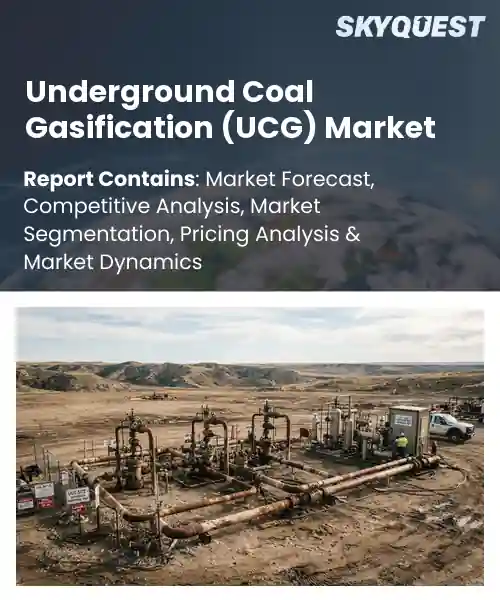
Underground Coal Gasification (UCG) Market
Report ID: SQMIG10G2086
Report ID: SQMIG10G2086
[email protected]
USA +1 351-333-4748
Report ID:
SQMIG10G2086 |
Region:
Global |
Published Date: September, 2026
Pages:
157
|Tables:
148
|Figures:
78


Global Underground Coal Gasification (Ucg) Market size was valued at USD 2.85 Billion in 2024 and is poised to grow from USD 3.04 Billion in 2025 to USD 5.03 Billion by 2033, growing at a CAGR of 6.5% during the forecast period (2026-2033).
Underground coal gasification (UCG) converts inaccessible coal seams into synthesis gas by injecting oxidants and recovering a hydrogen‑rich mixture, positioning the technology as a bridge between dwindling mining and energy demand. The market originated in the 1970s when oil crises spurred alternative‑fuel research, yet remained experimental until pilot projects in the United States, China and South Africa proved commercial viability in the 2000s. Today, UCG draws investors because it exploits reserves while avoiding surface‑mining impacts, extending the life of coal assets and enhancing energy security in regions lacking natural gas. This evolution reflects a shift from extraction toward fuel production. Regulatory encouragement for reduction pathways acts as a catalyst propelling UCG expansion, because governments award tax credits and carbon‑offset credits to projects that replace gas with syngas. This incentive framework directly lowers project economics, prompting companies such as Syngas Energy and China Coal Energy to scale pilot fields in Kazakhstan and Ordos, respectively. As these demonstrations achieve higher conversion efficiencies and lower emissions, they attract financing from green‑bond issuers, which in turn fuels R‑D on catalyst technologies and monitoring. The resulting ecosystem creates a loop where support drives commercial success, unlocking markets in power generation, chemicals and enhanced oil recovery.
How is AI improving efficiency and safety in the Underground Coal Gasification (UCG) market?
AI is reshaping Underground Coal Gasification by turning raw sensor streams into actionable insight. Machine learning models learn the complex chemistry of coal conversion and predict optimal injection pressures, reducing fuel waste. Real‑time image analysis watches the underground cavity, flagging cracks before they grow. Autonomous drilling rigs follow AI plans, cutting human exposure and speeding up well placement. Integrated risk engines combine weather forecasts, ground movement data and equipment health to advise operators on safe operating windows. Together these tools tighten process control, lower operating costs and create a safer work environment while keeping the gas output steady.UCG Solutions Ltd June 2024, introduced an AI driven control platform that continuously balances gas flow and alerts crews to pressure spikes, delivering higher efficiency and stronger safety margins in the UCG market.
Market snapshot - (2026-2033)
Global Market Size
USD 2.85 Billion
Largest Segment
Vertical Well Technology
Fastest Growth
Controlled Retractable Injection Point Technology
Growth Rate
6.5% CAGR
To get more insights on this market click here to Request a Free Sample Report
Global underground coal gasification (ucg) market is segmented by technology, gasifier type, product, application, end user and region. Based on technology, the market is segmented into Vertical Well Technology, Directional Drilling Technology, Controlled Retractable Injection Point Technology and Other UCG Technologies. Based on gasifier type, the market is segmented into Fixed-Bed Gasifiers, Moving-Bed Gasifiers and Other Gasifier Types. Based on product, the market is segmented into Syngas, Hydrogen and Other Gas Products. Based on application, the market is segmented into Power Generation, Chemical Production, Hydrogen Production, Synthetic Natural Gas Production and Other Applications. Based on end user, the market is segmented into Power Utilities, Chemical & Petrochemical Companies, Mining Companies and Industrial Gas Producers. Based on region, the market is segmented into North America, Europe, Asia Pacific, Latin America and Middle East & Africa.
Vertical Well Technology segment dominates because it enables direct access to deep coal seams, minimizing surface disruption and optimizing heat distribution. Its ability to create stable reaction zones reduces operational risk, attracting investors seeking reliable production. The technology’s proven field trials and compatibility with existing drilling infrastructure further reinforce its leadership position in the UCG market. Furthermore, its modular design allows rapid deployment across varied geological conditions, enhancing project scalability.
However, Directional Drilling Technology segment emerges as the fastest growing because of its capacity to target complex seam geometries with precision, unlocking previously inaccessible reserves. This capability fuels broader adoption of UCG projects, spurring investment in advanced drilling rigs and driving a surge in market activity that expands the overall addressable base.
Syngas segment dominates because it serves as a versatile intermediate, supporting multiple downstream processes such as power generation, chemical synthesis, and fuel production. Its composition can be tailored through onsite conditioning, meeting diverse quality standards and enabling flexible integration with existing infrastructure. This adaptability makes syngas the primary revenue driver and central focus for UCG developers. Consequently, investors prioritize projects that maximize syngas yield, reinforcing its market preeminence across diverse industry portfolios.
Meanwhile, Hydrogen segment is witnessing the strongest growth because of rising clean energy mandates and the high calorific value of UCG derived hydrogen. Emerging low carbon policies incentivize its production, prompting developers to integrate water gas shift processes and catalysis advancements. This momentum positions hydrogen as a strategic expansion avenue, attracting new capital and fostering cross sector partnerships.
To get detailed segments analysis, Request a Free Sample Report
North America’s leadership stems from a combination of deep technical expertise, robust research ecosystems, and a policy environment that encourages low‑carbon energy innovation. Strong ties between energy producers, academic institutions, and technology providers accelerate the development of advanced UCG processes. Established infrastructure for coal extraction and conversion supports rapid scaling, while regulatory frameworks balance environmental stewardship with commercial viability. Investment confidence is reinforced by clear pathways for integrating UCG output into existing power and industrial networks, positioning the region as a benchmark for operational excellence and sustainable coal utilization.
Underground Coal Gasification (UCG) Market in the United States benefits from a mature energy sector that embraces experimental pilot projects and collaborative engineering initiatives. A culture of innovation drives continual refinement of gasification techniques, emphasizing efficiency and emission control. Close cooperation between federal research agencies and private enterprises fuels technology transfer, while the existing coal basins provide a strategic foundation for expansion. Market participants leverage this ecosystem to align UCG output with broader decarbonization objectives across power generation and industrial applications.
Underground Coal Gasification (UCG) Market in Canada draws strength from extensive natural resource expertise and a policy agenda that prioritizes clean energy transition. Collaborative ventures between mining companies and research institutions focus on optimizing gasification chemistry and integrating carbon capture solutions. The country’s commitment to environmentally responsible development encourages adoption of UCG as a bridge technology, linking traditional coal assets with emerging low‑carbon pathways. Stakeholder confidence is reinforced by transparent regulatory processes that support sustainable project implementation.
Europe’s accelerating UCG expansion is propelled by stringent climate objectives, substantial public and private research funding, and a strategic desire to diversify energy sources while reducing reliance on imported fuels. Collaborative networks across the continent foster shared expertise in advanced gasification and carbon capture integration. Policy mechanisms that reward low‑emission technologies create favorable conditions for UCG projects, especially in regions with legacy coal deposits seeking economic revitalization. The collective emphasis on technological readiness and environmental compliance positions Europe as a dynamic arena for UCG growth.
Underground Coal Gasification (UCG) Market in Germany is emerging as a focal point for low‑carbon transition research, leveraging the country’s strong engineering heritage and extensive industrial base. Partnerships between universities, energy firms, and technology providers concentrate on refining process control and linking gasification outputs to chemical and power sectors. Regulatory support emphasizes stringent environmental performance, encouraging pilot initiatives that demonstrate commercial viability. This emerging momentum aligns with broader national goals to integrate cleaner coal technologies within a sustainable energy mix.
Underground Coal Gasification (UCG) Market in the United Kingdom is experiencing the fastest growth due to proactive policy incentives and a vibrant innovation ecosystem. Strategic investments target the adaptation of UCG for hybrid energy solutions, including integration with hydrogen production and carbon capture schemes. Collaborative frameworks between governmental bodies, research institutions, and industry accelerate technology validation and market entry. This rapid development reflects the United Kingdom’s ambition to harness domestic coal resources responsibly while meeting ambitious decarbonization targets.
Underground Coal Gasification (UCG) Market in France is emerging within a context of strong environmental regulation and a commitment to diversified low‑carbon energy sources. Research consortia focus on coupling UCG with advanced carbon management and renewable integration, positioning the technology as a complement to existing energy infrastructure. Governmental encouragement of clean‑technology pilots supports early‑stage development, while industry stakeholders explore synergies with petrochemical and power generation sectors. This emerging trajectory aligns with France’s broader strategic emphasis on sustainable industrial transformation.
Asia Pacific is advancing its UCG stance through strategic emphasis on energy security, technological collaboration, and alignment with climate mitigation pathways. Governments are fostering supportive frameworks that encourage research partnerships and the adoption of low‑emission coal conversion methods. Integration of UCG with emerging hydrogen economies and carbon capture initiatives enhances its appeal as a versatile energy bridge. Regional industry leaders prioritize skill development and knowledge exchange, positioning the market to capitalize on abundant coal resources while advancing broader sustainability objectives.
Underground Coal Gasification (UCG) Market in Japan focuses on leveraging advanced process engineering to support energy diversification and low‑carbon goals. Collaborative projects link UCG technology with hydrogen synthesis and stringent emission standards, reflecting the nation’s commitment to clean energy transitions. Research institutions contribute to refining catalyst systems and process efficiency, while industrial partners explore integration with existing power and chemical infrastructures. This cohesive approach underlines Japan’s intent to harness coal resources responsibly within a forward‑looking energy framework.
Underground Coal Gasification (UCG) Market in South Korea emphasizes innovative applications that complement the country’s rapid industrial growth and environmental aspirations. Joint initiatives between technology firms and research universities aim to improve gasification reliability and facilitate carbon capture deployment. Policy encouragement for low‑emission technologies drives interest in UCG as a supplemental energy source for high‑demand sectors. By aligning UCG development with broader clean‑energy strategies, South Korea seeks to reinforce its energy resilience while meeting stringent sustainability benchmarks.
To know more about the market opportunities by region and country, click here to
Buy The Complete Report
Increasing Energy Demand Is Driving Expansion
Policy Support And Incentives Are Emerging
Environmental Concerns Remain Significant
High Capital Expenditure Limits Adoption
Request Free Customization of this report to help us to meet your business objectives.
The competitive landscape of the global Underground Coal Gasification market is shaped by intense rivalry among established firms and emerging innovators, with strategic M&A activity, joint ventures, and technology‑focused collaborations driving market dynamics; recent examples include a partnership between a leading European energy group and a UCG technology provider to co‑develop modular reactors, and the acquisition of a niche UCG equipment supplier by a major mining conglomerate to expand its low‑carbon portfolio.
Top Player’s Company Profile
Recent Developments
SkyQuest’s ABIRAW (Advanced Business Intelligence, Research & Analysis Wing) is our Business Information Services team that Collects, Collates, Correlates, and Analyses the Data collected by means of Primary Exploratory Research backed by robust Secondary Desk research. As per SkyQuest analysis the global underground coal gasification market is being propelled primarily by rising energy demand, which encourages investors to convert low‑grade coal seams into cleaner syngas, while supportive policy incentives such as tax credits and streamlined permitting further boost project economics. The dominant region is North America, where deep technical expertise and existing coal infrastructure accelerate adoption, and the leading segment is Vertical Well Technology because it offers direct access to deep seams and stable reaction zones. However, environmental concerns over groundwater contamination and subsidence act as a significant restraint, adding regulatory scrutiny and mitigation costs that can slow new developments.
| Report Metric | Details |
|---|---|
| Market size value in 2024 | USD 2.85 Billion |
| Market size value in 2033 | USD 5.03 Billion |
| Growth Rate | 6.5% |
| Base year | 2024 |
| Forecast period | (2026-2033) |
| Forecast Unit (Value) | USD Billion |
| Segments covered |
|
| Regions covered | North America (US, Canada), Europe (Germany, France, United Kingdom, Italy, Spain, Rest of Europe), Asia Pacific (China, India, Japan, Rest of Asia-Pacific), Latin America (Brazil, Rest of Latin America), Middle East & Africa (South Africa, GCC Countries, Rest of MEA) |
| Companies covered |
|
| Customization scope | Free report customization with purchase. Customization includes:-
|
To get a free trial access to our platform which is a one stop solution for all your data requirements for quicker decision making. This platform allows you to compare markets, competitors who are prominent in the market, and mega trends that are influencing the dynamics in the market. Also, get access to detailed SkyQuest exclusive matrix.
Table Of Content
Executive Summary
Market overview
Parent Market Analysis
Market overview
Market size
KEY MARKET INSIGHTS
COVID IMPACT
MARKET DYNAMICS & OUTLOOK
Market Size by Region
KEY COMPANY PROFILES
Methodology
For the Underground Coal Gasification (UCG) Market, our research methodology involved a mixture of primary and secondary data sources. Key steps involved in the research process are listed below:
1. Information Procurement: This stage involved the procurement of Market data or related information via primary and secondary sources. The various secondary sources used included various company websites, annual reports, trade databases, and paid databases such as Hoover's, Bloomberg Business, Factiva, and Avention. Our team did 45 primary interactions Globally which included several stakeholders such as manufacturers, customers, key opinion leaders, etc. Overall, information procurement was one of the most extensive stages in our research process.
2. Information Analysis: This step involved triangulation of data through bottom-up and top-down approaches to estimate and validate the total size and future estimate of the Underground Coal Gasification (UCG) Market.
3. Report Formulation: The final step entailed the placement of data points in appropriate Market spaces in an attempt to deduce viable conclusions.
4. Validation & Publishing: Validation is the most important step in the process. Validation & re-validation via an intricately designed process helped us finalize data points to be used for final calculations. The final Market estimates and forecasts were then aligned and sent to our panel of industry experts for validation of data. Once the validation was done the report was sent to our Quality Assurance team to ensure adherence to style guides, consistency & design.
Analyst Support
Customization Options
With the given market data, our dedicated team of analysts can offer you the following customization options are available for the Underground Coal Gasification (UCG) Market:
Product Analysis: Product matrix, which offers a detailed comparison of the product portfolio of companies.
Regional Analysis: Further analysis of the Underground Coal Gasification (UCG) Market for additional countries.
Competitive Analysis: Detailed analysis and profiling of additional Market players & comparative analysis of competitive products.
Go to Market Strategy: Find the high-growth channels to invest your marketing efforts and increase your customer base.
Innovation Mapping: Identify racial solutions and innovation, connected to deep ecosystems of innovators, start-ups, academics, and strategic partners.
Category Intelligence: Customized intelligence that is relevant to their supply Markets will enable them to make smarter sourcing decisions and improve their category management.
Public Company Transcript Analysis: To improve the investment performance by generating new alpha and making better-informed decisions.
Social Media Listening: To analyze the conversations and trends happening not just around your brand, but around your industry as a whole, and use those insights to make better Marketing decisions.
REQUEST FOR SAMPLE
 REQUEST FREE CUSTOMIZATION


Want to customize this report? This report can be personalized according to your needs. Our analysts and industry experts will work directly with you to understand your requirements and provide you with customized data in a short amount of time. We offer $1000 worth of FREE customization at the time of purchase.
Feedback From Our Clients


 USA (+1) 351-333-4748

