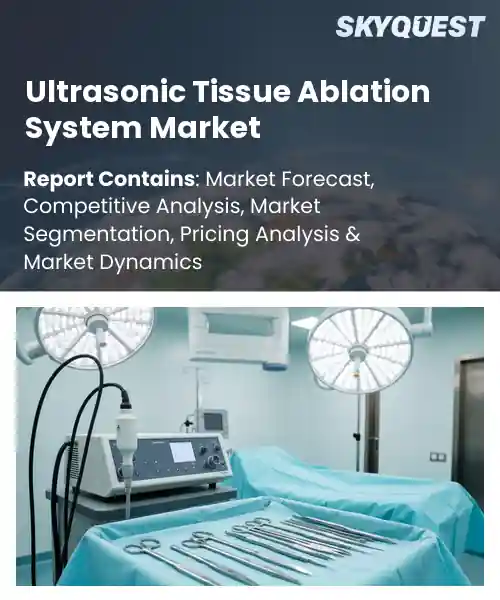
Ultrasonic Tissue Ablation System Market
Report ID: SQMIG35A4151
Report ID: SQMIG35A4151
[email protected]
USA +1 351-333-4748
Report ID:
SQMIG35A4151 |
Region:
Global |
Published Date: July, 2026
Pages:
157
|Tables:
122
|Figures:
77


Global Ultrasonic Tissue Ablation System Market size was valued at USD 621.46 Million in 2024 and is poised to grow from USD 676.27 Million in 2025 to USD 1329.82 Million by 2033, growing at a CAGR of 8.82% during the forecast period (2026-2033).
The global ultrasonic tissue ablation system market is focused on devices for destroying tissue without incisions using acoustic energy. The importance of this lies in the increasing demand for treatments that reduce hospital stays and complications. The rising prevalence of chronic liver disease and solid tumors has led to a pool of patients requiring ablation, which is the primary factor driving the growth of the market. Over the decade, piezoelectric transducer design and imaging integration have reduced the risk of procedures. For example, ultrasonic ablation for hepatocellular carcinoma is being adopted in Europe and Asia. The market has evolved from surgical instruments to therapeutic platforms.
The convergence of regulatory support and reimbursement reforms supporting invasive procedures is another important factor that is contributing to the growth of the ultrasonic tissue ablation system market. A clear approval pathway for ultrasonic devices from health authorities allows manufacturers to accelerate product launches and increase access for clinicians and patient adoption. The resulting spike in hospital procurement is reflected in United States, where Medicare now considers ultrasonic liver ablation a covered service, resulting in a 35 percent increase in installations over the past three years. The incentive will promote research into portable probes for cardiac arrhythmia, creating a revenue stream and positioning the technology as a solution.
How is AI-driven Automation Influencing The Growth Of The Ultrasonic Tissue Ablation System Market?
AI-powered automation is revolutionizing the market for ultrasonic tissue ablation system with intelligent algorithms at the core of the devices. Machine learning algorithms process the acoustic signatures in real time to enable the system to automatically adjust the energy levels for each patient. This reduces dependence on the operator, shortens procedure times and improves safety outcomes. The integration with hospital information systems allows for the seamless flow of data and predictive maintenance and inventory planning. Clearer visual feedback and decision support benefits clinicians driving adoption in cardiac, liver and oncology applications. Overall, the result is a faster, more reliable workflow that fuels market growth and attracts new players who want to tap into AI capabilities.
Market snapshot - (2026-2033)
Global Market Size
USD 621.46 Million
Largest Segment
High-Intensity Focused Ultrasound Systems
Fastest Growth
Magnetic Resonance-Guided Focused Ultrasound Systems
Growth Rate
8.82% CAGR
To get more insights on this market click here to Request a Free Sample Report
Global ultrasonic tissue ablation system market is segmented by product type, system portability, clinical application, end user and region. Based on product type, the market is segmented into High-Intensity Focused Ultrasound Systems, Magnetic Resonance-Guided Focused Ultrasound Systems, Ultrasonic Surgical Ablation Systems and Shockwave Therapy Systems. Based on system portability, the market is segmented into Standalone Console Systems and Compact Portable Systems. Based on clinical application, the market is segmented into Gynecologic Disorders, Oncology Treatment, Neurological Disorders, Cardiovascular Disease, Urological Disorders and Others. Based on end user, the market is segmented into Hospitals, Specialized Cancer Centers, Imaging Centers, Ambulatory Surgical Centers and Others. Based on region, the market is segmented into North America, Europe, Asia Pacific, Latin America and Middle East & Africa.
The High intensity Focused Ultrasound Systems segment is dominant, owing to its ability to provide precise energy deposition, enabling non invasive tissue destruction with real time imaging feedback, meeting the core demand for accuracy and safety. These systems are preferred by clinicians for a variety of indications from uterine fibroids to tumor ablation because they spare the surrounding structures. This clinical versatility and strong reimbursement pathways continue to drive hospital and specialty center preference.
However, Magnetic Resonance Guided Focused Ultrasound Systems are experiencing the highest growth momentum, due to the integration of high resolution MRI guidance, increasing clinician’s confidence in targeting deep lesions. Ongoing enhancements in magnet compatibility and reductions in system footprint are fueling adoption in oncology, neurology and elsewhere, creating new procedural opportunities and growth.
The Compact Portable Systems segment dominates as they bring point of care ablation capabilities directly into outpatient settings, reducing patient travel and procedural latency. Their smaller footprint and simplified user interface allow for rapid deployment in ambulatory surgical centers and imaging clinics to meet the growing demand for cost-effective, minimally invasive therapies. Healthcare providers like the flexibility and lower capital investment, leading to strong uptake across a range of care environments.
In contrast, Standalone Console Systems are emerging as the key high growth area as they combine imaging analytics and workflow integration. They are attractive to large hospital networks aiming to streamline their operations because they can support multiple procedures from a single platform, driving higher procurement and encouraging wider clinical applications that fuel market momentum.
To get detailed segments analysis, Request a Free Sample Report
North America is the largest market for Ultrasonic Tissue Ablation System globally due to a combination of a well-advanced research environment, well-established clinical infrastructure and favorable regulatory policies. Innovations are occurring fast due to partnerships between leading technology companies and academic institutions, and established reimbursement models allow for rapid uptake in hospitals and outpatient clinics. The region has a well-developed capital market that attracts investment for the expansion of manufacturing and the improvement of training programs. A high prevalence of specialty procedures means a steady demand. A culture of evidence-based practice means continuous improvement. The collaborative environment also facilitates early engagement with regulatory bodies, shortening time to market and improving patient access across the continent.
The United States ultrasonic tissue ablation system market growth is driven by the robust network of leading hospitals and specialized surgical centers focusing on minimally invasive therapies. Strong IP protection encourages domestic innovators. Extensive reimbursement frameworks ensure reimbursement. Device manufacturers collaborating with academic research institutions speed clinical trials, leading to the rapid integration of next-generation technologies into standard care pathways. This ecosystem drives high adoption rates and continuous product evolution.
In Canada, the Ultrasonic Tissue Ablation System Market is propelled by a national health system focusing on technology assessment and evidence-based adoption, providing a clear pathway for new devices. Provincial programs to support collaborative clinical research and early patient access. The strength of ties with U.S. innovators facilitates technology transfer, while the alignment of regulations with international standards accelerates market access. The result is consistent integration of ultrasound solutions into leading cardiac and oncology centers.
Europe’s Ultrasonic Tissue Ablation System market is experiencing rapid expansion driven by a confluence of supportive regulatory frameworks, comprehensive reimbursement schemes, and a deep commitment to minimally invasive therapeutic approaches. The region hosts several world‑leading device manufacturers that collaborate closely with academic hospitals, fostering a pipeline of innovative solutions tailored to local clinical needs. Harmonized standards across member states simplify product approval and enable cross‑border distribution, while public and private payers increasingly recognize the clinical and economic benefits of ultrasonic ablation. Moreover, a growing emphasis on personalized medicine and a demographic shift toward an older patient base stimulate demand for precise, tissue‑sparing technologies. These dynamics collectively accelerate market penetration and reinforce Europe’s position as a hub for cutting‑edge ultrasonics in healthcare.
Ultrasonic Tissue Ablation System Market in Germany is anchored by a strong engineering tradition and a highly regulated healthcare environment that values clinical evidence. Leading research institutes cooperate with manufacturers to accelerate product validation, while reimbursement policies grant favorable coverage for advanced therapeutic modalities. The country’s extensive network of specialized centers ensures swift diffusion of new technologies, solidifying Germany’s role as a benchmark for performance standards across the European Union.
Ultrasonic Tissue Ablation System Market in the United Kingdom benefits from an adoption strategy driven by national health initiatives that prioritize innovation and cost‑effectiveness. Accelerated approval pathways and collaborative research funding enable clinical evaluation of emerging devices. A growing number of private and academic hospitals invest in training programs, fostering clinician expertise. These factors combine to produce a fast‑moving market environment where ultrasonic technologies gain swift acceptance and market share.
Ultrasonic Tissue Ablation System Market in France is emerging as a niche segment, supported by a strong emphasis on translational research and incentives for medical technology development. Collaborative projects between universities and start‑ups accelerate prototype testing, while a reimbursement framework expands coverage for minimally invasive procedures. Early adoption by oncology and cardiology centers is creating demonstrable clinical benefits, positioning France as a fertile ground for significant growth in ultrasonic ablation.
Asia Pacific is strengthening its position in the Ultrasonic Tissue Ablation System market through a blend of rising healthcare investment, rapid adoption of minimally invasive techniques, and strong local manufacturing capabilities. Countries such as Japan and South Korea host world‑renowned technology firms that prioritize research partnerships with universities and hospitals, accelerating clinical validation of novel devices. Regional regulatory agencies are evolving to provide clearer pathways for product approval, while reimbursement policies are becoming more receptive to cost‑effective therapies. An expanding middle class and increasing prevalence of chronic conditions drive demand for precise, tissue‑preserving treatments. Together, these elements foster a competitive ecosystem that not only captures domestic growth but also positions Asia Pacific as an emerging hub for export and cross‑border collaboration in ultrasonic ablation technologies.
Ultrasonic Tissue Ablation System Market in Japan is propelled by a mature medical device sector that integrates engineering with rigorous clinical validation. Strong collaboration between leading corporations and research hospitals accelerates technology transfer, while national health insurance increasingly reimburses ultrasonic procedures for cardiac and oncologic applications. Government initiatives that support innovation clusters further enhance product development pipelines, establishing Japan as a reference market for high‑precision therapeutic solutions in the region.
Ultrasonic Tissue Ablation System Market in South Korea is driven by funding for research and a startup ecosystem focused on acoustic technologies. Ties between universities, hospitals, and device manufacturers expedite prototyping and clinical adoption. Reforms in regulatory assessment shorten timeframes for market entry, while insurance coverage expands to include ultrasonic therapies for liver and prostate conditions. These factors nurture growth and position South Korea as a leader in the region.
To know more about the market opportunities by region and country, click here to
Buy The Complete Report
Increasing Clinical Adoption
Advancements In Ultrasound Technology
High Capital Investment Requirements
Regulatory Approval Complexity
Request Free Customization of this report to help us to meet your business objectives.
The competitive landscape is shaped by aggressive M&A activity and sizable funding rounds, driving rapid consolidation and technology scaling; HistoSonics’ $2.25 billion acquisition in August 2025 followed by a $250 million raise exemplifies this, while partnerships between device makers and imaging firms accelerate integration of real‑time monitoring into ablation workflows, sharpening differentiation among incumbents.
SkyQuest’s ABIRAW (Advanced Business Intelligence, Research & Analysis Wing) is our Business Information Services team that Collects, Collates, Correlates, and Analyses the Data collected by means of Primary Exploratory Research backed by robust Secondary Desk research.
As per SkyQuest analysis, the global ultrasonic tissue ablation market is expanding rapidly, propelled primarily by increasing clinical adoption of minimally invasive procedures that shorten recovery and boost patient confidence; a second strong driver is the integration of AI‑driven automation and precision imaging, which enhances real‑time targeting, reduces operator dependence and speeds workflows. The high‑intensity focused ultrasound systems segment remains dominant because of its precise, non‑invasive energy delivery across multiple indications. North America leads the market due to advanced research ecosystems, supportive reimbursement and fast regulatory pathways. However, high capital investment requirements continue to restrain uptake, especially among smaller facilities, tempering overall penetration.
| Report Metric | Details |
|---|---|
| Market size value in 2024 | USD 621.46 Million |
| Market size value in 2033 | USD 1329.82 Million |
| Growth Rate | 8.82% |
| Base year | 2024 |
| Forecast period | (2026-2033) |
| Forecast Unit (Value) | USD Million |
| Segments covered |
|
| Regions covered | North America (US, Canada), Europe (Germany, France, United Kingdom, Italy, Spain, Rest of Europe), Asia Pacific (China, India, Japan, Rest of Asia-Pacific), Latin America (Brazil, Rest of Latin America), Middle East & Africa (South Africa, GCC Countries, Rest of MEA) |
| Companies covered |
|
| Customization scope | Free report customization with purchase. Customization includes:-
|
To get a free trial access to our platform which is a one stop solution for all your data requirements for quicker decision making. This platform allows you to compare markets, competitors who are prominent in the market, and mega trends that are influencing the dynamics in the market. Also, get access to detailed SkyQuest exclusive matrix.
Table Of Content
Executive Summary
Market overview
Parent Market Analysis
Market overview
Market size
KEY MARKET INSIGHTS
COVID IMPACT
MARKET DYNAMICS & OUTLOOK
Market Size by Region
KEY COMPANY PROFILES
Methodology
For the Ultrasonic Tissue Ablation System Market, our research methodology involved a mixture of primary and secondary data sources. Key steps involved in the research process are listed below:
1. Information Procurement: This stage involved the procurement of Market data or related information via primary and secondary sources. The various secondary sources used included various company websites, annual reports, trade databases, and paid databases such as Hoover's, Bloomberg Business, Factiva, and Avention. Our team did 45 primary interactions Globally which included several stakeholders such as manufacturers, customers, key opinion leaders, etc. Overall, information procurement was one of the most extensive stages in our research process.
2. Information Analysis: This step involved triangulation of data through bottom-up and top-down approaches to estimate and validate the total size and future estimate of the Ultrasonic Tissue Ablation System Market.
3. Report Formulation: The final step entailed the placement of data points in appropriate Market spaces in an attempt to deduce viable conclusions.
4. Validation & Publishing: Validation is the most important step in the process. Validation & re-validation via an intricately designed process helped us finalize data points to be used for final calculations. The final Market estimates and forecasts were then aligned and sent to our panel of industry experts for validation of data. Once the validation was done the report was sent to our Quality Assurance team to ensure adherence to style guides, consistency & design.
Analyst Support
Customization Options
With the given market data, our dedicated team of analysts can offer you the following customization options are available for the Ultrasonic Tissue Ablation System Market:
Product Analysis: Product matrix, which offers a detailed comparison of the product portfolio of companies.
Regional Analysis: Further analysis of the Ultrasonic Tissue Ablation System Market for additional countries.
Competitive Analysis: Detailed analysis and profiling of additional Market players & comparative analysis of competitive products.
Go to Market Strategy: Find the high-growth channels to invest your marketing efforts and increase your customer base.
Innovation Mapping: Identify racial solutions and innovation, connected to deep ecosystems of innovators, start-ups, academics, and strategic partners.
Category Intelligence: Customized intelligence that is relevant to their supply Markets will enable them to make smarter sourcing decisions and improve their category management.
Public Company Transcript Analysis: To improve the investment performance by generating new alpha and making better-informed decisions.
Social Media Listening: To analyze the conversations and trends happening not just around your brand, but around your industry as a whole, and use those insights to make better Marketing decisions.
REQUEST FOR SAMPLE
 REQUEST FREE CUSTOMIZATION
Global Ultrasonic Tissue Ablation System Market size was valued at USD 621.46 Million in 2024 and is poised to grow from USD 676.27 Million in 2025 to USD 1329.82 Million by 2033, growing at a CAGR of 8.82% during the forecast period (2026-2033).
The competitive landscape is shaped by aggressive M&A activity and sizable funding rounds, driving rapid consolidation and technology scaling; HistoSonics’ $2.25 billion acquisition in August 2025 followed by a $250 million raise exemplifies this, while partnerships between device makers and imaging firms accelerate integration of real‑time monitoring into ablation workflows, sharpening differentiation among incumbents. 'Johnson & Johnson', 'Medtronic plc', 'Olympus Corporation', 'Insightec Ltd.', 'SonaCare Medical, LLC', 'Bioventus LLC', 'Alpinion Medical Systems Co., Ltd.', 'Advanced Medical Solutions Group plc', 'Theraclion SA', 'Chongqing Haifu Medical Technology Co., Ltd.', 'EDAP TMS S.A.', 'FUSMobile Inc.', 'Monteris Medical Inc.', 'Soring GmbH', 'Bioventus', 'Striker Corporation', 'Integra LifeSciences Holdings Corporation', 'Bowa Medical', 'Shenzhen Promethe Medical Sci-Tech Co., Ltd.', 'Mianyang Sonic Electronic Co., Ltd.'
The growing acceptance of ultrasonic tissue ablation among clinicians is driven by its minimally invasive nature, which reduces patient recovery time and procedural discomfort. Physicians appreciate the precision of energy delivery that limits collateral damage, enhancing confidence in treating diverse pathologies. This clinical confidence translates into broader procedure portfolios within hospitals, encouraging investment in the technology. As more practitioners become familiar with workflow integration and training programs, the diffusion of the technique accelerates, fostering sustained demand for advanced ablation systems across multiple specialties.
Precision Imaging Integration: Clinicians are increasingly adopting real‑time high‑resolution imaging modalities alongside ultrasonic tissue ablation platforms, enabling precise targeting of pathological tissue while preserving surrounding structures. This convergence drives a shift from conventional surgical techniques to image‑guided, minimally invasive procedures, reducing patient recovery times and procedural complications. Vendors are responding by embedding advanced ultrasound, MRI, and optical coherence tomography capabilities directly into ablation units, fostering seamless workflow integration and expanding the technology’s applicability across oncology, cardiology, and orthopedic interventions, for both acute and chronic conditions.
Why does North America Dominate the Global Ultrasonic Tissue Ablation System Market? |@12


Want to customize this report? This report can be personalized according to your needs. Our analysts and industry experts will work directly with you to understand your requirements and provide you with customized data in a short amount of time. We offer $1000 worth of FREE customization at the time of purchase.
Feedback From Our Clients


 USA (+1) 351-333-4748

