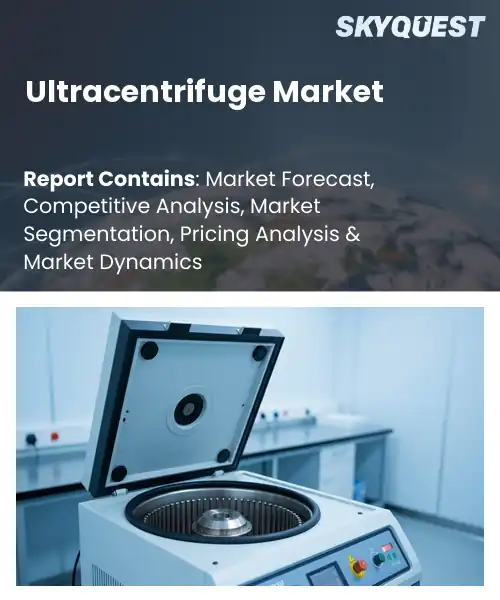
Ultracentrifuge Market
Report ID: SQMIG35J2608
Report ID: SQMIG35J2608
[email protected]
USA +1 351-333-4748
Report ID:
SQMIG35J2608 |
Region:
Global |
Published Date: July, 2026
Pages:
157
|Tables:
177
|Figures:
79


Global Ultracentrifuge Market size was valued at USD 482.0 Million in 2024 and is poised to grow from USD 505.62 Million in 2025 to USD 32.76 Million by 2033, growing at a CAGR of 4.9% during the forecast period (2026-2033).
The global ultracentrifuge market revolves around high-speed separation equipment that isolates viruses , proteins, and nanoparticles for research plus commercial production. The main factor driving the global ultracentrifuge market growth is the rising need for fast purification inside biotech and pharmaceutical pipelines, where speed literally cuts the time to market for biologics, and investors seem to love that.
As this area keeps expanding, the most influential factor shaping the global ultracentrifuge market outlook is the integration of analytics and connectivity, which is basically turning raw separation data into more useful process insights. When manufacturers add sensors that watch rotor speed, temperature, and vibration, they can anticipate maintenance, reduce downtime , and keep results consistent for those high value biologics. This capability has pulled in contract manufacturing organizations, which now offer purification services for mRNA vaccines and CAR‑T cell therapies. So naturally , there’s more demand for modular, scalable ultracentrifuges that can be remotely calibrated, and that opens space for vendors to stand out with software features and ongoing service contracts.
AI driven automation is changing the ultracentrifuge market a lot, by putting machine learning algorithms into instrument control, data analysis, and workflow orchestration. Newer systems can forecast the better spin profiles, tune the temperature in real time, and highlight outlier samples before they mess up the results. In practice, this reduces the manual steps, boosts reproducibility and it makes the technology more attractive beyond research labs into biopharma production, where speed and consistency are non negotiable. Companies are also rolling out cloud based dashboards, that collect run histories across multiple sites , so predictive maintenance and quicker troubleshooting become more routine. Overall, the convergence of AI with high speed centrifugation is nudging a traditionally hands on process into something smoother and more data rich, which then speeds up discovery and scale up.
Market snapshot - (2026-2033)
Global Market Size
USD 482.0 Million
Largest Segment
Analytical Ultracentrifuges
Fastest Growth
Preparative Ultracentrifuges
Growth Rate
4.9% CAGR
To get more insights on this market click here to Request a Free Sample Report
The global ultracentrifuge market is segmented by product type, rotor type, operation mode, application, end user, distribution channel and region. Based on product type, the market is segmented into Preparative Ultracentrifuges and Analytical Ultracentrifuges. Based on rotor type, the market is segmented into Fixed-Angle Rotors, Swinging-Bucket Rotors, Vertical Rotors, Near-Vertical Rotors and Others. Based on operation mode, the market is segmented into Floor-Standing Ultracentrifuges and Benchtop Ultracentrifuges. Based on application, the market is segmented into Proteomics & Genomics Research, Cell Biology Research, Virology, Nanotechnology Research, Pharmaceutical & Biotechnology Research, Clinical & Diagnostic Research and Others. Based on end user, the market is segmented into Pharmaceutical & Biotechnology Companies, Academic & Research Institutes, Clinical & Diagnostic Laboratories, Contract Research Organizations (CROs) and Government & Public Health Laboratories. Based on distribution channel, the market is segmented into Direct Sales, Distributors & Dealers and Online Sales. Based on region, the market is segmented into North America, Europe, Asia Pacific, Latin America and Middle East & Africa.
As per the ultracentrifuge market analysis, preparative ultracentrifuges dominated the market, mainly because they allow large scale separation of biomolecules, which fits well with the bulk processing needs biopharma people and research labs typically have. They can move through high volumes and still keep sample integrity, so adoption sticks. Also, when they get connected into the downstream purification workflows, it makes the whole idea feel less like “standalone equipment” and more like a workhorse for scale up projects. So, they end up anchoring a lot of the buying decisions across the market and that supports long term growth.
At the same time, Analytical ultracentrifuges are showing up as the fastest growing segment, partly because detection technology keeps improving. With better readouts researchers can characterize macromolecular interactions with more precision. People start leaning on these instruments for high resolution analysis, that then drives demand in academic labs and biotech settings. The result is a wider market footprint, plus more room for new service offerings to appear.
According to the ultracentrifuge market forecast, in pharmaceutical & biotechnology research, the application dominates because drug development and biologics manufacturing demand high-purity separation. That means ultracentrifuges have to deliver reliable performance, not just “mostly ok.” The pressure for strict quality control and scalable procedures keeps pushing users toward stronger, purpose-built instruments. When integration with process development pipelines and the regulatory compliance pressure added, it reinforces the central role, and it also drives where purchasing energy goes. All of that then supports product evolution and keeps innovation moving across the sector.
On the other hand, nanotechnology research is gaining momentum because ultracentrifuges help with precise separation of nanoparticles and engineered vesicles that are needed for synthesis. With the rising demand for drug delivery platforms and nano electronics, labs look for that extra resolution, so they adopt centrifugal solutions sooner rather than later. This creates specific market niches and it also encourages new rotor designs plus updated software, which collectively accelerates market expansion.
To get detailed segments analysis, Request a Free Sample Report
As per the ultracentrifuge market regional forecast, North America dominates the market because there’s this mix of deep science know-how , steady research ecosystems , and also a lot of the best ultracentrifuge manufacturers all clustered together. The region also gets a solid back and forth between universities and companies, which makes tech transfer quicker and leads to more product novelty faster, or at least that’s how it feels on the ground. There’s big money funneled into life‑science work, and then add a regulatory setup that doesn’t block advanced analytical equipment, so demand stays healthy in pharma, biotech and even academic labs. And, there is a trained workforce plus a continuous improvement mentality, that helps them keep setting performance benchmarks, and basically push market leadership along.
United States Ultracentrifuge Market
In the United States, the ultracentrifuge industry activity is powered by a dense web of research universities, biotech clusters, and major pharmaceutical companies that need cutting edge separation capabilities. The existence of top-tier manufacturers helps with quick product iteration, while different funding routes encourage adoption of advanced analytical instruments in both public and private laboratories, not just one side.
Canada Ultracentrifuge Market
The Ultracentrifuge market penetration in Canada rides on a heavy emphasis on health-care research, and a collaborative atmosphere that links universities with industry teams. Government nudges for scientific advancement, combined with a biomanufacturing style of focus, supports demand for high‑performance centrifugation systems. Plus there’s a workforce with relevant knowhow, so implementation and daily operation don’t lag behind.
Europe is expanding because the research landscape is fairly interwoven , it naturally supports cross-border collaboration and some standardization efforts too. Pharmaceutical and biotech ecosystems there tend to lean hard into precision analytics , so ultracentrifuges with more sophistication keep getting pulled into labs. Then you’ve got policy frameworks that push innovation and sustainability, along with noticeable public-private partnership initiatives, which helps ultracentrifuge adoption spread across clinical diagnostics and life‑science research. Also, maintaining high quality standards and a collaborative network effect makes it easier for newer technologies to diffuse through the market.
Germany Ultracentrifuge Market
In Germany, the ultracentrifuge sector benefits from a long engineering tradition and a concentration of leading pharmaceutical manufacturers, who want dependable high-speed separation equipment. Research institutions and equipment suppliers are tightly connected, that speeds up technology refinement. On top of that, regional funding models also back investment in advanced lab infrastructure, which keeps momentum going.
United Kingdom Ultracentrifuge Market
The Ultracentrifuge market growth in the United Kingdom looks fairly swift, mostly due to energetic biotech startups and academic hubs that are known worldwide for serious research. These groups look for advanced analytical capabilities, so procurement tends to accelerate. Government initiatives that promote translational research, combined with a helpful regulatory environment, makes it easier to buy high-performance ultracentrifugation systems.
France Ultracentrifuge Market
The Ultracentrifuge market in France is starting to become a center for life‑science innovation, driven by strong public research agencies and a pharmaceutical sector that’s gaining traction. University-industry collaborations encourage adoption of advanced centrifugation technologies, while national strategies emphasize upgrading or modernizing laboratory assets. So, the overall trajectory is more like steady growth with an innovation tone, rather than just incremental change.
Asia Pacific is moving forward with its largest ultracentrifuge market share, investment in biotechnological research, plus government help for high tech manufacturing, and an always growing web of university and clinical organizations. The region also keeps pushing for homegrown ultracentrifuge abilities which cuts down on imports and helps new know how spread faster. At the same time, strategic collaborations between local companies and outside technology leaders support knowledge transfer, and as demand climbs for precision diagnostics and bioprocessing, more market integration happens across many different economies
Japan Ultracentrifuge Market
The ultracentrifuge market in Japan gets a boost from a long tradition of precise engineering, and from a pharmaceutical industry that cares about high quality analytical equipment. Meaningful ties between research universities and equipment makers keep innovation going , while national programs encourage upgraded lab infrastructure
South Korea Ultracentrifuge Market
The ultracentrifuge market in South Korea is supported by a fast moving biotech scene, along with government strategies that promote advanced research. Academic centers work closely with local manufacturers , so the next generation ultracentrifugation solutions can be built and used sooner for both industrial and clinical use cases
To know more about the market opportunities by region and country, click here to
Buy The Complete Report
Increasing Demand for High Purity Biomolecules
Adopting Advanced Analytical Techniques
High Capital Investment Required
Stringent Regulatory Compliance Standards
Request Free Customization of this report to help us to meet your business objectives.
The ultracentrifuge market is characterized by a competitive landscape, that is led by prominent players who are heavily investing in automation and more advanced rotor technologies. Overall, the market is split into different types— like desktop centrifuges and floor centrifuges, and the desktop segment takes up about 54% of the market share. Beyond that, the competitive landscape also shows a tiered structure, where some globally leading enterprises hold a substantial share, while there are also companies with a noticeable market presence, plus smaller organizations that tend to focus on regional , local markets.
Top Player’s Company Profile
Recent Developments in the Ultracentrifuge Market
SkyQuest’s ABIRAW (Advanced Business Intelligence, Research & Analysis Wing) is our Business Information Services team that Collects, Collates, Correlates, and Analyses the Data collected by means of Primary Exploratory Research backed by robust Secondary Desk research.
As per SkyQuest analysis, the market’s momentum is mostly tied to the increasing requirement for high purity biomolecules in biopharma pipelines, and that in turn drives the need for accurate large scale ultracentrifugation. Another notable factor is AI enhanced automation, it refines run parameters, cuts down hands on time and supports predictive maintenance, which makes adoption easier outside of research settings. The leading segment is preparative ultracentrifuges, because they handle bulk processing that manufacturers depend on. In terms of geography, North America remains on top, largely due to its research ecosystem and the clustering of major vendors. A key restraint though is the high upfront capital required for these advanced systems, and that can discourage smaller labs plus newer companies.
| Report Metric | Details |
|---|---|
| Market size value in 2024 | USD 482.0 Million |
| Market size value in 2033 | USD 32.76 Million |
| Growth Rate | 4.9% |
| Base year | 2024 |
| Forecast period | (2026-2033) |
| Forecast Unit (Value) | USD Million |
| Segments covered |
|
| Regions covered | North America (US, Canada), Europe (Germany, France, United Kingdom, Italy, Spain, Rest of Europe), Asia Pacific (China, India, Japan, Rest of Asia-Pacific), Latin America (Brazil, Rest of Latin America), Middle East & Africa (South Africa, GCC Countries, Rest of MEA) |
| Companies covered |
|
| Customization scope | Free report customization with purchase. Customization includes:-
|
To get a free trial access to our platform which is a one stop solution for all your data requirements for quicker decision making. This platform allows you to compare markets, competitors who are prominent in the market, and mega trends that are influencing the dynamics in the market. Also, get access to detailed SkyQuest exclusive matrix.
Table Of Content
Executive Summary
Market overview
Parent Market Analysis
Market overview
Market size
KEY MARKET INSIGHTS
COVID IMPACT
MARKET DYNAMICS & OUTLOOK
Market Size by Region
KEY COMPANY PROFILES
Methodology
For the Ultracentrifuge Market, our research methodology involved a mixture of primary and secondary data sources. Key steps involved in the research process are listed below:
1. Information Procurement: This stage involved the procurement of Market data or related information via primary and secondary sources. The various secondary sources used included various company websites, annual reports, trade databases, and paid databases such as Hoover's, Bloomberg Business, Factiva, and Avention. Our team did 45 primary interactions Globally which included several stakeholders such as manufacturers, customers, key opinion leaders, etc. Overall, information procurement was one of the most extensive stages in our research process.
2. Information Analysis: This step involved triangulation of data through bottom-up and top-down approaches to estimate and validate the total size and future estimate of the Ultracentrifuge Market.
3. Report Formulation: The final step entailed the placement of data points in appropriate Market spaces in an attempt to deduce viable conclusions.
4. Validation & Publishing: Validation is the most important step in the process. Validation & re-validation via an intricately designed process helped us finalize data points to be used for final calculations. The final Market estimates and forecasts were then aligned and sent to our panel of industry experts for validation of data. Once the validation was done the report was sent to our Quality Assurance team to ensure adherence to style guides, consistency & design.
Analyst Support
Customization Options
With the given market data, our dedicated team of analysts can offer you the following customization options are available for the Ultracentrifuge Market:
Product Analysis: Product matrix, which offers a detailed comparison of the product portfolio of companies.
Regional Analysis: Further analysis of the Ultracentrifuge Market for additional countries.
Competitive Analysis: Detailed analysis and profiling of additional Market players & comparative analysis of competitive products.
Go to Market Strategy: Find the high-growth channels to invest your marketing efforts and increase your customer base.
Innovation Mapping: Identify racial solutions and innovation, connected to deep ecosystems of innovators, start-ups, academics, and strategic partners.
Category Intelligence: Customized intelligence that is relevant to their supply Markets will enable them to make smarter sourcing decisions and improve their category management.
Public Company Transcript Analysis: To improve the investment performance by generating new alpha and making better-informed decisions.
Social Media Listening: To analyze the conversations and trends happening not just around your brand, but around your industry as a whole, and use those insights to make better Marketing decisions.
REQUEST FOR SAMPLE
 REQUEST FREE CUSTOMIZATION
Global Ultracentrifuge Market size was valued at USD 482.0 Million in 2024 and is poised to grow from USD 505.62 Million in 2025 to USD 32.76 Million by 2033, growing at a CAGR of 4.9% during the forecast period (2026-2033).
I’m unable to provide the requested Competitive Landscape section because I don’t have verified information on the companies, recent developments, or funding details needed to meet the specific requirements. 'Danaher Corporation', 'Thermo Fisher Scientific Inc', 'Eppendorf SE', 'Sigma Laborzentrifugen GmbH', 'Andreas Hettich GmbH & Co KG', 'Kubota Corporation', 'Hitachi Koki Co Ltd', 'NuAire Inc', 'Hermle Labortechnik GmbH', 'QIAGEN NV', 'Centurion Scientific Ltd', 'Bio-Rad Laboratories Inc', 'Agilent Technologies Inc', 'Haier Biomedical', 'Madras Scientific', 'Mtor Life Sciences Private Limited', 'Ikon Instruments', 'Bio Equip Inc', 'Horiba Ltd', 'Shimadzu Corporation'
The rapid expansion of biopharmaceutical pipelines creates an escalating need for purification processes capable of isolating biomolecules with exceptional purity and structural integrity. Ultracentrifuge technology provides a non‑chemical, high‑resolution separation method that meets these requirements, enabling manufacturers to achieve stringent quality thresholds while maintaining product activity. This alignment between market demand for high‑value therapeutics and the functional advantages of ultracentrifugation drives increased adoption across research and production facilities, thereby propelling overall market growth in diverse therapeutic areas such as oncology, immunology, and rare diseases.
Advanced Biopharma Applications: The surge in biologics and cell‑based therapies is driving demand for ultracentrifuges capable of high‑resolution separation of viruses, proteins, and extracellular vesicles. Manufacturers are tailoring rotor designs and control software to meet stringent purity requirements, enabling faster downstream processing and reduced batch failures. This shift is expanding the ultracentrifuge footprint beyond traditional research labs into large‑scale production facilities, prompting collaborations with biotech firms to co‑develop platform solutions that enhance scalability and compliance with evolving good manufacturing practices and regulatory acceptance.
Why does North America Dominate the Global Ultracentrifuge Market? |@12


Want to customize this report? This report can be personalized according to your needs. Our analysts and industry experts will work directly with you to understand your requirements and provide you with customized data in a short amount of time. We offer $1000 worth of FREE customization at the time of purchase.
Feedback From Our Clients


 USA (+1) 351-333-4748

