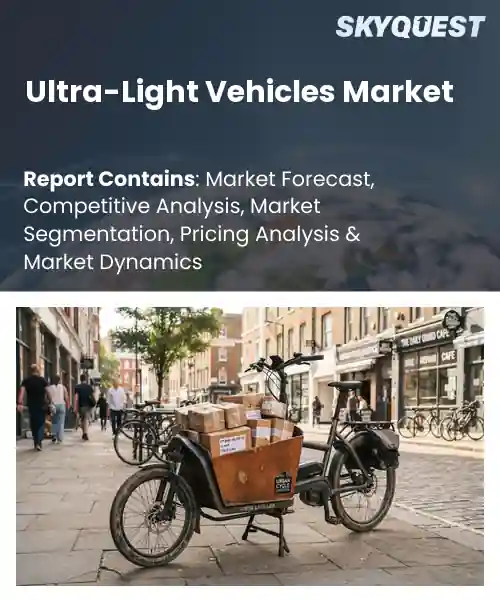
Ultra-Light Vehicles Market
Report ID: SQMIG25C2285
Report ID: SQMIG25C2285
[email protected]
USA +1 351-333-4748
Report ID:
SQMIG25C2285 |
Region:
Global |
Published Date: September, 2026
Pages:
157
|Tables:
120
|Figures:
77


Global Ultra-Light Vehicles Market size was valued at USD 6.8 Billion in 2024 and is poised to grow from USD 7.21 Billion in 2025 to USD 11.59 Billion by 2033, growing at a CAGR of 6.1% during the forecast period (2026-2033).
The ultra‑light vehicle (ULV) segment comprises three‑wheeled and two‑wheeled electric mobility devices that weigh less than 250 kg and are classified for personal transport. Its primary driver is urban congestion, which forces cities to seek compact, low‑emission solutions; the smaller footprint of ULVs allows them to navigate narrow streets and shared lanes that cars cannot. Historically, the market emerged in Europe during the early 2010s as municipalities piloted e‑scooter sharing schemes, and it expanded to Asia where motorcycle density already favored lightweight designs. Today, regulators recognise ULVs as a bridge between bicycles and automobiles, making them pivotal for sustainable mobility agendas. The second decisive factor shaping ULV growth is policy support that links emissions targets with incentives for electric platforms. When governments subsidise purchases, streamline registration and allocate dedicated lanes, consumer adoption accelerates, which in turn spurs manufacturers to scale production and lower unit costs. For example, India's Faster Adoption and Manufacturing of Hybrid and Electric Vehicles scheme offers a 20 percent tax rebate on ULVs under 200 kg, prompting Ola Electric to launch three‑wheelers for logistics. This causal chain creates a feedback loop: cheaper vehicles enlarge fleets, reduce emissions, and validate regulatory backing, unlocking new opportunities across delivery, tourism and feeder services.
How is AI-driven lightweight material automation reshaping the ultra-light vehicles market?
AI driven lightweight material automation combines machine learning, generative design and robotic manufacturing to create structures that are both strong and exceptionally light. Today manufacturers use these tools to select optimal composites, predict performance and program robots that place fibers with micron precision. The ultra light vehicle market is responding to stricter efficiency standards and consumer demand for longer range electric cars. Companies are deploying AI to replace manual layup, to accelerate 3D printed lattice production and to fine tune alloy blends. This shift shortens development cycles, lowers waste and opens new design possibilities that were previously impractical.Toyota March 2024, introduced AI driven automation of carbon fiber layup for its ultra light vehicle platform, cutting production time and enabling higher volume output. The technology demonstrates how intelligent material handling can boost efficiency and accelerate market adoption of ultra light designs across global automakers in the industry today.
Market snapshot - (2026-2033)
Global Market Size
USD 6.8 Billion
Largest Segment
Ultra-Light Aircraft
Fastest Growth
Ultra-Light Off-Road Vehicles
Growth Rate
6.1% CAGR
To get more insights on this market click here to Request a Free Sample Report
Global ultra-light vehicles market is segmented by vehicle type, propulsion, application, end user and region. Based on vehicle type, the market is segmented into Ultra-Light Aircraft, Ultra-Light Road Vehicles, Ultra-Light Off-Road Vehicles and Other Ultra-Light Vehicles. Based on propulsion, the market is segmented into Electric, Internal Combustion Engine and Hybrid. Based on application, the market is segmented into Personal Transportation, Recreational & Leisure, Commercial Transportation, Agriculture & Utility and Defense & Surveillance. Based on end user, the market is segmented into Individual Consumers, Commercial Operators and Government & Defense. Based on region, the market is segmented into North America, Europe, Asia Pacific, Latin America and Middle East & Africa.
Ultra Light Aircraft segment dominates because it offers efficiency for short range travel, leveraging lightweight structures and low operating costs. Operators value the ability to access remote airstrips, reducing infrastructure dependence while maintaining regulatory compliance. The combination of fuel economy, ease of piloting, and mission profiles attracts both private owners and commercial services, reinforcing its central role in shaping market demand. Additionally, the framework for ultra light aviation encourages certification, boosting adoption.
However, Ultra Light Road Vehicles segment is witnessing the strongest growth momentum as urban mobility demands shift toward compact low impact transportation. Advances in battery technology and lightweight materials enable longer range and safety, attracting commuters and delivery services. This surge expands market reach, creating opportunities for manufacturers and service ecosystems.
Electric propulsion segment dominates because it aligns with the industry’s push toward zero emissions and quiet operation, essential for ultra light vehicle acceptance in populated areas. Battery advancements provide sufficient energy density for short missions while keeping weight low, satisfying regulatory limits. Operators appreciate reduced fuel logistics and lower operating expenses, fostering widespread adoption across personal and commercial users. Moreover, supportive policies accelerate investment, reinforcing its leadership in market development.
Meanwhile, Hybrid propulsion segment emerges as the key growth area as manufacturers blend electric efficiency with range capabilities. The integration of combustion engines addresses range anxiety, opening use cases for longer missions and operations. This synergy attracts investment and stimulates innovation, propelling market expansion and creating revenue streams for developers and service providers.
To get detailed segments analysis, Request a Free Sample Report
Asia Pacific holds the leading position in the Ultra-Light Vehicles market because of a combination of deep engineering expertise, mature supply chains, and proactive policy environments that encourage lightweight mobility solutions. The region benefits from a densely populated urban landscape where demand for compact, energy‑efficient transport is intense. Manufacturers leverage cutting‑edge battery and material technologies developed within strong research ecosystems, while governments provide incentives that lower entry barriers for both producers and end users. In addition, a culture of early adoption supports rapid diffusion of new vehicle concepts, further amplifying scale and brand visibility. Regional automakers also capitalize on expansive export networks that position Ultra-Light Vehicles as viable alternatives in neighboring markets, further amplifying scale and brand visibility. This convergence of technological leadership, supportive regulation, and market readiness creates a self‑reinforcing loop that sustains Asia Pacific’s preeminence in the global arena.
Ultra-Light Vehicles Market in Japan is shaped by a longstanding tradition of precision engineering and a regulatory framework that prizes efficiency and reduced emissions. Domestic manufacturers integrate advanced lightweight materials with compact powertrains, catering to a consumer base that values reliability and space‑saving design. Collaboration between automotive firms and technology institutes accelerates innovation, while urban policies encourage adoption in densely populated cities, reinforcing Japan’s pivotal role. The market also benefits from supportive financing schemes that lower ownership costs for both private and fleet users.
Ultra-Light Vehicles Market in South Korea thrives on an ecosystem that blends aggressive government incentives with a vibrant start‑up culture focused on mobility solutions. Local manufacturers emphasize integration of smart connectivity features, aligning with national smart‑city initiatives that demand adaptable and low‑impact transport options. Close ties between automotive giants and electronics leaders foster rapid prototyping, while consumer openness to new mobility concepts drives swift market uptake.
Europe’s Ultra-Light Vehicles market expands rapidly thanks to an aligned blend of rigorous emissions standards, robust sustainability ambitions, and a mature automotive manufacturing base that readily adapts to lightweight concepts. Policy frameworks across the continent incentivize reduction of vehicle mass and promote electrified powertrains, creating a compelling environment for manufacturers to prioritize efficiency. Innovation clusters in key economies foster collaboration between automotive firms, material scientists, and digital technology providers, accelerating the development of advanced composites and integrated connectivity. Consumer preferences increasingly favor compact, low‑cost transport solutions that ease urban congestion and lower operating expenses. Together, these drivers generate a virtuous cycle that propels market growth and positions Europe as a leading hub for next‑generation ultra‑light mobility.
Ultra-Light Vehicles Market in Germany benefits from a deep engineering heritage and a coordinated industrial policy that emphasizes lightweight design and carbon reduction. Leading manufacturers combine sophisticated chassis engineering with high‑strength aluminum and composite solutions, delivering products that meet demanding performance criteria while reducing overall mass. Research institutions collaborate closely with the automotive sector, feeding continuous improvements into production pipelines. Strong demand from both commercial fleets and private users, especially in densely populated regions, reinforces Germany’s dominant position in the European landscape.
Ultra-Light Vehicles Market in United Kingdom accelerates at a notable pace driven by entrepreneurial ventures and supportive governmental schemes aimed at decarbonizing transport. Start‑ups and established manufacturers alike focus on modular vehicle architectures that simplify manufacturing and lower costs, resonating with a market eager for flexible mobility options. Investment in battery research and lightweight material development further enhances product appeal. Urban policies encouraging low‑emission zones create a fertile testing ground, prompting rapid adoption among city commuters and logistics operators.
Ultra-Light Vehicles Market in France is emerging as a vibrant segment anchored by strong environmental policy and a growing network of specialized suppliers. French manufacturers integrate innovative carbon‑fiber and high‑strength steel technologies to achieve significant weight reductions without compromising safety. Collaboration with design studios emphasizes aesthetic appeal tailored to urban users, while incentives for electric propulsion encourage broader market acceptance. The evolving ecosystem positions France as an important contributor to Europe’s overall ultra‑light vehicle momentum.
North America is strengthening its position in the Ultra-Light Vehicles market through a synergistic mix of sustainability incentives, advanced manufacturing capabilities, and a consumer base that values cost‑effective, low‑impact mobility. Federal and regional policies promote lightweight design as a pathway to reduced energy consumption, while industry leaders invest heavily in research on high‑strength alloys and composite structures. Partnerships between traditional automakers and technology firms accelerate the integration of connectivity and safety features, enhancing vehicle appeal. Urban planning initiatives that prioritize congestion mitigation further stimulate demand for compact, agile transport solutions. This convergence of policy support, innovation investment, and market readiness fuels a robust expansion of the North American ultra‑light vehicle landscape.
Ultra-Light Vehicles Market in United States leverages a strong tradition of automotive innovation combined with targeted governmental incentives that encourage lighter, more efficient vehicle architectures. Major manufacturers collaborate with research universities to advance material science, resulting in lighter chassis and powertrain solutions that meet rigorous performance expectations. Consumer interest in affordable, fuel‑saving alternatives drives adoption across both private and commercial segments, while city programs that favor low‑emission transportation create additional demand signals. The dynamic ecosystem sustains continuous growth and reinforces the United States as a pivotal contributor to the global market.
Ultra-Light Vehicles Market in Canada benefits from a supportive regulatory climate that emphasizes reduced emissions and fuel consumption, aligning with national climate objectives. Domestic manufacturers focus on integrating lightweight materials with electric propulsion to meet the expectations of environmentally conscious consumers. Collaborative initiatives between automotive firms and academic research centers accelerate the development of innovative structural solutions that balance durability with weight reduction. Provincial incentives for clean transportation further stimulate market uptake, positioning Canada as an emerging hub for ultra‑light vehicle advancement.
To know more about the market opportunities by region and country, click here to
Buy The Complete Report
Rising Urban Mobility Demand
Government Policies Supporting Sustainability
Limited Battery Energy Density
Infrastructure Gaps for Charging
Request Free Customization of this report to help us to meet your business objectives.
The ultra‑light vehicle market is shaped by intense rivalry as incumbents accelerate product cycles, pursue strategic M&A such as Arcimoto’s acquisition of a battery‑pack developer, and forge partnerships with lightweight‑material suppliers to cut curb weight, while tech innovators introduce carbon‑fiber chassis and AI‑driven range‑optimization, driving rapid differentiation and market entry pressure.
Top Player’s Company Profile
Recent Developments
SkyQuest’s ABIRAW (Advanced Business Intelligence, Research & Analysis Wing) is our Business Information Services team that Collects, Collates, Correlates, and Analyses the Data collected by means of Primary Exploratory Research backed by robust Secondary Desk research. As per SkyQuest analysis, the ultra‑light vehicles market is being propelled primarily by rising urban mobility demand as commuters seek compact, low‑cost transport that eases congestion, while supportive government policies that link emissions targets to incentives provide a powerful second driver accelerating adoption. Asia Pacific emerges as the dominating region, benefitting from dense cities, strong engineering talent and proactive subsidies that fuel rapid scale‑up. The ultra‑light road‑vehicle segment leads the market, driven by advances in battery technology and lightweight composites that extend range and safety. However, limited battery energy density remains a key restraint, constraining range and payload and tempering consumer confidence.
| Report Metric | Details |
|---|---|
| Market size value in 2024 | USD 6.8 Billion |
| Market size value in 2033 | USD 11.59 Billion |
| Growth Rate | 6.1% |
| Base year | 2024 |
| Forecast period | (2026-2033) |
| Forecast Unit (Value) | USD Billion |
| Segments covered |
|
| Regions covered | North America (US, Canada), Europe (Germany, France, United Kingdom, Italy, Spain, Rest of Europe), Asia Pacific (China, India, Japan, Rest of Asia-Pacific), Latin America (Brazil, Rest of Latin America), Middle East & Africa (South Africa, GCC Countries, Rest of MEA) |
| Companies covered |
|
| Customization scope | Free report customization with purchase. Customization includes:-
|
To get a free trial access to our platform which is a one stop solution for all your data requirements for quicker decision making. This platform allows you to compare markets, competitors who are prominent in the market, and mega trends that are influencing the dynamics in the market. Also, get access to detailed SkyQuest exclusive matrix.
Table Of Content
Executive Summary
Market overview
Parent Market Analysis
Market overview
Market size
KEY MARKET INSIGHTS
COVID IMPACT
MARKET DYNAMICS & OUTLOOK
Market Size by Region
KEY COMPANY PROFILES
Methodology
For the Ultra-Light Vehicles Market, our research methodology involved a mixture of primary and secondary data sources. Key steps involved in the research process are listed below:
1. Information Procurement: This stage involved the procurement of Market data or related information via primary and secondary sources. The various secondary sources used included various company websites, annual reports, trade databases, and paid databases such as Hoover's, Bloomberg Business, Factiva, and Avention. Our team did 45 primary interactions Globally which included several stakeholders such as manufacturers, customers, key opinion leaders, etc. Overall, information procurement was one of the most extensive stages in our research process.
2. Information Analysis: This step involved triangulation of data through bottom-up and top-down approaches to estimate and validate the total size and future estimate of the Ultra-Light Vehicles Market.
3. Report Formulation: The final step entailed the placement of data points in appropriate Market spaces in an attempt to deduce viable conclusions.
4. Validation & Publishing: Validation is the most important step in the process. Validation & re-validation via an intricately designed process helped us finalize data points to be used for final calculations. The final Market estimates and forecasts were then aligned and sent to our panel of industry experts for validation of data. Once the validation was done the report was sent to our Quality Assurance team to ensure adherence to style guides, consistency & design.
Analyst Support
Customization Options
With the given market data, our dedicated team of analysts can offer you the following customization options are available for the Ultra-Light Vehicles Market:
Product Analysis: Product matrix, which offers a detailed comparison of the product portfolio of companies.
Regional Analysis: Further analysis of the Ultra-Light Vehicles Market for additional countries.
Competitive Analysis: Detailed analysis and profiling of additional Market players & comparative analysis of competitive products.
Go to Market Strategy: Find the high-growth channels to invest your marketing efforts and increase your customer base.
Innovation Mapping: Identify racial solutions and innovation, connected to deep ecosystems of innovators, start-ups, academics, and strategic partners.
Category Intelligence: Customized intelligence that is relevant to their supply Markets will enable them to make smarter sourcing decisions and improve their category management.
Public Company Transcript Analysis: To improve the investment performance by generating new alpha and making better-informed decisions.
Social Media Listening: To analyze the conversations and trends happening not just around your brand, but around your industry as a whole, and use those insights to make better Marketing decisions.
REQUEST FOR SAMPLE
 REQUEST FREE CUSTOMIZATION


Want to customize this report? This report can be personalized according to your needs. Our analysts and industry experts will work directly with you to understand your requirements and provide you with customized data in a short amount of time. We offer $1000 worth of FREE customization at the time of purchase.
Feedback From Our Clients


 USA (+1) 351-333-4748

