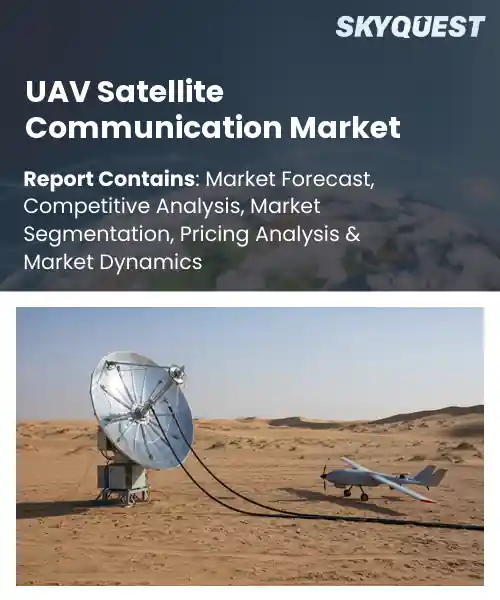
UAV Satellite Communication Market
Report ID: SQMIG20A2548
Report ID: SQMIG20A2548
[email protected]
USA +1 351-333-4748
Report ID:
SQMIG20A2548 |
Region:
Global |
Published Date: February, 2026
Pages:
157
|Tables:
151
|Figures:
78


Global Uav Satellite Communication Market size was valued at USD 7.23 Billion in 2024 and is poised to grow from USD 7.65 Billion in 2025 to USD 12.01 Billion by 2033, growing at a CAGR of 5.8% during the forecast period (2026-2033).
The primary driver of the UAV satellite communication market is the expanding need for reliable beyond line of sight connectivity that enables long range operations and real time data transfer for defense and commercial users. In context the market comprises satellite terminals, antennas, modems and services that link unmanned aerial vehicles to geostationary, medium and low Earth orbit networks, transforming drone missions from local pilots to networked systems capable of persistent surveillance and coordinated autonomy. Historically the sector moved from bulky airborne radios to compact electronically steerable antennas and low latency LEO constellations, seen in maritime patrol and precision agriculture.Building on that connectivity imperative, the proliferation of low Earth orbit constellations and advances in compact phased array antennas drive market expansion because they materially reduce latency and provide higher throughput, which in turn enables real time video, encrypted command links and cloud offload for AI processing. As a result operators can conduct persistent maritime surveillance, wide area disaster assessment and long range infrastructure inspection with actionable intelligence instead of delayed reports. This cause and effect dynamic attracts investment in specialized terminals, subscription services and integrated payloads, creating opportunities in commercial logistics, emergency management and defense modernization programs across sectors.
How is AI enhancing reliability in the UAV satellite communication market?
AI is improving reliability in the UAV satellite communication market by enabling adaptive link management, predictive interference mitigation and autonomous handovers between satellites and bands. Key aspects are real time signal analysis, model driven beam steering and anomaly detection that keep command and control links resilient during dynamic operations. The market context shows operators adopting multi band antennas and AI guided networking to reduce link drops and maintain intelligence surveillance and reconnaissance and safety workflows. Examples include AI orchestrating redundant paths across L band and Ka band, machine learning predicting fading and automated reconfiguration of UAV swarms to preserve coverage and continuity.Viasat February 2026, announced a dedicated UAV satellite service portfolio that pairs lightweight terminals and resilient L band connectivity. AI enabled scheduling and automatic route selection strengthen continuous command and control links and help scale operations with greater efficiency and mission assurance.
Market snapshot - (2026-2033)
Global Market Size
USD 7.23 Billion
Largest Segment
Antennas
Fastest Growth
Antennas
Growth Rate
5.8% CAGR
To get more insights on this market click here to Request a Free Sample Report
Global uav satellite communication market is segmented by component, uav type, technology type, frequency band, application area and region. Based on component, the market is segmented into Antennas, Transceivers, Modems, Power amplifiers, Upconverters / Downconverters and Others. Based on uav type, the market is segmented into Fixed-wing UAVs, Rotary‑wing UAVs and Hybrid UAVs. Based on technology type, the market is segmented into Fixed Satellite Systems and Mobile Satellite Systems. Based on frequency band, the market is segmented into L-Band, S-Band, C-Band, Ku-Band, Ka-Band, X-Band and Multi-Band Solutions. Based on application area, the market is segmented into Military & defense, Civil & commercial, Government and Others. Based on region, the market is segmented into North America, Europe, Asia Pacific, Latin America and Middle East & Africa.
Antennas segment dominates because antennas are the primary interface between UAVs and satellite networks, determining link reliability, coverage, and spectral efficiency. Advances in low size weight power phased arrays, electronically steerable antennas, and miniaturized high gain designs have enabled persistent beyond line of sight connectivity for diverse missions. Their role in overcoming mobility and pointing challenges, enabling multi band interoperability, and integrating with platform avionics makes antennas the central value driver in UAV satellite communications.
However, modems are emerging as the fastest growing component thanks to software defined architectures and adaptive coding that simplify multi orbit connectivity. Demand for secure data handling, payload interoperability, and field upgradeability is driving modem innovation, enabling new service models and rapid deployment capabilities that expand UAV satellite communications opportunities.
Ka-Band segment dominates because Ka-Band provides the bandwidth and spectral resources needed for high throughput uplinks and downlinks, aligning with data intensive UAV missions. Its compatibility with spot beam architectures and emerging high capacity satellites reduces latency and supports compact, high gain antenna designs that fit UAV size and power constraints. These capabilities drive operator preference, supplier investment, and integration into advanced mission payloads across commercial and defense applications.
However, Multi Band Solutions are emerging as the fastest growing option because they enable spectrum agility, interoperability, and resilient links across orbital regimes. Demand for mission flexibility, modular radio designs, and dynamic spectrum policies accelerates adoption, allowing UAVs to switch bands for performance optimisation and unlocking broader service models and operational resilience.
To get detailed segments analysis, Request a Free Sample Report
North America dominance stems from an integrated ecosystem that combines advanced satellite infrastructure, a concentration of leading aerospace and communication firms, and deep defense procurement programs that prioritize resilient connectivity for unmanned operations. Close collaboration among military organizations, commercial satellite operators, and technology vendors enables rapid system development, operational testing, and maturation of complex solutions. A mature regulatory and certification environment supports secure deployment at scale, while established supply chains and robust R&D investment drive miniaturized terminals, hardened links, and end to end architectures. Collective expertise in space operations, spectrum coordination, and mission assurance further cements North America role as the primary hub for sophisticated UAV satellite communication capabilities and global commercialization pathways.
UAV Satellite Communication Market in United States is driven by a dense defense procurement ecosystem, extensive satellite infrastructure, a concentration of leading OEMs, and deep investment in research and development. Collaboration between military, commercial operators, and space communication providers fosters rapid system integration and operational validation. Regulatory coordination and established supply chains further enable deployment of advanced satellite links across diverse unmanned platforms for complex commercial and humanitarian missions globally.
UAV Satellite Communication Market in Canada benefits from strong partnerships between aerospace companies, satellite operators, and research institutions, supported by expansive northern operational requirements and emphasis on secure connectivity. Emphasis on interoperability, ruggedized communication terminals, and extension of coverage into remote regions drives specialized solutions. Public procurement and industry collaboration accelerate testing and deployment, positioning Canada as an important regional node for resilient satellite links in diverse unmanned applications overall.
Asia Pacific expansion reflects a convergence of operational demand, industrial capability, and policy support that together accelerate adoption of satellite enabled connectivity for unmanned systems. Growing requirements for maritime domain awareness, border security, and disaster response create strong use cases for persistent beyond line of sight links. Regional electronics manufacturing strengths enable local development of compact, high quality terminals while indigenous satellite programs and international capacity arrangements expand coverage. Government industry collaboration on testing, standards, and secure communications supports dual use deployment across commercial and defense domains. Integration with advanced terrestrial networks and focus on low latency and resilience further enhance suitability for varied unmanned applications, positioning Asia Pacific as a dynamic center for both adoption and innovation.
UAV Satellite Communication Market in Japan is characterized by integration of advanced aerospace technologies, strong terrestrial and satellite telecom ecosystems, and close collaboration between manufacturers and government agencies. Focus on compact, high performance terminals and secure link management supports civilian and defense missions across maritime and disaster response domains. Active testing programs, technology partnerships, robust electronics supply chain promote innovation and adaptation of satellite communication solutions for regional unmanned operations.
UAV Satellite Communication Market in South Korea draws strength from a vibrant electronics manufacturing base, commercialization of satellite technologies, and close ties between defense agencies and industry innovators. Emphasis on miniaturized terminals, low-latency links, and seamless integration with terrestrial networks drives advanced payload development. Collaborative research, strong supply chain capabilities, and government support for secure communications accelerate deployment of reliable satellite links across commercial, industrial, and tactical unmanned use cases.
Europe is strengthening its position through coordinated industrial strategies, cross border collaboration, and a clear emphasis on sovereign and secure communication capabilities for unmanned systems. Regional initiatives that promote standardization, certification, and interoperability enable manufacturers and service providers to scale solutions across diverse national defense and civil use cases. Investment in resilient ground segments, encryption technologies, and regional satellite capacity complements strong aerospace engineering and systems integration competencies. Public private partnerships and multi nation demonstration programs accelerate operational validation while safeguarding critical supply chains. By focusing on dual use solutions, export readiness, and integration within broader security frameworks, Europe is enhancing its ability to deliver certified, interoperable UAV satellite communication solutions for both domestic and allied operational needs.
UAV Satellite Communication Market in Germany emphasizes integration of reliable communication systems, engineering heritage, and collaboration between industrial primes and research institutes. Focus on secure, certified terminals and interoperability supports defense modernization and commercial deployment. Investments in secure ground segment, system integration expertise, and partnerships with European satellite operators promote resilient connectivity. Industrial ecosystems and testing ranges facilitate validation of advanced satellite links for logistics, surveillance, and critical infrastructure monitoring.
UAV Satellite Communication Market in United Kingdom is shaped by a focus on sovereign secure communication capabilities, collaboration between defense primes and startups, and certification. Demand for resilient space links spans maritime, border security, and emergency response use cases. Investment in ground infrastructure, spectrum coordination, and public private partnerships enhances operational readiness. Testing facilities and export development support adoption of advanced satellite terminals and integrated connectivity solutions for unmanned platforms.
UAV Satellite Communication Market in France is driven by aerospace capabilities, coordinated defense modernization programs, and industry research partnerships. Emphasis on secure encryption, native terminal design, and interoperability with European networks supports surveillance and civil protection missions. Public procurement and collaborative demonstration projects foster system validation. Robust manufacturing base and export orientation help position France as a leader in delivering tailored satellite communication solutions for diverse unmanned operational profiles globally.
To know more about the market opportunities by region and country, click here to
Buy The Complete Report
Expansion Of Autonomous UAS Operations
Integration With Commercial Satellite Networks
Regulatory and Airspace Restrictions
High Cost Of Satcom Payload Integration
Request Free Customization of this report to help us to meet your business objectives.
Competitive dynamics in the global UAV satellite communication market are driven by rapid LEO constellation deployments and antenna terminal innovation, which force providers to pursue M&A, strategic partnerships and product differentiation. Recent examples include SpaceX acquiring Swarm Technologies and Astrocast acquiring Hiber, while vendors invest in flat panel and low latency architectures to win airborne beyond line of sight connections and defence contracts.
Top Player’s Company Profile
Recent Developments
SkyQuest’s ABIRAW (Advanced Business Intelligence, Research & Analysis Wing) is our Business Information Services team that Collects, Collates, Correlates, and Analyses the Data collected by means of Primary Exploratory Research backed by robust Secondary Desk research. As per SkyQuest analysis, One key driver is the expanding need for reliable beyond line of sight connectivity that enables long-range operations and real time data transfer for defense and commercial users. A second driver is the proliferation of low Earth orbit constellations and compact phased array antennas that reduce latency and raise throughput. One restraint remains fragmented regulatory and airspace restrictions that slow routine BLOS deployments and add certification complexity. North America is the dominating region due to mature satellite infrastructure, defense procurement and R&D concentration, while the antennas segment is the dominating component because miniaturized, electronically steerable designs determine link reliability and mission feasibility.
| Report Metric | Details |
|---|---|
| Market size value in 2024 | USD 7.23 Billion |
| Market size value in 2033 | USD 12.01 Billion |
| Growth Rate | 5.8% |
| Base year | 2024 |
| Forecast period | (2026-2033) |
| Forecast Unit (Value) | USD Billion |
| Segments covered |
|
| Regions covered | North America (US, Canada), Europe (Germany, France, United Kingdom, Italy, Spain, Rest of Europe), Asia Pacific (China, India, Japan, Rest of Asia-Pacific), Latin America (Brazil, Rest of Latin America), Middle East & Africa (South Africa, GCC Countries, Rest of MEA) |
| Companies covered |
|
| Customization scope | Free report customization with purchase. Customization includes:-
|
To get a free trial access to our platform which is a one stop solution for all your data requirements for quicker decision making. This platform allows you to compare markets, competitors who are prominent in the market, and mega trends that are influencing the dynamics in the market. Also, get access to detailed SkyQuest exclusive matrix.
Table Of Content
Executive Summary
Market overview
Parent Market Analysis
Market overview
Market size
KEY MARKET INSIGHTS
COVID IMPACT
MARKET DYNAMICS & OUTLOOK
Market Size by Region
KEY COMPANY PROFILES
Methodology
For the UAV Satellite Communication Market, our research methodology involved a mixture of primary and secondary data sources. Key steps involved in the research process are listed below:
1. Information Procurement: This stage involved the procurement of Market data or related information via primary and secondary sources. The various secondary sources used included various company websites, annual reports, trade databases, and paid databases such as Hoover's, Bloomberg Business, Factiva, and Avention. Our team did 45 primary interactions Globally which included several stakeholders such as manufacturers, customers, key opinion leaders, etc. Overall, information procurement was one of the most extensive stages in our research process.
2. Information Analysis: This step involved triangulation of data through bottom-up and top-down approaches to estimate and validate the total size and future estimate of the UAV Satellite Communication Market.
3. Report Formulation: The final step entailed the placement of data points in appropriate Market spaces in an attempt to deduce viable conclusions.
4. Validation & Publishing: Validation is the most important step in the process. Validation & re-validation via an intricately designed process helped us finalize data points to be used for final calculations. The final Market estimates and forecasts were then aligned and sent to our panel of industry experts for validation of data. Once the validation was done the report was sent to our Quality Assurance team to ensure adherence to style guides, consistency & design.
Analyst Support
Customization Options
With the given market data, our dedicated team of analysts can offer you the following customization options are available for the UAV Satellite Communication Market:
Product Analysis: Product matrix, which offers a detailed comparison of the product portfolio of companies.
Regional Analysis: Further analysis of the UAV Satellite Communication Market for additional countries.
Competitive Analysis: Detailed analysis and profiling of additional Market players & comparative analysis of competitive products.
Go to Market Strategy: Find the high-growth channels to invest your marketing efforts and increase your customer base.
Innovation Mapping: Identify racial solutions and innovation, connected to deep ecosystems of innovators, start-ups, academics, and strategic partners.
Category Intelligence: Customized intelligence that is relevant to their supply Markets will enable them to make smarter sourcing decisions and improve their category management.
Public Company Transcript Analysis: To improve the investment performance by generating new alpha and making better-informed decisions.
Social Media Listening: To analyze the conversations and trends happening not just around your brand, but around your industry as a whole, and use those insights to make better Marketing decisions.
REQUEST FOR SAMPLE
 REQUEST FREE CUSTOMIZATION


Want to customize this report? This report can be personalized according to your needs. Our analysts and industry experts will work directly with you to understand your requirements and provide you with customized data in a short amount of time. We offer $1000 worth of FREE customization at the time of purchase.
Feedback From Our Clients


 USA (+1) 351-333-4748

