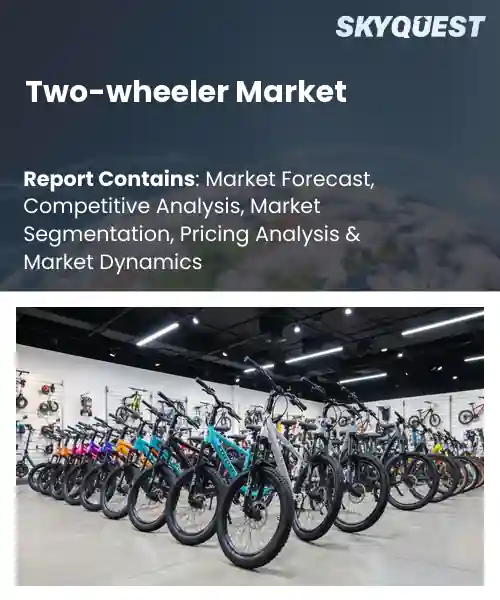
Two-wheeler Market
Report ID: SQMIG25D2020
Report ID: SQMIG25D2020
[email protected]
USA +1 351-333-4748
Report ID:
SQMIG25D2020 |
Region:
Global |
Published Date: May, 2026
Pages:
157
|Tables:
176
|Figures:
79


Global Two-Wheeler Market size was valued at USD 118.5 Billion in 2024 and is poised to grow from USD 125.37 Billion in 2025 to USD 196.83 Billion by 2033, growing at a CAGR of 5.8% during the forecast period (2026-2033).
The two-wheeler industry is made up of motorcycles, scooters, and electric bicycles. These provide affordable, flexible mobility across urban AND peri-urban areas in a way that matters a lot, because billions of consumers lean on them for commuting, day-to-day livelihood, and last-mile logistics. It also matters for industry and jobs, since the segment affects manufacturing employment and fuel demand in many emerging economies. In the past, the market grew fast after the post-war era, when low-cost ICE models kept showing up across Asia; for instance, Japan, and later India had local powerhouses like Honda and Hero that took large mass segments, and meanwhile, China moved differently, leapfrogging straight into electric bikes more recently. That path really shows how policy, income changes, and infrastructure act like quiet nudges, shaping how the market evolves.
Right now, one major factor pushing global two-wheeler market growth is electrification, and it’s largely driven by battery costs dropping, supportive policy, and more charging or swapping infrastructure showing up. Once battery prices fell, manufacturers could price electric models with a competitive total cost of ownership, so private buyers and commercial fleets both had a reason to switch, mainly for lower operating costs and better regulatory alignment. So OEMs are putting money into EV platforms, startups run battery-swap systems like Gogoro in Taiwan, and delivery companies electrify fleets to reduce fuel bills and emissions. At the same time, this opens a door for aftermarket work around battery services, grid integration, and telematics, but it also raises hard questions about raw materials and recycling, because supply chains cannot stay vague for long.
AI is basically reshaping the customer experience in the two-wheeler sector by enabling smarter personalization, predictive maintenance, and safer connected rides. Some key pieces here are onboard diagnostics that can anticipate service needs before they become annoying, and conversational agents that make purchasing and support feel smoother. There’s also a vehicle assistance that gets tuned for real city conditions, not some generic assumption. OEMs and mobility brands are embedding AI into vehicle software and companion apps, so updates keep coming over the air, which is important now that the market is shifting toward connected electric models. These changes lower ownership friction and lift perceived value, because the rider gets hardware that behaves like evolving software, and that keeps customers more engaged.
Market snapshot - (2026-2033)
Global Market Size
USD 118.5 Billion
Largest Segment
Motorcycles
Fastest Growth
Electric Two-wheelers
Growth Rate
5.8% CAGR
To get more insights on this market click here to Request a Free Sample Report
The global two-wheeler market is segmented by vehicle type, propulsion type, engine capacity, application, end user, distribution channel, and region. Based on vehicle type, the market is segmented into Motorcycles, Scooters, Mopeds and Electric Two-wheelers. Based on propulsion type, the market is segmented into Internal Combustion Engine, Electric and Hybrid. Based on engine capacity, the market is segmented into Below 125 cc, 125 cc to 250 cc and Above 250 cc. Based on application, the market is segmented into Personal Transportation, Commercial & Delivery Services, Sports & Racing, Touring & Adventure Riding and Others. Based on end user, the market is segmented into Individual Consumers, Fleet Operators, Delivery & Logistics Companies, Rental Service Providers and Others. Based on distribution channel, the market is segmented into OEM Dealerships, Multi-brand Dealers and Online Sales Platforms. Based on region, the market is segmented into North America, Europe, Asia Pacific, Latin America and Middle East & Africa.
As per the two-wheeler market analysis, the Internal combustion engine (ICE) segment seems to lead, mostly because the older manufacturing ecosystems stay in place, there’s a lot of refueling infrastructure, and the ownership economics feel familiar, so the value chains stay solid and they keep favoring ICE models. OEMs end up optimizing their supply chains and even dealer service networks around these powertrains, which lowers the small frictions that usually occur at the time of buying, and later during maintenance. For consumers, the repairability is known; there are many model choices across different price tiers, and strong aftermarket support, so people feel confident buying and sticking with ICE. That’s why ICE remains the main commercial focus in the two-wheeler market, even when the industry talks about change.
However, the Electric segment is showing up as the fastest expanding area, because battery technology keeps improving, charging solutions are getting more common, and operating costs are trending lower. There’s also strong interest from city commuters and from fleet operators, and policy signals are supportive, so demand is forming faster. A lot of product designs also seem tailored for last-mile needs, which helps create fresh demand pools, opens the door for new business models, and pushes the market forward toward future expansion and more opportunity.
According to the two-wheeler market forecast, the OEM dealerships part dominates, because it gives this all-in-one brand vibe, with certified after-sales support and a structured financing setup that really cuts down on buyer hesitation. Authorized technicians, warranty assurance, and access to those exclusive models also add a layer of trust, and once that trust shows up, it turns into longer-term customer relationships. Moreover, when manufacturers and franchised dealers align on inventory movements really well, it often means faster availability and a more standardized ownership experience, so OEM dealerships basically become the main artery for normal, everyday two-wheeler purchases.
However, online sales platforms are the fastest-growing route, mainly because digital discovery moves quickly, the purchase journey feels streamlined, and contactless transactions make the whole thing feel a bit lighter. Stronger product visualization, service bundles, and personalized suggestions pull in younger buyers, and even shoppers who don’t usually fit the traditional mold. That wider market access then helps scalable sales systems, which speeds up penetration, and opens up new revenue opportunities across the two-wheeler industry.
To get detailed segments analysis, Request a Free Sample Report
As per the two-wheeler market regional forecast, Asia Pacific dominance comes from a combination of structural, industrial, and consumer pressures that let two-wheeler demand and supply grow together. High population density, and the whole urban mobility need, leans people toward compact, cost-efficient transport, while long-standing manufacturing know-how and closely linked supply lines help speed up product development and enable large-scale production. Local original equipment manufacturers keep deep dealer networks and after-sales ecosystems, and that reinforces how the market gets penetrated. On top of that, policy attention on clean mobility and the rising curiosity about electric propulsion support the technology shift. Meanwhile, consumer groups that range from commuters to commercial operators keep the product line-up varied. Regional suppliers and component specialists also deliver cost advantages, which helps maintain competitiveness versus global rivals, so Asia Pacific keeps its place at the front of the two-wheeler market evolution, and innovation.
Japan Two-wheeler Market
The two-wheeler sector in Japan is defined by advanced engineering, high quality norms, and a strong brand heritage that backs premium and performance focused offerings. People tend to like urban mobility and leisure riding, so the product mix stays broad, from small scooters to motorcycles. The industry pushes electrification, hybrid approaches, and safety breakthroughs, and that is strengthened by established dealer networks and strict regulatory frameworks. This setup helps the adoption of newer tech and keeps export potential alive.
South Korea Two-wheeler Market
In South Korea, the two-wheeler market is more or less shaped by advanced electronics integration, with an intense lean on connectivity, and a busy tech environment that embraces electric scooters and motorcycles. Urban commuters often prefer compact vehicles that feel digitally enabled, and manufacturers frequently work hand in hand with suppliers, so product refinement moves faster. There’s also this supportive charging buildout, strong attention on safety technology, and supply chains that run efficiently, so the market responds quickly. So, it’s no surprise that South Korea shows up as a major development hub in the two-wheeler industry.
Europe is expected to have the largest two-wheeler market share, mostly because regulations push cleaner city air, consumers keep shifting toward efficient ways of moving, and there’s a big investment in charging alongside shared mobility frameworks. Cities want congestion reduced, and they tend to favor compact transport solutions, which makes two-wheelers feel even more appealing for everyday commuting and last-mile connections. Battery improvements, especially around performance and connectivity, make electric rides seem more attractive, while safety features and vehicle standards help people feel more confident. The segments stay varied too, from high-end leisure motorcycles to commuter scooters, all backed by solid dealer networks and a service ecosystem that actually supports riders. Cross-border supply chains and partnerships between manufacturers, technology firms, and mobility operators also push maturation along, which speeds adoption across both urban and suburban settings throughout Europe. Flexible ownership setups, stronger aftersales offerings, and pilot programs add consumer confidence and support commercial scalability.
Germany Two-wheeler Market
The Two-wheeler Market in Germany is anchored by solid engineering skills, long-established manufacturers, and a well-matured dealer and service network that backs premium motorcycles and practical commuter models. Demand gets a boost from developed charging and maintenance infrastructure, strict safety standards, and a culture that values performance and reliability. Collaboration between the industry and technology companies also nudges electrification and connectivity efforts forward, which improves products and supports Germany's role within the broader European two-wheeler scene.
United Kingdom Two-wheeler Market
The Two-wheeler Market in the United Kingdom is marked by rising interest in electric urban mobility, pilot programs, and wider acceptance of compact commuting options. Major urban areas tend to prefer solutions that tackle congestion while still offering flexible commuting, and investment supports charging, along with micro mobility infrastructure. Manufacturers and mobility providers tune their models for different use cases like ownership and rental , aided by aftersales networks that keep improving and by clearer regulations. Together, these factors encourage broader adoption across cities as well as suburbs.
France Two-wheeler Market
The Two-wheeler Market penetration in France shows fast uptake, mainly driven by forward-looking urban policies, strong consumer interest in micromobility, and a steady commitment to electric vehicle integration. Local authorities promote compact transport to reduce congestion and support better air quality, which helps create conditions for scooter and motorcycle adoption. A lively ecosystem of manufacturers, mobility operators, and service providers focuses on charging, upkeep, and financing solutions. That combination helps acceptance among commuters and riders across both urban zones and suburban areas.
North America is strengthening its position through a blend of market diversification, technology uptake, and strategic investments that tune two-wheeler offerings to regional travel habits. There’s more curiosity around electric scooters, and also electric motorcycles, and that’s matched by a wider product supply from established makers and new players, who are mainly dialing in on city commuting and delivery routines. At the same time, money and attention go into charging infrastructure, improved battery tech and vehicle connectivity, which in turn boosts the everyday ride feel, even when the regulatory rules keep shifting. As regulatory frameworks are evolving, and pilot projects are showing how things can work, the routes toward commercialization start looking clearer. OEMs, tech vendors, and mobility operators also team up more often, so scaling, service packages, and fleet-style models can happen faster. Meanwhile, the aftermarket and dealer ecosystem keeps maturing, and that supports ownership and fleet operations, helping North America to become more and more influential in worldwide two-wheeler development. Local innovation hubs and trial rollouts with logistics companies then refine actual commercial use, while financing choices and a bit of consumer know-how, targeted education, help spread adoption.
United States Two-wheeler Market
The Two-wheeler Market in the United States shows a broad spread of demand, from urban commuters to riders who want something practical for daily movement, with a stronger push toward electric options lately. Big manufacturers and smaller startups both keep releasing products aimed at city mobility, and commercial delivery fleets, too, and they lean on charging networks and pilot programs. Dealers and service providers are also adapting to new maintenance needs, while financing routes and marketing efforts improve consumer comfort and familiarity, which helps commercialization land across different regions, and climates that behave differently depending on where someone is.
Canada Two-wheeler Market
The Two-wheeler Market in Canada signals rising city demand, with a preference for electric solutions that can handle varied weather conditions. Inner cities tend to favor compact movement tools, while tourism and leisure riding back up an additional slice of the audience. Manufacturers and dealers often stress durability, battery performance, service coverage, and partnerships with energy organizations and infrastructure providers to increase charging availability. Fleet experimentation by logistics operators, combined with consumer financing options, also broadens the appeal across multiple metropolitan areas, where practicality matters and the ride has to keep going.
To know more about the market opportunities by region and country, click here to
Buy The Complete Report
Urbanization Driving Commuter Demand
Advances In Electric Mobility
Rising Fuel Price Uncertainty
Charging Infrastructure Shortages
Request Free Customization of this report to help us to meet your business objectives.
Competitive dynamics in the global two-wheeler market are now being shaped by strategic investments, OEM equity arrangements, and technology collaborations. This can be witnessed in cases like Hero MotoCorp raising its stake in Ather Energy, while Gogoro is pushing swap partnerships with Yamaha so they can scale swapping networks faster. In general, the race is being powered by quick electrification and those network effects things, which then leads to acquisitions, joint ventures, and very quick product refresh cycles from both incumbents and startups.
Top Player’s Company Profile
Recent Developments in the Two-Wheeler Market
SkyQuest’s ABIRAW (Advanced Business Intelligence, Research & Analysis Wing) is our Business Information Services team that Collects, Collates, Correlates, and Analyses the Data collected by means of Primary Exploratory Research backed by robust Secondary Desk research.
As per SkyQuest analysis, a key driver is electrification, powered by falling battery costs and supportive policy, and a second driver is fast urbanization that ramps up commuter demand. One restraint is that charging infrastructure shortages can trigger range anxiety, so adoption gets delayed. Asia Pacific is leading the market overall due to manufacturing scale, dense city populations, and wide dealer networks, while the Internal Combustion Engine segment still holds the top spot because existing refueling and service ecosystems are already in place. OEMs putting money into EV platforms, swap networks, and also digital sales channels show that the transition is probably going to keep going, as it’ll roll forward. At the same time, there are actual opportunities for operators that can help bridge the infrastructure gaps, and maybe even provide those flexible ownership models, more practically.
| Report Metric | Details |
|---|---|
| Market size value in 2024 | USD 118.5 Billion |
| Market size value in 2033 | USD 196.83 Billion |
| Growth Rate | 5.8% |
| Base year | 2024 |
| Forecast period | (2026-2033) |
| Forecast Unit (Value) | USD Billion |
| Segments covered |
|
| Regions covered | North America (US, Canada), Europe (Germany, France, United Kingdom, Italy, Spain, Rest of Europe), Asia Pacific (China, India, Japan, Rest of Asia-Pacific), Latin America (Brazil, Rest of Latin America), Middle East & Africa (South Africa, GCC Countries, Rest of MEA) |
| Companies covered |
|
| Customization scope | Free report customization with purchase. Customization includes:-
|
To get a free trial access to our platform which is a one stop solution for all your data requirements for quicker decision making. This platform allows you to compare markets, competitors who are prominent in the market, and mega trends that are influencing the dynamics in the market. Also, get access to detailed SkyQuest exclusive matrix.
Table Of Content
Executive Summary
Market overview
Parent Market Analysis
Market overview
Market size
KEY MARKET INSIGHTS
COVID IMPACT
MARKET DYNAMICS & OUTLOOK
Market Size by Region
KEY COMPANY PROFILES
Methodology
For the Two-wheeler Market, our research methodology involved a mixture of primary and secondary data sources. Key steps involved in the research process are listed below:
1. Information Procurement: This stage involved the procurement of Market data or related information via primary and secondary sources. The various secondary sources used included various company websites, annual reports, trade databases, and paid databases such as Hoover's, Bloomberg Business, Factiva, and Avention. Our team did 45 primary interactions Globally which included several stakeholders such as manufacturers, customers, key opinion leaders, etc. Overall, information procurement was one of the most extensive stages in our research process.
2. Information Analysis: This step involved triangulation of data through bottom-up and top-down approaches to estimate and validate the total size and future estimate of the Two-wheeler Market.
3. Report Formulation: The final step entailed the placement of data points in appropriate Market spaces in an attempt to deduce viable conclusions.
4. Validation & Publishing: Validation is the most important step in the process. Validation & re-validation via an intricately designed process helped us finalize data points to be used for final calculations. The final Market estimates and forecasts were then aligned and sent to our panel of industry experts for validation of data. Once the validation was done the report was sent to our Quality Assurance team to ensure adherence to style guides, consistency & design.
Analyst Support
Customization Options
With the given market data, our dedicated team of analysts can offer you the following customization options are available for the Two-wheeler Market:
Product Analysis: Product matrix, which offers a detailed comparison of the product portfolio of companies.
Regional Analysis: Further analysis of the Two-wheeler Market for additional countries.
Competitive Analysis: Detailed analysis and profiling of additional Market players & comparative analysis of competitive products.
Go to Market Strategy: Find the high-growth channels to invest your marketing efforts and increase your customer base.
Innovation Mapping: Identify racial solutions and innovation, connected to deep ecosystems of innovators, start-ups, academics, and strategic partners.
Category Intelligence: Customized intelligence that is relevant to their supply Markets will enable them to make smarter sourcing decisions and improve their category management.
Public Company Transcript Analysis: To improve the investment performance by generating new alpha and making better-informed decisions.
Social Media Listening: To analyze the conversations and trends happening not just around your brand, but around your industry as a whole, and use those insights to make better Marketing decisions.
REQUEST FOR SAMPLE
 REQUEST FREE CUSTOMIZATION
Global Two-Wheeler Market size was valued at USD 118.5 Billion in 2024 and is poised to grow from USD 125.37 Billion in 2025 to USD 196.83 Billion by 2033, growing at a CAGR of 5.8% during the forecast period (2026-2033).
Competitive dynamics in the global two wheeler market are now shaped by strategic investments, OEM equity deals and technology partnerships. Examples include Hero MotoCorp increasing its stake in Ather Energy and Gogoro expanding swap alliances with Yamaha to scale swapping networks. Competition is driven by rapid electrification and network effects, prompting acquisitions, joint ventures and rapid product innovation from incumbents and startups. 'Honda Motor', 'Hero MotoCorp', 'Yamaha Motor', 'Bajaj Auto', 'TVS Motor Company', 'Suzuki Motor Corporation', 'KTM AG', 'Royal Enfield', 'Harley-Davidson', 'BMW Motorrad', 'Piaggio Group', 'Kawasaki Heavy Industries', 'Ducati Motor Holding', 'Triumph Motorcycles', 'Zero Motorcycles', 'NIU Technologies', 'Ather Energy', 'Ola Electric', 'Gogoro', 'CFMOTO'
Urban population growth concentrates commuters in dense corridors where two-wheelers offer compact, flexible transport, reducing travel time and parking constraints. As urban residents seek affordable and nimble mobility solutions for daily commutes, manufacturers and dealers respond with varied models and distribution strategies that align with city travel patterns. This proximity-driven demand shapes product planning and retail presence, encouraging investment in localized sales and service networks, which in turn reinforces adoption by improving accessibility, convenience, and overall ownership experience for urban riders.
Urban Micromobility Integration: Two-wheelers are increasingly integrated into urban mobility systems, with shared fleets, micromobility operators, and transit agencies coordinating to offer seamless last-mile connections and on-demand services. Product design shifts toward lightweight frames, modular components, and digital onboarding to suit shared and personal use. Policy makers reconfigure curb access, parking, and dedicated lanes to favor compact vehicles. Industry stakeholders invest in interoperable platforms, predictive maintenance, and user-centric apps to capture commuters seeking affordable, flexible, and lower-emission alternatives to private cars and lifestyles.
Why does Asia Pacific Dominate the Global Two-wheeler Market? |@12


Want to customize this report? This report can be personalized according to your needs. Our analysts and industry experts will work directly with you to understand your requirements and provide you with customized data in a short amount of time. We offer $1000 worth of FREE customization at the time of purchase.
Feedback From Our Clients


 USA (+1) 351-333-4748

